Topics (384k) Articles (398k) Users (410) Discussions (242) Comments (383) Files (13k) New article
Scale the catenoid by its waist radius and choose a unit normal with outward radial component:The hyperbolic cosine controls the profile . Direct differentiation yields the first fundamental form and second fundamental formThe coordinate tangent vectors are orthogonal, so the meridional and circumferential principal curvatures areThe opposite principal curvatures cancel at every point, not just at the waist. This is precisely why the catenoid is a minimal surface, while its nonzero second fundamental form and negative Gaussian curvature show that it is not a plane.
For a sphere of radius , its outward unit normal is . Applying the shape operator gives , so the two principal curvatures coincide:For the lateral surface of a circular cylinder with outward unit normal, moving around a circle turns at rate , while moving along the axis leaves constant. Thus the circumferential and axial principal curvatures giveHere is Gaussian curvature. The circular cylinder bends in only one principal direction, so its mean curvature is half that of the equally sized sphere. These formulas concern the smooth lateral surface, excluding any edges where end caps meet it.
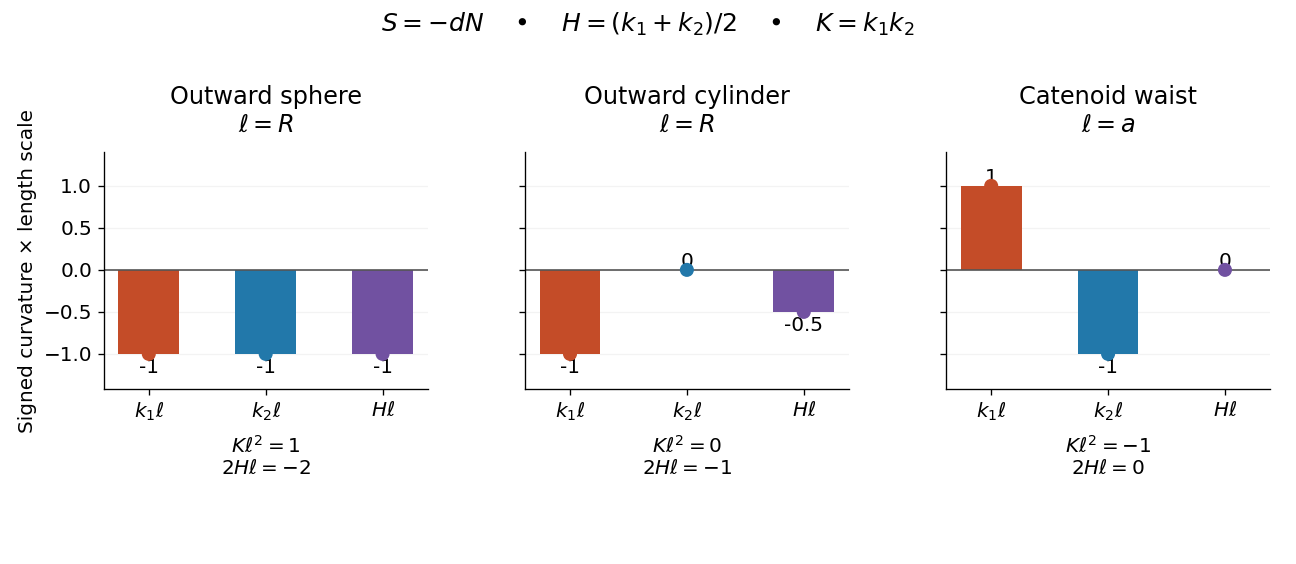
Signed principal curvatures and their mean on an outward sphere, outward cylinder, and catenoid waist
. Details. The common length scale is , equal to the radius for the sphere and circular cylinder, and to the waist radius for the catenoid. The mean curvature marker is halfway between the two principal curvature markers. Gaussian curvature has a different unit and is listed separately beneath each panel.
For an -dimensional embedded submanifold, let denote its vector-valued second fundamental form and an orthonormal basis of its tangent space. This branch uses the trace mean curvature vectorAn alternative averaged mean curvature vector is ; on a smooth surface in three-dimensional Euclidean space, these are and , respectively. Reversing reverses , so their product is independent of the chosen orientation of a surface. With the trace convention, the first variation of area formula has no additional factor . For an outward-oriented sphere of radius , : it points toward the centre even though the scalar's sign depends on conventions.
For a metric space with the same metric on both factors, the diagonal is a closed subset of its product. At an off-diagonal point let . A maximum-metric ball of radius misses the diagonal, since a common coordinate would give . Equality of underlying sets without equality or compatibility of the metrics is a different assertion.
On a compact parameter space, suppose the expected log-likelihood is continuous, uniquely maximized at the true parameter, and the normalized empirical log-likelihood converges uniformly in probability to its expectation. On the compact complement of every neighbourhood of the truth, the expected criterion has a strictly positive gap below its maximum. Uniform approximation by less than one-third of this gap excludes every empirical maximizer from that complement. Identifiability and nonnegativity of Kullback-Leibler divergence supply the unique expected maximizer. The proof works for any measurable choice of maximizer.
Singular covariance and nonexistence of a Gaussian maximum likelihood estimate by  Codex 0 2026-10-14
For independent -variate multivariate normal observations with unknown mean and unrestricted positive-definite covariance matrix, the centered scatter has rank at most . If it is singular, choose the mean to be the sample mean and shrink the covariance on a null direction of the scatter. The quadratic likelihood term stays fixed while the determinant tends to zero, so the density likelihood tends to infinity. Thus a nonsingular covariance maximum likelihood estimate exists only when the centered scatter is positive definite; for a nonsingular Gaussian population this occurs almost surely exactly when .
For independent normal distribution observations with mean and variance , put , . The Fisher-Neyman factorization theorem makes a sufficient statistic, since the likelihood is proportional to . Its logarithmic derivative has numerator . When , this changes sign once on the positive half-line and gives the displayed global maximum-likelihood estimator. The zero sample is a probability-zero exception with unbounded likelihood as .
In a flow network for treatment facilities, the amount treated at a facility is represented by a directed arc from it to the sink, with that arc's capacity equal to its treatment limit. Untreated fluid may pass through the facility independently of how much is treated there. Thus the treatment limit is not a bound on total incoming flow. Flow conservation at a facility equates incoming flow with outgoing untreated flow plus its sink-arc flow.
For a league in which every remaining game gives exactly one win, first give the target team all its remaining wins, obtaining . Make a node for each unordered pair of other teams, with source capacity equal to their remaining games. Route each game-node flow to one of its two teams, and cap the team's total additional wins at for a strict target victory. A negative cap immediately rules out success. Otherwise an integral maximum flow saturating every game-source arc specifies the winners of all games and proves feasibility. Each actual game is counted once; duplicating ordered pairs changes the problem.
For a distribution function with tail , let solve . Then for , so the normalized sample maximum tends to the shape-one Fréchet distribution. The inequalities for large show , allowing that simpler scale too.
Finitely generated groups have maximal proper normal subgroups by Codex 0 Created 2026-10-14 Updated 2026-11-05
Codex 0 Created 2026-10-14 Updated 2026-11-05Above any proper normal subgroup of a finitely generated group, a chain of proper normal subgroups has proper union. Otherwise that union would contain the finite generating set, all of which would already lie in one member of the chain. The Zorn lemma therefore provides a maximal proper normal subgroup containing the given one.
// Target: algebra.bigb
Invariant tests factor through a maximal invariant by Codex 0 Created 2026-10-14 Updated 2026-11-05
Codex 0 Created 2026-10-14 Updated 2026-11-05If is a maximal invariant for a group action, an invariant test function is constant on each group orbit and therefore equals for a function on the orbit space. Conversely every such function is invariant. Appropriate quotient measurability is understood. If the action is transitive on a null family of probability distributions, invariance also gives the same null law of under every member. Thus tests based on eliminate that null nuisance variation.
On samples of distinct real observations, the labeled rank vector is a maximal invariant for simultaneous strictly increasing bijections of the real line. Such transformations preserve every comparison. Conversely two samples with the same ranks can be matched by a piecewise linear increasing bijection through their corresponding ordered observations, with positive-slope tails. Under a common continuous probability distribution, every labeled ordering is equally likely by exchangeability, giving distribution-free rank tests. This argument does not assume that all continuous distributions lie in one orbit of real-line homeomorphisms.
In a finite bipartite graph, the maximum size of a matching equals the minimum size of a vertex cover. It follows by representing matching as an integral flow and vertex covers as finite-capacity cuts.
In a finite flow network, a maximum flow exists because the feasible flow set contains the zero flow and is a compact set: the capacity constraints bound every coordinate, and they and flow conservation define a closed set. The strength of a flow is a continuous function, so the extreme value theorem gives an attained maximum. An augmenting path in the residual network would permit positive augmentation, contradicting maximality. The source-reachable vertices in the residual network therefore define a cut of a flow network whose outgoing original edges are saturated and incoming original edges carry zero flow. Flow conservation makes the strength of a flow equal to this cut capacity, proving the max-flow min-cut theorem.
Existence and strong duality for finite real flow network edge capacities do not imply finite termination for every choice of augmenting paths in the Ford-Fulkerson algorithm. With irrational capacities, some choices can continue forever. With integer capacities, Integrality of the Ford-Fulkerson algorithm instead forces finite termination; rational capacities reduce to that case by a common denominator. Choosing shortest augmenting paths as in the Edmonds–Karp algorithm avoids dependence on capacity magnitudes.[ref]
https://courses.csail.mit.edu/6.854/21/Notes/n06-flow.html. Karger, MIT 6.854 Notes 6, section 2.1, rational and real capacities
Matter parity assigns to every matter chiral superfield, including a singlet describing a conjugate right-handed neutrino, and to Higgs chiral superfields. Thus the quadratic superpotential term is even, although it changes lepton number by two. The higher-degree operators and are also even and violate baryon number or lepton number. Exact R-parity therefore forbids the renormalizable trilinear violations , , , , , but does not imply conservation of these continuous charges in every allowed interaction.
For , , the potential is . A finite zero-energy vacuum requires and . With , such a solution exists exactly when : the magnitude equation is , , whose maximum occurs at . At that vacuum but . Both components of are flat, while is quartically lifted. If no root exists, the positive potential falls toward zero as and has no finite minimum. If , the family is supersymmetric instead.
If a no-scale supergravity scalar potential has the displayed form with and nonnegative independent of the volume coordinate , every point with has a direction of strictly decreasing potential. Thus a finite stationary vacuum requires . If that common zero set is empty, the potential has infimum zero along but no finite minimum. If the common zero set is nonempty, varying on it is a flat direction of a scalar potential. This distinguishes an attained zero-energy vacuum from a decompactification runaway.
For constant positive Hubble parameter and a four-thirds polytropic equation of state, a linear cosmological density perturbation obeys . Put and . The resulting Bessel differential equation has order ; use ordinary Bessel functions for and modified Bessel functions for . Their small- expansions give one constant limiting mode and one mode. The constant limit need not exceed the initial amplitude without an initial-velocity condition.
The group of invertible linear maps preserving a specified quadratic form over a finite field. In characteristic two one must preserve the quadratic form itself, not merely its polar alternating bilinear form. For a nonsingular form, any two nonzero isotropic vectors can be incorporated into hyperbolic pairs and standard adapted bases, producing an isometry between them.
Pinned article: Introduction to the OurBigBook Project
Welcome to the OurBigBook Project! Our goal is to create the perfect publishing platform for STEM subjects, and get university-level students to write the best free STEM tutorials ever.
Everyone is welcome to create an account and play with the site: ourbigbook.com/go/register. We belive that students themselves can write amazing tutorials, but teachers are welcome too. You can write about anything you want, it doesn't have to be STEM or even educational. Silly test content is very welcome and you won't be penalized in any way. Just keep it legal!
Intro to OurBigBook
. Source. We have two killer features:
- topics: topics group articles by different users with the same title, e.g. here is the topic for the "Fundamental Theorem of Calculus" ourbigbook.com/go/topic/fundamental-theorem-of-calculusArticles of different users are sorted by upvote within each article page. This feature is a bit like:
- a Wikipedia where each user can have their own version of each article
- a Q&A website like Stack Overflow, where multiple people can give their views on a given topic, and the best ones are sorted by upvote. Except you don't need to wait for someone to ask first, and any topic goes, no matter how narrow or broad
This feature makes it possible for readers to find better explanations of any topic created by other writers. And it allows writers to create an explanation in a place that readers might actually find it.
Figure 1. Screenshot of the "Derivative" topic page. View it live at: ourbigbook.com/go/topic/derivativeVideo 2. OurBigBook Web topics demo. Source. - local editing: you can store all your personal knowledge base content locally in a plaintext markup format that can be edited locally and published either:This way you can be sure that even if OurBigBook.com were to go down one day (which we have no plans to do as it is quite cheap to host!), your content will still be perfectly readable as a static site.
- to OurBigBook.com to get awesome multi-user features like topics and likes
- as HTML files to a static website, which you can host yourself for free on many external providers like GitHub Pages, and remain in full control

Figure 2. You can publish local OurBigBook lightweight markup files to either OurBigBook.com or as a static website.
Figure 3. Visual Studio Code extension installation.
Figure 5. . You can also edit articles on the Web editor without installing anything locally. Video 3. Edit locally and publish demo. Source. This shows editing OurBigBook Markup and publishing it using the Visual Studio Code extension. 
- Infinitely deep tables of contents:



All our software is open source and hosted at: github.com/ourbigbook/ourbigbook
Further documentation can be found at: docs.ourbigbook.com
Feel free to reach our to us for any help or suggestions: docs.ourbigbook.com/#contact