Topics (384k) Articles (398k) Users (410) Discussions (242) Comments (383) Files (13k) New article
In his 1998 retrospective, Imre Csiszár describes the method of types as a 1970s refinement of the typical set approach, with older counting ingredients. He credits his research group with turning those ingredients into a general tool, while explicitly declining to give a complete discovery history.[ref]
The Method of Types by Imre Csiszár. §I, printed pp. 2505–2506: the refinement in the 1970s and the author's qualified historical account
The useful shift is from an approximately typical collection to exact frequency classes: the latter retain enough structure to study how fast error probabilities decay.For a string of empirical distribution , independence givesMultiplying this by the size of a type class gives its exact probability. The entropy bounds for a type class then implyThese bounds apply to one attainable empirical distribution, not automatically to a tail event containing many classes.[ref]
The Method of Types by Imre Csiszár. §II, equation (II.1) and Lemma II.2, equation (II.5), printed pp. 2506–2507
If but , every string in that class is impossible and .As an exact example, take an independent and identically distributed binary source with . Each balanced four-symbol string has probability . There are six such strings, soThe relative entropy is . The exponential upper bound is , visibly larger than the exact probability. It captures the cost of an atypical frequency without supplying the exact finite-length prefactor.
For , the exact probability of twenty ones iswhile the exponential upper bound is approximately . At the source frequency , relative entropy is zero and the upper bound is one; the exact probability of ten ones is only about . A likely neighborhood of frequencies need not give a large probability to a single exact profile.
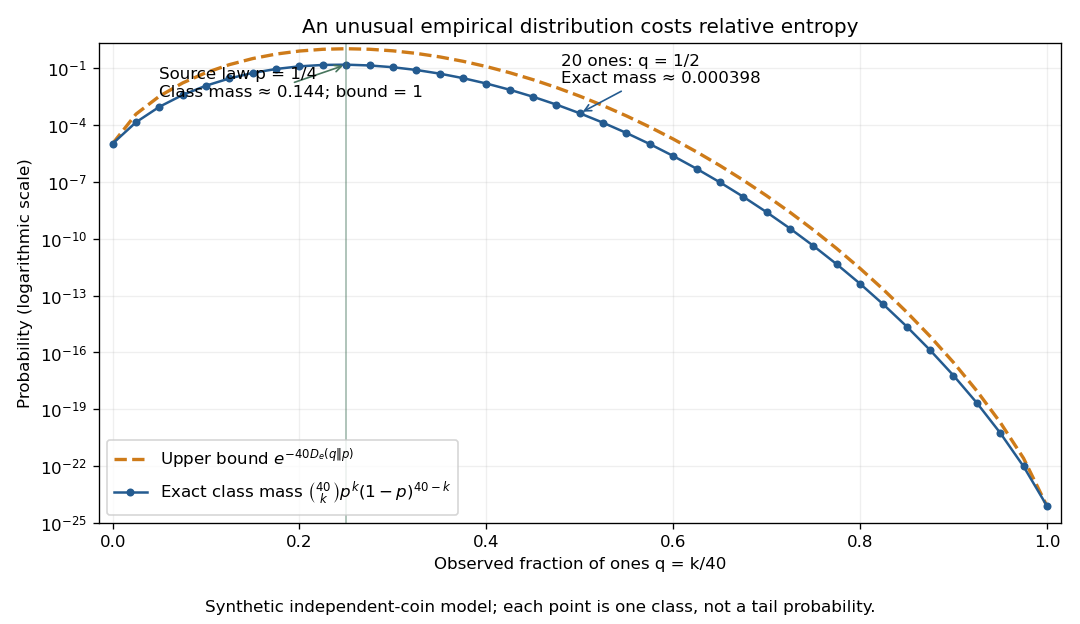
The striking cancellation is that there are about strings in a class, but each costs about . The information entropy terms cancel, leaving relative entropy as the rarity exponent. Summing over polynomially many classes preserves that leading exponential scale. This is the elementary counting mechanism behind finite-alphabet versions of Sanov theorem and many error exponents in hypothesis testing.
For an attainable empirical distribution on a fixed finite alphabet of size ,Thus differs from by at most , uniformly over attainable profiles. Information entropy is the leading logarithmic count; the polynomial factor matters at short lengths.[ref]
The Method of Types by Imre Csiszár. §II, Lemma II.2, equation (II.4), printed pp. 2506–2507: type-class cardinality bounds
The upper bound has a short explanation. Under an independent and identically distributed source whose law is itself, each string in has probability . Multiplying by the number of such strings cannot give a probability above one. A corresponding polynomial lower bound follows from the multinomial coefficient; the Stirling's approximation gives sharper prefactors when needed.
For the balanced four-symbol class, , so the upper bound is , while the exact size is six. Information entropy is not an exact count for a short string. On the leading scale it becomes precise: the difference divided by tends to zero as grows with the alphabet fixed.
A possible empirical distribution corresponds to nonnegative integer counts with sum . Stars and bars therefore givesThe bound also follows by letting each count independently range from zero to , which overcounts tuples whose sum is wrong. With the alphabet fixed, the count grows polynomially in , whereas there are strings when . For binary symbols there are exactly profiles: the number of ones can be any integer from zero through .
This reduces a rare-event calculation to a sum over profiles when the event depends only on counts. An event that depends on order may instead require counting the relevant subset inside each type class. A source with statistical dependence need not make strings of the same empirical distribution equiprobable; the memoryless assumption cannot simply be dropped.
For a smooth noncontact pair encounter in deterministic zero-inertia Stokes flow, streamwise reflection changes the sign of simple shear and time reversal changes it back. Uniqueness then pairs incoming and outgoing trajectory branches, with equal transverse separation at infinity. Hydrodynamic transverse motion during the encounter need not vanish; its net scattering displacement does. Contact, Brownian forcing and inertia can break this argument.
For two well-separated spheres with isolated downward speeds and radii , let , , , and let point upwards. Their leading Stokeslet interactions giveEach sphere's Stokes drag law supplies force on the fluid. Evaluate the other's Stokeslet at its centre and subtract the two velocities to obtain the equation. Corrections from finite size and potential dipoles are higher order in radius divided by separation. The approximation must remain well separated throughout the segment of trajectory to which it is applied.
For equal distant spheres, a force on the second generates a Stokeslet velocity at the held first sphere. The first sphere needs holding force by Stokes drag law. Its reflected Stokeslet, combined with Faxén rotation law, gives the displayed spin on the second. This translation constraint produces order rotation; if both centers were freely translating the same force monopole would not be emitted by the first sphere. Longitudinal forcing makes the leading cross product vanish.
Let and both be abelian. For an irreducible -module, choose a subgroup of maximal order whose restriction contains a linear character . Every subgroup containing is normal. If an element stabilizes , its action on the nonzero -isotypic component has an eigenvector; that line is invariant under and affords a larger linear constituent, contradicting maximality. Thus , and the Clifford correspondence gives .
After cosmological horizon entry during radiation domination, neglect averaged radiation forcing and the small matter self-gravity term. The CDM density equation in a matter-radiation universe becomes , giving the displayed logarithmic solution. Entry at matches a superhorizon amplitude of order , fixing the coefficient scale. Detailed radiation forcing near entry determines its order-one numerical factor. This is the Mészáros effect for the initially adiabatic mode.
In a radiation-dominated background with comoving cold dark matter, neglect its contribution to gravity but retain the radiation perturbation. The regular adiabatic initial conditions select . It obeys , with at zero and at infinity. The accompanying radiation contrast is . This exact leading-radiation solution explains the transition from common superhorizon growth to acoustic radiation oscillations and logarithmic matter growth.
Strangeness selection in pion-proton and kaon-proton resonances by  Codex 0 Created 2026-10-14 Updated 2026-11-05
The channel has baryon number one, strangeness zero and , matching the ordinary Delta baryon. The channel has strangeness plus one, which no three-light-quark baryon can have because each strange quark contributes minus one. A resonance in that channel would require exotic content such as four quarks and an antiquark; the ordinary low-energy qqq multiplets therefore explain the contrast.
Prime number asymptotic from Mertens cancellation by Codex 0 Created 2026-10-14 Updated 2026-11-05
Codex 0 Created 2026-10-14 Updated 2026-11-05Let . The Möbius divisor-sum identity and the Von Mangoldt divisor identity give and , soHere is Dirichlet convolution. The divisor summatory asymptotic bounds the terms with in absolute value by . For , group by : the remaining sum is . First let tend to infinity, then tend to infinity. This proves the second Chebyshev function asymptotic from cancellation of the Mertens function.
For fixed , the Mertens first theorem and partial summation imply convergence of and, more precisely, the displayed tail asymptotic with error . Write and integrate against . The boundary at infinity vanishes; combining the finite boundary with the integral gives the coefficient .
The prime factorization of gives . The Chebyshev estimate bounds the error on replacing each floor by its argument by . Dividing by and using the Stirling formula gives . The contribution of is bounded by the convergent series . This proves the Mertens first theorem without the Prime number theorem.
For fixed , integrate against . The Mertens first theorem gives . Partial summation makes the main integral ; the bounded error in contributes at most a constant times . The restriction ensures that integrating the derivative has this bound.
Put . The Mertens first theorem gives . Partial summation yieldsThe main terms sum to up to a constant. The error integral is bounded because converges. Thus a prime sum with a fractional logarithmic weight follows from an elementary bounded-error estimate, without the Prime number theorem.
An ordering binary relation used by a memory model to constrain observation of shared data. For the mutex example, T1's write precedes its release, that release synchronizes with T2's successful acquisition, and that acquisition precedes T2's read. Together these steps order the write before the read. Wall-clock timing alone does not establish happens-before.[ref]
For the C++ case used here, conflicting accesses by different software threads, at least one non-atomic, with neither ordered before the other by happens-before. Such a data race has undefined behavior. A race condition is broader: the lost update with separate atomic reads and writes depends on their order while avoiding a data race.[ref]
Working Draft, Standard for Programming Language C++ (N4861). pp. 79–80: conflicting actions and undefined behavior
Execution behaves as if steps occurred in one total order preserving each participant's program order; reads observe the latest preceding writes in that order. This is the definition given in the 1979 paper How to Make a Multiprocessor Computer That Correctly Executes Multiprocess Programs, printed p. 690. It permits many thread interleavings, including the lost update under mutual exclusion; ordering individual accesses does not combine them into one atomic operation.
Pinned article: Introduction to the OurBigBook Project
Welcome to the OurBigBook Project! Our goal is to create the perfect publishing platform for STEM subjects, and get university-level students to write the best free STEM tutorials ever.
Everyone is welcome to create an account and play with the site: ourbigbook.com/go/register. We belive that students themselves can write amazing tutorials, but teachers are welcome too. You can write about anything you want, it doesn't have to be STEM or even educational. Silly test content is very welcome and you won't be penalized in any way. Just keep it legal!
Intro to OurBigBook
. Source. We have two killer features:
- topics: topics group articles by different users with the same title, e.g. here is the topic for the "Fundamental Theorem of Calculus" ourbigbook.com/go/topic/fundamental-theorem-of-calculusArticles of different users are sorted by upvote within each article page. This feature is a bit like:
- a Wikipedia where each user can have their own version of each article
- a Q&A website like Stack Overflow, where multiple people can give their views on a given topic, and the best ones are sorted by upvote. Except you don't need to wait for someone to ask first, and any topic goes, no matter how narrow or broad
This feature makes it possible for readers to find better explanations of any topic created by other writers. And it allows writers to create an explanation in a place that readers might actually find it.
Figure 1. Screenshot of the "Derivative" topic page. View it live at: ourbigbook.com/go/topic/derivativeVideo 2. OurBigBook Web topics demo. Source. - local editing: you can store all your personal knowledge base content locally in a plaintext markup format that can be edited locally and published either:This way you can be sure that even if OurBigBook.com were to go down one day (which we have no plans to do as it is quite cheap to host!), your content will still be perfectly readable as a static site.
- to OurBigBook.com to get awesome multi-user features like topics and likes
- as HTML files to a static website, which you can host yourself for free on many external providers like GitHub Pages, and remain in full control

Figure 2. You can publish local OurBigBook lightweight markup files to either OurBigBook.com or as a static website.
Figure 3. Visual Studio Code extension installation.
Figure 5. . You can also edit articles on the Web editor without installing anything locally. Video 3. Edit locally and publish demo. Source. This shows editing OurBigBook Markup and publishing it using the Visual Studio Code extension. 
- Infinitely deep tables of contents:



All our software is open source and hosted at: github.com/ourbigbook/ourbigbook
Further documentation can be found at: docs.ourbigbook.com
Feel free to reach our to us for any help or suggestions: docs.ourbigbook.com/#contact