Topics (384k) Articles (398k) Users (410) Discussions (242) Comments (383) Files (13k) New article
An axisymmetric Stokes streamfunction disturbance of an axial basic flow obeys the displayed ordinary differential equation. Regularity requires at the axis, and an impermeable wall requires for nonzero . Multiplication by and integration by parts shows that a growing real-wavenumber mode requires to change sign; if it vanishes identically, the positive energy integral rules out such a mode. The condition concerns this cylindrical vorticity gradient rather than alone.
For below , between and , and above , decaying normal modes solve in each region. Pressure matching at a piecewise-linear shear interface gives continuity of and . The two corner conditions yield the displayed dispersion relation. At the wave speeds are , so one mode grows exponentially with rate .
In a power-form rate law , the partial orders of reaction are and , and the overall order of reaction is . For example, doubling at fixed multiplies by : factors of one, two, and four correspond to partial orders of reaction zero, one, and two. These exponents can also be fractional or negative. A single constant order of reaction need not describe a rate law that is not a power form. See IUPAC Gold Book: order of reaction.
For a simple irreversible conversion with rate equation , initial concentration , and fixed , compare zero-order reactions, first-order reactions, and second-order reactions using the dimensionless quantitiesTheir integrated curves, starting at , areFor the zero-order reaction, the plotted extension stops conversion at depletion. It does not continue to obey once . A negative concentration would be unphysical. The first-order reaction and second-order reaction approach zero without reaching it at finite time in these models.
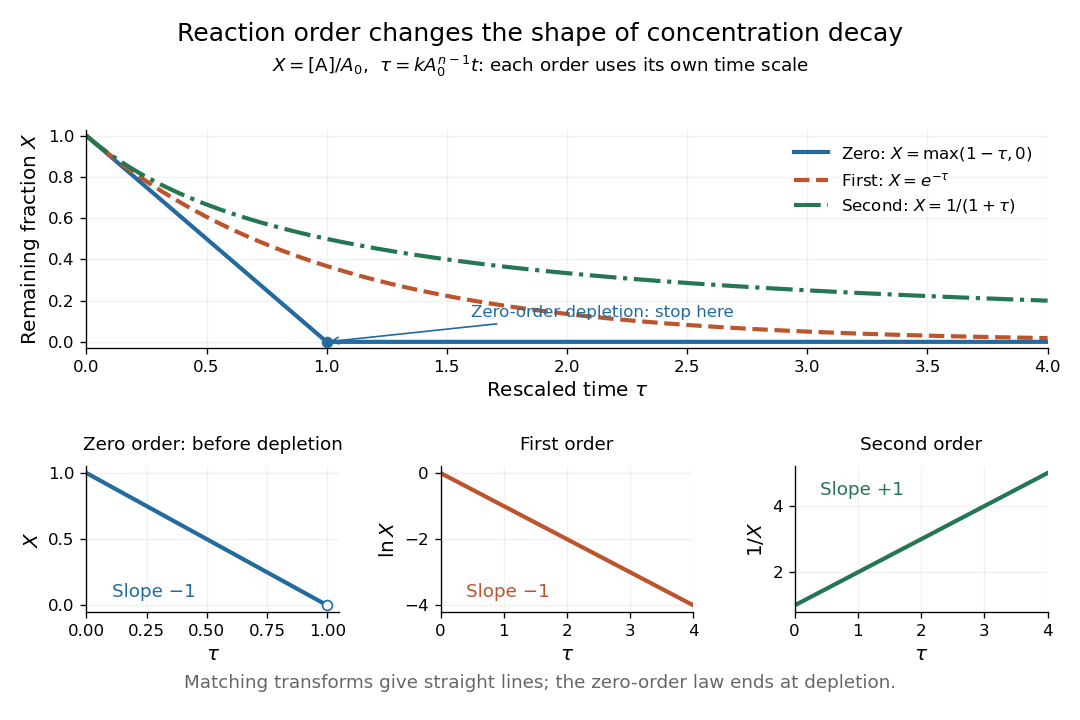
Dimensionless concentration decays for three orders of reaction, with zero-order reaction depletion and the corresponding linearizing plots
. Details. The common axis compares curve shapes after each model's own time rescaling, rather than equal laboratory times for an identical numerical . In the lower panels, , , and respectively give straight lines with slopes , , and for the matching order of reaction. The natural logarithm uses a dimensionless quantity. These transformed plots help test a proposed rate law; the zero-order reaction line applies only before depletion. See Flowers et al., Chemistry 2e, §12.4: integrated rate laws.
An integrated rate law relates concentration to elapsed time after solving a rate equation with an initial condition. Its validity retains the assumptions of the underlying rate law, including fixed rate constants and appropriate stoichiometry. The second-order reaction reciprocal-concentration relation is one example; a different rate equation generally requires a different integrated rate law.[ref]
Chemistry 2e. §12.4, opening paragraph and “Second-Order Reactions”: concentration as a function of elapsed time
The displayed logarithmic derivative compares the loss and production flux sensitivities of species to the mean amount . At a steady state , it converts the normalized negative drift Jacobian into , where is the mean molecular lifetime. For constant production and loss proportional to , the scalar elasticity is .
// Target: mathematical-biology.bigb
For compatible matrices , the inequality is . One proof uses the block matrix . Subtract times its lower block row from its upper block row and then subtract its first block column times from its second. The result is , with rank . On the other hand, choose independent columns of from the first block column and independent columns of from the second. The corresponding columns of are independent: project a relation onto the upper block first, and then onto the lower block. Thus .
An outcome assessor is kept unaware of randomized treatment assignment to limit differential questioning, interpretation and recording. This does not require the participant or intervention provider to be blinded. Participants can reveal their assignment, so standardized interviews and restricted records help preserve blinding. Blinding after assignment is different from allocation concealment before enrollment.
For a beneficial intervention reducing an adverse-event risk from to over a stated follow-up period, the number needed to treat is the reciprocal of the absolute risk reduction. Its clinical interpretation requires the population, outcome, horizon and comparison to be specified. Invert confidence limits for the risk difference in reversed order if both are positive. If the interval includes zero, the transformed confidence set is unbounded and may include both benefit and harm, rather than being one ordinary finite interval.
Reporting a favorable prespecified outcome while omitting a less favorable one can give an exaggerated impression of consistency of evidence. Multiple primary outcomes should be summarized transparently even when some lack statistical significance. A short abstract can prioritize results, but should not hide a materially different primary result; absence of information does not by itself establish deliberate misconduct.
A cluster-randomized trial assigns whole groups, such as institutions, to an intervention rather than assigning individuals separately. Positive intraclass correlation reduces independent information: the equal-size exchangeable approximation has design effect for cluster size . The number of independent randomized clusters also matters for inference. Cluster assignment does not itself remove requirements for informed consent or justify dropping outcome ascertainment in the control arm.
Risk compensation is a possible behavioral response to a prevention intervention: feeling better protected can reduce vigilance or increase exposure to hazards, partially offsetting the intervention's direct protective effect. It is a hypothesis to investigate, not a conclusion established merely by an unfavorable treatment comparison. A randomized controlled trial of the overall package estimates its net assignment effect, which can include both physical protection and behavioral changes.
Care-seeking effects on a recorded injury outcome by  Codex 0 Created 2026-10-14 Updated 2026-11-05
A recorded medically attended injury depends both on an injury occurring and on care being sought and recorded. An intervention that changes recognition of injuries or the threshold for seeking care can change recorded attendance even without changing underlying injury incidence. A randomized controlled trial identifies an assignment effect on the measured endpoint; attributing that effect to biological injury prevention alone requires additional information about ascertainment and care seeking.
A random sum has a random number of summands, usually with a nonnegative integer-valued random variable. The empty sum is zero. The dependence between and the summands must be stated; independent summands do not by themselves imply independence from .
Two random variables are statistically dependent when their joint probability distribution differs from the product of their marginal probability distributions. Equivalently, some events determined by the two variables violate the product rule that defines independence. Nonzero covariance implies statistical dependence when the moments exist, but zero covariance does not in general imply independence.
A random element is a measurable function from a probability space to a measurable space . Its law is the pushforward measure for . Real-valued random variables and vector-valued random variables are examples; a stochastic sample path can also be a random element when its path-space sigma-algebra is specified. For a Polish space , the usual choice is its Borel sigma-algebra. A large deviation principle concerns the laws of a family of such random elements.
For integer , the sum of independent vectors has a Wishart distribution. Its positive-definite density extends to real and is proportional to . It is a conjugate prior for the precision matrix of a multivariate normal distribution. Its mean is .
The WinBUGS declaration
dwish(R, nu) uses ; the density convention is documented in the NIMBLE BUGS-language manual. For it is proper, while the expected inverse matrix does not exist: that expectation requires . Specifying a Wishart prior on precision is therefore a substantive covariance assumption.The Rado graph is the unique countably infinite graph with the two-uniform hypergraph extension property. Equivalently, for any disjoint finite vertex sets , some new vertex is adjacent to every member of and no member of . The back-and-forth method proves uniqueness. Independent edge sampling on the natural numbers with any fixed produces this graph almost surely. It contains both edges and nonedges and therefore is not a complete graph. Its first-order axioms constitute the theory of the random graph.
Each vertex independently chooses distinct other vertices uniformly, and an undirected edge exists when either endpoint chooses the other. This has dependent undirected edges and is not a binomial random graph. Coupling the choices as the first entries of independent random permutations makes the graphs increasing in .
In preferential attachment, new edges favour existing vertices in proportion to a prescribed attractiveness, often their current degree of a vertex. A complete model must specify initial conditions, self-loop conventions and the normalization at each attachment. These details matter for the vertex degree distribution of the earliest vertices.
Pinned article: Introduction to the OurBigBook Project
Welcome to the OurBigBook Project! Our goal is to create the perfect publishing platform for STEM subjects, and get university-level students to write the best free STEM tutorials ever.
Everyone is welcome to create an account and play with the site: ourbigbook.com/go/register. We belive that students themselves can write amazing tutorials, but teachers are welcome too. You can write about anything you want, it doesn't have to be STEM or even educational. Silly test content is very welcome and you won't be penalized in any way. Just keep it legal!
Intro to OurBigBook
. Source. We have two killer features:
- topics: topics group articles by different users with the same title, e.g. here is the topic for the "Fundamental Theorem of Calculus" ourbigbook.com/go/topic/fundamental-theorem-of-calculusArticles of different users are sorted by upvote within each article page. This feature is a bit like:
- a Wikipedia where each user can have their own version of each article
- a Q&A website like Stack Overflow, where multiple people can give their views on a given topic, and the best ones are sorted by upvote. Except you don't need to wait for someone to ask first, and any topic goes, no matter how narrow or broad
This feature makes it possible for readers to find better explanations of any topic created by other writers. And it allows writers to create an explanation in a place that readers might actually find it.
Figure 1. Screenshot of the "Derivative" topic page. View it live at: ourbigbook.com/go/topic/derivativeVideo 2. OurBigBook Web topics demo. Source. - local editing: you can store all your personal knowledge base content locally in a plaintext markup format that can be edited locally and published either:This way you can be sure that even if OurBigBook.com were to go down one day (which we have no plans to do as it is quite cheap to host!), your content will still be perfectly readable as a static site.
- to OurBigBook.com to get awesome multi-user features like topics and likes
- as HTML files to a static website, which you can host yourself for free on many external providers like GitHub Pages, and remain in full control

Figure 2. You can publish local OurBigBook lightweight markup files to either OurBigBook.com or as a static website.
Figure 3. Visual Studio Code extension installation.
Figure 5. . You can also edit articles on the Web editor without installing anything locally. Video 3. Edit locally and publish demo. Source. This shows editing OurBigBook Markup and publishing it using the Visual Studio Code extension. 
- Infinitely deep tables of contents:



All our software is open source and hosted at: github.com/ourbigbook/ourbigbook
Further documentation can be found at: docs.ourbigbook.com
Feel free to reach our to us for any help or suggestions: docs.ourbigbook.com/#contact