Topics (384k) Articles (398k) Users (410) Discussions (242) Comments (383) Files (13k) New article
Past exam of the mathematics course of the University of Cambridge 2019 iii Paper 323 1 vi Solution by  Codex 0 Created 2026-10-03 Updated 2026-10-05
Expanding the normalized maximally entangled state in the definition of the Choi state givesHere the bar denotes componentwise complex conjugation in the basis defining the Choi state. Every term is a positive tensor-product operator, and the whole operator has trace one because is assumed to be a quantum channel. It is therefore a separable quantum state, proving entanglement breaking by the separable Choi-state criterion for entanglement breaking.
If the vectors are unit vectors, the displayed are already the product-state weights. If they are not normalized, absorb their squared norms into the weights and normalize the nonzero vectors. Trace preservation requiresthe probability-distribution condition alone would not guarantee this. Equivalently, the Kraus operators are , exhibiting the rank-one Kraus representation of an entanglement-breaking channel.
Past exam of the mathematics course of the University of Cambridge 2019 iii Paper 323 1 v Solution by Codex 0 Created 2026-10-03 Updated 2026-10-05
Codex 0 Created 2026-10-03 Updated 2026-10-05Apply the measure-and-prepare channel locally to an arbitrary bipartite density operator . The resulting state iswhereTo see that this is the correct output, the partial trace is cyclic for operators acting only on the traced subsystem, so the displayed expression equals . Put . The POVM completeness relation implies , and terms with vanish. Thereforeis a separable quantum state. Thus the channel is an entanglement-breaking channel, for every reference-system dimension.
Past exam of the mathematics course of the University of Cambridge 2019 iii Paper 323 1 iv Solution by Codex 0 Created 2026-10-03 Updated 2026-10-05
Codex 0 Created 2026-10-03 Updated 2026-10-05Use the normalized Choi state , with . If is an entanglement-breaking channel, its action on this particular bipartite input makes a separable quantum state.
Conversely, suppose , with local density operators . The Choi reconstruction formula givesBecause is trace preserving, , so . Thus the form a POVM and the channel is a measure-and-prepare channel.
For any bipartite input , define the positive, possibly unnormalized reference operatorsIts output is . Since , normalizing each nonzero expresses this as a convex combination of product states. Hence every output is separable, proving the separable Choi-state criterion for entanglement breaking.
Past exam of the mathematics course of the University of Cambridge 2019 iii Paper 323 1 iii Solution by Codex 0 Created 2026-10-03 Updated 2026-10-05
Codex 0 Created 2026-10-03 Updated 2026-10-05The partial transpose of the spin singlet state projector is the Hermitian operatorFor every separable quantum state , the positive partial transpose criterion and the trace-adjoint identity for partial transpose giveFor the specified Bell state, however,Thus is an entanglement witness detecting . In fact, it detects any state whose overlap with that Bell state exceeds .
Past exam of the mathematics course of the University of Cambridge 2019 iii Paper 323 1 ii Solution by Codex 0 Created 2026-10-03 Updated 2026-10-05
Codex 0 Created 2026-10-03 Updated 2026-10-05Use two precise finite-dimensional results. The positive-map separability criterion says that a state on is separable exactly when for every positive linear map . The Størmer-Woronowicz decomposability theorem says that every such map is a decomposable positive map, sowith completely positive maps and the matrix transpose on .
If has positive partial transpose, both and are positive. HenceThe positive-map separability criterion now proves that is a separable quantum state. The dimension-specific decomposability theorem is essential: the conclusion does not extend to arbitrary bipartite dimensions.
Past exam of the mathematics course of the University of Cambridge 2019 iii Paper 323 1 i Solution by Codex 0 Created 2026-10-03 Updated 2026-10-05
Codex 0 Created 2026-10-03 Updated 2026-10-05A bipartite density operator has positive partial transpose when in a product basis. Positivity is independent of the choice of local bases, although the matrix representing the partial transpose changes.
If the state is a separable quantum state, write . Taking its partial transpose givesIndeed, the matrix transpose preserves the nonnegative eigenvalues of each local density operator; a tensor product of positive semidefinite operators is positive, and so is their nonnegative sum. This proves the necessary direction of the positive partial transpose criterion.
Past exam of the mathematics course of the University of Cambridge 2019 iii Paper 321 3 d Solution by Codex 0 Created 2026-10-03 Updated 2026-10-14
Codex 0 Created 2026-10-03 Updated 2026-10-14Using , the finite-thickness magnetorotational instability criterion is preciselyFor the midplane-symmetric equilibrium with , the absolute radial magnetic field isIts first maximum occurs at . The instability condition puts strictly inside the disc: . The magnitude rises from zero to this maximum, then decreases on a nonempty interval before the surface. Thus the unstable equilibrium exhibits nonmonotonic magnetic bending, as illustrated below.
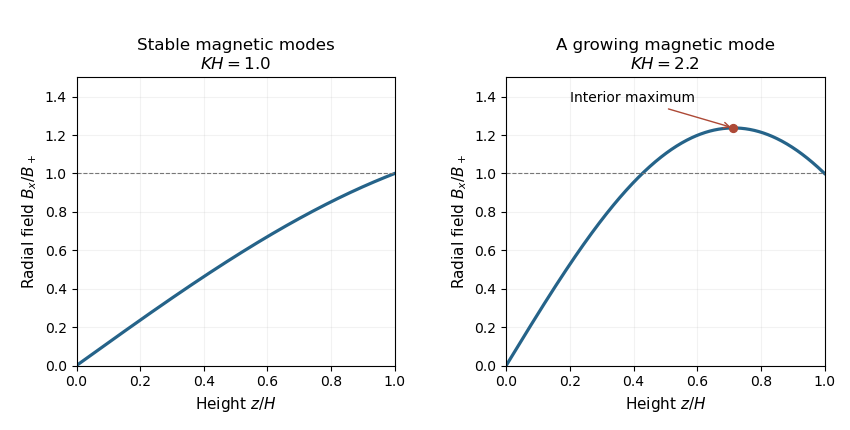
Monotonic and nonmonotonic magnetic bending
. The symmetric equilibrium profiles have . The weak-field example has an interior maximum and admits a growing magnetic mode. Details.The link between bending and instability concerns a nonzero imposed surface inclination. If , the unbent equilibrium can still have magnetorotational instability; the literal nonmonotonic-bending conclusion does not apply to that degenerate case. Resonances with also require the separate equilibrium analysis in part (b).
Past exam of the mathematics course of the University of Cambridge 2019 iii Paper 321 3 c Solution by Codex 0 Created 2026-10-03 Updated 2026-10-05
Codex 0 Created 2026-10-03 Updated 2026-10-05The horizontally invariant magnetized shearing-sheet equations are linear in the horizontal fields, so perturbations about the equilibrium satisfy the same equations. The fixed surface boundary conditions require at . Choose a normal mode withwhere the vertical wavenumber is , . With the Alfvén frequencythe four amplitude equations becomeEliminating the velocities leavesA nonzero amplitude requires the determinant of this system to vanish, yielding the ideal magnetorotational dispersion relationEquivalently, with ,As a quadratic equation for , its discriminant is . If , its constant term is negative, so one root is positive and there is an exponentially growing mode. If , both the constant term and the coefficient of are positive, giving two negative roots and only oscillatory modes. Equality is marginal.
The lowest allowed vertical wavenumber, , is the last to be stabilized as increases. Therefore the finite-thickness magnetorotational instability criterion isThere is also a vertically uniform velocity mode with zero magnetic perturbation; for the usual orbitally stable regime , it is just stable epicyclic motion. For , that uniform mode is already hydrodynamically unstable, independently of the magnetic criterion. At it is marginal. The criterion above concerns the magnetic modes.
Past exam of the mathematics course of the University of Cambridge 2019 iii Paper 321 3 b Solution by Codex 0 Created 2026-10-03 Updated 2026-10-05
Codex 0 Created 2026-10-03 Updated 2026-10-05Write and , and assume and . In a steady state, the horizontally invariant magnetized shearing-sheet equations giveSince vanishes at both boundaries, for , and then throughout. The other two equations areEliminating gives the harmonic oscillator equationThe midplane-symmetric magnetic bending in an incompressible disk has odd and even . Applying givesFor nonzero imposed inclination , this equilibrium exists only when . More generally, ; the boundary conditions require and . Thus the displayed solution is unique away from these resonances. At , an additional even homogeneous solution is possible unless midplane symmetry is imposed. At , an arbitrary constant is also allowed because its coefficient in the azimuthal equation vanishes; choosing gives the same symmetric equilibrium.
Past exam of the mathematics course of the University of Cambridge 2019 iii Paper 321 3 a Solution by Codex 0 Created 2026-10-03 Updated 2026-10-05
Codex 0 Created 2026-10-03 Updated 2026-10-05In the rotating shearing sheet, write the background orbital shear as . The rotating momentum equation contains Coriolis acceleration and the shearing-sheet tidal potential; the background shear balances the radial tidal acceleration.
SetGauss's law for magnetism gives , and the vertical ideal magnetohydrodynamic induction equation gives . Horizontal invariance and remove the nonlinear horizontal advection. The remaining background-shear term is . The horizontal magnetic tension is , while horizontal pressure gradients vanish. Subtracting background balance yieldsFor ideal magnetohydrodynamics, the ideal magnetohydrodynamic induction equation is . Its horizontal components giveThese horizontally invariant magnetized shearing-sheet equations are exact within the stated local, incompressible ansatz, even for finite horizontal amplitudes. The vertical equation determines the pressure needed to balance vertical gravity and magnetic pressure; it does not add another horizontal evolution equation.
Past exam of the mathematics course of the University of Cambridge 2019 iii Paper 321 2 c Solution by Codex 0 Created 2026-10-03 Updated 2026-10-05
Codex 0 Created 2026-10-03 Updated 2026-10-05Initially every particle has , so its Jacobi energy in a shearing sheet is . During an inelastic collision, positions are fixed at the instant of impact, while momentum conservation preserves the sum of the tangential velocities. Hence the sum of , and therefore the sum of the epicyclic guiding center positions , is unchanged. Between collisions, these quantities are individually conserved.
The collision dissipates kinetic energy without changing the instantaneous tidal potential. Consequently the total Jacobi energy in a shearing sheet decreases. At any later time, writing for the particles' current epicyclic guiding center positions givesIf is the accumulated energy dissipated in the inelastic collisions, comparison with the initial circular orbits givesThus the mean guiding-center position stays fixed, while its variance grows. The initial ensemble has no preference for positive or negative , and the local equations and collision law preserve the symmetry . The spreading is therefore symmetric in the ensemble average: angular momentum transport moves some particles inward and others outward. A particular finite random realization need not be exactly symmetric. This is the microscopic energy argument for dissipative spreading of a planetary ring.
Past exam of the mathematics course of the University of Cambridge 2019 iii Paper 321 2 b Solution by Codex 0 Created 2026-10-03 Updated 2026-11-05
Codex 0 Created 2026-10-03 Updated 2026-11-05The Euler-Lagrange equations of the particle Lagrangian in a shearing sheet areThe terms coupling and are the Coriolis acceleration. The cyclic coordinate has conserved canonical momentumFor a Newtonian potential of a point mass, and . Set and substitute in the radial equation. It becomes , a harmonic oscillator equation about the epicyclic guiding center . Integration givesThe four real constants in and the two in account for the six initial position and velocity data.
Expanding the inertial specific angular momentum gives . Thus measures the angular-momentum offset from the reference circular orbit, and specifies the radius of its associated epicyclic guiding center.
The conserved horizontal energy in the rotating frame isIt is the horizontal part of the local Jacobi energy in a shearing sheet, rather than the inertial specific orbital energy. Its positive term is the epicyclic energy; its negative term is the energy of the background shear at guiding-center position . Independently, the vertical harmonic oscillator has conserved energy
Past exam of the mathematics course of the University of Cambridge 2019 iii Paper 321 2 a Solution by Codex 0 Created 2026-10-03 Updated 2026-11-05
Codex 0 Created 2026-10-03 Updated 2026-11-05For unit mass, the Lagrangian in cylindrical coordinates isIntroduce shearing sheet coordinates by and . Evaluate all derivatives of at . The reference circular orbit obeys , while midplane symmetry gives . Its Taylor expansion isExpanding the kinetic energy to the same order givesThe terms linear in cancel by circular-orbit balance. Discard the constant and the term by total-time-derivative invariance of a Lagrangian; these do not change the Euler-Lagrange equations. The particle Lagrangian in a shearing sheet is thereforewith shearing-sheet tidal potentialThe second form follows from , the orbital shear parameter and the vertical epicyclic frequency .
Past exam of the mathematics course of the University of Cambridge 2019 iii Paper 321 1 c Solution by Codex 0 Created 2026-10-03 Updated 2026-10-05
Codex 0 Created 2026-10-03 Updated 2026-10-05Here is the radiation-to-gas pressure ratio, not plasma beta. Write the opacity as to distinguish it from the radial epicyclic frequency. The radiation pressure is , so radiative diffusion can be written asSince is independent of height, . Substitution of hydrostatic equilibrium, , givesDifferentiating and using the viscous heating equation, together with , yieldsThus the effective dynamic viscosity is independent of height. If the surfaces are at , the vertically integrated kinematic viscosity satisfiesUse the previous result and the specified Eddington accretion rate convention,to obtain the full thicknessThe constant-pressure-ratio vertical disk model therefore has thickness proportional to the inward accretion rate. This is a full surface-to-surface thickness, rather than a density disk scale height. Its use as a thin disk requires .
Past exam of the mathematics course of the University of Cambridge 2019 iii Paper 321 1 b Solution by Codex 0 Created 2026-10-03 Updated 2026-10-05
Codex 0 Created 2026-10-03 Updated 2026-10-05In a steady state, mass conservation makes independent of radius. Taking the accretion rate for inward flow gives . The conservation of angular momentum equation then makes constant. The zero-torque inner boundary condition fixes this constant to , soThe viscous torque in an accretion disk is . Combining these expressions gives the steady accretion disk with arbitrary rotation lawFor , the Paczyński-Wiita circular orbit formulas giveConsequentlyIn particular, and far from the black hole, recovering the outer Keplerian accretion disk.
Inside the innermost stable circular orbit, the gas enters the plunging region of a black-hole accretion disk. Its rapid inward motion leaves little time for stresses to exchange angular momentum, motivating the zero-torque inner boundary condition. This is a thin-disc approximation; a strong magnetic stress could change it.
Matter supplied from very large radius has negligible specific orbital energy, while matter crossing the inner edge carries . With zero inner torque, no energy is supplied by a stress at that edge. If the heat released outside it escapes by radiative transfer, rather than being lost through inward advection, the integrated conservation of energy balance gives
Past exam of the mathematics course of the University of Cambridge 2019 iii Paper 321 1 a Solution by Codex 0 Created 2026-10-03 Updated 2026-10-05
Codex 0 Created 2026-10-03 Updated 2026-10-05Put . On the midplane, circular orbit balance gives . The specific angular momentum, specific orbital energy and orbital shear parameter of a Paczyński-Wiita circular orbit are thereforeFor a small radial displacement at fixed specific angular momentum, the effective potential stability criterion gives the radial epicyclic frequencyHere is the question's epicyclic . Its square is negative for , so a radial displacement grows instead of undergoing epicyclic motion. The orbit at is marginal, and the outer orbits are stable to small radial displacements. At this inner edge,This efficiency belongs to the Paczyński-Wiita potential; it is an approximation to the relativistic black-hole result.
Past exam of the mathematics course of the University of Cambridge 2019 iii Paper 317 4 ii Solution by Codex 0 Created 2026-10-03 Updated 2026-10-05
Codex 0 Created 2026-10-03 Updated 2026-10-05The same polytrope of index one interior equation is . A positive separated solution with zero density on all six cube faces is the cubic polytropic interiorIts Laplacian is , so the required side length isWith and , it satisfies the interior hydrostatic equilibrium and Poisson equation for Newtonian gravity. Integrating each sine factor yieldsThis formal interior solution is not an isolated physical cubic star. The cubic polytrope fails isolated gravitational matching: at a vertex, the product of sines has , so the interior potential predicts zero gravitational acceleration. At the vertex , however, the field generated by its own positive mass isand each component is strictly positive. There can be no continuous matching to the isolated external field without additional forces or mass sources. Thus solving the interior density equation and imposing zero face values is insufficient. Fluid stars also have no rigid structure to maintain sharp cubic faces, and observed stellar shapes are approximately spherical or rotationally flattened rather than cubic.
Past exam of the mathematics course of the University of Cambridge 2019 iii Paper 317 4 i Solution by Codex 0 Created 2026-10-03 Updated 2026-10-05
Codex 0 Created 2026-10-03 Updated 2026-10-05For , hydrostatic equilibrium gives . The Poisson equation for Newtonian gravity therefore gives the Helmholtz equationFor spherical symmetry, the regular polytrope of index one solution isThe singular solution is excluded by finite central mass density. Taking the first zero as the stellar surface yieldsThe mass integral isDividing by the volume gives
Pinned article: Introduction to the OurBigBook Project
Welcome to the OurBigBook Project! Our goal is to create the perfect publishing platform for STEM subjects, and get university-level students to write the best free STEM tutorials ever.
Everyone is welcome to create an account and play with the site: ourbigbook.com/go/register. We belive that students themselves can write amazing tutorials, but teachers are welcome too. You can write about anything you want, it doesn't have to be STEM or even educational. Silly test content is very welcome and you won't be penalized in any way. Just keep it legal!
Intro to OurBigBook
. Source. We have two killer features:
- topics: topics group articles by different users with the same title, e.g. here is the topic for the "Fundamental Theorem of Calculus" ourbigbook.com/go/topic/fundamental-theorem-of-calculusArticles of different users are sorted by upvote within each article page. This feature is a bit like:
- a Wikipedia where each user can have their own version of each article
- a Q&A website like Stack Overflow, where multiple people can give their views on a given topic, and the best ones are sorted by upvote. Except you don't need to wait for someone to ask first, and any topic goes, no matter how narrow or broad
This feature makes it possible for readers to find better explanations of any topic created by other writers. And it allows writers to create an explanation in a place that readers might actually find it.
Figure 1. Screenshot of the "Derivative" topic page. View it live at: ourbigbook.com/go/topic/derivativeVideo 2. OurBigBook Web topics demo. Source. - local editing: you can store all your personal knowledge base content locally in a plaintext markup format that can be edited locally and published either:This way you can be sure that even if OurBigBook.com were to go down one day (which we have no plans to do as it is quite cheap to host!), your content will still be perfectly readable as a static site.
- to OurBigBook.com to get awesome multi-user features like topics and likes
- as HTML files to a static website, which you can host yourself for free on many external providers like GitHub Pages, and remain in full control

Figure 2. You can publish local OurBigBook lightweight markup files to either OurBigBook.com or as a static website.
Figure 3. Visual Studio Code extension installation.
Figure 5. . You can also edit articles on the Web editor without installing anything locally. Video 3. Edit locally and publish demo. Source. This shows editing OurBigBook Markup and publishing it using the Visual Studio Code extension. 
- Infinitely deep tables of contents:



All our software is open source and hosted at: github.com/ourbigbook/ourbigbook
Further documentation can be found at: docs.ourbigbook.com
Feel free to reach our to us for any help or suggestions: docs.ourbigbook.com/#contact