Topics (384k) Articles (398k) Users (410) Discussions (242) Comments (383) Files (13k) New article

A perfect fluid in general relativity has isotropic rest-frame pressure and no rest-frame heat flux or anisotropic stress. In units and signature , let , let be rest-frame energy density and rest-frame pressure. Its stress-energy tensor isThe energy measured with the fluid is . The orthogonal projection isolates spatial directions and gives isotropic projected stress . A fluid moving relative to another observer can have nonzero momentum density even though its own rest-frame stress is isotropic.
Projecting stress-energy conservation along and perpendicular to the four-velocity givesThese are the comoving energy balance and relativistic Euler equation. The inertial factor is enthalpy density . An equation of state is needed to close the evolution; relativistic dust sets , while an isotropic radiation fluid has . Perfect-fluid behavior does not require irrotational motion: the potential-flow action below describes a restricted subset.
Star formation is the conversion of interstellar gas into self-gravitating protostars and eventually stars. A region can contract when gravity overcomes support from gas pressure and other motions or fields. Cooling matters because it removes compression energy: during approximately isothermal fragmentation, rising mass density lowers the Jeans mass, permitting smaller regions to collapse independently.
When the gas becomes opaque and cannot cool efficiently, adiabatic suppression of fragmentation changes that behaviour. A first hydrostatic core and second protostellar collapse describe successive physical stages rather than two arbitrary labels for the same contraction. Accretion, rotation and magnetic fields affect the resulting objects, while stellar feedback limits how much gas becomes stellar mass. The initial mass function summarizes the resulting birth-mass distribution.
A brown dwarf is a self-gravitating body that does not sustain ordinary core hydrogen burning. Contraction initially heats it, but growing electron degeneracy pressure limits further compression before long-lived hydrogen fusion can establish the thermal balance of a main-sequence star. It subsequently cools and becomes fainter.
Some brown dwarfs temporarily burn deuterium; the deuterium-burning mass is a composition-dependent classification scale rather than a unique formation test. Their radii can be close to Jupiter's across a broad mass range. Consequently, exoplanet transit photometry alone cannot distinguish a giant planet from a brown dwarf. The transit and Doppler spectroscopy measurements of CoRoT-3b illustrate why independent mass information is decisive for characterizing such compact companions.
A supernova is an explosive stellar event whose expanding, heated ejecta can become extraordinarily luminous. Two major physical routes are stellar core collapse in an evolved massive star and thermonuclear disruption of a white dwarf. The observed spectral category and the energy source are distinct: the absence of hydrogen lines alone does not prove a Type Ia supernova.
A light curve follows how deposited energy escapes as the ejecta expand, while spectral lines reveal composition and motion through their Doppler shifts. SN 1987A additionally supplied a neutrino signal that probes the deep collapse rather than only the radiating envelope. Supernovae connect stellar evolution to the production and dispersal of chemical elements, and calibrated Type Ia supernovae provide astronomical distance measurements.
A Cepheid variable is a pulsating evolved star whose regular changes in stellar radius and temperature produce a repeating light curve. The kappa mechanism supplies driving in a suitable part of the instability strip. Large stellar radius gives a long dynamical time, connecting the pulsation period to the star's mean mass density.
The practical importance is the calibrated Cepheid period-luminosity relation. Measuring a period predicts an absolute magnitude within a specified population and spectral band; comparison with apparent magnitude then constrains distance. Extinction, composition and unresolved companions affect that comparison. Thus the variable brightness acts as a physical ruler only after calibration, rather than every pulsating star having one universal luminosity at a given period.
A confidence interval is a random interval constructed from a statistical sample to cover a fixed unknown statistical parameter with a prescribed coverage probability. For a scalar target , a procedure with nominal confidence satisfiesThe subscript records which probability distribution generates the repeated samples. The endpoints are statistics, so they vary from sample to sample; the target is fixed. Equality gives exact nominal coverage probability, while the inequality also permits conservative procedures. For a general estimand , replace the target inside the interval by .
A realized confidence interval communicates the precision of an estimate in the target's own units. Reporting alone conceals the difference between an estimate with standard error and one with standard error . A narrow confidence interval indicates greater precision for the stated statistical model, rather than a guarantee that its assumptions describe the experiment correctly.
Once is observed, either contains the fixed target or does not. The 95% statement concerns the random procedure , not a posterior probability of 0.95 that this particular interval contains . A credible interval instead assigns specified posterior probability to a region under Bayesian inference. These interpretations can differ even when the numerical endpoints agree. The repeated-sampling interpretation is explained in NIST's confidence-limits teaching reference.
Jerzy Neyman's 1937 paper formulates the fixed-target, random-endpoint construction in Section II, especially equation (20) on page 348. Its confidence coefficient must hold across the allowed statistical parameters, rather than only at the value suggested by one sample. See Neyman, Outline of a Theory of Statistical Estimation Based on the Classical Theory of Probability and the original paper scan.
Semiparametric statistics studies a statistical model with a finite-dimensional target statistical parameter and an infinite-dimensional nuisance parameter. For example, the partially linear model , with , targets the scalar while leaving the function and the covariate distribution unrestricted.
Writing and removes : . If the needed second moments exist and , then . The positivity condition expresses the residual variation needed to identify the target.
A nuisance tangent space describes first-order changes the nuisance can imitate. Projecting a parametric score function away from that space gives the efficient score and efficient information. Thus a finite-dimensional target can sometimes be estimated efficiently without fully specifying an infinite-dimensional distribution; the allowed model and its regularity determine whether this is possible.
An accidental symmetry is respected by every operator of the chosen field content and dimension even though it was not imposed when constructing the theory. Higher-dimensional operators can violate it.
The weak interaction changes particle species through the charged current and also acts through the neutral current. Familiar examples include beta-minus decay and neutrino scattering. It is short-range and chiral: its W boson and Z boson couplings distinguish chirality. Above the electroweak scale it belongs to the unbroken electroweak interaction. At much lower energies, W boson exchange is approximated by the Fermi interaction.
A particularly direct window into the weak interaction is the Wu experiment: a sample with oriented nuclear spins emits electrons preferentially toward one end of its spin axis. The comparison tests parity conservation, because spin is an axial vector and momentum is a polar vector. The polarized beta-decay angular distribution translates that geometric distinction into a measurable counting asymmetry.
The strong interaction is the color interaction described by quantum chromodynamics. Quarks carry color charge, gluons mediate the interaction and also carry color themselves, and physical low-energy states organize into color-singlet hadrons.
At short distances, asymptotic freedom makes a perturbative treatment useful. At hadronic distances, confinement and strong collective dynamics require other methods. The binding of quarks into a proton and the residual interaction between nucleons in an atomic nucleus are related effects at different descriptive levels. The latter can be modeled using hadrons rather than pretending that a free gluon simply travels between two structureless nucleons. Scattering resolves the short-distance constituents, while hadron and nuclear spectra constrain their low-energy collective behavior.
The Weinberg soft theorem constrains interactions of a massless particle by requiring its soft-emission amplitude to be invariant under shifts of an unphysical polarization. For helicity one it gives charge conservation, for helicity two it gives universal gravitational coupling, and for higher helicity it obstructs generic long-range interactions.
Descriptive set theory studies definable subsets of spaces such as the real line and the Baire space of sequences. It relates how a set is described to its topological and measure-theoretic regularity.
The Borel sets arise from open sets by complements and countable unions. Projecting a Borel set produces an analytic set, which need not be Borel. For example, the set of infinite sequences that admit a witness sequence satisfying a Borel condition is naturally analytic: the witness is an existentially quantified real. The subject gives precise complexity hierarchies for such definitions and connects regularity with infinite games of perfect information and determinacy.
An inner model is a transitive class containing every ordinal and satisfying the specified axioms of set theory with the inherited membership relation.
An integer partition of a nonnegative integer is a multiset of positive integers whose sum is : repetitions matter, but the order of the summands does not. Equivalently, write its parts in decreasing order, allowing equality:The notation says that is an integer partition of . The partition count counts all integer partitions of , with any number of parts. Zero has one empty integer partition, so . The partition of an integer article develops the same objects in representation theory of the symmetric group.[ref]
Enumerative Combinatorics, Volume 1 (second-edition draft) by Richard Stanley. section 1.7, definitions of partitions and diagrams
Computed example. The seven integer partitions of five are exactlyThus . Sorting each list of positive summands into decreasing order prevents repetitions in this enumeration. Grouping by largest part verifies completeness: largest parts contribute respectively possibilities. For largest part , the remaining is either or ; for largest part , the remaining uses only and , giving or .
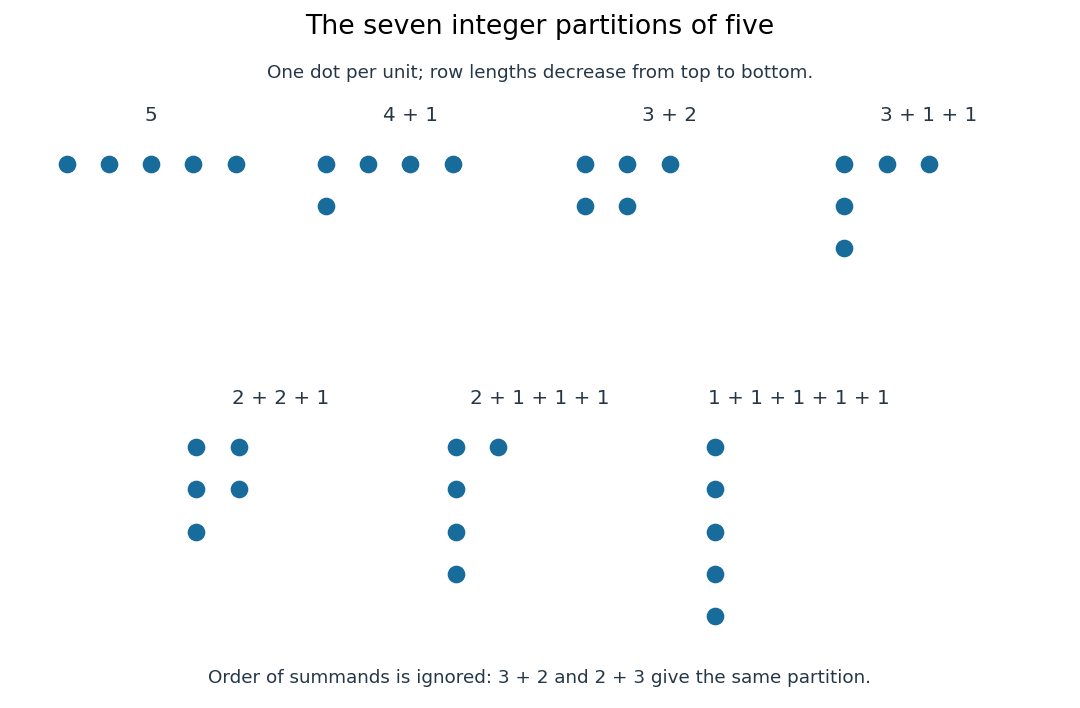
All seven integer partitions of five, drawn as Ferrers diagrams: each row has as many dots as its part
. Details. An integer partition keeps sizes without named positions. The compositions of an integer and are different tuples, but sorting either gives the same integer partition . A weak composition of an integer also retains its empty first position; dropping its zero and sorting gives that same integer partition. Conversely, a set partition records which distinct elements belong to each block. For example, the set partitions and differ even though both have the same integer partition of block sizes.
The Ferrers diagram makes an integer partition into a shape. For , the column lengths are : exchanging rows and columns gives its conjugate partition . Exchanging again recovers , so this operation is a bijection. In particular, the three integer partitions of five with at most two parts are , , and ; their conjugate partitions , , and are precisely the three with largest part at most two. This visible symmetry explains the equal counts for these two restrictions. The square-cell version is the existing Young diagram.
Counting by a generating function. An integer partition is determined by its multiplicities , the number of parts equal to . Its size condition is . Consequently its ordinary generating function isProof outline. Choose the term from the th geometric series. The product contributes exactly when those multiplicities describe an integer partition of , once for each such integer partition. As a formal power series, each coefficient is determined by finitely many factors: factors with contribute only their constant term to the coefficient of . For , multiplication through gives up to degree five, independently recovering . Restricting the factors gives the generating function for partitions with bounded parts. This is useful because restrictions on summands become choices of factors, while conjugate partitions turn restrictions on numbers of rows into restrictions on row lengths.[ref]
Enumerative Combinatorics, Volume 1 (second-edition draft) by Richard Stanley. section 1.8, conjugation and partition generating functions
For the Levi-Civita connection, the cyclic covariant derivative of curvature vanishes: . Contracting this identity gives the contracted Bianchi identity.
The representation theory of is organized by a partition of an integer. Over the complex numbers, partitions label the irreducible Specht modules; over positive-characteristic fields, the simple modules are labelled by regular partitions.
The Fierz-Pauli equations describe a free massive spin-two field. A symmetric tensor obeys the Klein-Gordon equation together with and , leaving five propagating polarizations in four dimensions.
Two events are spacelike separated when no signal traveling at or below the speed of light can connect them. Their temporal order can differ between inertial frames.
Pinned article: Introduction to the OurBigBook Project
Welcome to the OurBigBook Project! Our goal is to create the perfect publishing platform for STEM subjects, and get university-level students to write the best free STEM tutorials ever.
Everyone is welcome to create an account and play with the site: ourbigbook.com/go/register. We belive that students themselves can write amazing tutorials, but teachers are welcome too. You can write about anything you want, it doesn't have to be STEM or even educational. Silly test content is very welcome and you won't be penalized in any way. Just keep it legal!
Intro to OurBigBook
. Source. We have two killer features:
- topics: topics group articles by different users with the same title, e.g. here is the topic for the "Fundamental Theorem of Calculus" ourbigbook.com/go/topic/fundamental-theorem-of-calculusArticles of different users are sorted by upvote within each article page. This feature is a bit like:
- a Wikipedia where each user can have their own version of each article
- a Q&A website like Stack Overflow, where multiple people can give their views on a given topic, and the best ones are sorted by upvote. Except you don't need to wait for someone to ask first, and any topic goes, no matter how narrow or broad
This feature makes it possible for readers to find better explanations of any topic created by other writers. And it allows writers to create an explanation in a place that readers might actually find it.
Figure 1. Screenshot of the "Derivative" topic page. View it live at: ourbigbook.com/go/topic/derivativeVideo 2. OurBigBook Web topics demo. Source. - local editing: you can store all your personal knowledge base content locally in a plaintext markup format that can be edited locally and published either:This way you can be sure that even if OurBigBook.com were to go down one day (which we have no plans to do as it is quite cheap to host!), your content will still be perfectly readable as a static site.
- to OurBigBook.com to get awesome multi-user features like topics and likes
- as HTML files to a static website, which you can host yourself for free on many external providers like GitHub Pages, and remain in full control

Figure 2. You can publish local OurBigBook lightweight markup files to either OurBigBook.com or as a static website.
Figure 3. Visual Studio Code extension installation.
Figure 5. . You can also edit articles on the Web editor without installing anything locally. Video 3. Edit locally and publish demo. Source. This shows editing OurBigBook Markup and publishing it using the Visual Studio Code extension. 
- Infinitely deep tables of contents:



All our software is open source and hosted at: github.com/ourbigbook/ourbigbook
Further documentation can be found at: docs.ourbigbook.com
Feel free to reach our to us for any help or suggestions: docs.ourbigbook.com/#contact