
Spin echo 2026-10-18
A spin echo is a reappearance of transverse magnetization after a pulse sequence reverses an earlier spread of phases. An ensemble can have almost no net transverse magnetization while its components retain enough individual phase memory to reassemble. In the ideal Hahn echo below, a short 90° pulse prepares transverse magnetization, a 180° pulse follows after time , and the signal refocuses at . The receiver observes freely precessing magnetization, as in free induction decay; no third driving pulse is needed at the echo time.
The useful distinction is between cancellation in an ensemble average and loss of recoverable phase memory. A static spread of Larmor precession frequencies can make free induction decay much faster than transverse nuclear magnetization decay. A spin echo can remove that static spread from the echo amplitude, allowing a more selective measurement of transverse relaxation. It does not in general reverse noise, population relaxation, or every interaction between spins.
Continuous-wave nuclear magnetic resonance 2026-10-18
For constant drive, set the three rotating frame derivatives to zero. Substitution first gives , then , henceThe absorption is proportional to . With , its frequency dependence is a Cauchy distribution profile, often called a Lorentzian. With appreciable , the response broadens and on resonance: nuclear magnetic resonance saturation limits the response. The short-pulse amplitude in the previous example is not a weak continuous drive; these are different operating regimes of the same equations.
Free induction decay 2026-10-18
Free induction decay is a receiving signal from freely precessing transverse magnetization after excitation ends. Faraday's law of induction gives coil voltage proportional to the time derivative of linked magnetic flux, with sign set by the winding. At its envelope follows the transverse magnetization; a fixed receiver phase can absorb the derivative's near-quadrature shift. We define the calibrated complex signal below to represent magnetization, not raw coil voltage.
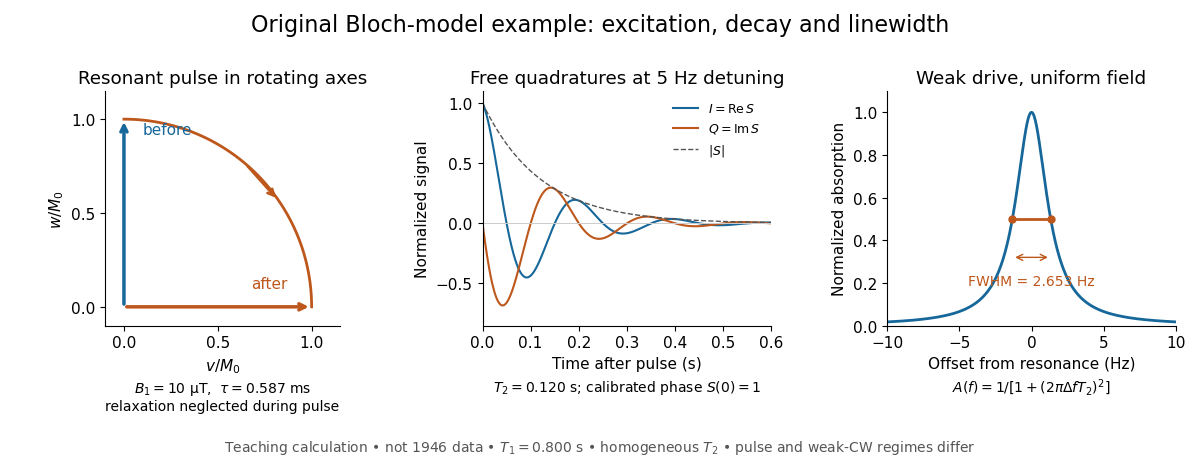
For an original teaching model, take positive , a circular drive , and axes rotating at about . Define , , and . The Bloch equations becomeA linearly oscillating field of peak amplitude has a co-rotating component of amplitude ; neglecting its counter-rotating component requires near resonance.
At resonance, a short pulse starting from gives with , neglecting relaxation during duration . A receiver phase rotation can make a pulse's initial transverse signal real. After the pulse, direct integration givesThese are the two components extracted by quadrature demodulation. Differentiating verifies ; taking its magnitude separates decay from detuning.
Choose rounded illustrative , , , and . Then and the duration is , short relative to both relaxation times. For receiver detuning and , and . These are calculated examples, not 1946 measurements.

Bloch equations 2026-10-18
The Bloch equations describe an ensemble magnetization with Larmor precession plus phenomenological recovery and decay:Here are model parameters, not a microscopic explanation of relaxation. The precession term follows from the torque on a magnetic moment; the two dissipative terms prescribe exponential decay. Bloch explicitly introduced this macroscopic relaxation description as a simplifying approximation.[ref]
Nuclear Induction by Felix Bloch. §4, pp. 467–468, equations (32), (37) and (38): longitudinal recovery and assumed exponential transverse decay
For positive and no transverse drive, rotates as : its signed rotation is negative about , although the resonance angular frequency is positive. This distinction prevents a hidden sign change when choosing a rotating frame.
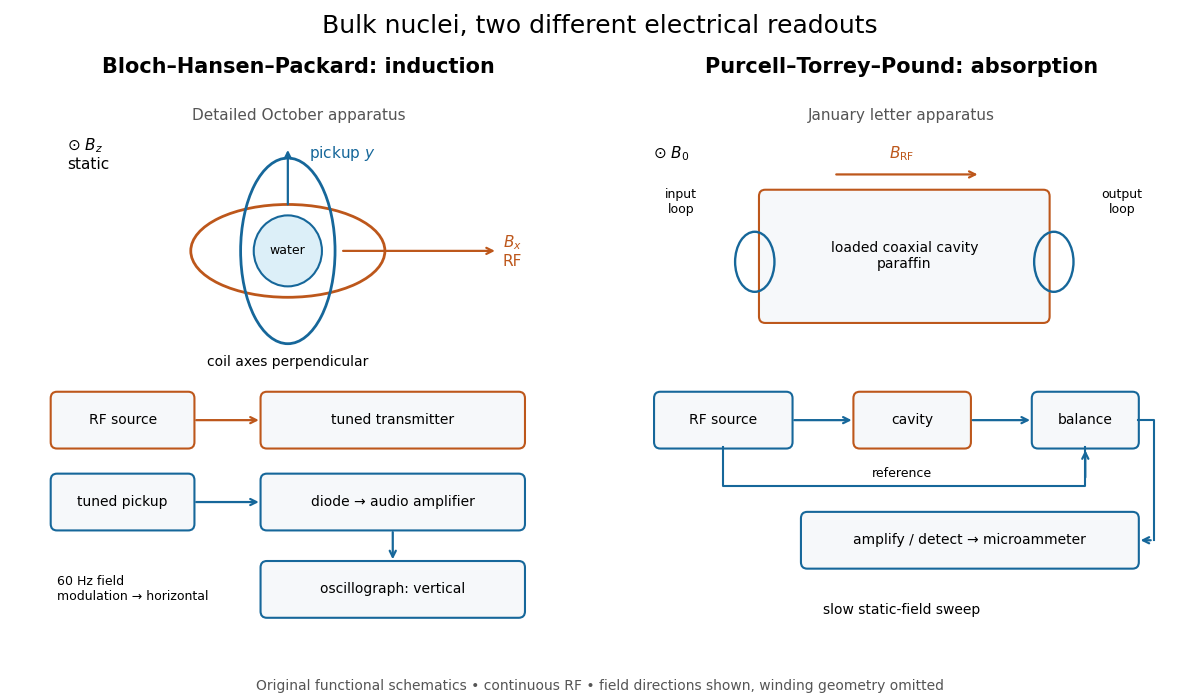
Edward Mills Purcell, Henry Cutler Torrey, and Robert Vivian Pound placed paraffin wax in a capacitively loaded coaxial cavity near 30 MHz between magnet poles. Coupling loops supplied and extracted power; oscillating and steady fields were perpendicular. Output balanced against a generator reference fed amplification, detection and a microammeter. A slow field sweep revealed absorption above fluctuations at room temperature. Weak drive avoided population equalization. Calibration was rough; field inhomogeneity could contribute to linewidth.[ref]
Resonance Absorption by Nuclear Magnetic Moments in a Solid by Edward Mills Purcell and others. pp. 37–38, apparatus and results; weak drive, balanced cavity output, microammeter, field sweep, calibration and linewidth limitations
Two electrical routes to bulk nuclear magnetic resonance
. Original functional diagrams of the distinct instruments described above. Arrows show connections and field directions, not scale or winding geometry. Details.
These are driven experiments with continuous radiofrequency excitation and changing static field, not demonstrations of modern pulsed Fourier transform nuclear magnetic resonance. Bloch's theoretical paper explicitly distinguishes proposed free precession after a pulse from the forced precession actually studied.[ref]
Nuclear Induction by Felix Bloch. pp. 460–461, introduction: proposed pulse/free-precession experiment versus performed forced-precession experiment
An experimental failure need not mean absent nuclear magnetic moments. In the model below, excessive drive reduces the population imbalance through nuclear magnetic resonance saturation; waiting too briefly can leave insufficient polarization. Separately, ordinary electrical losses can cause heating without identifying a nuclear resonance. The absorption experiment measured a balanced electrical signal, rather than using heating as its readout. Useful diagnostic checks include moving off resonance, changing the frequency, checking field uniformity and reducing drive. These are general checks; the historical operations actually documented are specified above.
Bloch nuclear induction experiment Created 2026-10-18 Updated 2026-10-20
In their 1946 letter, Felix Bloch, William Webster Hansen, and Martin Packard reported water at room temperature. A steady magnetic field along and an oscillating field along produced a signal in a pickup coil along , displayed on an oscilloscope. Some samples included paramagnetic additives to accelerate thermal equilibrium. Resonance fields at two frequencies gave the same field-to-frequency ratio, consistent with the proton value.[ref]
Nuclear Induction by Felix Bloch and others. p. 127, Nuclear Induction, entire letter; geometry, water, additives, readout and two-frequency check
The detailed paper describes glass water bulbs inside tuned receiving coils. Transmitter coils, shields and a conducting paddle controlled leakage. Field modulation at 60 Hz drove the horizontal oscilloscope sweep. A diode and audio amplification supplied the vertical trace. Vibration changed coupling: their largest difficulty. Coil tuning capacitors formed tank circuits. The actual receiver omitted the conceptual diagram's radiofrequency amplifier.[ref]
The Nuclear Induction Experiment by Felix Bloch and others. pp. 475–480, Figs. 1–4, APPARATUS and opening RESULTS; actual diode receiver versus conceptual amplifier
The orthogonal coil axes suppress direct transmitter pickup, but do not eliminate it. A field-dependent signal at the nuclear resonance must be distinguished from leakage and noise; merely detecting a radiofrequency voltage is insufficient. This is why the field sweep and the independently checked field-to-frequency ratio matter.
Molecular mass 2026-10-18
The molecular mass is the mass of a molecule; relative molecular mass compares it with a reference mass.
Mass fraction Created 2026-10-18 Updated 2026-11-05
The mass fraction of component in a mixture is . It is dimensionless, lies between zero and one, and the component mass fractions sum to one when all material is included.
For example, a mixture containing grams of solute and grams of solvent has solute mass fraction , or five percent by mass. This differs from a mole fraction, which counts amounts of substance, and from a mass-per-volume concentration. A temperature-dependent volume change does not by itself change the mass fraction of a closed sample.
Colloid Created 2026-10-18 Updated 2026-10-20
A colloid contains dispersed particles in a continuous medium. A fine particle suspension can form a colloid; the particles in the Perrin sedimentation experiment illustrate this case.
Unit of measurement 2026-10-18
A unit of measurement is a chosen reference for comparing magnitudes of a physical quantity. A value written as a number times a measurement unit changes its numerical part when the measurement unit changes, while representing the same physical quantity.
Measurement resolution 2026-10-18
Measurement resolution is the smallest change in an instrument indication that its reading method can distinguish. It contributes to measurement uncertainty, but does not by itself establish accuracy or remove systematic error. The manometer height-to-pressure calibration shows how a height scale affects the inferred pressure.
Dimensional metrology Created 2026-10-18 Updated 2026-10-20
Measurement of length and geometrical dimensions. A length standard supplies a reference; a differential length comparator measures the difference between two lengths rather than treating its own structure as perfectly invariant.
Cylinder-plane image charges 2026-10-18
An infinite conducting cylinder of radius at centre height above a grounded plane has the same exterior electric potential as opposite line charges at heights . If and are distances from the positive and negative lines, . The plane has ; the cylinder has . Its voltage is therefore , giving the displayed capacitance per unit length. The Uniqueness of the Dirichlet problem fixes the exterior field. A Gaussian contour surrounding the cylinder encloses the positive image line, so is also its physical charge per unit length.
Neumann image lattice for a point source in a strip Created 2026-10-18 Updated 2026-10-20
For , the Poisson equation in with homogeneous Neumann boundary conditions on both edges admits the even-in- method of images solution in the title, where . All image strengths are . Pairing the images at and subtracting their constant logarithms makes each summand , giving local uniform convergence away from the source. The unrenormalized sum of logarithms does not converge.
Differentiating givesThe corresponding -derivatives cancel in reflected pairs on . For , integration across the strip yields a telescoping arctangent sum:One closed form, up to an additive constant, is . Its near-source logarithmic singularity has coefficient . Conditions at large or a symmetry class must be specified for a uniqueness claim; side Neumann boundary conditions alone allow additional homogeneous harmonic functions.
Patient 2026-10-18
Cervical cancer Created 2026-10-18 Updated 2026-11-05
Immunology Created 2026-10-18 Updated 2026-11-05
The study of the immune system, including recognition, regulation, protection and pathological responses. A strong measured response need not equal better protection if the same activity damages host tissue.
Valve 2026-10-18
Piston Created 2026-10-18 Updated 2026-11-05
A piston is a moving component that fits within a cylinder and transmits force between a fluid pressure and a mechanical linkage. For an effective face area and pressure difference , the ideal axial pressure force is . Sliding seals reduce leakage but introduce friction, and connecting rods can add side loads. In an engine the piston converts pressure work into motion; in a compressor mechanical work instead raises fluid pressure. The swept volume is face area times stroke for a constant-bore cylinder.
Mechanical engineer Created 2026-10-18 Updated 2026-11-05
A mechanical engineer applies mechanical engineering to components and systems involving motion, loads or energy conversion. The work can include modeling stresses and vibration, sizing thermal systems and specifying tolerances or manufacturing processes. A rotating shaft, for example, requires reasoning about torque, deflection, fatigue and bearing support together. The resulting design depends on load histories and material properties as well as the geometry of the part.
There are unlisted articles, also show them or only show them.