
Square-root stock implied volatility 2026-10-14
For a square-root stock claim priced by , the constant-volatility geometric Brownian motion price is . If , and , its unique nonnegative inverse volatility is the displayed . For bounded predictable volatility in , bounds give , without independence from the Brownian motion. At zero stock price the claim price is also zero and no volatility is identified by this equation; a separate convention is needed.
Square-class group of a p-adic field Created 2026-10-14 Updated 2026-11-05
For a finite extension , its square-class group of a field is . When is odd, parity of the valuation and the square class of the unit residue give . Representatives are , where is a uniformizer of and has nonsquare residue. The Hensel lemma lifts square roots of units with square residue.
For , the group is , with generators ; a unit is a square exactly when it is one modulo eight. More generally, if has degree , the group has order . Indeed, the principal-unit group of a mixed-characteristic local field has a finite cyclic 2-power torsion factor and a free factor of rank , each contributing its quotient by squares, and the valuation contributes one further factor . The specific representatives therefore apply to for odd ; a ramified extension needs its own uniformizer.
Spring constant Created 2026-10-14 Updated 2026-11-05
The spring constant is the positive proportionality coefficient in the ideal spring restoring force . Its SI unit is newtons per metre. With a constant attached mass , it sets the angular frequency of simple harmonic motion. Doubling doubles the restoring force at a fixed displacement, but increases that angular frequency only by a factor .
Decomposing sphere system for a knot 2026-10-14
A finite collection of disjoint splitting spheres of a knot encodes a connected sum of knots. Cut along every sphere and fill each spherical boundary with a three-ball containing a straight arc joining its two marked endpoints. The resulting oriented knots are the factors. The system is complete when its nontrivial factors are prime knots.
Rarita-Schwinger field 2026-10-14
A vector-spinor describes a spin-three-halves field after its lower-spin components are removed by constraints and, in the massless theory, gauge equivalence. The massless equation is invariant under . Gamma-trace gauge and the field equation give . Only helicities remain. A four-dimensional Majorana field has two physical polarizations; a complex field also has independent antiparticle modes. The gravitino is the supergravity realization of this field.
Even-dimensional Clifford spinor dimension Created 2026-10-14 Updated 2026-11-05
After complexification, pair the Clifford algebra generators into fermionic creation and annihilation operators. Their occupation basis has states, giving the irreducible complex Dirac module. The chirality operator separates its even and odd occupation subspaces, each with states. Majorana reality conditions concern real dimensions and depend on spacetime signature; they must not be imposed in every even dimension indiscriminately.
Spinor Lorentz generator commutator Created 2026-10-14 Updated 2026-10-25
Define using the gamma matrix Clifford algebra. Moving through the two factors with proves the displayed operator commutator. For real antisymmetric and , it gives . This is the infinitesimal Lorentz covariance identity required by the Dirac equation.
Spinor bundle 2026-10-14
A chosen spin structure on a spin manifold defines the complex spinor bundle associated to the spin representation. In dimension its vector bundle rank is . Its chirality matrix is in the negative Clifford multiplication convention. It satisfies and anticommutes with each , giving and an odd Dirac operator. In odd dimension there is no such canonical chiral splitting of the irreducible spinor bundle.
Spinor covariant derivative 2026-10-14
Lift the Levi-Civita connection to the spinor bundle using the spin representation of the Lorentz algebra. Under a local Lorentz transformation, its matrix obeys , so . The Clifford algebra identity fixes the coefficient. The tetrad postulate then gives , establishing compatibility with curved Clifford multiplication.
Tetrad postulate 2026-10-14
The tetrad postulate expresses compatibility of the spacetime and Lorentz-frame connections on a vierbein. For the inverse coframe , solving gives . Metric compatibility makes the lowered connection antisymmetric in its Lorentz indices. Lifting this connection through the Spinor representation of the Lorentz group defines the spinor covariant derivative.
Spin connection of a conformally flat metric 2026-10-14
For , use the vierbein and constant flat gamma matrices. The tetrad postulate and give the displayed lowered spin connection. With , its spinor action is . The Lorentz index lowering matters in indefinite signature.
Spherical Abel deprojection 2026-10-14
Put and . Then . Composing this Abel transform with itself and exchanging convergent integrals gives , because the inner integral from to is . Differentiate after writing to obtain . Substituting yields the displayed reconstruction. Decay and regularity sufficient for the exchanges and derivatives are required.
Strip density of a spherical system Created 2026-10-14 Updated 2026-11-05
The strip density is the mass per unit projected Cartesian coordinate : . It is even in . For , changing variables to projected radius gives . Alternatively integrate the three-dimensional mass density over the plane of coordinates to obtain the displayed expression. Consequently for .
Light-second Created 2026-10-14 Updated 2026-10-18
A light-second is a unit of length: the distance vacuum light travels in one second. It is useful in a spacetime diagram because a time of one second corresponds to a coordinate of one light-second, making the slopes of the light cone particularly easy to read. The unit is a distance, rather than an elapsed time.
Ambient restriction formula for the spherical Laplacian Created 2026-10-14 Updated 2026-11-05
Let be a smooth function near the unit sphere , and write for the ordinary ambient second-derivative trace. For the positive Laplace-Beltrami operator ,evaluated at radius one. The negative of this formula is the restriction identity for the nonpositive Laplace-Beltrami operator convention.
Choose an orthonormal basis of . The great circles giveThe negative sum is ; supplementing the tangent basis by the radial vector gives the displayed formula. If is a degree- homogeneous polynomial that is a harmonic polynomial, then , and . Its restriction therefore has positive-convention eigenvalue , as in the spectrum of the Laplacian on a sphere.
For a closed unital subalgebra with common identity, its group of invertible elements of a Banach algebra is relatively open in by the Neumann series. It is relatively closed because inversion in is continuous and is closed. Consequently each connected component of either consists entirely of elements invertible in , or entirely of elements whose inverses do not belong to .
For a Laplace-type operator on a closed manifold, let be the constant coefficient of its full heat trace expansion. In the Mellin transform defining the spectral zeta function, the reduced trace has constant coefficient . Its contribution is , and proves the identity. For the scalar positive Laplace-Beltrami operator on a closed surface, and is the number of connected components. In particular, a connected sphere has value and a connected flat torus has value .
Complexified transport Cauchy kernel 2026-10-14
For and , the operator has the displayed decaying fundamental solution. A rotated real-linear coordinate turns it into a multiple of a Wirtinger derivative, reducing the kernel identity to . The kernel is analytic in separately inside and outside the unit circle, is at zero and at infinity, and develops a jump at the real directional-transport limit.
Let , , and be the directed attenuated Radon transform. With the signed Cauchy boundary operators, set . An integrating factor turns the attenuated equation into unattenuated directional transport; its spectral solution has jump on the unit circle. A normalized Cauchy integral formula and the coefficient at spectral infinity then prove the reconstruction formula. Known attenuation and full directed angular data determine the source; attenuation itself is not reconstructed by this pair.
Calibrated photometer model 2026-10-14
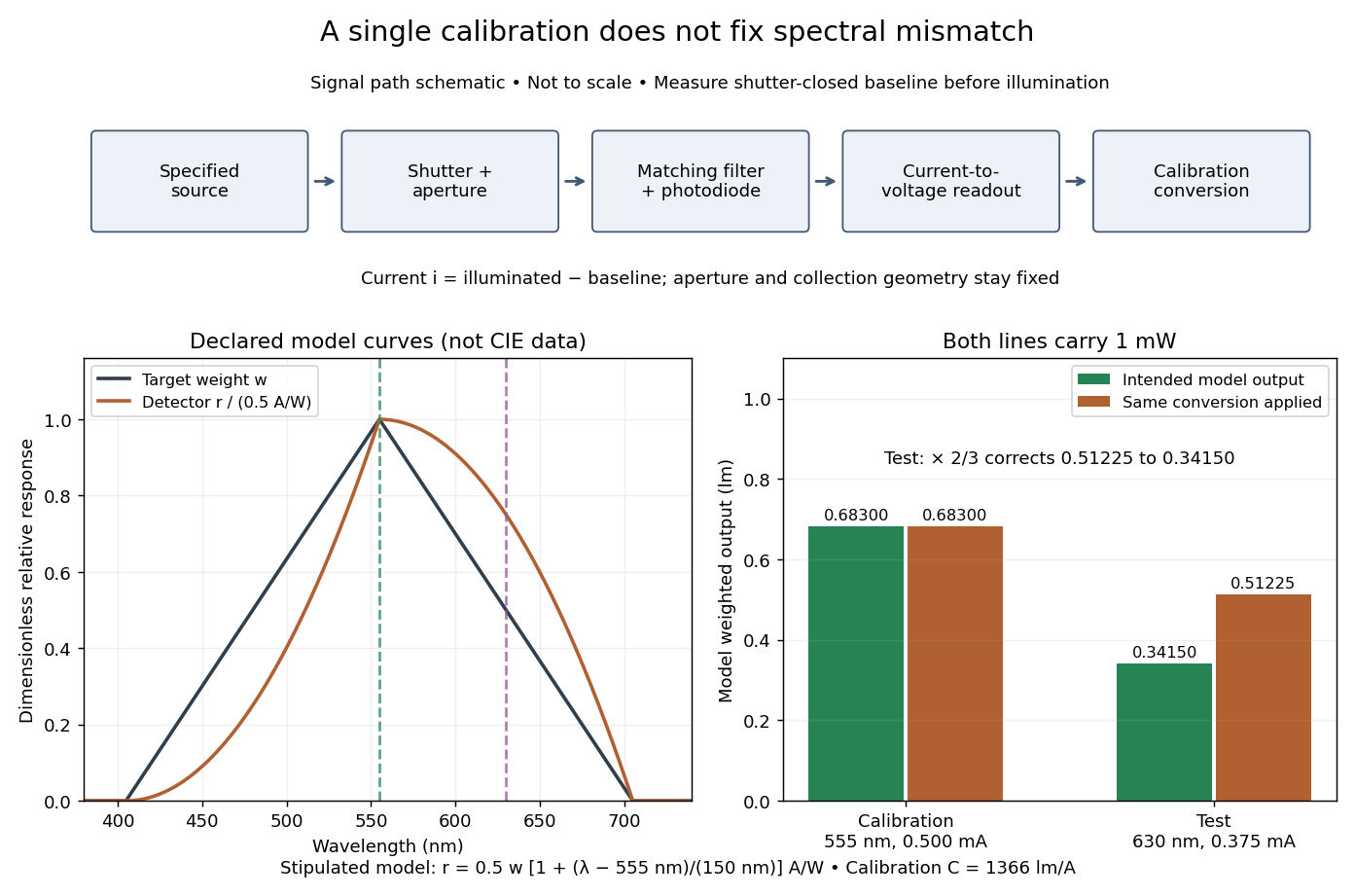
Use the triangular in equal radiant power under visual weighting and stipulate the detector's spectral responsivityThis model has nonnegative response: is zero outside –. For a ideal calibration line at , and , so . An equal-radiant flux test line at gives , and . The unchanged conversion indicates , whereas the model's intended weighted result is . The required spectral mismatch correction is : the uncorrected result is 50% too large. All these numbers are declared model outputs, not instrument measurements or standard photometry data.

There are unlisted articles, also show them or only show them.