
Hirsch length Created 2026-10-14 Updated 2026-11-05
The Hirsch length of a polycyclic group counts infinite cyclic factors in a polycyclic series. Refinement shows it is independent of the series, additive in extensions, and unchanged in finite-index subgroups. A finite-index poly-infinite cyclic group has one infinite cyclic factor for each unit of Hirsch length.
Polycyclic groups are virtually poly-infinite cyclic Created 2026-10-14 Updated 2026-11-05
Every polycyclic group has a finite-index subgroup with a series whose nontrivial factors are infinite cyclic. This is the polycyclic finite-index lemma; it also supplies torsion-free finite-index subgroups. Such a subgroup is a poly-infinite cyclic group. Combining its series with the extension rule for Poincare duality groups makes it a duality group of dimension its Hirsch length.
Take every three-element subset of a four-element vertex set as a hypergraph edge. Any three-colouring repeats a colour on two vertices. A triple containing that pair cannot contain all three colours. Thus this uniform hypergraph has no polychromatic three-colouring, although each edge meets only three other edges.
Two-dimensional quantum-gravity interpretation of strings Created 2026-10-14 Updated 2026-11-05
The Polyakov path integral integrates over string worldsheet metrics as well as embedding fields, modulo worldsheet diffeomorphisms and Weyl transformations. Summing surface topologies gives perturbative two-dimensional quantum gravity coupled to the coordinate matter fields. Gauge fixing retains worldsheet moduli and introduces ghosts; a conformal gauge is locally flat, not a global flat metric on every genus. Cancellation of the worldsheet Weyl anomaly makes the critical bosonic version consistent.
Pollen tube germination assay Created 2026-10-14 Updated 2026-11-05
A pollen tube germination assay makes tube emergence visible outside a flower. The published Practical Biology experiment, Observing the growth of pollen tubes (Practical Biology), Technical note 3, lists florist lilies among successful materials without specifying a species. Record the actual identification; success with one sample cannot establish a universal growth rate.[ref]
Observing the growth of pollen tubes (Practical Biology). Technical note 3 and Teaching notes: material dependence and contorted versus straight tubes
Pearson's Core practical 4: Investigate the effect of sucrose concentration on pollen tube growth by Pearson Education Ltd, Teacher sheet, pp. 1–2, describes an inspectable experiment. Mix equal volumes of sucrose solution and mineral-salt medium on clean cavity slides. Dust in pollen from mature anthers with a mounted needle, record the addition time, and incubate without coverslips in covered dishes containing wet filter paper. The moist chamber reduces drying; the uncovered drops avoid oxygen limitation. Brief observations with an optical microscope at , using an eyepiece graticule calibrated against a stage micrometer, reveal tube emergence and length. Return slides to the chambers and switch off the lamp between observations to reduce heating and drying. For comparisons of sucrose concentration, use the same flower across treatments to control maturity, then repeat with other flowers.[ref]
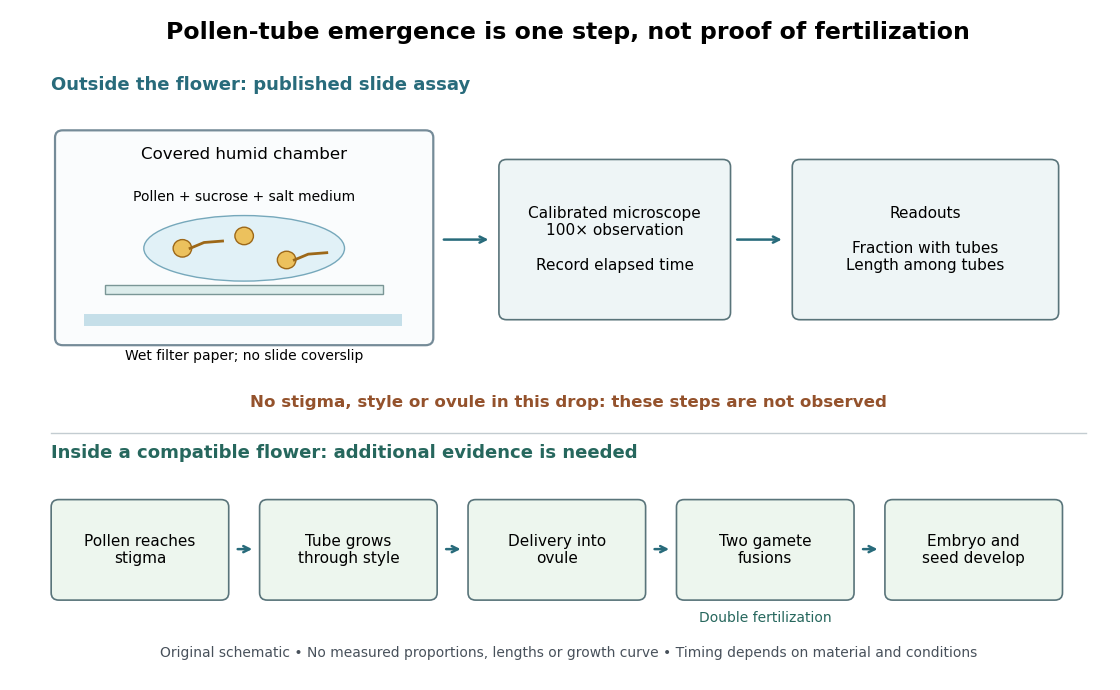

An additional proposed experimental design check is a medium-only slide: it tests whether debris is being mistaken for pollen tubes. Compare matched pollen samples at different final sucrose concentrations, keeping temperature, elapsed time and observation rules fixed. A sample known to produce pollen tubes in a previously successful medium would test whether an apparent failure comes from handling or the tested condition. These controls are questions to test, not guaranteed outcomes. A negative result cannot distinguish dead pollen from an unsuitable medium without further comparisons.
Two original calculations clarify the readout. First, take of sucrose solution and of sucrose-free medium. Assuming additive volumes, conservation of the amount of substance givesThis dilution also halves the medium's original component concentrations. Label the final molar concentration, not the starting bottle.
Second, stipulate a toy field containing pollen grains, of which have emerged pollen tubes. Its emergence fraction is . If those twelve pollen tubes have total measured length , their arithmetic mean length is . Assigning length zero to the other grains instead gives per grain. These invented numbers show why emergence fraction and mean length among emerged tubes answer different questions. Specify the denominator and the emergence criterion before counting, and avoid selecting only conspicuous long pollen tubes.
Tube emergence in a drop demonstrates growth under that medium's conditions. It observes no stigma interaction, passage through a style, delivery into an ovule, gamete fusion, or seed development. Thus a positive pollen tube germination assay does not demonstrate successful fertilization in a living flower. Its beauty is making one otherwise hidden part of sexual reproduction directly observable.[ref]
Observing the growth of pollen tubes (Practical Biology). Teaching notes: steps between pollen germination and seed formation; prepared style slides as a separate observation
Segal quantization criterion for fermions 2026-10-14
For the irreducible representation of the canonical anticommutation relations determined by , a unitary one-particle map is unitarily implementable precisely when is Hilbert-Schmidt, equivalently when is Hilbert-Schmidt. The implementer is unique up to a scalar phase. The equivalent representation criterion for two polarizations is that their projections differ by a Hilbert-Schmidt operator. This yields a continuous projective unitary representation of the restricted unitary group.
For integer modes filled at indices below zero, set and on the finite-energy domain. The canonical anticommutation relations give a central term in . Summing across the filled-empty boundary gives , with . The current's level is the coefficient of this central term.
Fermion-boson correspondence on the circle Created 2026-10-14 Updated 2026-11-05
In charge , let fill all integer modes below . Its rotation energy is . The negative Heisenberg current algebra of a fermion on the circle modes create mutually commuting oscillators with . Their normalized occupation monomials applied to are orthonormal. The Jacobi triple product identifies the fermionic charge-energy generating function with , proving completeness in each finite-dimensional energy space. Thus the rotation Hamiltonian is .
Polarizer 2026-10-14
A linear polarizer transmits one linear polarization and suppresses the orthogonal one. Two ideal crossed polarizers block light unless an intervening medium changes its polarization of an electromagnetic wave. A twisted nematic field effect uses this selection to convert field-driven reorientation into brightness modulation.
Faraday effect Created 2026-10-14 Updated 2026-10-20
The Faraday effect is magnetic field-induced circular birefringence: opposite circular polarizations acquire different wave phases, rotating transmitted linear polarization. For a transparent medium with isotropy before applying the magnetic field, in the linear magnetic-response regime at fixed vacuum wavelength and temperature ,Here is the Verdet constant, is the material path length, and is the applied magnetic flux density component along the ray. This is the external bias, distinct from the oscillating magnetic field of the light itself. Michael Faraday discovered the effect in 1845.[ref]
Faraday effect. RP Photonics Encyclopedia, Faraday Effect, Rüdiger Paschotta: What is the Faraday Effect?, rotation law and discovery
Fix the sign before using the formula. On the forward path choose a right-handed Cartesian coordinate system, propagation along , and measure from toward for the electric field's oscillation line. Positive is counterclockwise in the -right, -up end view seen from , looking toward the source. Then and positive means positive rotation for positive . This convention differs from the clockwise-positive convention in optical rotation. A linear polarization line is unchanged by ; a measured orientation determines accumulated rotation only modulo , unless continuity selects a branch.
For uniform , the formula reduces to . Its appeal is that a weak change of refractive index becomes a visible change of orientation. Magnetic reversal measurement of Faraday rotation turns this into an inference of or of the magnetic field path integral. Faraday rotation on a round trip explains the directional behavior used by an optical isolator. In an astronomical cold plasma, the high-frequency limit instead leads to the rotation measure law ; that wavelength dependence is not a universal law for transparent solids.
Joint red and green Poisson count formula Created 2026-10-14 Updated 2026-11-05
For a finite-intensity set of mean , independent red marking with probability gives counts withDisjoint source sets give independent pairs of these counts. Refining overlapping test sets into disjoint cells then proves independence of the two whole Poisson point processes, not only their counts on one set.
Assign each of claims with independent category labels to one of finitely many categories with probabilities . Conditional counts have a multinomial distribution with probability generating function . Averaging over gives . This proves independent category counts and supports discrete-severity compound Poisson distribution representations.
Let be a nonnegative integer-valued random variable with finite expected value , and independently label each of its items with either of two equally likely labels. If the two resulting counts are independent random variables, then has a Poisson distribution. Indeed, its probability generating function obeys . With , iteration gives . Finite expected value gives , hence and . Conversely, Poisson thinning produces independent Poisson distributions for the two counts.
Dependence in Poisson thinning 2026-10-14
Independent marking is the hypothesis that guarantees the Poisson thinning theorem. Equal marginal retention probabilities do not guarantee it. Consider one Bernoulli random variable with success probability , independent of a Poisson process, and retain every arrival when and none when . Each arrival is retained with probability , but the marks share the same coin. In an interval whose original count has Poisson distribution of mean , the retained count is and the rejected count is , soThe extra variance shows that is not Poisson distributed; the negative covariance proves dependence. Its no-arrival probability is , rather than . For the toy values , both rules have retained mean , but the common-coin rule has variance and no-arrival probability , compared with variance and no-arrival probability for independent marking. These formulas follow by conditioning on and using the law of total variance.
An arrival-dependent or adversarial retention rule can change the law just as strongly. Keeping every second arrival gives . Its successive retained gaps are sums of two independent exponential random variables, hence have the Erlang distribution of shape two and rate , not an exponential distribution. The resulting renewal process and its count variance are analyzed in Every second Poisson arrival has underdispersed counts, and the two dependent streams in alternating split of a Poisson process. As an even more restrictive rule, keeping only the first arrival ever gives , a Bernoulli distribution at each , so it cannot have a positive-mean Poisson distribution. A thinning rule must specify how decisions depend on arrivals and on one another; the independent-marking conclusion cannot be applied automatically to arbitrary deletion.
A simple locally finite point measure on with void probability on finite unions of bounded intervals is a Poisson random measure with Lebesgue measure intensity. Void-event intersections factor, hence the occupation indicators on disjoint cells are independent. The dyadic occupancy approximation of a simple point measure is binomial with rare-event probability and converges to a Poisson count of mean the interval length. Independence survives joint convergence for disjoint intervals. Extension of the mean measure and the Laplace functional of a Poisson random measure to Borel functions identifies all Borel counts, not just intervals.
Laplace functional of a Poisson random measure Created 2026-10-14 Updated 2026-11-05
For nonnegative measurable , independent Poisson counts first prove this formula for simple functions on disjoint measurable sets. Monotone approximation gives the general formula, allowing infinite integrals with . Conversely, the formula evaluated at for disjoint finite-intensity sets gives the joint Laplace transform of independent Poisson counts, so characterizes the law of a Poisson random measure.
L2 construction of compensated Poisson integrals Created 2026-10-14 Updated 2026-11-05
For deterministic square-integrable and a Poisson random measure of intensity , first define the integral for simple functions on disjoint finite-intensity sets. Independence and the equality of Poisson distribution mean and variance prove the displayed isometry. Completion defines the integral for all , even when . A small-jump compensated martingale is thereby defined through convergence in Lp, not by subtracting two divergent ordinary integrals.
Existence of a Poisson random measure on a standard Borel space Created 2026-10-14 Updated 2026-11-05
A sigma-finite measure on a standard Borel space is the intensity measure of a point process with Poisson counts. Partition the space into sets of finite intensity, draw an independent Poisson count on each piece, and conditional on that count draw independent points from its normalized intensity measure. The sum of their Dirac measures is the required Poisson random measure. Non-atomic intensity gives simplicity; local finiteness of the intensity gives local finiteness of the point configuration.
Mecke formula for a Poisson random measure Created 2026-10-14 Updated 2026-11-05
For nonnegative measurable and a Poisson random measure of sigma-finite intensity , removing the selected point from a sum leaves an independent copy of the original process under the integral. For finite intensity, condition on the Poisson count, represent the points as independent samples from normalized , and shift the count index using . For sigma-finite intensity, first select points in a finite-intensity set, condition on the independent outside process and then exhaust the space. Repetition gives the corresponding formula for ordered distinct tuples of points.
Poisson polar projections share their total count Created 2026-10-14 Updated 2026-11-05
There are unlisted articles, also show them or only show them.