
Kernel of a graph Laplacian 2026-10-14
The kernel of the Graph Laplacian consists exactly of vectors constant on each connected component of a graph. Indeed, implies , so the Graph Laplacian quadratic form forces equality at the endpoints of every edge; equality then propagates along graph paths. Conversely, these equalities make every entry of zero. Thus the dimension of the kernel, equivalently the multiplicity of the zero eigenvalue, counts the connected components of a graph.
For the disconnected graph with just two edges, and , in order ,The two displayed vectors form a basis of the kernel. The other two eigenvectors and each have eigenvalue two, so the full list of eigenvalues, including multiplicities, is . Separate connected components of a graph allow independent constant levels; a single global constant is only one of these possibilities.
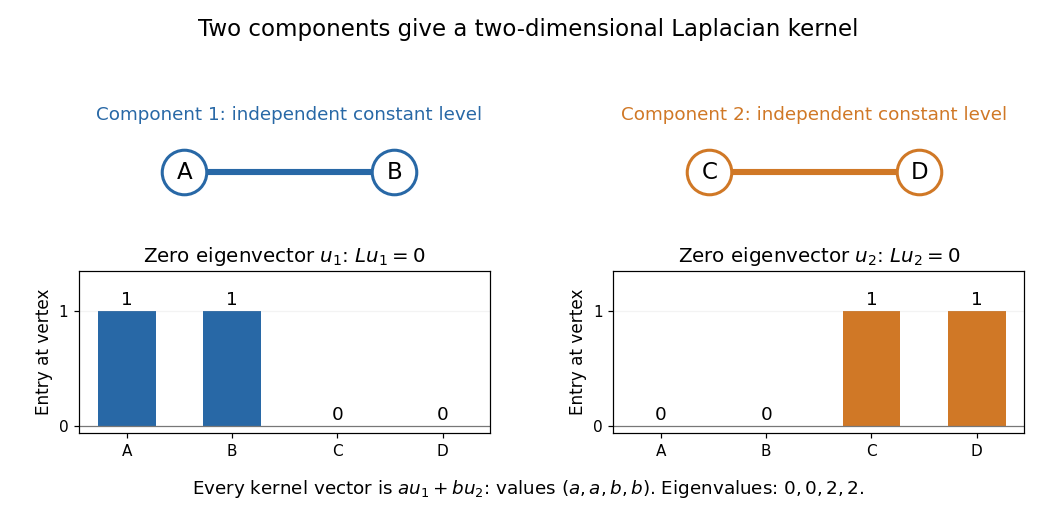
Two disconnected edges give two independent zero eigenvectors
. Details. Graph Laplacian quadratic form 2026-10-14
Assign a real value to each vertex. The Graph Laplacian quadratic form measures disagreement across edges:This makes the Graph Laplacian a positive semidefinite matrix. The energy is small when neighbours have similar values, even if distant vertices have very different values; it depends on connections rather than where the graph is drawn. In the three-vertex path graph, take . Thenand the two edges contribute and .
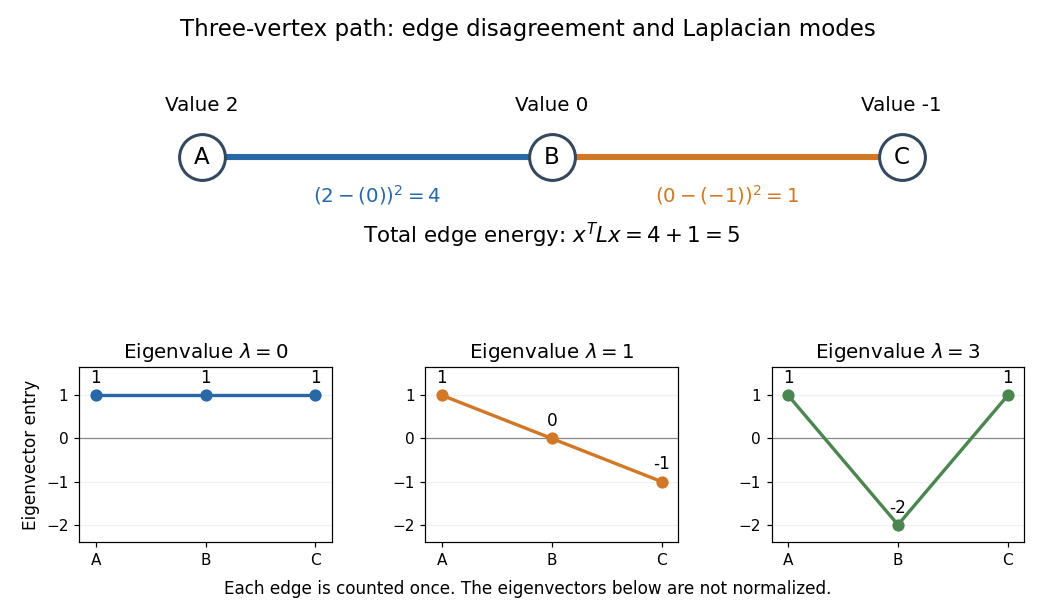


For a short proof, expand . Each edge contributes through the degree matrix and through the adjacency matrix, yielding . The sum over unordered edges has no factor ; a sum over all ordered pairs does:Equivalently, let be an oriented incidence matrix, with one row per edge. Then records endpoint differences and , independently of the chosen orientations. This translates a local comparison into a global quadratic form and makes its nonnegativity visible.
Degree matrix 2026-10-14
The degree matrix is the diagonal matrix whose th diagonal entry is the degree of a vertex . For a finite simple graph, , where is its adjacency matrix. For a Weighted graph Laplacian, use the sum of incident edge weights instead of the number of incident edges.
Second-moment expansion of a Laplace transform Created 2026-10-14 Updated 2026-11-05
For nonnegative with finite second moment, differentiation under the expectation gives for . The exponential Taylor remainder divided by tends pointwise to zero and is bounded in absolute value by . The dominated convergence theorem therefore proves the displayed expansion without requiring a third moment.
Ramanujan's function 2026-10-14
For , this Laplace transform converges at zero because is integrable, and at infinity because of exponential damping. Its large- behavior is governed by a logarithmic zero-endpoint singularity and begins with , rather than a power of .
Causal extension by zero 2026-10-14
Extend a function given for nonnegative time to the real line by setting it to zero before the starting time. This turns unilateral convolution into whole-line convolution and identifies a Laplace transform slice with a Fourier transform after exponential function weighting.
The set of complex numbers for which the displayed integral is finite is the region of absolute convergence of a Laplace transform. It depends only on the real part . Once the condition holds for one , it holds for every larger real part. For the exponential function it is exactly ; in general, convergence on the boundary must be checked separately. An analytic continuation outside this set need not equal a convergent defining integral.
Exponential order Created 2026-10-14 Updated 2026-10-25
A function has exponential order if some and give the displayed bound. Bounded functions, including sine, have exponential order zero; has exponential order . The bound need not use the smallest possible . Together with piecewise continuity, it guarantees a Laplace transform for .
If an odd amplitude multiplies an even Gaussian phase on an interval asymmetric about its interior minimum, the symmetric central integral cancels exactly. The surviving leading term can be exponentially small and comes from the nearer unmatched endpoint. For example,An interior Laplace method expansion alone yields zero to every algebraic order and does not capture this term.
Two-term monotone-endpoint Laplace expansion 2026-10-14
For a smooth real phase decreasing away from its endpoint maximum, put and write the transformed amplitude as . Its first two Taylor coefficients are and . Applying Watson lemma gives the displayed two-term Laplace integral expansion. Localization and a Taylor remainder estimate justify termwise integration.
Localization condition for Laplace's method 2026-10-14
A unique nondegenerate interior minimum does not by itself ensure that a integral treated by Laplace's method is localized there. A sufficient condition is a positive gap above the minimum outside every sufficiently small fixed neighbourhood, together with finiteness of the integral for some positive exponent. The exterior contribution is then exponentially negligible. Without localization, on has its unique interior minimum at zero with , but its boundary contribution is at least and dominates the nominal interior Gaussian contribution.
Laplace approximation Created 2026-10-14 Updated 2026-11-05
For a smooth phase and a continuous amplitude nonzero at a unique interior maximum with positive-definite negative Hessian matrix, a quadratic expansion and rescaling by give the displayed Gaussian integral, provided the tails are negligible. In a regular Bayesian inference it approximates the integrated likelihood by the likelihood at its dominant point times the prior density and inverse square root of local curvature. Boundary modes, singular Hessians, and multiple equally dominant modes need modified formulas.
Mixed cubic and quadratic Laplace endpoints Created 2026-10-14 Updated 2026-11-05
Consider with a smooth nonnegative phase positive in the interior and zero only at the endpoints. Suppose, in inward endpoint coordinates ,where . The rescalings and and the Gamma integral giveThe first two terms therefore come from different endpoints. The absent quartic phase term and linear amplitude term at the cubic endpoint are essential for the stated remainder: either can produce a correction. Smoothness, the compact interval and positivity away from the endpoints justify localization and the termwise error estimates. Without those cancellations the two leading scales remain the same when their amplitudes are nonzero, but the next error is generally .
Kepler dynamical symmetry algebra 2026-10-14
For , the angular momentum and Laplace-Runge-Lenz vector obey . On negative or positive energy regions use to obtain the compact or Lorentz Lie algebra, respectively. At zero energy the algebra on the characteristic orbit quotient is the Euclidean motion algebra. Global group actions require complete generators or collision regularization; simply replacing by a constant inside a Hamiltonian-vector-field derivative is not valid on the unreduced energy hypersurface.
Choose an orthonormal basis of the tangent space at and the unit-speed geodesics with initial velocities . Their covariant accelerations vanish, so . Taking the metric trace of the Riemannian Hessian proves the formula for . The positive Laplace-Beltrami operator has the opposite sign.
Cartesian formula for the angular Laplacian 2026-10-14
Writing , the spherical-coordinate Laplacian gives . Thus the positive angular Laplace-Beltrami operator has the displayed Cartesian expression and eigenvalues on spherical harmonics. Omitting is incorrect when the square means composition: on , the truncated expression gives , whereas the degree-one angular eigenvalue is two.
// Target: fluid-mechanics.bigb
Laplacian spectrum Created 2026-10-14 Updated 2026-11-05
Use the positive Laplace-Beltrami operator . On a closed manifold of positive dimension, its self-adjoint realization has a discrete spectrumcounted with the finite dimensions of the Laplacian eigenspaces. The zero eigenspace consists of functions constant on each connected component. On the unit circle, has eigenvalue zero once and eigenvalues twice for every integer , represented by sine and cosine modes.
The opposite convention , used in the coordinate formula for the Laplace-Beltrami operator, negates these eigenvalues. Specifying the sign is therefore part of specifying the spectrum.
On a compact manifold with boundary, Dirichlet boundary conditions or Neumann boundary conditions give corresponding discrete self-adjoint spectra. On a noncompact manifold, continuous spectrum can occur. The operator domain and any boundary conditions belong to the spectral problem, rather than being determined by the local differential formula alone.
Normal form (abstract rewriting) 2026-10-14
An expression in normal form admits no further reductions. A term is strongly normalizing when every reduction sequence from it terminates; weak normalization requires only one terminating sequence. Strong normalization theorem for simply typed lambda calculus establishes the stronger property for well-typed terms.
Church encoding 2026-10-14
Church encoding represents data and operations as terms of the lambda calculus. A Church numeral represents a natural number by repeated function application; a Church Boolean selects one of two arguments.
Lambda model Created 2026-10-14 Updated 2026-10-20
A lambda model interprets variables, lambda application and lambda abstraction so that capture-avoiding substitution agrees with environments and all beta equivalence equations hold. A reflexive domain gives such an interpretation. Validity of eta conversion requires an extra inverse law and does not follow merely from a retraction.
There are unlisted articles, also show them or only show them.