
Linear algebraic group Created 2026-10-14 Updated 2026-11-05
An affine algebraic group is an affine variety whose multiplication and inversion are regular maps. Equivalently, its coordinate ring is a finitely generated reduced commutative Hopf algebra, with comultiplication induced by multiplication in .
Exponential product defect identity 2026-10-14
For finite matrices, differentiate the ordered product to obtain . Multiplying the error by and integrating gives . This exact variation-of-constants formula identifies noncommutativity as the source of Lie-Trotter splitting error.
A resident trait occupies fraction when its colonization rate exceeds fire extinction. With net competitive replacement given by ability difference , a rare mutant has the displayed per-capita growth. The selection gradient is . A singular trait with negative mutant-fitness curvature is a strict local evolutionarily stable strategy. Global strict uninvadability requires that be smaller than its resident value for every other trait. Monotonicity alone does not specify the shape or existence of an optimum.
Variation of Levi-Civita connection Created 2026-10-14 Updated 2026-10-25
For a family of Levi-Civita connections, the difference of affine connections is a tensor. Dividing by the family parameter and taking the limit shows that its variation is tensorial. Vary the metric compatibility equation and retain the symmetry of the two lower indices. Adding the two cyclic identities and subtracting the third gives the displayed result. In a normal coordinate frame it is the direct derivative of the Christoffel formula; its tensorial form then holds in every frame.
Image parity in gravitational lensing 2026-10-14
Image parity in gravitational lensing is the sign of the determinant of the source-from-image Jacobian matrix . A positive sign preserves the local handedness of a small source pattern; a negative sign reverses it. Negative signed lensing magnification therefore means a reflected orientation, not negative received light. This is a two-dimensional property: the derivative of a signed radial equation alone does not determine it.
For a point-mass gravitational lens, differentiate , where . The radial and tangential eigenvalues of areConsequently the outer member of the two images of a point-mass lens has positive image parity in gravitational lensing; the inner member has negative image parity in gravitational lensing. At the tangential eigenvalue vanishes: this is the tangential critical curve of an axisymmetric lens, and its gravitational-lensing caustic is the aligned source point. The signed lensing magnification is , but measured total light uses .
Focus (optics) Created 2026-10-14 Updated 2026-10-31
An optical focus is a point where a specified bundle of light rays converges, or where its backward extensions meet. For a converging thin lens receiving light rays parallel to the optical axis, the rear optical focus is when the thin lens is at ; its front optical focus is . An object's image is generally elsewhere: the optical focus describes the parallel incoming bundle, while the thin lens equation locates the image for a finite object distance.
Gauss's lemma (number theory) Created 2026-10-14 Updated 2026-11-05
Let be an odd prime and an integer with . Reduceto their least positive residue classes modulo . If exactly of these representatives exceed , Gauss's lemma statesThe symbol on the left is the Legendre symbol. For example, and give representatives . Exactly one exceeds , so is a quadratic nonresidue modulo .
For a proof, replace every representative above by its negative modulo , obtaining numbers in . These numbers are distinct: equality would give , forcing because . They therefore form a permutation of . Multiplying the signed representatives givesThe factorial is invertible modulo . Cancelling it and applying the Euler criterion proves the lemma. Counting signs can thus replace a potentially large modular exponentiation.
Left derived functors on an abelian category 2026-10-14
For a right-exact additive functor out of an abelian category with enough projectives, apply the functor to a projective resolution and take homology objects. The zeroth derived functor is , positive derived functors vanish on projective objects, and the degreewise split horseshoe lemma produces a long exact sequence from every short exact sequence in an abelian category. The target can be any abelian category, including an opposite category of one.
Such a self-map of exists exactly when one factor is a torus. Necessity follows because its Lefschetz number equals the Euler characteristic and must vanish. Sufficiency is translation by a nonzero point in the torus factor, times the identity on the other factor. The condition does not determine the product , since the other genus can be arbitrary.
Every self-map has in the mod-two cohomology ring, with . Its mod-two Lefschetz number is , equal to one for either value of . This is the reduction of the integral cellular Lefschetz number, so the latter is nonzero and a fixed point exists.
Double a compact orientable genus-zero topological surface with boundary circles. The resulting closed surface has genus . The involution exchanging the halves fixes the seam circles and has local collar form . Compose it with a flow rotating each seam coordinate by a small nonzero amount, with speed supported in its collar. Equality with the initial point would force , where the rotation is nonzero; off the collars the original reflection already has no fixed points. The new map is fixed-point-free and homotopic to the reflection through the flow. This gives a surface example in every genus where having fixed points is not a homotopy invariant.
Oriented manifold retract for the Lefschetz theorem Created 2026-10-14 Updated 2026-11-05
A closed smooth manifold X embeds in Euclidean space. The double M of a closed tubular neighbourhood is a closed oriented manifold retracting onto X. If i is its inclusion and r its retraction, the fixed points of F correspond to those of f, and cyclicity of finite-dimensional trace gives from . Thus the oriented diagonal-class proof of the Lefschetz fixed-point theorem implies the theorem for possibly nonorientable X, without incorrectly treating its diagonal as cooriented.
For a real -dimensional vector space of continuous functions on a compact interval, choose sites maximizing the absolute evaluation determinant in any basis. Linear independence ensures some nonzero evaluation determinant, so a maximizer exists and has distinct sites. Replacing row by evaluation at multiplies the determinant by the cardinal function . Maximality implies , hence the Lebesgue constant of interpolation is at most . This gives a useful interpolation set without asserting that determinant maximization minimizes the Lebesgue constant of interpolation.
For metric , the commutator is . Vanishing for every spectral parameter is exactly the Anti-self-dual Yang-Mills equations. The derivative parts span a totally null two-plane in the complexified tangent space. Thus an invertible fundamental solution of exists locally exactly when the three gauge curvature coefficients vanish; compatibility of one possibly zero vector alone is not enough.
// Destination: fiber-bundle.bigb
Coercive variable-coefficient Dirichlet form Created 2026-10-14 Updated 2026-10-31
On the zero-boundary Sobolev space with norm , assume measurable coefficients and . The Poincaré inequality and Cauchy-Schwarz inequality give , while nonnegativity of gives . Thus the form is a bounded bilinear form and a coercive bilinear form. For a source in , the Lax-Milgram theorem yields a unique weak solution and every conforming Galerkin method approximation. No derivative of the bounded coefficient is needed for this weak formulation.
Zeroth law of thermodynamics Created 2026-10-14 Updated 2026-10-20
If two thermodynamic systems are each in thermal equilibrium with the same third system in the same equilibrium state, they are in thermal equilibrium with each other. Write for this relation. The zeroth law of thermodynamics supplies transitivity:Its symmetric relation property and self-equilibrium (reflexivity), together with transitivity, make thermal equilibrium an equivalence relation. Its equivalence classes can be labelled by a common empirical temperature; choosing an absolute numerical scale requires the further structure of thermodynamic temperature.[ref]
4 Classical Thermodynamics. §4.1, printed pp. 109–110: thermal contact, transitivity and temperature labels
The comparison assumes internally equilibrated macroscopic bodies, unchanged composition and mechanical constraints, and contact permitting only heat exchange. Use rigid, impermeable diathermal walls so that neither matter transfer nor boundary work spoils the test. The same state of matters: letting warm while measuring , then cool while measuring , does not supply the premise. Ordinary nonrelativistic laboratory thermodynamics is assumed; the Tolman temperature law treats gravitational qualifications. Equal temperatures establish the thermal condition, without requiring mechanical equilibrium or chemical equilibrium.
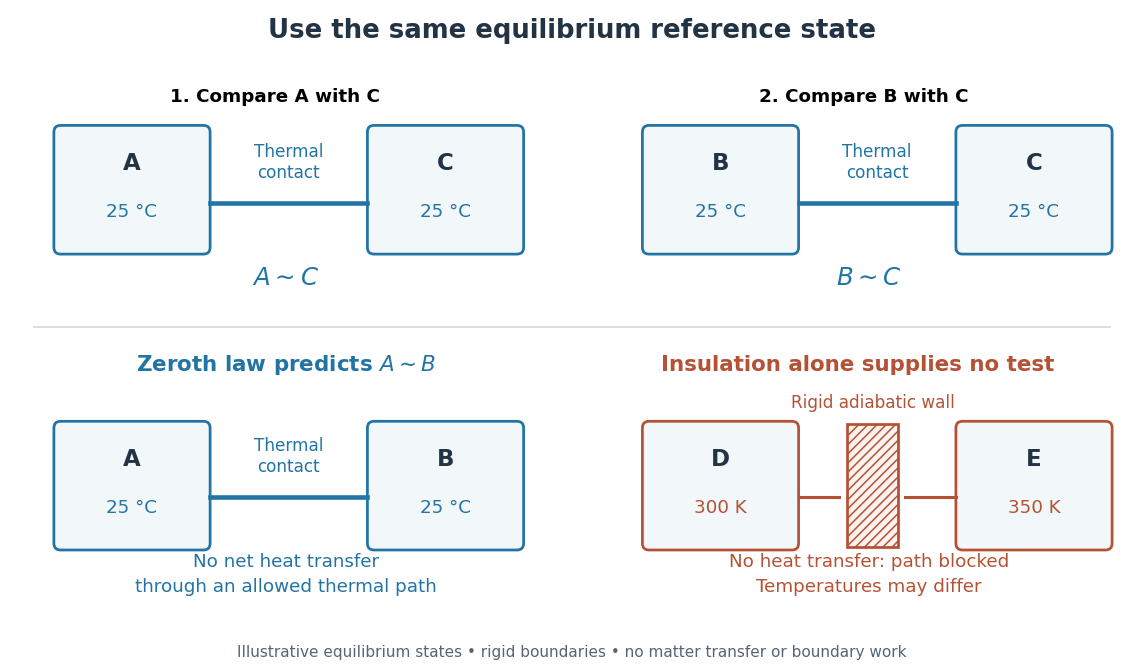

This explains why a thermometer can compare unlike materials: it supplies a reusable third system. A temperature is a property of an equilibrium state, while heat is energy transferred because of a temperature difference. Two bodies at the same temperature can have different internal energies and heat capacities. A thermometer therefore does not measure a body's stored amount of heat; the finite-body disturbance and waiting-time calculations in thermometer describe how making the comparison can change the state being measured.[ref]
The name “zeroth” reflects logical order rather than the date of the first thermometer: this premise about thermal equilibrium precedes the already numbered first law of thermodynamics, Second law of thermodynamics and third law of thermodynamics. This is the naming explanation given in University Physics Volume 2 by Samuel J. Ling and others (§1.1, “Thermal Equilibrium”).[ref]
University Physics Volume 2 by Samuel J. Ling and others. §1.1, paragraph introducing the zeroth law: retrospective numbering; the textbook credits the name to Ralph Fowler in the 1930s
The corresponding Zeroth law of black-hole mechanics states constancy of surface gravity over an equilibrium horizon; Hawking radiation identifies that quantity with physical temperature up to its universal conversion factor.
Lasso dropout knot 2026-10-14
On a least-angle segment , a nonzero active regression coefficient reaches zero at the displayed first positive root. Continue only as far as the first dropout, inactive-entry event or zero-correlation endpoint. At a dropout remove the vanishing regression coefficient from the active direction and recompute. This preserves agreement between nonzero regression coefficient signs and residual-score signs, which the Karush-Kuhn-Tucker conditions for the Lasso require. A removed regression coefficient may re-enter later; the active set need not grow monotonically.
At a positive penalty level, let be the residual-score equality set, its signs and the nonzero regression coefficient support. With full column rank, the displayed strictly convex quadratic program selects the direction for a small decrease of the penalty. Existing nonzero regression coefficients have unrestricted tangent components; tied zero regression coefficients may move only with their residual signs. Stationarity gives for and for entering zero coordinates, and for tied coordinates that remain zero. These are exactly the first-order Karush-Kuhn-Tucker conditions for the Lasso along the next segment. Normalize to obtain the corresponding least-angle direction. This resolves simultaneous entries or dropouts without adding a generic-position assumption.
// Target: mathematical-optimization.bigb
Liénard radiated-power formula Created 2026-10-14 Updated 2026-11-05
The Liénard radiated-power formula gives the total instantaneous emitted power of an accelerated classical point charge. Write for its velocity, for its coordinate acceleration and for its Lorentz factor. In SI units,For small this reduces to the Larmor formula. The perpendicular and parallel components carry different powers of , which makes the constraint in a radiation comparison important.
With metric signature , four-velocity and four-acceleration , the same SI result isThe minus sign compensates the negative squared norm of the four-acceleration. This total emitted power is invariant under changes of inertial frame; directional detected radiative flux involves additional angle and arrival-time transformations. [ref]
Classical Electromagnetism by Richard Fitzpatrick. Larmor Formula, equations 1940–1944; SI four-acceleration and three-acceleration forms
For circular motion perpendicular to a magnetic field, givesThis substitution uses the magnetic Lorentz force and keeps the same SI units throughout.
Diffusion on a graph 2026-10-14
The continuous-time diffusion model on a finite undirected graph uses the Graph Laplacian in the ordinary differential equationAcross each edge, the higher value sends an amount proportional to the difference to the lower value. The two contributions cancel in the sum over vertices, giving conservation of mass:If the entries represent masses, start with nonnegative entries; signed entries can instead describe deviations from a common level. For the three-vertex path graph, the initial vector is an eigenvector with eigenvalue one, so the exact solution isMore generally, an eigenvector with eigenvalue decays by . The spectral theorem for real symmetric matrices supplies an orthonormal basis of these eigenvectors, and the kernel of a graph Laplacian identifies the surviving terms. On a nonempty connected graph,The limiting value is the original arithmetic mean. On a disconnected graph, each connected component of a graph converges to its own original arithmetic mean. The same matrix therefore measures neighbour disagreement, detects disconnected regions and governs relaxation toward agreement.
There are unlisted articles, also show them or only show them.