The canonical stress-energy tensor is the Noether current associated with translation symmetry. For a Lagrangian density with no explicit coordinate dependence,
The Euler-Lagrange field equations imply . Thus are conserved densities and their fluxes; integrated charges are conserved when the boundary flux vanishes. For a real scalar field with , the energy density is in natural units. The general canonical stress-energy tensor need not be symmetric. [ref]
Linearized point-mass metric in radial Cartesian form by  Codex 0 Created 2026-09-24 Updated 2026-10-14
For a point mass and , writeThe vacuum scalar-curvature equation gives , so . The remaining vacuum equations fix in the corresponding Schwarzschild gauge.
Shear stress is the tangential component of traction on a surface. For leading unidirectional flow in a Newtonian fluid, .
A negative temperature system transfers heat spontaneously to a positive-temperature system when their allowed energy exchange increases total entropy. Let leave the first system and enter the second. For small exchange between internally equilibrated bodies,If denotes the canonical inverse temperature, the same result isThe factor is required when has physical entropy units; it disappears only for dimensionless .
Thus every negative temperature is hotter, in the heat-flow sense, than every positive temperature. Energy transfer eventually changes the inverted distribution; maintaining it requires the appropriate isolation or preparation rather than simply placing a hot ordinary gas on a negative Kelvin scale.
Instantaneously reversing a Hamiltonian satisfying leaves populations unchanged but rewrites them as a canonical distribution with . When the partition function is unchanged, the free energy changes sign and the heat capacity is unchanged.
Nearly-free electron dispersion near a one-dimensional band gap by Codex 0 Created 2026-09-24 Updated 2026-10-18
Codex 0 Created 2026-09-24 Updated 2026-10-18Rayleigh-Bénard convection is buoyancy-driven flow caused by heating a fluid from below. In an infinite-Prandtl-number reduction, velocity is determined instantaneously by a forced Stokes equation, while temperature satisfies an advection-diffusion equation.
For a periodic or boundary-tangent divergence-free vector field , integration by parts givesConsequently , the cancellation underlying many fluid energy estimates.
The Stokes operator is on divergence-free vector fields, where is the Leray-Helmholtz projection. On a periodic domain it equals on its domain, and its inverse gains two Sobolev derivatives.
The Leray-Helmholtz projection is the orthogonal projection of square-integrable vector fields onto divergence-free vector fields. Applying it to an incompressible momentum equation removes the pressure gradient.
Free-endpoint normal mode of a coupled variational functional by Codex 0 Created 2026-09-24 Updated 2026-10-06
Codex 0 Created 2026-09-24 Updated 2026-10-06Forwith free terminal values, the Euler-Lagrange equations and natural conditions give a nonzero stationary family exactly when . It is
For a language , defineThis is a right congruence, and its equivalence classes are the states of the minimal deterministic finite automaton for .
Incremental information in a twofold binary repetition code by Codex 0 Created 2026-09-24 Updated 2026-10-14
Codex 0 Created 2026-09-24 Updated 2026-10-14Send a uniform bit twice through independent binary symmetric channels of crossover probability . The first received bit supplies bits. Since the received bits disagree with probability , the additional information in the second bit is
For finite discrete random variables, the mutual information supplied by two observations equals the information supplied by the first plus the additional conditional mutual information supplied by the second:The order changes the individual contributions but leaves the total unchanged.[ref]
https://web.stanford.edu/class/ee376a/files/lecture_3.pdf. Stanford EE376A/STATS376A, Lecture 3, Definition 7 and equations (48)–(51)
To prove the first identity, add and subtract the intermediate conditional entropy:With base-two logarithms, all contributions are in bits. Repeatedly inserting intermediate conditional entropies makes them cancel, as in a telescoping series, and gives the rule for any finite list of observations:where the term is . The same calculation with already known gives .For the fair-bit exclusive or example in conditional mutual information, observing alone tells nothing about , but observing after tells everything:Here by independence and because . In the reverse order, , so and : the two observations are individually uninformative but jointly reveal one bit. Simply adding their separate mutual informations would miss all of it.
The chain rule is useful for measuring the value of each new observation without double counting information already supplied. It also guarantees by nonnegativity of conditional mutual information. Keeping and adding can help, even though discarding and retaining only a processed is constrained by the data processing inequality. Equating the two observation orders gives the precise identitywhich explains why there is no general rule that conditioning decreases mutual information.
For finite discrete random variables, conditional mutual information measures the average reduction in uncertainty about from observing , when is already known. With base-two logarithms, it is measured in bits:The second expression follows from the chain rule for conditional entropy and makes the symmetry in visible. Equivalently, compute the mutual information separately in each conditional probability distribution and then average:Here is the Kullback-Leibler divergence, also computed with base-two logarithms; zero-probability terms contribute zero. The Gibbs inequality gives , with equality exactly when and have conditional independence given : the conditional joint probability mass function factors for every of positive probability.[ref]
For a fully computed example, take independent random variables that are fair bits, and let , where is exclusive or. The complete joint probability distribution has only these four positive entries:
Table 1. .
Every pair has probability , so . But . Given , the pairs each have conditional probability , while both conditional marginals are fair. ThusGiven , the pairs give the same calculation. ThereforeThe conditional entropy calculation tells the same story: because either value of leaves fair, whereas because . Learning the exclusive or does not reveal either bit alone; it reveals whether they agree, so learning one then determines the other.
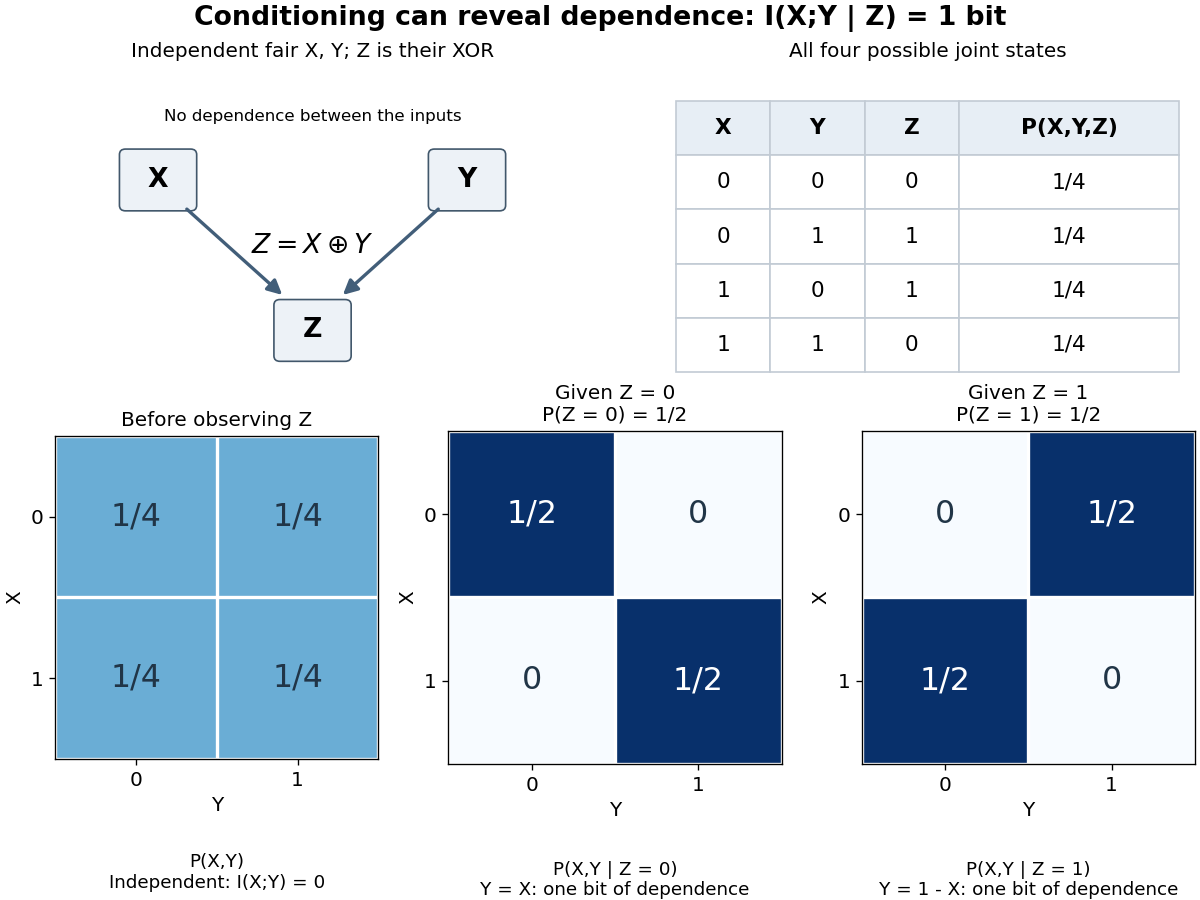

This example distinguishes conditional independence from ordinary independence. It also disproves the claim that conditioning always reduces mutual information, despite conditioning reduces entropy. There is no general ordering between and : the example above increases it from zero to one, while taking and for a fair bit decreases it from one to zero. The chain rule for mutual information explains why both are possible.[ref]
Conditional mutual information is useful for asking whether an additional observation tells us anything after information already available has been accounted for. Its zero case expresses conditional independence exactly; in a Markov chain, this is the step that turns the chain rule for mutual information into the data processing inequality.
For discrete random variables ,The difference between the left- and right-hand sides is the nonnegative conditional mutual information .
For a fixed-coefficient linear multistep method applied to a well-posed initial value problem with a continuous right-hand side uniformly Lipschitz continuous in the solution argument on the relevant region, consistency of a numerical method and zero-stability are equivalent to numerical convergence for arbitrary starting values whose errors tend to zero. The time interval is fixed while the step size tends to zero; an implicit numerical method must use its well-defined nearby solution branch for sufficiently small steps.
The quantitative statement is that a zero-stable method with consistency error and starting errors has global error , provided the exact solution is sufficiently smooth for that residual bound. A bounded response to step defects follows from the root condition for a multistep method, and the discrete Gronwall inequality controls the nonlinear error terms. Mere continuity of the right-hand side does not by itself supply these hypotheses or uniqueness of the exact solution.
Zero-stability controls whether small perturbations are amplified uniformly as a fixed time interval is covered by more and more steps. For a constant-coefficient linear multistep method, the zero-step recurrence isZero-stability requires a bound , with independent of small and the starting perturbation. The root condition for a multistep method characterizes this uniform boundedness.[ref]
Fundamentals of Numerical Computation by Tobin A. Driscoll and others. Zero-stability of multistep methods, Theorem 74, root condition and recurrence-mode proof
For , every solution is , so perturbations remain bounded even though the alternating component does not decay. For , the mode grows like at fixed positive time and violates zero-stability. This is distinct from absolute stability, which tests nonzero and can constrain a particular step size.
There are unlisted articles, also show them or only show them.