
A helix-coil transition model assigns local states of a biopolymer to an ordered helical conformation or a disordered coil conformation. Their competing free energies determine the tendency to form a helix, while the cost of boundaries between regions gives cooperativity: forming a new helical run can be less favorable than extending an existing one. A coil state is a class of disordered conformations, not a claim that the whole molecule is an ideal chain. The Zimm-Bragg model is a simple nearest-neighbour statistical model of this competition.
In the reaction displayed here, an electron antineutrino interacts with a proton to produce a Positron and a neutron. It turns an otherwise hard-to-observe incident particle into two products with different detection signatures. A prompt Positron signal followed by neutron capture can identify a candidate much more selectively than a single energy deposit. Inverse beta decay is a weak interaction; the incident electron antineutrino is detected through its reaction products.
A beta particle is an electron or Positron emitted in beta decay. It has the same intrinsic properties as an electron or Positron produced by another process; the name identifies its origin rather than a new particle species.
Unlike a specified two-body alpha transition, ordinary beta emission shares available energy with a neutrino and daughter recoil. The emitted beta particles therefore have a continuous range of kinetic energies. In an applied magnetic field, electrons and positrons curve in opposite senses for the same incident direction. Detector response, energy loss in the sample and collection geometry modify the measured distribution.
Double beta decay changes the atomic number of a nucleus by two while preserving its mass number. The ordinary two-neutrino process can connect even-even nuclear isobars when the intermediate odd-odd nucleus is too heavy for a single beta decay. Neutrinoless variants would violate lepton number and require additional physics.
A nuclide is beta-stable if it has no energetically allowed single beta-minus decay, beta-plus decay, or electron capture to a lower-mass neighboring nuclear isobar, with electron thresholds treated consistently. Beta stability need not imply stability against alpha decay, double beta decay, or nuclear fission.
A nuclear beta decay connects initial and final quantum states through vector and axial-vector parts of the weak charged current. At leading order in the lepton wavelength expansion, Fermi transitions carry lepton-pair spin , while Gamow-Teller transitions carry . If the lepton pair carries orbital angular momentum , its total angular momentum is for , or for . The nuclear states must obey , and their parities satisfy in this leading orbital classification. The least permitted labels the degree of forbiddenness. Real forbidden transitions involve several weak multipole operators; the elementary spin classification does not assert that only one operator or nuclear matrix element exists.
Beryllium-8 has four protons and four neutrons and is unstable against breakup into two alpha particles. Its ground-state resonance lies just above the two-alpha threshold.
This short-lived intermediate is important in the Triple-alpha process: in a sufficiently dense stellar helium environment, a further alpha particle can be captured before breakup. The nuclear resonance therefore connects the structure of a very light unstable nucleus with the production of carbon in stars.
An actual teaching experiment prepares a Kool-Aid stock by weighing powder, transferring it quantitatively into a volumetric flask, and filling to the mark with water. A Genesys 30 spectrophotometer, blanked with water in a cuvette, scans for the peak absorbance wavelength. A Genesys 10 then measures absorbance at that wavelength, with a water reference blank. Each serial dilution transfers of the preceding chemical solution to a volumetric flask and fills to the mark; the protocol records the blank and sample readouts and repeats the halving sequence. These are prescribed experimental steps, not a published numerical data set.[ref]
Quantitative Analysis of Kool-Aid by Mary Jane Simpson. Quantitative Analysis of Kool-Aid by Mary Jane Simpson, Procedure: Prepare Kool-Aid Stock Solution; Measure Peak Absorption of Kool-Aid Solution; Measure Absorbance of Solution at Various Concentrations, steps 1–5
The experiment tests whether absorbance tracks the prepared concentration. Its concentration is powder mass per final volume, so the calibration does not by itself supply a single dye's molar absorption coefficient. The manual identifies loss of discrimination for very concentrated, very dilute, or very similar samples.[ref]
Quantitative Analysis of Kool-Aid by Mary Jane Simpson. Quantitative Analysis of Kool-Aid by Mary Jane Simpson, Background: three limits on distinguishing samples; Procedure: stock preparation and concentration in grams per millilitre
To interpret such a calibration, hold cuvette orientation fixed with its clear faces in the light path, keep fingerprints and bubbles out of that path, and keep the geometric length unchanged. Mix each dilution completely. Re-read the reference blank during the sequence and re-read one standard to test drift. A separate preparation of a standard checks errors propagated through serial dilution; repeating only its instrumental reading does not test the transferred volumes. These controls follow from keeping , , and comparable between readings.
Three mechanisms explain why a straight line can fail. First, scattering of light can divert radiant power away from the photodetector, so cloudiness can raise apparent absorbance without the intended absorbing solute. A reference blank removes only losses shared with the sample. Second, stray light reaching the photodetector can make a strongly absorbing sample appear too transmissive. In an original model with extra detected radiant power in both readings,As the ideal transmittance approaches zero, the reported absorbance approaches for . This finite ceiling is a model prediction, not measured instrument performance.
Third, chemical equilibrium can redistribute the absorbing chemical species when dilution, pH, or temperature changes. Even if each chemical species separately follows the Beer-Lambert law, their combined absorbance is , where is each species' molar concentration; changing those fractions need not preserve one effective molar absorption coefficient. Thus an unknown should be compared with standards under matching chemical solution conditions, within the tested concentration range. A good linear regression alone does not establish chemical selectivity.
Choose an ideal absorbing chemical species with at a fixed wavelength, and a cuvette with geometric length . These are stipulated model parameters. A micromolar molar concentration is , so each additional gives . Five chosen standards therefore predictThe absorbance graph is a straight line of slope , while the transmittance graph shows exponential decay. Equal increments of molar concentration multiply transmittance by ; they do not subtract a fixed transmitted fraction.
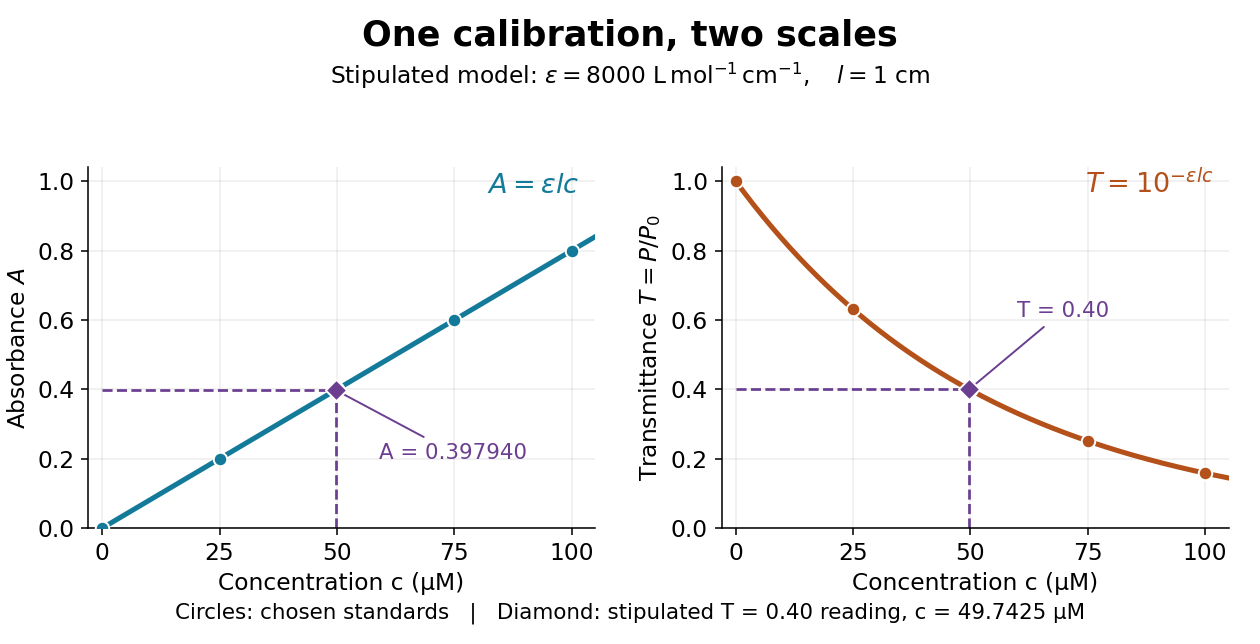

Suppose a measurement returns the stipulated blank-normalized reading under those same conditions. The inferred absorbance and molar concentration areThis lies slightly below the standard because is slightly above . A calibration determined experimentally by linear regression may instead have . Then use , keeping the slope and intercept in their measured units. A nonzero intercept calls for checking the reference blank and sample preparation; it does not uniquely identify the cause.
The decadic molar absorption coefficient specifies absorbance per geometric length and molar concentration. With in centimetres and in , has units ; its SI unit is .[ref]
Beer–Lambert law. IUPAC Compendium of Chemical Terminology, fifth edition (Gold Book) by International Union of Pure and Applied Chemistry; Beer–Lambert law, entry B00626: coefficient name and conventional and SI units
The units cancel in . Since and , one equals . Specify the wavelength and chemical solution conditions when giving a molar absorption coefficient: changing the absorbing chemical species can change it even at fixed total analytical concentration.
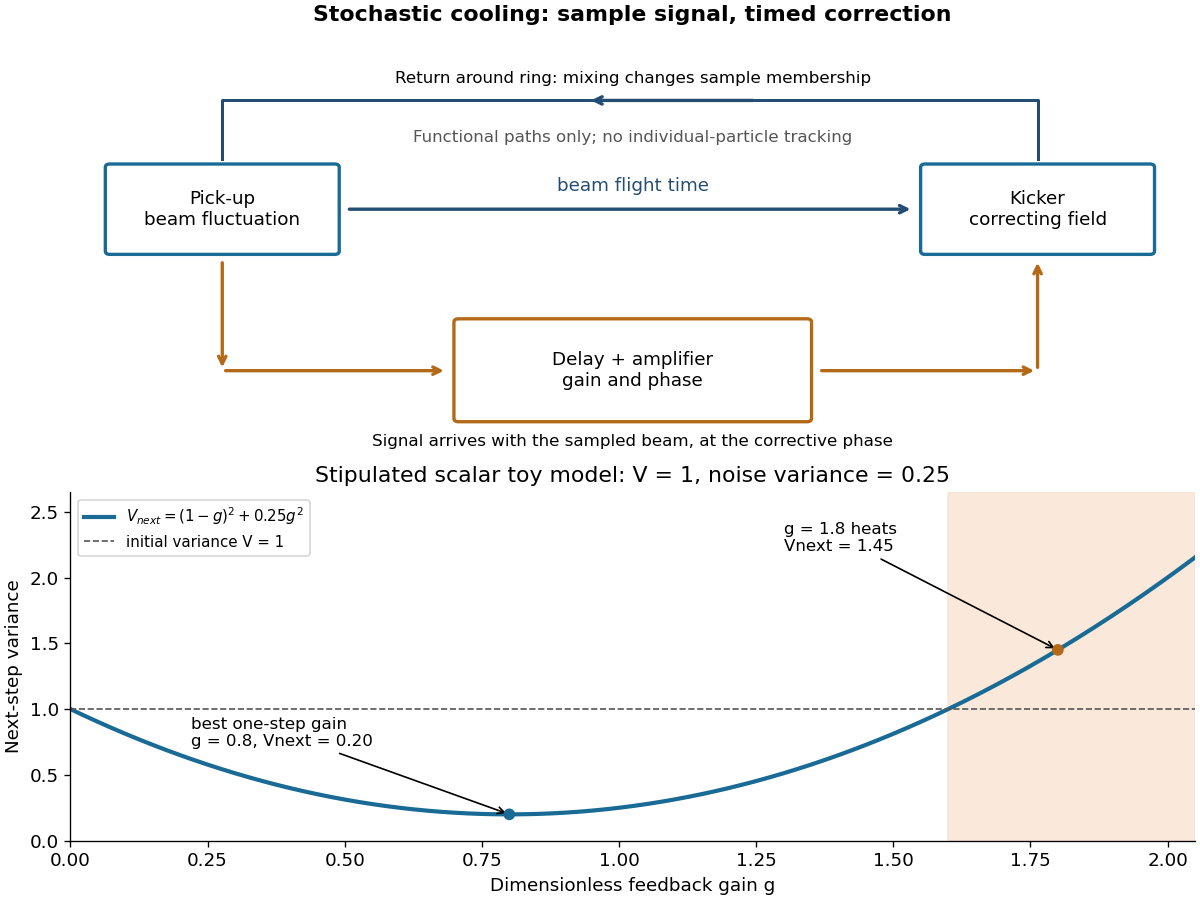
Simon van der Meer's stochastic cooling uses measured beam fluctuations, a pick-up, amplifier and timed kicker. Finite samples supply the signal; other particles and electronic noise contribute unwanted kicks. Delay and oscillation phase must make the correction oppose the sampled deviation.[ref]
This active system dissipates energy; it is no one-particle Maxwell's demon individually tracking antiprotons. The stochastic cooling variance model isolates the tradeoff.

A strong interaction decay must conserve quark flavour and have final rest energy below the initial mass. An excited light baryon can often decay to a lighter baryon plus a pion. A ground-state strange baryon may lack any such open flavour-conserving channel even when its spin permits one. In particular, the Omega baryon cannot decay strongly to a Xi baryon plus a pion because that changes strangeness; its flavour-conserving Xi-kaon channel is closed by the mass threshold. A spin-three-half assignment alone does not imply a strong decay.
A near-surface region whose predominant mobile charge carrier species is opposite to that in the interior: for example a layer rich in electron holes on an n-type semiconductor.
There are unlisted articles, also show them or only show them.