The electronic contribution to differential capacitance arising from a change of chemical potential as particles are added. For noninteracting electrons at zero temperature, it is times the density of states of the whole sample at the Fermi energy. The quantum capacitance of a graphene cone gives a worked example.
For a collection of fixed electrical conductors in linear electrostatics, the capacitance matrix relates conductor charges to potentials relative to a specified reference: . It includes mutual electrostatic effects omitted when each conductor is treated as an isolated capacitor. Its electrostatic energy is . Geometry and separation are needed to determine its entries.
Arithmetic-harmonic bounds for dielectric capacitance by  Codex 0 Created 2026-10-18 Updated 2026-10-20
For a parallel-plate capacitor of area and separation , filled by a spatially varying positive scalar permittivity, neglect edge fields. At fixed terminal voltage, the physical electric potential minimizes . A linear trial potential gives the arithmetic upper bound. At fixed plate charge, minimizing over divergence-free electric displacement fields gives the harmonic lower bound by using a uniform trial displacement. The averages are volume averages. Layers parallel to the field attain the arithmetic bound; layers perpendicular to the field attain the harmonic bound. Equal volumes of vacuum and relative permittivity therefore give , where .
Two independently available parts of a thermodynamic system are noninteracting in the canonical description when their state space is a Cartesian product and their energy is additive, . Both conditions are needed for the canonical partition function to factor:An additive expression on a constrained set of allowed state pairs need not give this factorization. Relabeling the states to make their allowed labels independent can instead introduce an interaction into the energy. For two two-state labels, an additive energy necessarily satisfies the rectangular identity .
A quantum Gibbs state is the density operator of a canonical ensemble with inverse temperature . It exists when the canonical partition function is finite. The spectral theorem assigns probabilities to an orthonormal eigenbasis of the Quantum Hamiltonian. An additive constant in the Quantum Hamiltonian cancels between numerator and denominator. For , the exponential of a Pauli vector, continued to an imaginary argument, gives .
A particle calorimeter designed to measure electron and photon energies through particle showers. Track reconstruction helps distinguish charged electrons from neutral photons.
The record for one active invocation in a call stack, containing information such as local variables and the place to resume its caller. Returning removes that invocation's stack frame, allowing the caller's computation to continue.
Calcium hydroxide supplies calcium cations and hydroxide anions on dissolution in water. The ideal one-to-two stoichiometry relates molar solubility to the dissolved concentrations; solubility product measurement by titration explains how the hydroxide inventory is measured.
Calcium-40 is an even-even nucleus with the closed-shell values . Its extra stability illustrates nuclear shell corrections beyond a smooth semi-empirical mass formula.
For a quasihydrostatic bubbly mixture with gas void fraction , volume averaging gives the displayed mass density. A body displacing mixture volume has approximate buoyant force . A floating body of mass therefore needs ; gas release can increase its draft until the required displacement exceeds its available watertight volume. This mechanism explains a possible loss of flotation without making sinking inevitable in every gas plume. Upward liquid flow, turbulence and nonuniform bubble distributions require additional hydrodynamic forces beyond this simple mixture model.
The centre of buoyancy is the point through which the resultant hydrostatic buoyant force acts. In a uniform fluid under uniform gravitational acceleration, it is the volume centroid of the displaced fluid. For a floating body its position generally changes when the body tilts, because the displaced volume changes shape.
A bubble chamber using liquid hydrogen as both target and recording medium. For a beam interaction on a proton, the target's initial momentum can usually be approximated as zero on the scale of the beam momentum. This makes four-momentum conservation especially useful: the initial state does not include the unknown motion of a proton bound inside a heavier atomic nucleus. The approximation still neglects molecular binding and thermal motion.
Stereoscopy enables three-dimensional track reconstruction.[ref]
How It Works: Bubble Chamber (CERN teaching archive). How it works, views
Calibrated camera positions and optical geometry are needed before a photographed arc becomes a physical radius of curvature. Neutral particles do not directly leave the same continuous ionization trail as charged particles; an interaction or decay can instead reveal them through charged secondary tracks. A photon's inferred path between interactions is not a photographed luminous line.In a uniform magnetic field, with negligible stopping power and elastic scattering over the fitted segment, the transverse projection is a circle. The Lorentz force turns transverse momentum at angular rate , givingHere is measured in the plane perpendicular to the magnetic field. The relation remains valid with relativistic physical momentum; it does not require . Thus curvature determines magnetic rigidity, not mass or kinetic energy alone. For chosen , and , . This is an invented example, not a fit to a historical photograph. Reconstructing a three-dimensional helix also determines the component parallel to the magnetic field; the transverse radius of curvature alone does not. Determining the sign of electric charge additionally requires the field direction and the direction of travel, as in the charge-sign ambiguity of a curved track.
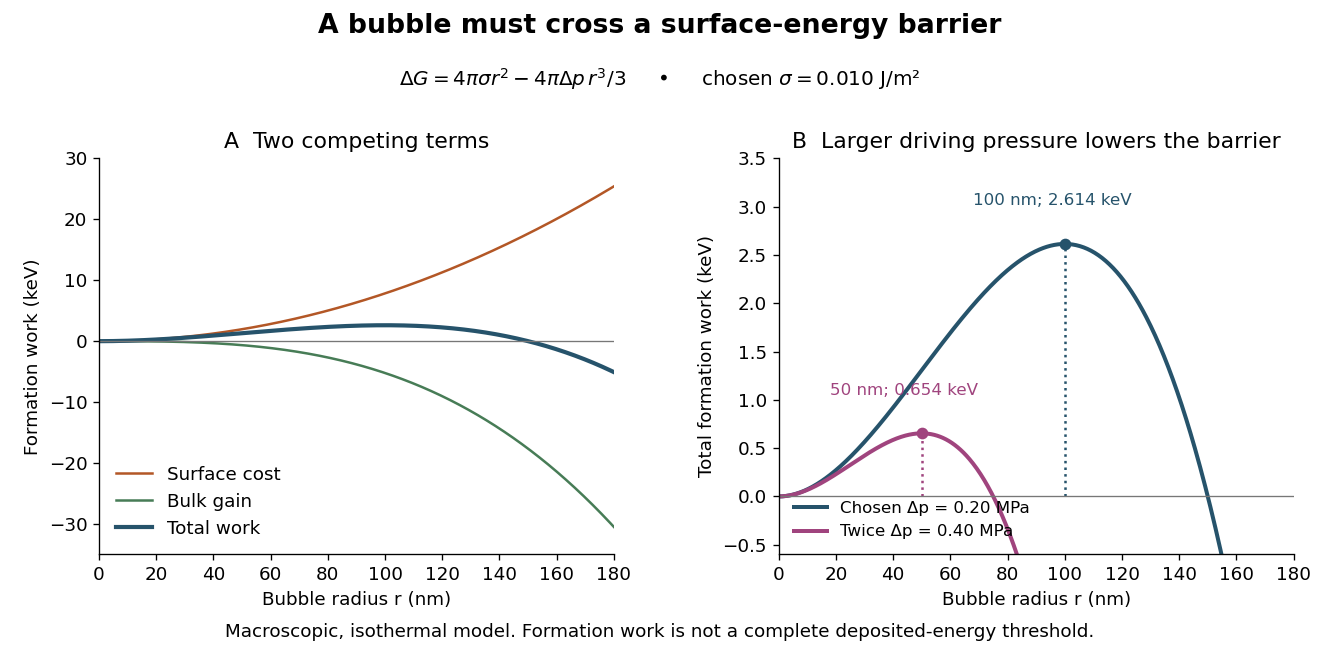
Why can hot liquid wait for a charged particle rather than immediately turn into vapor? A small cavity costs surface energy. Consider an original macroscopic capillarity model at fixed temperature with surface tension , imposed liquid pressure , and driving difference , where is the planar-interface vapor pressure. Neglect dissolved gas, interface thickness, heat transfer and curvature dependence of . The reversible formation-work approximation isThe first term charges for surface area; the second rewards the new vapor volume. This is a macroscopic free energy model, not the energy that an actual detector must receive as localized heat. It shares the capillarity balance used in the cloud-chamber expansion model, but the new phase is now a bubble.
Differentiating givesAt the critical nucleus, . The barrier is a maximum: cavities smaller than tend to shrink, while larger ones can grow in this model. Doubling halves and quarters if stays fixed. This explains the strong sensitivity to operating conditions without claiming a universal detector threshold.
Choose and solely for a teaching example. ThenFor the same chosen and twice the driving pressure, and . These are calculated formation-work scales, not measured bubble thresholds for diethyl ether or any other substance.

A simplified way to discuss localization is to stipulate deposited energy within a segment of length and a trial conversion fraction . A toy criterion gives an energy per unit length scale . It is only a bookkeeping estimate: a real bubble also needs latent heat, must exchange heat, and is affected by the spatial pattern and time scale of energy deposition. Consequently neither a single stopping power value nor this barrier alone predicts detection efficiency or the number of bubbles. Two tracks with the same mean stopping power can distribute their energy differently on the scale of a critical nucleus.
Unlike the Blackett-Occhialini triggered cloud-chamber experiment, Glaser used counter-controlled flashes after expansion. A detector trigger can select recording in sensitive liquid; subsequent expansion cannot recover a vanished latent track.[ref]
Elementary Particles and Bubble Chambers by Donald Arthur Glaser. pp. 537, 541, 550: timing distinction
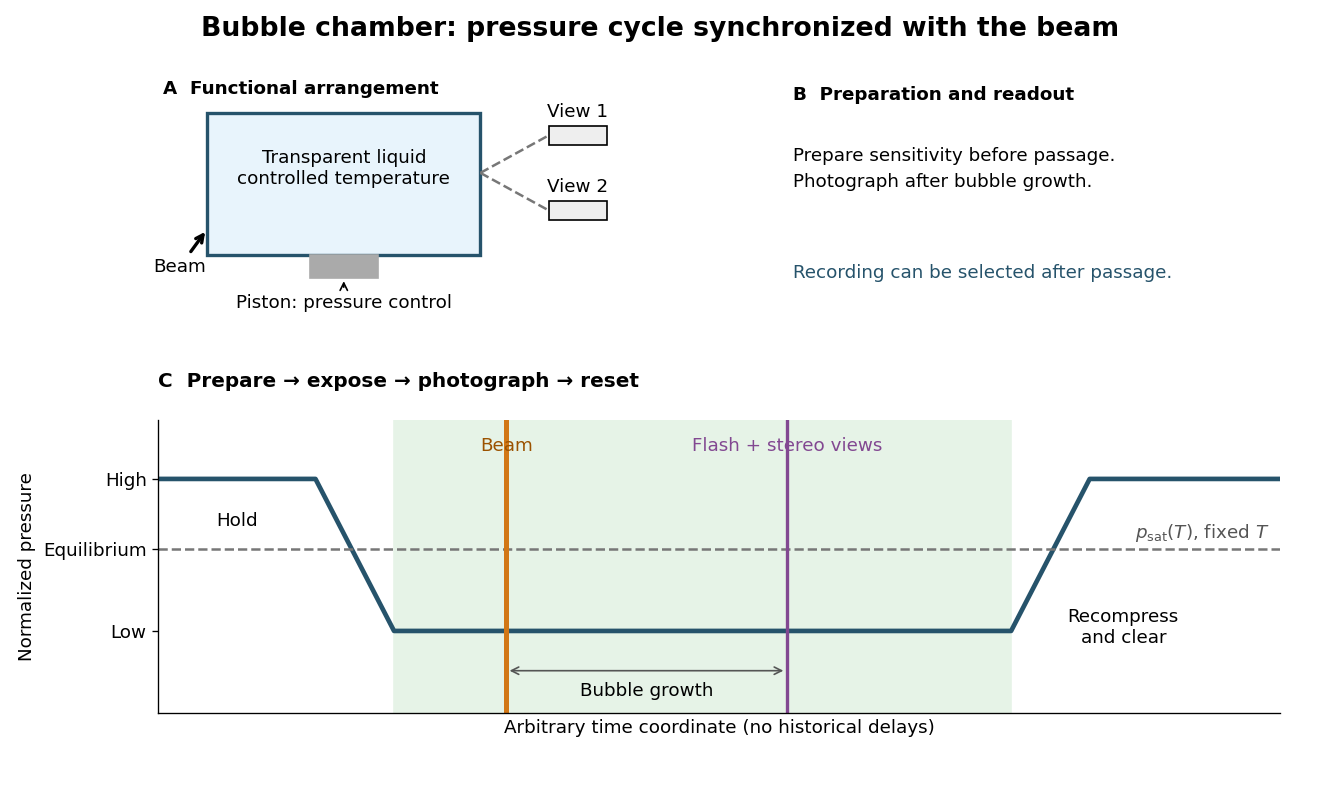
Bubble-chamber pressure cycle and photographic readout
. Original functional diagram with an arbitrary time coordinate and chosen normalized pressure levels. The dashed equilibrium line assumes fixed temperature; no measured waveform, apparatus scale or historical delay is reproduced. Details.
The diagram deliberately separates the preparation through thermodynamics from the readout decision. Its green interval is a stipulated operating window, not a prediction from pressure alone. Excess superheating can increase unwanted nucleation; insufficient superheating can suppress tracks. A useful proposed sensitivity check holds the readout settings fixed while varying pressure or temperature, with matched background exposures. A proposed timing check moves the beam within the cycle; a proposed optical check varies flash delay to distinguish growing bubbles from changes in spatial resolution. These are experimental design examples, not additional historical measurements.
Donald Arthur Glaser developed the bubble chamber in 1952 during experimental particle research at Michigan.[ref]
His 1960 lecture, Elementary particles and bubble chambers, describes evacuated capillary bulbs containing pure diethyl ether. Cooling one bulb reduced pressure; the other remained hot. A cobalt-60 source initiated boiling. Small glass chambers subsequently used hot-oil baths, hand-cranked pistons and high-speed photography. Automatic cycling with counter-controlled flashes produced finer tracks. Local ionization deposits energy that can initiate bubble nucleation.[ref]
Later metal-chamber photographs compared operation with and without a nearby radioactive source: wall boiling occurred without interior tracks; irradiation produced tracks before disruptive flow ended sensitivity.[ref]
Elementary Particles and Bubble Chambers by Donald Arthur Glaser. pp. 539–543, Fig. 6
These observations separate two questions: can radiation start boiling, and can a detector preserve the geometry of a passing charged particle? Whole-vessel boiling alone answers only the first. Wall background, finite sensitivity and growth before photography constrain the second.
There are unlisted articles, also show them or only show them.