
The gain and bounded bias in this equation give an upper bound on average reward for every policy: summing its action inequalities telescopes the bias, leaving total expected reward at most . A stationary maximizing action at each state attains equality and hence the gain . Policy improvement computes the current gain and bias, then switches to actions with greater reward-plus-expected-bias value.
An ARMA equation need not be a minimal-order representation when its autoregressive polynomial and moving-average polynomial have a common factor. For a stationary causal solution, a common stable factor can be cancelled using its convergent inverse filter. For example, reduces to , an MA(1). Its autocorrelation function vanishes beyond lag one, despite the displayed ARMA(1,2) equation. Root conditions should be applied to a reduced representation when asserting necessary and sufficient causality and invertibility root criteria for an ARMA model.
With and , expand the transfer function by its geometric series. Its coefficient of is the displayed expression; after the coefficients follow a geometric tail. Causality gives for , and zero otherwise. Hence for , with in the zero-lag equation.
For an autoregressive moving-average model, set and . If both have no zeros on the closed unit disc, the causal and inverse filters have absolutely summable coefficients and . Comparing power series coefficients gives and , where , for , and all out-of-range coefficients vanish. The backshift operator then gives the corresponding time-series filters.
An ARIMA model applies an autoregressive moving-average model to the differenced process , where is the backshift operator. Differencing permits stochastic trends whose levels are not weakly stationary processes. A local random-walk level observed with independent measurement white noise has an ARIMA(0,1,1) representation, or a formal ARMA(1,1) equation with autoregressive coefficient one.
Normalize the autoregressive and moving-average polynomials to have constant coefficient one, cancel common factors, and require all their zeros to lie outside the closed unit disk. With positive innovation variance these conditions give a causal, invertible, minimal Gaussian process representation. To prove identifiability, compare two such models with the same time-series spectral density. The ratio of their scaled rational transfer functions and its reciprocal are analytic on a neighbourhood of the closed unit disk and have modulus one on its boundary. The maximum modulus principle makes the ratio constant; its positive value at zero forces equality of the innovation variances and equality of the rational functions. Coprimality and the constant-coefficient normalization then force equality of both polynomials. Without the root restrictions, reciprocal root reflection of an ARMA representation and a rescaling of the innovation variance can preserve the spectrum, so the unrestricted parameters are not identifiable.
For a causal autoregressive moving-average model driven by independent white noise, multiply its recursion by and take covariance. When , all driving white noise values in its moving-average term occur strictly after , so their covariances with vanish. The resulting homogeneous tail recurrence has the same characteristic roots as the autoregressive model recursion. Distinct roots of modulus below one give exponential autocovariance decay.
The holomorph acts on the underlying set of a group by . Its multiplication is . This is exactly the normalizer of the left regular permutation representation: a normalizing permutation fixing the identity is an group automorphism, and every normalizing permutation is a left translation followed by one. The embedded copy of is normal and the identity stabilizer is its group automorphism group.
For a chemical element in a specified population, its relative atomic mass or atomic weight is the dimensionless ratio , with the mean neutral atomic mass weighted by isotopic abundance. For the illustrative neon population, , whereas has mass units.[ref]
The mass deficit of a bound atomic nucleus relative to its separated protons and neutrons. If their rest masses are and , the atomic nucleus has rest mass , and the positive nuclear binding energy is , thenwith the speed of light. Releasing energy when the nucleons bind reduces the rest mass of the bound system without changing the exact count . A neutral atomic mass also includes electron rest masses, reduced by the energy required to separate those bound electrons. Consequently is not the definition of the nuclear mass defect: the reference unit and constituent rest masses must also be accounted for.
The unified atomic mass unit and dalton are names for the same mass unit:where the carbon-12 chemical atom is free, at rest, and in its nuclear and electronic ground state. Its conversion to SI mass units is determined experimentally. See The International System of Units (SI), ninth edition, SI Brochure (Table 8, footnote (f), printed p. 146: dalton and unified atomic mass unit).
A Hurwitz stable matrix has all eigenvalues strictly in the open left half-plane. For , this is equivalent to for every initial vector. Jordan blocks contribute polynomial factors times , which decay exactly when their eigenvalues have negative real part. Translating an affine equilibrium reduces its attractivity to this same condition.
For , differentiation gives . A uniform negative-definiteness bound with yields exponential contraction by direct integration of this differential inequality. This is a sufficient criterion for asymptotic stability, stronger than requiring all eigenvalues of to have negative real parts. A merely semidefinite symmetric part needs additional analysis.
An equilibrium point is quasi-asymptotically stable when some neighborhood of initial conditions has forward solutions converging to it. This attraction condition alone does not include Lyapunov stability. Asymptotic stability requires both attraction and Lyapunov stability. A positive Lyapunov function with nonpositive derivative and no nonstationary invariant trajectory in its zero-derivative set proves both when its sufficiently small sublevel sets are compact and forward invariant.
In A Mathematical Theory of Communication by Claude Shannon (1948, section 7), Claude Shannon explains that the common symbol counts in a long independent message make its negative logarithmic probability approximately the message length times the source entropy. Theorem 3 separates an exceptional collection of small total probability from messages with this normalized information cost; Theorem 4 relates the number needed to accumulate a fixed probability to the entropy. The finite-state source setting matters to the historical statement.[ref]
Choose one of two regimes once, with equal probability: a source of independent and identically distributed random variables with one-bit probability , or one with one-bit probability . Keep the chosen regime forever. The resulting source is a strictly stationary process, because shifting a block does not change either component law. It is not an ergodic stationary process: its limiting empirical frequency identifies the regime.
The source's information rate isConditioning on the single regime bit changes any block's information entropy by at most one bit, so dividing by the block length proves this rate. However, the limiting realized information content per symbol is approximately in the first regime and one in the second. The alternative component's likelihood ratio decays exponentially along a typical path from the chosen component, at a rate given by the positive relative entropy between the two Bernoulli distributions. The mixture therefore has two possible pathwise limits, not one limit equal to the averaged information rate.
Take an IID random variable source of bits with . Its binary entropy isA word of length containing ones has probability . Its information content per symbol isThus weakly typical sequences for this biased source have near . With tolerance bits per symbol, the exact condition isFor , this includes exactly . There are words with each count: a type class with that many possible orderings. Summing the counts and their probability masses givesThese are fewer than one percent of the possible words, yet they carry nearly 64 percent of the probability. The most likely individual word is all zeros, with probability ; it is outside this typical set. No contradiction is involved: the type classes near ten ones each contain many more individual words.
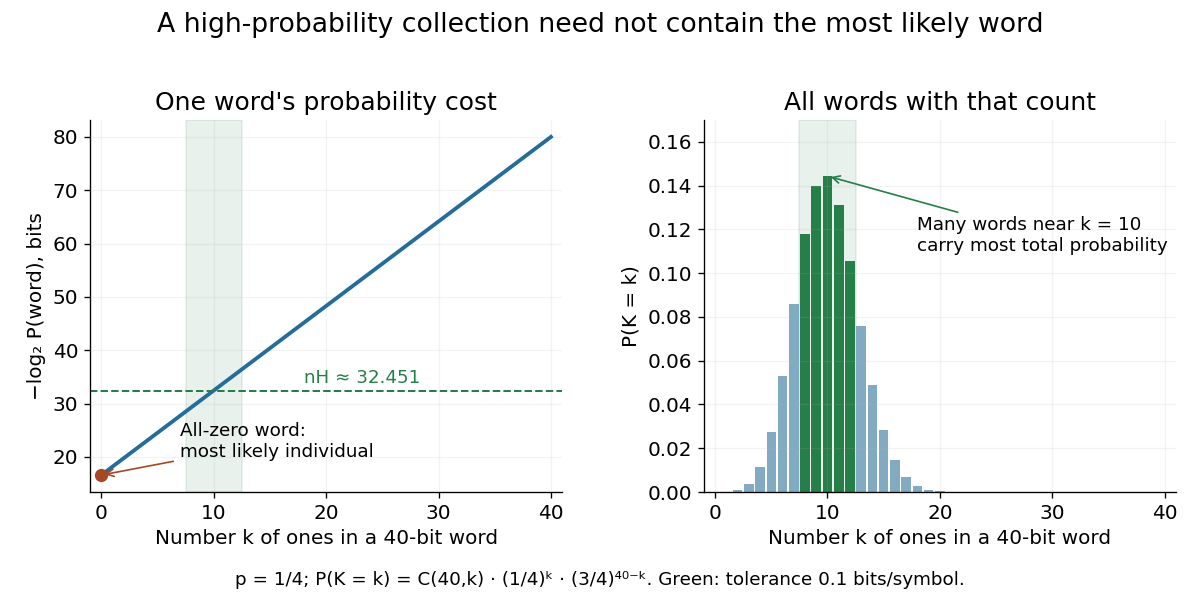
The most likely individual word differs from the counts carrying most probability
. The left plot gives the information content of one word with each number of ones. The right includes the binomial coefficient counting every such word, giving the exact binomial distribution of the count. Both use , ; the green band marks the typical set with tolerance bits per symbol. Details.
The cocenter of a finite-dimensional algebra is the quotient by the vector subspace spanned by additive commutators ; this subspace need not be an ideal. For a group algebra, its basis is indexed by conjugacy classes: every commutator of basis elements is a difference of conjugates, and every difference of conjugates is a commutator. For , off-diagonal matrix units and show that the quotient is one-dimensional, identified by the trace.
A complex associative algebra with a conjugate-linear involution satisfying the displayed product-reversal identities. An operator algebra closed under the Hilbert-space adjoint is a star-algebra. A C-star algebra additionally has a complete norm with .
An associative algebra with a two-sided multiplicative identity. For a subalgebra of bounded operators, the term unital here means that it contains the identity of the represented Hilbert space.
There are unlisted articles, also show them or only show them.