An S-duality relates descriptions at different coupling strengths. In type IIB superstring theory, acts on the axion-dilaton and string charge doublets.
For signature and , the convention gives the displayed tensor. Varying the inverse metric yields the derivative product, while varying the volume element yields the term proportional to . A homogeneous field has energy density and pressure .
The metric variational stress tensor is defined by the matter action's response to a metric change. With signature and the corresponding usual matter-action signs, the displayed convention means . Fix the independent matter variables while varying the metric. Sign conventions must be matched to the action; copying a mostly-plus stress formula into this convention can reverse its energy density.
For a steady axisymmetric compressible fluid flow, mass conservation permits this representation. The mass flow through an annulus between two stream surfaces is . In a steady adiabatic wind without magnetic forces, the specific entropy, specific angular momentum and Bernoulli function are locally functions of on connected regular stream surfaces.
The incompressible planar field has the displayed stream function under and vorticity . In rotated coordinates , , . For positive parameters its nonstationary streamlines are closed ellipses if , hyperbolas and straight separatrices if , and parallel straight lines with a stationary diagonal if .
Using , the displayed stream function gives . Its streamlines are level sets of . At , the Jacobian matrix is , so the points are saddle equilibria. At the eigenvalues are , giving center equilibria surrounded by closed streamlines. The grid lines and form heteroclinic orbits between adjacent saddles; circulation alternates between cells.
For a discrete space and , the continuous extension of to remains idempotent by density, so it takes values in . Its one-set is the clopen closure of . If is any open set in , density gives , so this closure is clopen as well. Thus is an extremally disconnected space. For infinite , this does not imply that every subset of has open closure.
Clopen separation in discrete Stone-Čech compactifications by  Codex 0 Created 2026-10-14 Updated 2026-10-31
In the Stone-Čech compactification of a discrete space, the closure of each subset of is clopen, because its indicator extends to a continuous zero-one-valued function. For disjoint closed sets , choose on and on by Urysohn's lemma. Then and are disjoint clopen sets containing and , respectively. Density proves these containments.
Polycondensation is step-growth polymerization in which joining reactions eliminate small molecules. Its chain-bearing molecule count excludes those byproducts; otherwise two chains joining while releasing one small product would misleadingly appear to conserve the counted population.[ref]
IUPAC Compendium of Chemical Terminology, fifth edition (Gold Book) by International Union of Pure and Applied Chemistry. polycondensation, P04722, definition and growth-step equation
Polyaddition is step-growth polymerization by joining reactions without elimination of small molecules. Compatible functional groups on different chain lengths remain eligible to join; the word addition alone does not imply chain-growth polymerization.[ref]
In cyclization in step-growth polymerization, compatible functional groups on the same chain react and close it into a ring. They consume groups without merging two molecules. If ring-closing events and intermolecular joins occur in an otherwise balanced bifunctional feed, the group conversion is , while . ThusFor example, an dimer can close its remaining and ends: two group pairings have occurred among two starting monomer molecules, giving , but the resulting single cyclic molecule has only two monomeric units. This counterexample shows exactly where the linear Carothers equation fails. Rings have no chain ends, so counting every chain-bearing molecule as two ends also fails.
The balanced Carothers equation follows immediately from linear step-growth molecule count and functional-group conversion in step growth:The same Carothers equation extends to unequal group counts once the limiting-group convention is specified.[ref]
Generalization of the Carothers equation for linear step growth polymers by Emilio Meaurio. Introduction, equations (1)–(6): Carothers equation, end-group count and limiting- conversion
For an original balanced feed of monomer molecules, , , and intermolecular joins give , , and . The remaining counts are , , and , hence number-average degree of polymerization values , , and . The last thirty joins quadruple the average even though they consume only another of the initial groups of either type. These are exact synthetic counts, not experimental measurements.
The derivative explains the sensitivity: near , an absolute conversion uncertainty of changes the predicted degree of polymerization substantially. The exact balanced values at and are approximately and , instead of . An instrument reporting rounded “complete conversion” cannot distinguish those chain lengths. In a finite no-ring system, even one chain retains two ends; the maximum is and . The formal divergence at is a large-system limit, not an infinite chain in a finite flask.
Use an ideal feed in which every starting molecule has exactly two suitable functional groups: either one and one , or two groups mixed with two groups. Only an – pairing can form a joining chemical bond. Assume no loss of feed-derived material, no splitting of chains, no competing consumption of the counted functional groups, no branching, and no cyclization in step-growth polymerization. Linear here describes connectivity; a chain can bend in space. Small byproducts of polycondensation do not enter the chain-bearing molecule count.
Let count all initial feed molecules, the number of intermolecular joins, and all remaining chain-bearing molecules, including unreacted monomers. Each join turns two molecules into one, so exactly. If chain contains feed-derived monomeric units, conservation gives . Consequently the number-average degree of polymerization isThis is a count of both feed species' monomeric units, rather than a count of interior constitutional repeating units. For chemistry an interior repeat often contains two feed-derived units, as explained in monomer. Equal functional group reactivities are not needed for this bookkeeping at a specified ; predicting a time course or a chain-length probability distribution requires additional assumptions.
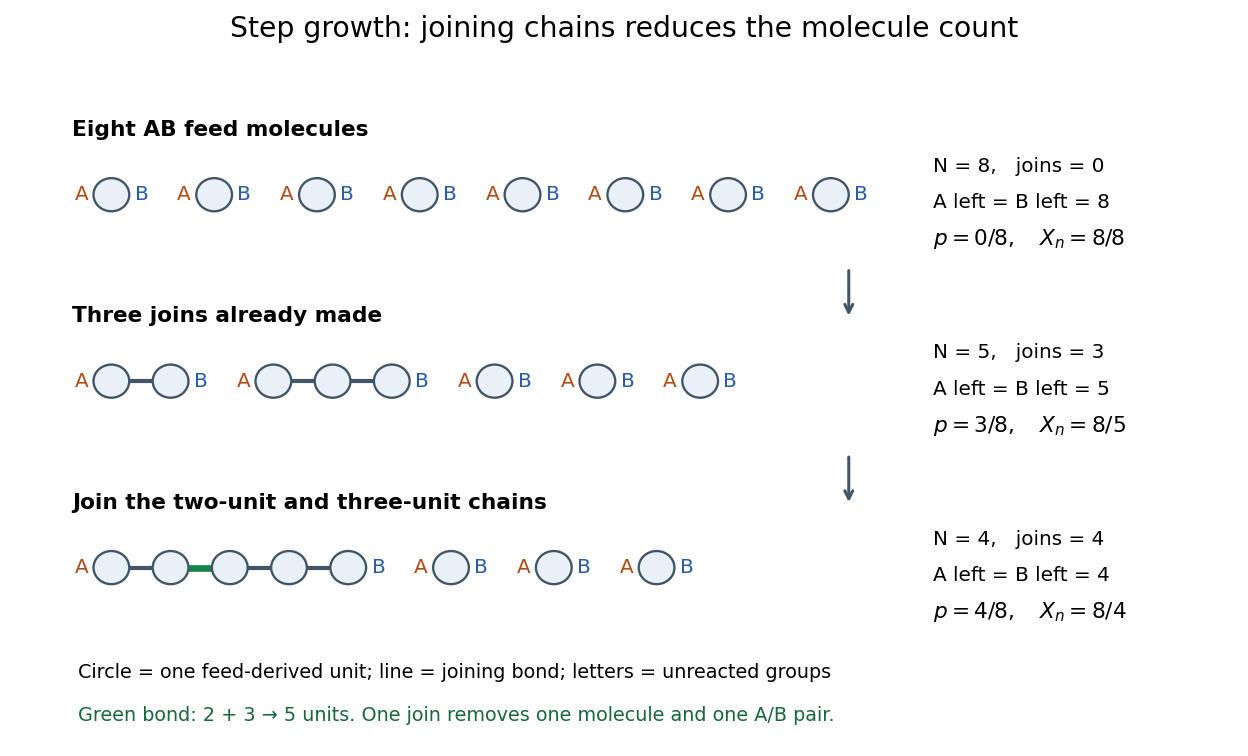
Exact step-growth polymerization count: joining a two-unit chain to a three-unit chain consumes one pair of functional groups
. Original stipulated eight--molecule example. Circles are feed-derived monomeric units, lines joining chemical bonds, and letters the surviving functional groups. Internal and groups have already reacted and are not drawn. The depicted layouts are schematic connectivity, not molecular geometry or sampled experimental chains. Details.
For the figure's eight feed molecules, three joins can give lengths , so and . Joining the first two chains gives : the incorporated total stays eight, becomes four, and . A graph makes the bookkeeping visible: each starting monomer molecule is a vertex of a graph, and each intermolecular joining chemical bond connects two previously distinct connected components of a graph. The connected pieces are the counted molecules.
The parsec is a distance unit defined by the exact conventionThe astronomical unit is exactly ; one arcsecond is exactly radians. The IAU resolution explicitly records the parsec convention. A megaparsec is one million parsecs. [ref]. [ref].
The familiar description "the distance giving one arcsecond of stellar parallax" uses the small-angle approximation. Exact right triangle geometry instead gives , slightly shorter than the conventional parsec. The relative difference is approximately . This is negligible for the examples here, but distinguishing an exact unit convention from an approximate geometric interpretation prevents a misleading equality.
At sufficiently large neutron density, successive neutron captures outrun relevant beta decays and produce very neutron-rich nuclei. Decay toward stability afterward yields many heavy isotopes, including some actinides. Neutron-rich ejecta from neutron star mergers provide an established site; particular magnetically driven collapse outflows are additional candidates. This does not imply that every ordinary core-collapse supernova produces a complete heavy-element pattern.
Hot explosive material can use photodisintegration on pre-existing heavy seed nuclei through neutron, proton and alpha emission. This gamma process supplies some proton-rich isotopes that the principal neutron-capture paths bypass. It is a particular mechanism, rather than a synonym for every proposed proton-rich nucleosynthetic process.
Two alpha captures and an intervening beta-plus decay turn each nitrogen-14 nucleus into neon-22, incorporating eight baryons from helium and converting one proton to a neutron. With no loss or dilution and nuclear mass defects neglected, a nitrogen-14 mass fraction therefore yields neon-22 mass fraction , not . In otherwise symmetric carbon-oxygen matter this gives the displayed electron fraction in stellar matter. A final neon mass fraction and a pre-helium-burning metallicity must not silently be treated as identical.
The spin of a star about its axis, which can be solid-body rotation or vary through the interior. Angular momentum transport and rotational mixing can change the stellar composition profile and available fuel. An observed surface rotation rate does not determine the entire interior profile.
Loss of matter from a star or other astronomical system, for example through a stellar wind or explosive ejection. Mass loss rate conventions must distinguish the positive ejected rate from the negative change of the retained mass, . In a binary star, the fate of an orbit also depends on the specific angular momentum carried away.
Orbital dynamics gives the most direct stellar masses: a resolved binary orbit and distance determine the relative semimajor axis, and Kepler's third law gives the total mass. The barycentric size or radial-velocity amplitude ratio gives individual masses. An eclipsing binary inclination removes the sine-cubed projection factor from spectroscopic masses; a single-lined binary mass function alone does not uniquely determine both masses. Surface-gravity/radius and stellar-track estimates are model-dependent and are calibrated against dynamical binary measurements.
There are unlisted articles, also show them or only show them.