
Fix with . Choose primes in , repetitions allowed, and an integer cofactor so that . The product is between and , so and all resulting integers are -smooth. The Mertens theorem for reciprocal primes makes the reciprocal prime sum tend to . Since , there are ordered representations. Each integer has only prime factors in that interval, counted with multiplicity, so representation multiplicities are bounded by a constant depending on . This proves the density bound. For arbitrary fixed positive , choose a smaller reciprocal-integer exponent.
// Target: number-theory.bigb
The six pentads are the six one-factorizations of the complete graph on six points. Permuting the ground-set points permutes these factorizations. The action sends a transposition to three disjoint transpositions and a -cycle to two disjoint -cycles. Its restriction to is faithful by simplicity, and the full action of is faithful because an order-two kernel would be central. It is consequently an automorphism of . Its restriction preserves and changes -cycle type, so it cannot be induced on by any conjugation from .
A tag SNP represents other nearby single-nucleotide polymorphisms whose alleles are strongly correlated through linkage disequilibrium. Tagging reduces the number of markers needed for association mapping; it does not establish that the tag itself causes the phenotype.
// Target: biology.bigb
For an ideal open ion channel with constant electrical conductance , membrane potential and reversal potential , define outward electric current as positive:This is an Ohm's law model of the open state, not a universal channel law or a rule for opening probability. In the synthetic figure, and . Because , the open-state electric currents at and are and . Zero electric current at the reversal potential does not imply a closed ion channel. Real ion channels can have nonlinear responses, so the straight line is an explicit idealization.
A conical pendulum is a pendulum whose bob executes uniform horizontal circular motion beneath a fixed pivot, with its string at a constant angle to the downward vertical. The string sweeps a right circular conical surface; the bob follows its circular rim, without any physical cone supporting it. The ideal model has a point mass , a taut, massless, inextensible string of length , uniform gravitational acceleration of magnitude , and negligible drag force and pivot friction. A nonzero circular motion requires . This geometry and the corresponding forces are described in Richard Fitzpatrick, The conical pendulum, equations 262–267.
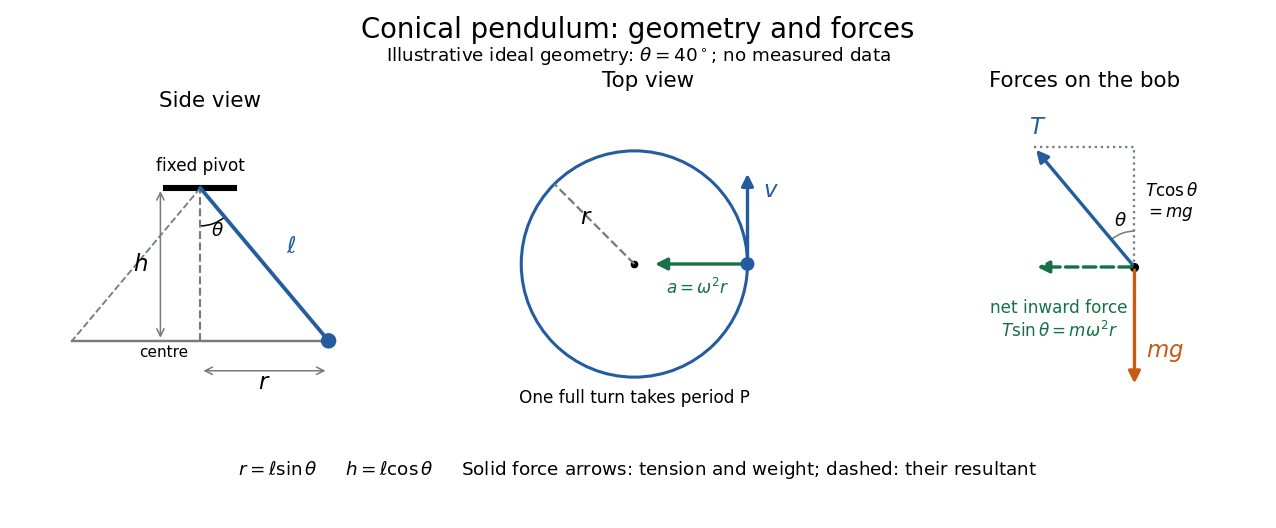

The right triangle formed by the pivot, the orbit centre, and the bob gives and . Here is the orbit radius and is the vertical drop from the pivot to the bob's horizontal plane, not the bob's height above a table. Write for tension, for the oscillation period of one revolution, and for the angular speed; then the bob's speed is . A side view compresses the horizontal circle to a line segment; the top view reveals the circle and its tangent velocity.
The two actual forces on the bob are tension toward the pivot and gravitational weight vertically downward. The vertical acceleration is zero, while the horizontal centripetal acceleration is . Thus Newton's second law givesThe inward net force is the horizontal component of tension, rather than an extra interaction to add to these two forces. Constant speed still requires acceleration because the velocity changes direction. [ref]
https://openstax.org/books/university-physics-volume-1/pages/6-3-centripetal-force. Ling, Sanny and Moebs, University Physics 1, §6.3: centripetal acceleration and net force
Dividing the two component equations and using gives the useful collection of predictionsIf is the azimuthal angle, then ; either direction of rotation satisfies . The mass cancels from the angular speed and oscillation period, but not from the tension. The motion is a relative equilibrium: in a rotating frame following the bob at angular speed , its position is fixed. This is a concrete way to see how rotational symmetry can turn an apparently moving solution into a stationary one.
A signed spatial filter model of a simple cell assigns a weight to each sampled location and takes its dot product with the visual contrast image . Positive weights favor bright features; negative weights favor dark features. The signed driveis a linear function of the image, while the rectified linear unit output is nonlinear. and below are arbitrary model units. To obtain a predicted firing rate one would need a calibrated gain, background response and possibly a different output function. The model does not generate a spike train; a linear-nonlinear-Poisson cascade model adds a stochastic event-generation assumption.
For the first diagram, every one of five rows has weightsA bright central column, with and zero elsewhere, gives . A bright middle row gives ; a uniformly bright patch also gives , since every row sums to zero. Move the bright column one site right: , so . Make that shifted column dark instead: and . Thus an OFF-like weight can increase output for darkness. A negative weight is a descriptive sensitivity, not evidence for a particular inhibitory synapse.
For a smooth example use the real, even Gabor filterThe Gaussian function localizes the weights; the cosine supplies alternating polarity. Choose , and in arbitrary spatial units. The stripes' spatial frequency is cycles per unit. Their axis makes angle with horizontal, while brightness changes across the perpendicular axis. is their spatial phase. Normalize the full-plane integral of by its value at , . The Gaussian integral and the product identity for cosines givewhereAt , horizontal stripes give , stripes give , and vertical stripes give . At the same vertical orientation, gives , while reversing the polarity with gives and . The preferred axis persists while the response changes dramatically with position. Shifting the vertical stripes by a quarter of their wavelength changes phase by up to sign, without rotating them.
These are two different toy filters, not discretizations of the same fitted receptive field. The discrete filter exactly rejects a uniform contrast patch; this Gabor filter need not reject uniform contrast because its weight integral need not vanish. Neither toy includes stimulus history, recurrent interactions, saturation or a measured response baseline. Their value is a transparent prediction: orientation selectivity can emerge from spatial summation, and it does not by itself imply tolerance to phase.
A renovating shear flow holds a planar shear flow fixed for an interval , then chooses a fresh orientation independently of preceding intervals. Each interval acts on a material line by a rotated copy of the displayed deformation gradient. The orientation law must be specified: independent uniformly distributed orientations define the isotropic model, whereas a biased orientation law generally gives another Lyapunov exponent.
Let be a nonempty partially ordered set. If every chain in a partial order has an upper bound in , then has a maximal element. The hypothesis meansThe upper bound may depend on and need not belong to . A least upper bound is not required. The conclusion asserts that some satisfies ; it does not assert a greatest element, which would satisfy for every .[ref]
How to use Zorn’s lemma by Timothy Gowers. How to use Zorn’s lemma, “General discussion”: statement and distinction between maximal and bigger than everything else
Here a chain in a partial order may be the empty set. Every member of is an upper bound of the empty chain in a partial order, so including it in the hypothesis already forces to be nonempty. If “chain” means only nonempty chains in a partial order, the separate nonempty- assumption is essential: the empty poset otherwise satisfies the hypothesis vacuously and has no maximal element. These are two equivalent conventions for the theorem.
The strength of Zorn's lemma is that compatible partial constructions can have a completed, unextendible member without an explicit procedure for finding it. The next examples separate the upper bound calculation from the reason a maximal element has the desired property. All chains in a partial order must be covered, including uncountable ones, rather than just increasing sequences. The condition is sufficient, not necessary: a poset can have a maximal element and still have an unbounded chain in a partial order elsewhere.
A standard model of set theory interprets membership by the ambient membership relation restricted to its domain. A transitive model additionally has a transitive set or class as its domain. Standardness alone does not impose transitivity.
A family of subsets of is independent when every finite choice of distinct members and their complements has nonempty intersection. Write and in the displayed condition. Every assignment of zero or one to the family then gives a collection with the finite intersection property, which can be extended to an ultrafilter.
Two sets with exactly the same members are equal. In a transitive model, all actual members of its sets are available internally, so ambient extensionality gives the internal axiom as well.
For any two sets there is a set containing exactly those two members. Together with other ZFC axioms it permits ordinary ordered-pair coding. Countable-subset closure implies this axiom for the structure of hereditarily countable sets.
Objects have sorts , with membership allowed only from sort to sort . A set predicate distinguishes sets from atoms; atoms have no members, extensionality applies to sets, and every well-typed formula defines a set in the next sort by comprehension. First-order models may have only a specified collection of subsets, as in Henkin semantics. For a full finite-type model, take at widely separated increasing ranks, represent sets at level by , and treat the remaining objects as atoms under typed membership.
New Foundations uses ordinary extensionality and comprehension restricted to stratified formulas. Its atom-permitting weakening is New Foundations with urelements.
For a strong-limit cardinal of countable cofinality, defineHere smallness bounds every individual membership extension; it does not bound the cardinality of the entire transitive closure. The transitive class satisfies all ZF axioms except possibly the Axiom of union: functional images have fewer than elements, and the power set of a set of size has size . These facts give Axiom schema of replacement and Axiom of power set; pairs and definable subsets also remain locally small. For , the countable set belongs to , but its union has size and does not. This gives an explicit relative-independence model for the Axiom of union.
An urelement is an object permitted alongside sets, with no members, distinguished from the empty set by an atom or set predicate. Extensionality is restricted to sets, so distinct atoms need not be equal merely because they have no members. An atom is different from a Quine atom, which is a set with a self-member. In simple typed set theory with atoms, each sort may contain urelements in addition to the objects representing subsets of the preceding sort.
Unrestricted formation of a set contradicts its own membership condition: substituting for gives the displayed equivalence. Thus a predicate cannot always define a set of all objects satisfying it. Restricted set comprehension forms a subset of a previously given set, avoiding this argument. The contradiction does not assert that a set whose elements happen not to contain themselves is impossible; it rules out the universal collection with exactly the specified membership condition.
There are unlisted articles, also show them or only show them.