
A spherical triangle is bounded by three great circle arcs. For the usual convex minor spherical triangle, the vertices are neither antipodal nor on one great circle, and its angular sides and interior angles lie in . An interior angle is measured between outgoing tangent vectors to the two sides at a vertex, rather than between straight chords inside the sphere. The spherical law of sines and spherical law of cosines determine its side-angle relations; the spherical excess formula determines its area.
Spherical trigonometry calculates the sides and interior angles of spherical triangles using trigonometric functions. Its sides must be shorter great circle arcs, which are geodesics on a round sphere. A curve at constant nonzero latitude does not qualify. The spherical law of sines and spherical law of cosines play the roles of the familiar flat-triangle rules, but account for the sphere's curvature.
Use uppercase both for the vertices and for their interior angles, and lowercase for the opposite angular sides. For example, is the central angle subtended by the arc from to . On a sphere of radius , its physical arc length is when is in radians; similarly and . Only on the unit sphere do the angular and physical side lengths have the same numerical values. See J. B. Tatum, Celestial Mechanics, chapter 3, section 3.5: great-circle sides and angular units.
One useful application of spherical trigonometry is finding great-circle distance from spherical coordinates. Write a unit vector as , where is latitude and is the equatorial azimuth, or longitude, measured from a chosen reference direction. The dot product of two such unit vectors givesHere is the central angle and is the great-circle distance. The same identity follows from the spherical law of cosines by adding the north pole as the third vertex, with angular sides and . This connects spherical geometry to position calculations in astronomy and to navigation on a spherical model of Earth. Choosing the surface model matters: Paula Neeley and Anthony Narkawicz, Map Projection Induced Variations in Locations of Polygon Geofence Edges, NASA/TM-2017-219675 (2017), sections 2-3 distinguishes spherical and ellipsoidal geodesics and gives this coordinate identity.
For a toy example, put two points at latitude , with equatorial azimuths and . The great-circle distance and the arc length along constant latitude areThe great circle takes a shorter route by bending towards the pole in these spherical coordinates. To locate its highest latitude, the endpoint unit vectors are and . Their great circle lies in the plane through the origin with . On its shorter arc, the maximum latitude occurs at and is . Thus a geodesic can change latitude substantially even when its endpoints have equal latitude. These are lengths on an ideal sphere; the example illustrates the geometry rather than specifying an actual flight route.
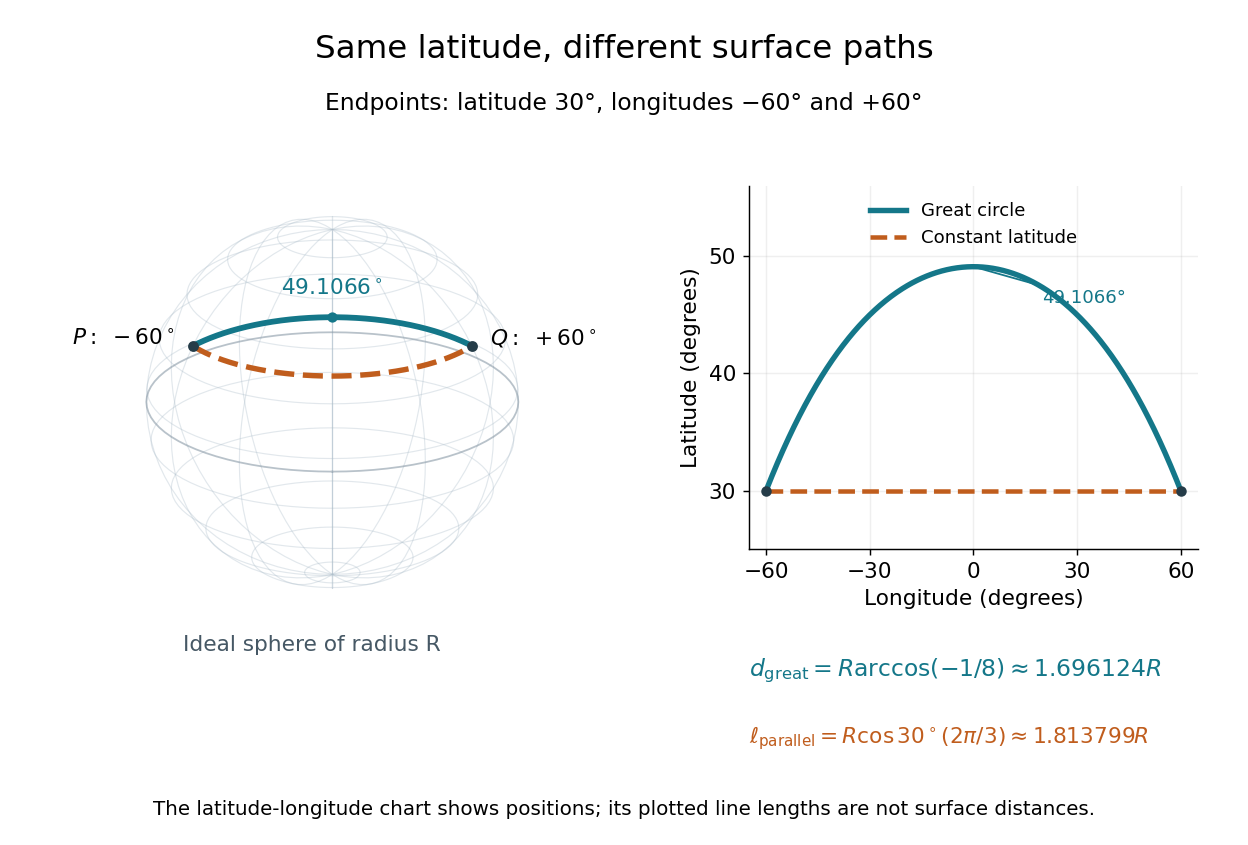
On an ideal sphere, two points at latitude and longitudes are joined by a shorter great-circle arc reaching latitude
. Details. 
Historically, spherical trigonometry was prominent in teaching as well as in astronomy. John Conway and Alex Ryba note its presence in early twentieth-century school textbooks in Remembering spherical trigonometry, The Mathematical Gazette 100(547), March 2016, pages 1-8, DOI 10.1017/mag.2016.3. Their introductory observation documents that teaching history; it does not identify a single inventor of the spherical law of sines or spherical law of cosines.
For points on a sphere of radius , write their position vectors relative to the centre as with unit vectors. The great-circle distance is the shorter great circle arc length, times its central angle. Hence it equals , including zero for identical points and for antipodal points. At antipodal points the shortest arc is not unique, but its length is.
A spherical lune is the region between two great semicircles joining antipodal points. On a unit sphere a lune of opening angle has area , obtained by integrating area over longitude width . Lune area counting yields the spherical excess formula.
On a sphere of radius , a spherical circle of radius is the locus at spherical distance from its center. Its polar angle about that center is , so parametrization by longitude has speed . Its circumference is therefore . For small , this is , with the deficit determined by the sphere's positive Gaussian curvature.
On a sphere of radius , a nondegenerate convex convex regular spherical polygon with sides, contained in an open hemisphere, has equal interior angles satisfyingThe spherical excess formula gives its area as ; the excess itself equals the area only on the unit sphere. Conversely, place equally spaced vertices at colatitude around a pole. Bisecting each central spherical triangle gives by the spherical law of cosines. As increases, the interior angle ranges continuously from the Euclidean limiting value to .
For a sphere with centre and radius , and a plane with unit normal , the orthogonal projection of onto the plane is . The orthogonal decomposition gives the intersection circle radius by the Pythagorean theorem. A genuine circle requires ; equality gives tangency and larger distance gives no intersection. The signed displacement is not determined by the two radii alone: it is with sign fixed by the oriented plane.
For a parametric surface , source parametric curve and eye , put and . The visible reflection locus satisfies , with the source and eye on the reflecting side. Rank two of the resulting Jacobian matrix gives a locally one-dimensional locus in by the implicit function theorem.
// Target: analysis.bigb
The joint spectral radius measures the worst exponential growth under arbitrary products from a finite family of matrices. Submultiplicativity gives its existence and invariance under changes of the chosen norm. Every fixed-length product satisfies , while the maximum norm of all length- products to the power is an upper bound. A repeated product gives the first inequality; grouping an arbitrary long word into blocks proves the second. The spectral radius of each individual matrix does not control growth of all switched products.
For a holomorphic Banach algebra-valued function, put . Apply the Hadamard three-circle theorem to the holomorphic powers . The continuous functions decrease to the spectral radius. Supremum convergence for decreasing continuous functions passes the boundary suprema to the limit, proving the inequality with the same logarithmic interpolation parameter. In particular, at the geometric-mean radius, the square of the middle spectral radius is at most the product of the two boundary suprema.
A 4f pulse shaper uses a diffraction grating to disperse an input pulse, a lens to focus its frequencies at different positions in a shared Fourier plane, a spectral mask or spatial light modulator there to modify them, and a second lens and grating to recombine them. In the symmetric idealization the distances are , with the lenses separated by . Shaping the spatially resolved spectrum implements spectral pulse shaping rather than a direct time-domain mask.
Phylogenetic species concepts use ancestry and diagnostic inherited differences; versions differ over requiring a clade, an exclusive ancestry pattern at genetic loci, or a distinguishable character combination. State which criterion is intended. [ref]
Species Concepts and Species Delimitation by Kevin de Queiroz. p. 880, Table 1: distinct monophyletic, genealogical and diagnosable versions of phylogenetic criteria
For an original operational example, suppose a phylogenetic tree inferred from one genetic locus separates two sampled biological populations. Compare further genetic loci and additional local samples before interpreting that branch as a species boundary. Otherwise the test may merely identify the particular ancestry of the sampled alleles. Adding more sites from the same genetic locus improves that locus's evidence without creating an independent ancestry test.
A morphological species concept distinguishes species using morphology: measurable differences in form or structure. It can be applied to preserved specimens and fossils when mating cannot be observed. Similar appearance need not imply the same species, and different appearance need not imply different species. [ref]
Biology 2e by Mary Ann Clark and others. §18.2, “Species and the Ability to Reproduce”, paragraphs accompanying Figures 18.9–18.10: appearance can mislead
An original operational example is to compare a chosen structure in specimens of comparable age, sex and rearing conditions. Suppose two apparent groups differ in size, but one group contains only juveniles. The observed difference does not yet diagnose two species. Specify the measured phenotype, variation within each sample, and whether the distinction persists across comparable specimens. A single striking specimen is a poor substitute for that comparison.
The biological species concept groups naturally interbreeding biological populations with viable, fertile offspring, distinguished from other such groups by reproductive isolation. An operational test examines mating, fertilization, offspring survival and offspring reproduction, rather than only whether two adults can be paired. Sexual reproduction is its scope: fossils and organisms studied only through asexual reproduction cannot supply the same mating evidence. [ref]
Biology 2e by Mary Ann Clark and others. §18.2, “Species and the Ability to Reproduce”, “Speciation” and “Reproductive Isolation”
For an original hypothetical example, imagine two separated biological populations that reproduce successfully after contact. The separation alone did not demonstrate reproductive isolation. Conversely, failure to mate in one unfamiliar chamber could reflect the assay conditions. Field observations of gene flow and tests under suitable conditions address the biological question more directly. A successful laboratory pairing does not establish frequent interbreeding in nature.
A spacetime extension is an isometric embedding of a spacetime as a proper open subset of a larger connected spacetime with a nondegenerate Lorentzian metric. The allowed differentiability class must be specified: analytic, smooth and low-regularity extensions are different questions. Divergent curvature can obstruct a regular extension even when an incomplete geodesic has finite affine length.
A spacetime event is an idealized occurrence at one point of spacetime, such as a light pulse reaching a detector. An inertial frame assigns spatial coordinates and a time coordinate to it. Different frames can assign different coordinates to the same spacetime event; the event itself is not changed by a coordinate transformation.
The solar wind is the outward plasma flow from the Sun, carrying an interplanetary magnetic field. Its pressure and field compress intrinsic planetary magnetospheres, form magnetotails, and can drive an induced magnetosphere around a planet with no appreciable intrinsic field.
Firn is compacted, recrystallized old snow that has not yet become dense glacier ice. Its porosity affects meltwater infiltration and heat transfer.
For a specified finite prime factor base , a nonzero integer is -smooth if every prime dividing its absolute value belongs to . Negative residues are handled by including the sign in their exponent vectors. This notation refers to a finite prime set, rather than the alternative convention in which a numerical smoothness bound is called .
There are unlisted articles, also show them or only show them.