
Anfinsen, Haber, Sela and White's 1961 experiments began by treating bovine pancreatic ribonuclease A with mercaptoethanol in urea. Urea promotes unfolding; mercaptoethanol breaks protein disulfide bonds. The peptide bonds along the chain remain intact. After separating the chain from those reagents, the authors allowed its reactive sulfur groups to form protein disulfide bonds in the presence of molecular oxygen, at pH and temperature –. They examined protein concentrations of and . Measurements showed recovery of native properties under these conditions; the isolated major component had normal activity toward both RNA and a synthetic substrate. See Anfinsen, Haber, Sela and White, The Kinetics of Formation of Native Ribonuclease during Oxidation of the Reduced Polypeptide Chain, PNAS 47, 1309–1314 (1961), pp. 1309–1311.
The observation supports the sufficiency of that intact sequence to recover native protein structure in the tested surroundings without a folded template. It does not establish that every protein refolds, that the original living biological cell needed no assistance, or that activity always returns immediately. Protein folding, forming protein disulfide bonds and recovering an active site are related processes rather than interchangeable measurements.
Anfinsen's lecture also discusses forming protein disulfide bonds while the chain remains in concentrated urea. This gave mostly inactive material; after removing urea, a small amount of mercaptoethanol permitted rearrangement toward the native form. As an exact combinatorial check, eight labeled reactive sulfur groups have ways to be paired into four protein disulfide bonds: choose the partner of one group, then repeat with the unpaired groups. Only one pairing is the native one. Equal counting does not mean that all pairings are equally likely experimentally, nor that actual protein folding searches them uniformly. See Anfinsen's Nobel lecture, 1973 publication: scrambled ribonuclease and the 105 pairings, p. 223.
The Wheatstone bridge has four resistor arms and two diagonals. Here the supply holds node at constant electric potential difference relative to node , our electrical reference potential. The left path is ; the right path is . The unknown is , and is adjustable. A voltmeter or galvanometer connects to . We define its positive reading as ; exchanging its leads reverses the sign. All four electrical resistances are positive, the supply is ideal, and the calculation describes steady electric currents at fixed temperature.
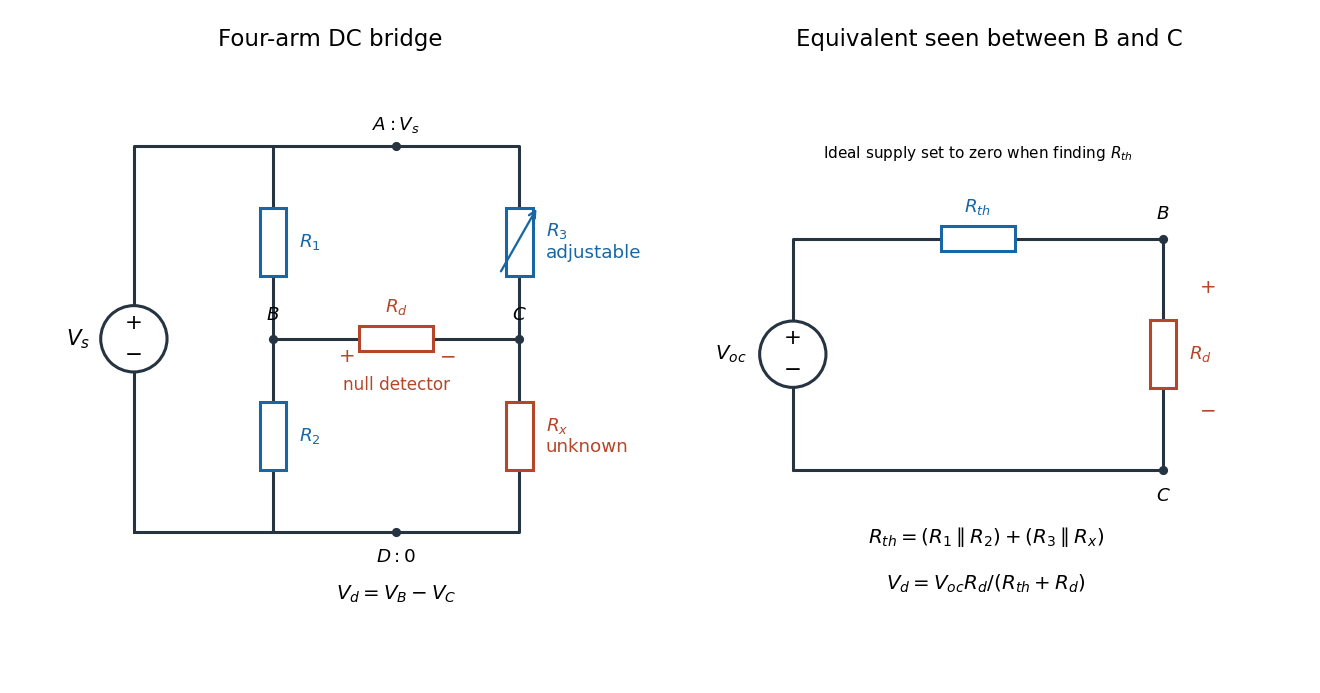
Four labeled Wheatstone bridge arms and the equivalent circuit seen by the detector
. The supply spans ; the detector spans and reads . The right panel uses Thévenin's theorem to replace the bridge by its open-circuit electric potential difference and a series electrical resistance. Source. Details.
Charles Wheatstone described the instrument in his 1843 Bakerian lecture while explicitly crediting Samuel Hunter Christie. The account from King's College London's collection identifies that attribution; the familiar name should not be read as an assertion that Wheatstone alone originated the bridge.[ref]
Wheatstone Collection by King's College London. Wheatstone Collection, section “Wheatstone's contributions to electricity”: 1843 lecture and credit to Samuel Hunter Christie
If the origin of a nonrotating reference frame has inertial position and a particle has relative position , then . Newton's second law becomes . The effective inertial force is therefore . No rotation-dependent terms arise because the coordinate axes remain parallel to the inertial axes.
A reduction decreases an oxidation state, recording gain in the formal electron assignment. For , the decrease is . The reduced chemical species serves as the oxidizing agent in the coupled redox.[ref]
Chemistry 2e by Paul Flowers and others. §4.2, “Oxidation-Reduction Reactions”: reduction as decreasing oxidation number
In the electrochemistry examples here, reduction is gain of electrons by a chemical species; it occurs at the cathode. That electrode definition holds in both a galvanic cell and an electrolytic cell; it does not fix terminal polarity.
A redox titration adds a measured amount of substance of one reactant to determine another through a known redox chemical equation. The burette reading becomes an amount through concentration; the balanced chemical equation supplies the amount ratio. A colour endpoint additionally needs a chemical explanation, as in the permanganate-iron titration.
The useful bridge is an electron inventory. If each sample entity supplies electrons and each titrant entity accepts , matching the formal exchanged amount of substance of electrons givesHere is the titrant molar concentration and the volume attributable to the sample at the equivalence point. These are net half-reaction counts, not a claim that free electrons accumulate in the flask. The redox conversion must be sufficiently complete and selective for the stated stoichiometry to identify .
This is why a small visible signal can reveal a much larger invisible inventory: the signal locates a stopping point, while titrant standardization and stoichiometry turn delivery into amount of substance. The titration endpoint estimates the equivalence point; repeatable colour alone establishes neither correct titrant concentration nor chemical selectivity. The permanganate-iron endpoint and blank model separates these assumptions.
An oxidation increases an oxidation state, recording loss from the formal electron assignment. For , the increase is . Oxidation need not involve oxygen.[ref]
In the electrochemistry examples here, oxidation is loss of electrons by a chemical species; it occurs at the anode. That electrode definition holds in both a galvanic cell and an electrolytic cell; it does not fix terminal polarity. The oxidized chemical species serves as the reducing agent in the coupled redox.
A genetic genetic carrier has one disease-associated recessive allele and one normal allele at a genetic locus, and is unaffected under a fully penetrant recessive model. Two genetic carriers have affected-offspring probability under Mendelian segregation; a genetic carrier and an individual with no disease allele have affected-offspring probability zero under that same mutation-free model.
Sibling recurrence risk is the conditional probability that another child has the disease, given an affected sibling. For unaffected parents, complete penetrance and a single recessive disease allele, the affected child identifies both parents as genetic carriers. Independent Mendelian segregation then gives recurrence probability , whether or not the parents are related. Incomplete penetrance, phenocopies, different causal loci or affected parents change this calculation.
// Target: biology.bigb
Receptor binding occupancy is the fraction of binding sites occupied by a ligand. Consider reversible, noncooperative binding at chemical equilibrium, with homogeneous independent sites: every site has the same binding properties, and binding at one site does not change binding at another. Let denote free ligand, an unoccupied receptor site and the bound complex. In this dilute concentration model,Square brackets denote concentrations; is the total site concentration. Here the dissociation constant has concentration units. Use free ligand in excess so binding negligibly depletes it; only under that approximation may the supplied total ligand concentration substitute for . See Analysis of Receptor–Ligand Interactions: equilibrium binding and saturation.
For an illustrative dissociation constant , where , free ligand concentrations , and give , and , respectively. At , exactly half the sites are occupied in this model. Raising tenfold from to raises occupancy from to about , rather than tenfold: the finite pool of sites causes saturation.
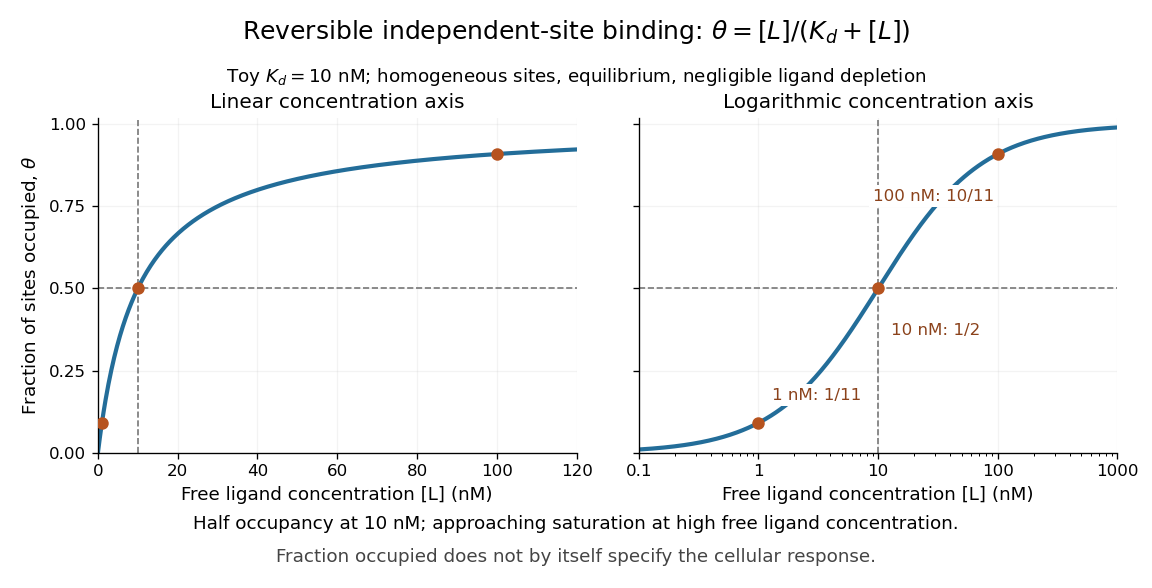

A short derivation uses the law of mass action: at chemical equilibrium, association balances dissociation, giving . Substitute this into and cancel to obtain the displayed formula. The limiting values follow directly: zero free ligand gives zero occupancy, and increasing far above drives occupancy toward one.
Receptor binding occupancy is not automatically the fraction of maximal response. Signal amplification, differing effects of bound ligands, and downstream saturation can change the relationship. Consequently, specifies half occupancy here; it does not universally specify either half-maximal or maximal cellular response. These numbers describe a toy binding model, not measured responses of every receptor. See Higham and Colquhoun, 2024: the affinity–efficacy problem.
There are unlisted articles, also show them or only show them.