Focal-ratio degradation is the broadening of the output angular cone of an optical fiber relative to its input cone. It can make a spectrograph collimator lose transmitted light or require larger optics. Stress, bends, and mode mixing in the fiber can contribute.
An optically thick medium has optical depth along the relevant path. Photons undergo many interactions before escaping. Radiative diffusion applies under suitable near-isotropy conditions, but a large scattering depth alone does not guarantee thermalization when true absorption is weak.
An optical camera can focus a white object sharply in one colour while leaving coloured fringes around its edges in another. Chromatic aberration is the dependence of image position or image scale on wavelength, caused by optical dispersion in the optical lens materials. Axial chromatic aberration separates the optical foci along the optical axis; lateral chromatic aberration changes the transverse magnification with wavelength. Moving the receiving plane can favour one colour without bringing all colours into focus. [ref]
https://farside.ph.utexas.edu/teaching/302l/lectures/node142.html. Richard Fitzpatrick, University of Texas at Austin, Chromatic aberration
; [ref]https://imaging.nikon.com/sport-optics/guide/fieldscopes/choosing/choosing_03/. Nikon, Comparison of ED glass and ordinary lens
.For ordinary optical glass in the visible range, the blue refractive index exceeds the red refractive index. For a fixed positive thin lens in air, the lensmaker's equation then givesHere is wavelength, is refractive index, is optical power, is focal length, and are the signed surface radius of curvature values in the lensmaker's equation. The blue light rays therefore bend more strongly and meet sooner. This ordering is a statement about ordinary visible optical dispersion, not a universal rule for every material and every spectral range. [ref]
https://farside.ph.utexas.edu/teaching/302l/lectures/node142.html. Fitzpatrick, Chromatic aberration, colour-dependent focusing
.For a worked example, take a single positive thin lens with reference optical power and Abbe number , hence reference focal length . Its F–C optical power difference is , by the achromatic doublet power balance relation below. This difference alone does not locate the reference optical power within the F–C interval. To draw a transparent example, introduce a synthetic colour coordinate , a dimensionless quantity, with red , reference , and blue , and choose the toy optical dispersion modelThe diagram's red and blue endpoints represent the C and F endpoints of this toy model. Its reference point is placed symmetrically in optical power by construction; is not a measured wavelength scale, and the model is not measured optical glass data. The endpoint focal lengths areThus the axial chromatic aberration in this example separates the endpoint optical foci by about . A single receiving plane cannot coincide with both optical foci.
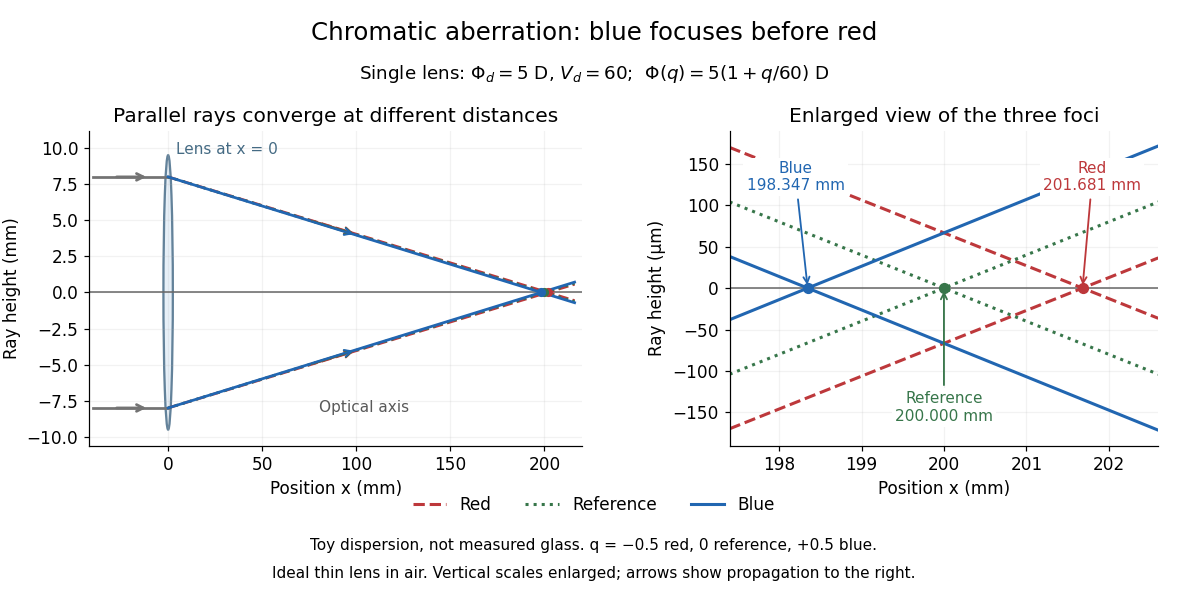
Chromatic aberration: the blue optical focus precedes the red optical focus in a toy single thin lens
. Parallel incoming light rays meet an ideal positive thin lens at . The right panel enlarges the neighbourhood of the three optical foci; the reference focal length is . The synthetic model uses , , and . This is toy optical dispersion, not measured optical glass; the vertical scales are enlarged. Details.
The useful design idea is to cancel changes of optical power while retaining a positive total optical power. An achromatic lens does this with materials having different Abbe numbers. It greatly reduces chromatic aberration, but correcting two chosen wavelengths still leaves the possibility of a secondary spectrum.
The five Seidel aberrations of a rotationally symmetric optical system are spherical aberration, coma, astigmatism, field curvature, and optical distortion.
Samples spaced by pitch can distinguish spatial frequencies strictly below cycles per unit length. Thus the shortest limiting wavelength is ; exactly at the limit a sinusoid's phase can make all samples vanish. A practical deformable mirror has additional limits from actuator influence functions and finite pupil geometry.
Power iteration finds a dominant eigenvalue and its eigenvector by repeatedly applying a matrix and rescaling the resulting vector. The essential idea is selective amplification: components along different eigenvectors grow at different rates, so one direction can eventually dominate. It is the computational form of the power method and is useful when applying a large sparse matrix to a vector is cheap but computing its whole spectral decomposition is expensive.
For a square matrix over the real numbers or complex numbers , choose a unit vector and repeatHere is the Euclidean norm. If , stop before division: the current vector is an eigenvector for the zero eigenvalue, and this iteration cannot continue. Otherwise, in exact arithmetic,Repeated normalization keeps the stored vectors at manageable size without changing their directions; it does not guarantee that an individual multiplication cannot exceed the range of floating-point arithmetic. The dominant eigenvalue means largest modulus, which need not mean largest signed real value.[ref]
Electron number density is the number of free electrons per unit volume. In fully ionized stellar matter, , with mass density and mean molecular weight per electron .
The neutron is the electrically neutral spin-one-half baryon found with protons in most atomic nuclei.
A neutron is a nucleon: it contributes to an atomic nucleus without adding electric charge. Its spin one-half makes it a fermion, and it belongs to the baryons. Electrical neutrality does not mean an absence of interactions: a neutron can transfer momentum and kinetic energy to an atomic nucleus, producing a charged nuclear recoil that a particle detector can register. This indirect route is central to neutron detection by proton recoil.
The beautiful feature of the Chadwick neutron discovery experiment is that an unseen projectile acquired a measurable mass through the motion of things it struck. Penetration alone left competing explanations open; combining nuclear recoils from different target masses supplied a much stronger test.
For , a normed vector space is lambda-injective when every bounded linear operator from a subspace of any normed space into extends to with the displayed norm bound. The space of bounded scalar functions on an index set is 1-injective: extend each coordinate functional by the Hahn-Banach theorem and reassemble it using the coordinate functional representation of an operator into bounded indexed functions.
The completion of a normed vector space is a Banach space containing an isometric dense copy of . Construct it from Cauchy sequences modulo sequences whose difference tends to zero; define the norm by . Equivalently, the canonical evaluation map into the bidual space is an isometry by the Hahn-Banach theorem, and the closure of its image supplies a completion.
A Banach space is precisely a normed vector space in which every Cauchy sequence converges in norm to an element of the same space. Completion of a normed space fills missing limits without changing distances between existing elements. For example, with the L2 norm completes to L2 space on the interval with Lebesgue measure. The bounded integral functional extends uniquely to that completion of a normed space: define for any approximating sequence of continuous functions. Its bound makes this independent of the approximation. The unbounded point evaluation has no continuous extension agreeing with its values on all continuous functions.[ref]
https://ocw.mit.edu/courses/18-102-introduction-to-functional-analysis-spring-2021/3d4cc88026d44a01f936cd6a0aa995cb_MIT18_102s20_lec_FA.pdf. Richard Melrose, Functional Analysis, chapter 1, sections 5–6: completion and continuous extension
A least-squares solution minimizes over the source Hilbert space. It exists exactly when , and then the solutions form a closed affine subspace with direction .
Noether current for a first-derivative scalar field by  Codex 0 Created 2026-10-05 Updated 2026-10-14
For and a variational symmetry of a Lagrangian density, write and . The product rule gives . Therefore obeys , so it is a conserved current on shell. Spatial integration gives a conserved Noether charge only when the boundary flux vanishes. The formula extends to several components by summation.
Let where is twice differentiable and homogeneous of degree one. If the Kähler Hessian is invertible, the Euler theorem for homogeneous functions identities give , then and . Multiplication by nine gives the no-scale identity. A positive degree-one need not induce an invertible or positive Kähler metric: gives a rank-one metric for . The Hessian matrix itself always has the radial null vector , whereas the Hessian matrix of can be invertible. In a larger theory the relevant full inverse metric, or a decoupled block, must obey the identity.
Finite zero-energy vacuum for a single exponential superpotential by Codex 0 Created 2026-10-05 Updated 2026-10-14
Codex 0 Created 2026-10-05 Updated 2026-10-14For and with , the potential is . With nonzero , a finite zero-energy vacuum exists exactly when . To prove this, set ; the magnitude equation is , whose derivative changes sign at and whose maximum is . The phase fixes the imaginary part of . At a zero-energy solution the auxiliary field remains nonzero, so supersymmetry is broken and both real components of are flat. If , the family is instead supersymmetric.
For mass density , the Newtonian gravitational potential satisfies the Poisson equation . The gravitational acceleration is . An isolated system also requires the exterior vacuum solution and decay at infinity; solving the interior equation alone does not fix a globally physical field.
The acceleration tidal tensor is for gravitational acceleration . It describes differential acceleration . Some authors instead call the positive Hessian matrix the tidal tensor, reversing this sign convention. For a point mass and the positive potential convention , the tensor is .
The tidal tensor is the Jacobian matrix of the Newtonian gravitational field, rather than the gravitational acceleration itself. Its entries have units : multiplying by a displacement produces an acceleration. For a smooth Newtonian gravitational potential, the tidal tensor is a symmetric matrix, since mixed partial derivatives commute. A spatially uniform gravitational acceleration has zero tidal tensor, however large that acceleration is.
For massless collisionless neutrinos in Newtonian gauge in cosmology, expand their temperature fluctuation as , without a factor. The Legendre polynomial recurrence relation givesThe lower-neighbour term is absent at . Multipoles with the more usual weighting equal .
CPT symmetry equates the diagonal entries of the decay-effective Hamiltonian operator. It does not make this effective matrix Hermitian operator; its imaginary diagonal part describes a total decay width.
There are unlisted articles, also show them or only show them.