
A measurement channel writes a POVM's outcome into an orthogonal classical register:For any input orthonormal basis , the Kraus operators realize this map and satisfy . It is therefore a trace-preserving completely positive map.
When a Cox proportional-hazards model uses the Breslow estimator, the sum of fitted martingale residuals is zero. Each estimated baseline hazard jump redistributes one observed event across its risk set, so summing cumulative fitted intensities equals summing observed event counts. The identity holds for any finite regression coefficient used consistently in both calculations.
For fair independent and identically distributed random variables with the Bernoulli distribution, is a nonnegative martingale. It has almost sure convergence to zero but , so it lacks convergence in L1.
For a real continuous function on , let be its secant slope on each length- dyadic cell. Regard as a probability space and use the filtration of half-open dyadic cells with the endpoint as a separate null cell. The mean of the two child slopes equals the parent slope, so is a martingale. Its integral gives the linear interpolation of on that grid. If is Lipschitz continuous, these slopes are bounded by its Lipschitz constant; the Lp martingale convergence theorem then supplies a bounded integral density for .
For a killed Markov process and a positive harmonic function , its Doob h-transform weights the path law through a stopping time by , with localization when necessary. It describes conditioning on a boundary behaviour of probability zero. In the complex upper half-plane, conditions killed planar Brownian motion to remain in that half-plane.
An affine process is a time-homogeneous Markov process whose conditional moment-generating function is exponential-affine in its starting state. In discrete time one writes on the finite exponential moment domain. Continuous-time definitions allow the functions to depend also on elapsed time.
Two Directed acyclic graphs are Markov equivalent directed acyclic graphs if and only if they have the same skeleton of a directed graph and the same unshielded colliders. Thus these two structures determine the observational equivalence class. This structural theorem is what converts the skeleton and collider phases of the PC algorithm into identification of an equivalence class.
The completed partially directed acyclic graph of a Markov equivalence of directed acyclic graphs class has their common skeleton of a directed graph. An edge is directed exactly when its orientation agrees in every member of the class, and is otherwise undirected. It can be constructed by enumerating all acyclic orientations with the prescribed unshielded colliders and retaining only the common directions; practical PC algorithms use orientation propagation instead of enumeration.
A fiber monodromy is the return homeomorphism of the fiber of a bundle over . Its mapping torus reconstructs the total space.
A smooth atlas is a collection of manifold charts covering a topological manifold whose coordinate changes are smooth transition maps. It determines a smooth manifold structure by adjoining every compatible chart.
The terminal-age main sequence denotes the end of central hydrogen burning. It does not mark complete exhaustion of hydrogen throughout the star; a hydrogen-burning shell can subsequently supply its luminosity.
A cylindrical magnetostatic equilibrium is an axisymmetric vector field and pressure configuration independent of the axial coordinate. Its radial Lorentz force density balances the pressure gradient, as expressed by cylindrical magnetostatic pressure balance.
A poloidal magnetic field lies in meridional planes through the symmetry axis, in contrast to a toroidal magnetic field. For an axisymmetric vector field, it is represented by a poloidal magnetic flux function as .
A flux tube is a bundle of magnetic field lines bounded by a surface everywhere tangent to the magnetic field. Gauss's law for magnetism makes the magnetic flux through any transverse cross-section constant along the tube. For a narrow tube with nearly uniform field magnitude and transverse area , this gives .
A magma intrusion is the emplacement of magma into surrounding rock. A shallow, approximately axisymmetric intrusion can lift an elastic plate roof, with spreading determined by viscous peeling of an elastic plate or fracture toughness.
With and formal edge conditions , the lubrication theory equation is . Its positive separated long-time profile hasWriting in terms of the beta function, the centre height is . The edge region of a draining viscous film determines how the singular outer profile matches the flow over the physical edge.
For a thin viscous gravity current with hydrostatic pressure , a no-slip boundary condition at its base and a stress-free boundary condition at its top, horizontal momentum balance gives . Integrating across the depth gives the volume flux . Horizontal spreading follows if the substrate is impermeable.
For measurable functions with values in the real numbers or complex numbers on the same measure space , and , membership in the same Lp space givesThus adding two functions cannot make their combined Lp norm exceed the sum of their separate Lp norms. The measure need not be finite or a probability measure. The hypotheses require finite Lp norms; uses the essential supremum of the absolute value, not an ordinary pointwise supremum. For complex numbers, the absolute value is the complex modulus. As usual, Lp spaces identify functions equal almost everywhere. [ref]
Measure, Integration & Real Analysis by Sheldon Axler. Axler, Measure, Integration & Real Analysis, §7A, Definition 7.1, pp. 194–195, and Theorem 7.14, p. 199
The Minkowski inequality makes the Lp norm a workable notion of size: it supplies the triangle inequality needed to turn into a metric on Lp space. Applied to , it says that travelling through an intermediate function cannot shorten the direct distance measured by this metric. Applied to two error functions, it gives a bound on the total error even when the errors reinforce one another; Minkowski inequality for error aggregation gives explicit examples.
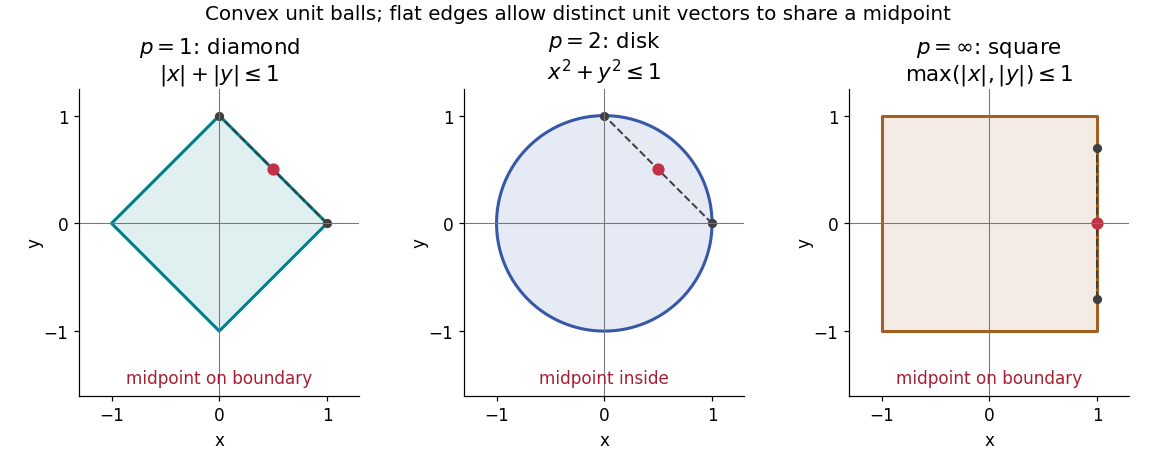
The geometry is already visible in the Euclidean plane. Under counting measure on two coordinates, the closed unit balls for the L1 norm, Euclidean norm, and L-infinity norm are respectively , , and . Every one is a convex set: if have Lp norm at most one, the Minkowski inequality and absolute homogeneity of a norm give for . The Euclidean norm has no flat boundary segments, whereas the other two norms do. This is the distinction captured by a strictly convex normed space and developed in equality in Minkowski inequality.

A short Hölder's inequality proof outline handles . First , so has finite Lp norm before any division. With conjugate exponents and , set ; then . The scalar triangle inequality followed by Hölder's inequality givesDivide if ; otherwise the desired bound is immediate. For , integrate . For , the almost everywhere bounds and give the result by the essential supremum. The same scalar triangle inequality works for real numbers and complex numbers.
There are unlisted articles, also show them or only show them.