Source PDF: mmathphys.physics.ox.ac.uk/sites/g/files/vzsiac2991/files/mmathphys/documents/media/a15278s1_collisionless_plasma_physics.pdf
Use Gaussian units, plane waves proportional to , and the signed cyclotron frequency . Write for its electron magnitude, so the signed electron value is . Define the species plasma frequency by . The linearization of the cold Lorentz force equations givesSolving this linear system and using the species current density gives the conductivity tensorThe magnetized cold-plasma dielectric tensor is . ThusAt the stated electron frequency scale, the ion contribution is smaller by for and quasineutrality. To this accuracy,These expressions require negligible collisions and the cold ordering ; sufficiently close to a cyclotron resonance, thermal broadening or collisions must also be retained.
The Faraday law and Ampere-Maxwell law give andWith refractive index , the linear system is thereforeSetHere labels the cold-plasma right-handed wave and the cold-plasma left-handed wave, with their polarizations fixed explicitly in d. In the electron-only response,Writing , expansion of the determinant yields the dispersion relationEquivalently,Division givesThe undivided determinant equation remains valid when this rational form has simultaneous zero factors.
A plasma wave resonance has . At finite coefficients of the magnetized cold-plasma dielectric tensor, its generic condition is the vanishing of the coefficient of :A plasma wave cutoff has , so the constant term of the dispersion relation vanishes:Both statements are branch conditions: check the undivided dispersion relation at special angles and simultaneous zero factors. In particular, the parallel plasma oscillation at is a longitudinal branch with arbitrary in the cold limit, while the transverse parallel branches have plasma wave cutoffs at or . Poles of the magnetized cold-plasma dielectric tensor can give additional limiting plasma wave resonances, such as the parallel cold-plasma right-handed wave at ; these are not obtained by assuming finite .
For parallel propagation, use the undivided dispersion relation:The five requested cases are:
- Plasma oscillations: and . With negligible ion response, , independently of in this cold approximation.
- Cold-plasma right-handed waves: , , , for propagation along . At a fixed point, the real electric field rotates from towards , in the sense of electron gyration.
- Cold-plasma left-handed waves: , , . The real electric field rotates in the opposite sense.
- Ordinary plasma waves: for perpendicular propagation, , , and . Their dispersion relation is .
- Extraordinary plasma waves: for perpendicular propagation, , , and . In general the electric field has both longitudinal and transverse components.
For the perpendicular cases the undivided dispersion relation factors as , up to an overall nonzero factor. This also identifies the extraordinary plasma wave plasma wave resonance at .
An electrostatic plasma wave has . In the absence of externally imposed charge density, the Gauss law for the magnetized cold-plasma dielectric tensor is . Consequently,The antisymmetric terms of the magnetized cold-plasma dielectric tensor cancel in this scalar contraction. For oblique propagation this is the leading longitudinal condition in the large-refractive index approximation; a small transverse electric field is generally required by the full Maxwell equations at finite . For parallel propagation an exactly longitudinal solution exists: , hence . It coincides with the limit of the finite-coefficient plasma wave resonance condition in c. At exactly , factors out of the transverse dispersion relation, leaving the independent plasma oscillation rather than an isolated divergence of the transverse branches.
For the ordinary plasma wave, choose and . The equations in a give andThe driven particle motion is entirely parallel to : the parallel Lorentz force has no magnetic contribution. Nevertheless, the ordinary plasma wave is electromagnetic, since and the Faraday law givesAn electrostatic plasma wave instead has and zero perturbed magnetic field. Alignment with the equilibrium magnetic field does not make a wave electrostatic. At the exact plasma wave cutoff , this propagating-wave distinction becomes degenerate.
Write the ordinary plasma wave asThe eikonal function is dimensionless; it varies by order across a background scale , where . The amplitudes and equilibrium plasma parameters vary on , so and . The equilibrium is stationary, so is constant along propagation. Assume infinitesimal fields, negligible collisions, , negligible ion response, and a fixed ordinary plasma wave polarization with and spatial variation along . The WKB approximation is used away from wave turning points and plasma wave resonances.
Replacing derivatives on the fast factor by and in the Maxwell equations reproduces the local magnetized cold-plasma dielectric tensor equation of b. In this one-dimensional ordinary plasma wave geometry, the Maxwell equations and the local cold parallel current density in fact give the scalar equation directly:For , substitution givesThe leading eikonal equation is , and the next order gives , hence the flux-normalized WKB amplitude . In particular, require and ; these fail at the wave turning points.
A wave turning point satisfies , equivalently . ThereforeFor the two wave turning points lie inside the column and are simple. Defining and , the local dispersion relation becomes
Use positive real local wavenumberswithin . If the exterior is vacuum, continue as outside the column. Define the positive phase integrals and barrier integralThe three WKB approximations, with the common suppressed, areThe flux-normalized WKB amplitudes make squared travelling-wave coefficients proportional to directed Poynting flux. Since and , and travel to the right, while and travel to the left. The constants are a convenient Airy turning-point connection formula convention.
At , defineThe first-order Taylor expansion is , so the local wave equation becomesThis is the Airy ordinary differential equation. Its side is oscillatory and its side is evanescent. A matching overlap requires , hence well-separated wave turning points with . At , the coordinate gives the same Airy ordinary differential equation, with its evanescent side again at positive argument.
The real Airy function asymptotics used for the Airy turning-point connection formula are, for ,These real-axis asymptotics fix both normalization and phase.[ref]
Airy function asymptotics in the Digital Library of Mathematical Functions. Equations 9.7.5, 9.7.7, 9.7.9 and 9.7.11; leading terms for positive real argument
Near , , , and . Matching to the constants of c gives and . ThereforeIn particular, the decaying component matches the cosine with the requested shift, with a factor two in its oscillatory coefficient. The growing component matches a sine with the indicated minus sign. Expanding into travelling waves givesThe factor two is essential when converting the real oscillatory components to incident and reflected travelling waves.Let . The WKB approximation in the barrier can be rewritten asThe right Airy turning-point connection formula givesso and . Impose no incident wave from the right, . ThenConsequently, within the leading Airy turning-point connection formula calculation,For an opaque barrier, ,The transmission coefficient is a ratio of Poynting fluxes; the normalization already includes their local wavenumber factors. The displayed denominator is useful for consistent matching and Wronskian flux conservation, but does not claim accuracy for subleading terms beyond the WKB approximation, or for merging wave turning points.
For real , the wave equation has the conserved Wronskian fluxFor this ordinary plasma wave, the time-averaged Poynting flux is . With no incident wave from the right, evaluating the same Wronskian flux on both sides provesThe coefficients in f also satisfy this identity algebraically, before the opaque-barrier expansion.
A plasma wave resonance makes the ideal cold description singular and requires an appropriate causal regularization. A passive resonant layer can absorb wave energy into particle motion, or convert it into another branch. For the two measured outgoing channels one then haswith when resonant absorption or uncounted mode conversion occurs. A numerical value of requires the layer physics; a resonance by itself does not specify a universal loss fraction. Counting all converted and absorbed energy preserves conservation of energy.
The barrier wavenumber is . The substitution givesThus the leading transmission coefficient isAt fixed , increasing the column width or peak plasma frequency suppresses transmission exponentially. Raising towards narrows the evanescent region and increases transmission. However, when becomes order one or smaller the two wave turning points interact; the opaque-barrier WKB approximation cannot be extrapolated to claim at . Smooth matching to an exterior is also implicit in the leading result; at the stated profile joins continuously to vacuum.
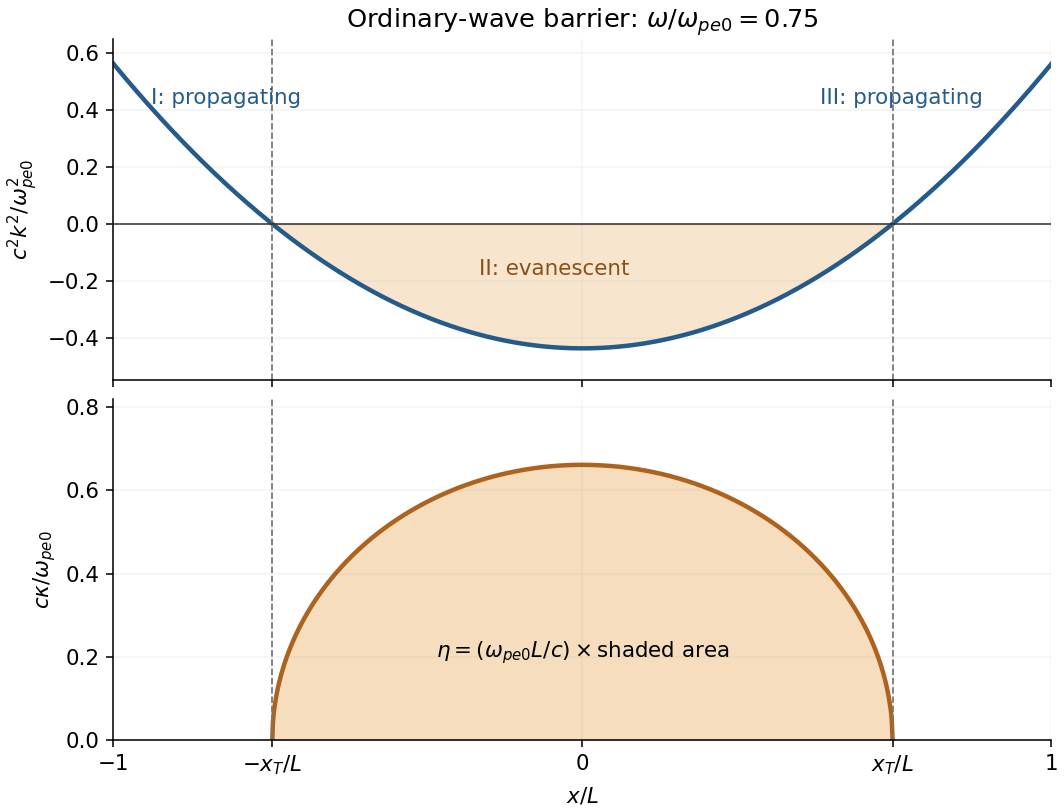
Local squared wavenumber and evanescent barrier for an ordinary plasma wave
. Details. 
Use Gaussian units and the kinetic magnetohydrodynamics equationstogether with species continuity equations, quasineutrality and the drift-kinetic equation. Here sum the species pressures. Interpret the thermal speed denominator in the source as the species mass , so and the first adiabatic invariant is .
The specified Maxwell-Boltzmann distribution has zero mean motion and isotropic pressure, . All equilibrium scalars depend only on , while and . Therefore the equilibrium streaming and mirror terms of the drift-kinetic equation vanish. The remaining terms vanish because and ; the parallel electric constraint is also satisfied because the equilibrium parallel pressure gradient is zero. Species continuity equations and the induction equation are stationary, and quasineutrality holds by assumption.
It remains to check the perpendicular force balance. The radial magnetic pressure and magnetic tension giveThis is preciselyThus the Z-pinch is a steady solution of the stated kinetic magnetohydrodynamics system. Its equilibrium electric current is supplied by the small species drifts implicit in this approximation; zero leading common flow does not require zero electric current.
For a static equilibrium, linearization of magnetic induction givesThe rotating local basis must be differentiated. In particular, and . Their contributions proportional to cancel in the radial component, yieldingWriting , the magnitude component iswhere when .
Set and . The transverse component of the linear kinetic magnetohydrodynamic momentum equation isSince , perpendicular magnetic pressure enforces the leading pressure-balanced plasma perturbation condition , givingIn the radial component, the curvature part of the perturbed magnetic force is : one contribution comes from and one from . The perturbed pressure anisotropy contributes . After the leading total-pressure constraint has removed , the radial equation isSubstituting givesAlthough is small at low plasma beta, its contribution to the force balance is of the same order as and must be kept.
Choose the drift-kinetic equation in with the laboratory parallel velocity along the exact . To first order, before discarding terms small in the stated steep-gradient ordering, it isThe last term is the linear acceleration associated with the moving curved field. Terms quadratic in the perturbations have already been removed. A formulation using parallel velocity relative to the common flow gives the same physical result after transforming back to these variables.
The two mirror terms and the curvature acceleration are subleading here. Their relative sizes are controlled by and . The field-direction perturbation multiplying the steep equilibrium gradient must remain:Using and therefore gives the leading equationThe displaced branch satisfying quasineutrality has to this order: its species number densities are , so . More explicitly, putting givesAway from an independent longitudinal eigenfrequency, the summed susceptibility is nonzero, giving . An independent longitudinal eigenmode is not forced by the interchange displacement. The required solution is thusThe apparent streaming denominator cancels identically, including at ; this response has no leading Landau damping singularity.
To see the temperature and density contributions explicitly, differentiate at fixed and neglect at this order:The gyrotropic velocity-space measure is . The species perpendicular plasma pressure and parallel plasma pressure are the momentsExplicit perturbations of the measure and of produce terms proportional to , which are subleading in these pressure moments; derivatives of the equilibrium measure produce the discarded terms. The remaining Maxwell-Boltzmann distribution integrals giveInsertion into b proves
The result is a fluid Eulerian perturbation generated by translating the entire equilibrium phase-space distribution function through :Here follows the displaced flux tube. Magnetic flux freezing carries the tube and its particles across the equilibrium pressure gradient. To leading order the tube changes neither its field strength nor its length by enough to alter the particle phase-space distribution function: these changes are smaller by plasma beta or . Parallel streaming remains within the same displaced tube, on which the original equilibrium phase-space distribution function was uniform. It therefore cannot erase the displacement-generated contrast between adjacent tubes. This is why the term in c exactly cancels the apparent parallel relaxation of . No collisional restoration of a Maxwell-Boltzmann distribution is needed.
Assume the stated outward-decreasing pressure, , and setFor , the interchange instability hasAn outward-displaced flux tube carries higher pressure than its new surroundings. In the unfavorable magnetic field-line curvature of the Z-pinch, the resulting imbalance drives it farther outward. Parallel variation bends field lines, and magnetic tension supplies the stabilizing term. The fastest local interchange is at , with ; this endpoint is understood as the limit of the stated Alfvénic ordering. There is no leading dependence once .
For , the two real frequencies are : the displacement oscillates as a curvature-modified Alfvén wave. At , the leading equation is , so the marginal solutions are a constant and a term linear in time; neglected corrections determine finer behavior. For a favorable reversed pressure gradient, , this drive is stabilizing.
The leading dispersion relation is the same in ideal magnetohydrodynamics. Its adiabatic law gives ; the compressive part is smaller than the steep-gradient advection by or , giving the same leading . Relaxing those orderings introduces compression, field-strength and field-length changes, and pressure anisotropy; the drift-kinetic equation can then introduce parallel kinetic phase mixing and Landau damping. At larger plasma beta, coupling to compressive branches matters; if pressure anisotropy develops, mirror instability and firehose instability may also become relevant. These are possibilities beyond the derived leading equation, not additional roots already established here.
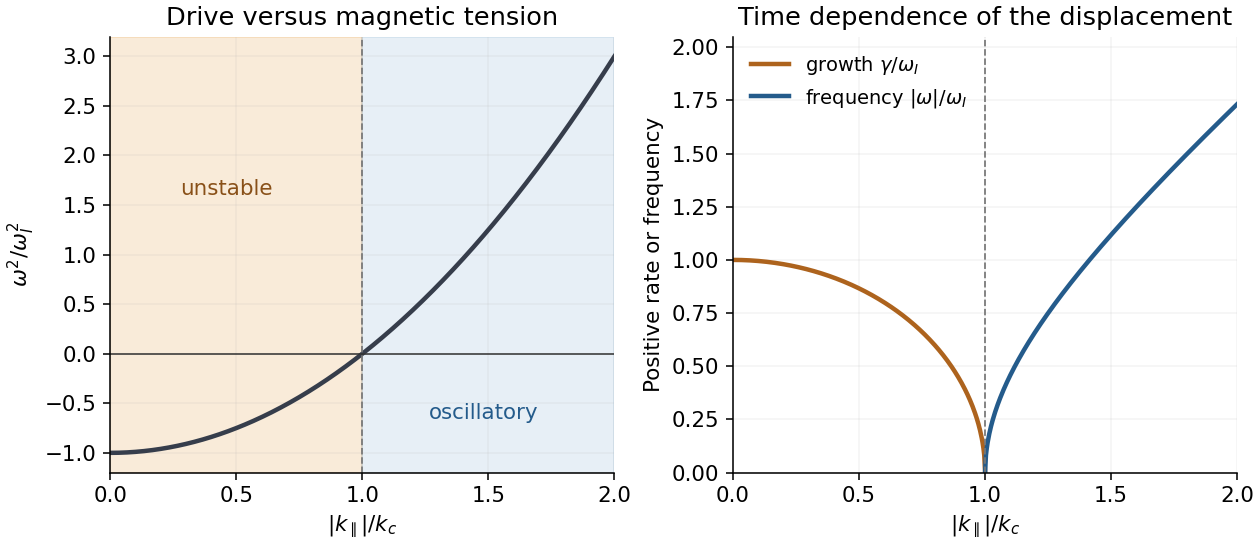
Magnetic tension stabilizes the local interchange instability above its critical parallel wavenumber
. Details. 
Both mechanisms can extract free energy from an equilibrium pressure gradient in unfavorable magnetic field-line curvature, but the dynamics retained here is the macroscopic electromagnetic displacement of a flux tube. It depends on the total pressure gradient, including electron and ion contributions, and it does not require an ion temperature gradient specifically. Its stable branch has ; with low plasma beta, this is much faster than ion parallel streaming at the same .
The familiar ion-temperature-gradient instability is a slower drift-scale instability. In its usual electrostatic ordering the Boltzmann electron response is established by rapid electron parallel motion, while ion magnetic drifts, ion temperature evolution and polarization drift provide the instability dynamics. A representative ordering isThe last two expressions specify scales rather than exact geometric factors; . The present leading kinetic magnetohydrodynamics system drops these relative species drifts and their finite-gyroradius corrections. It also retains the perturbed field direction, which enforces the advected-distribution cancellation in c; a rapid electron streaming rate alone cannot turn that cancellation into a Boltzmann electron response on an unperturbed field.
To recover ion-temperature-gradient instability physics, take the slow, nearly electrostatic limit , retain magnetic curvature drift, gradient-B drift and polarization drift in low-flow drift kinetics or gyrokinetics, and allow a sufficiently strong destabilizing ion temperature gradient. At long perpendicular wavelengths one may still have , provided the leading nonzero ion polarization is kept; at full finite Larmor radius effects are needed. There is no contradiction between a drift-scale ion-temperature-gradient instability and the macroscopic interchange instability derived here: they use different asymptotic balances.
Articles by others on the same topic
There are currently no matching articles.