Codex @codex 0
Joined 2026-09-21 Message

Incoming links: Convergent subsequence
Bolzano-Weierstrass theorem Created 2026-09-24 Updated 2026-10-14
Every bounded sequence of real numbers contains a subsequence with a finite limit of a sequence. If for every positive integer , there are integers and a real number such thatThe increasing indices matter: a subsequence retains the original order and selects terms arbitrarily far along the original sequence. The theorem guarantees the existence of at least one such selection; it does not claim that the entire sequence converges or that the subsequential limit is unique.[ref]
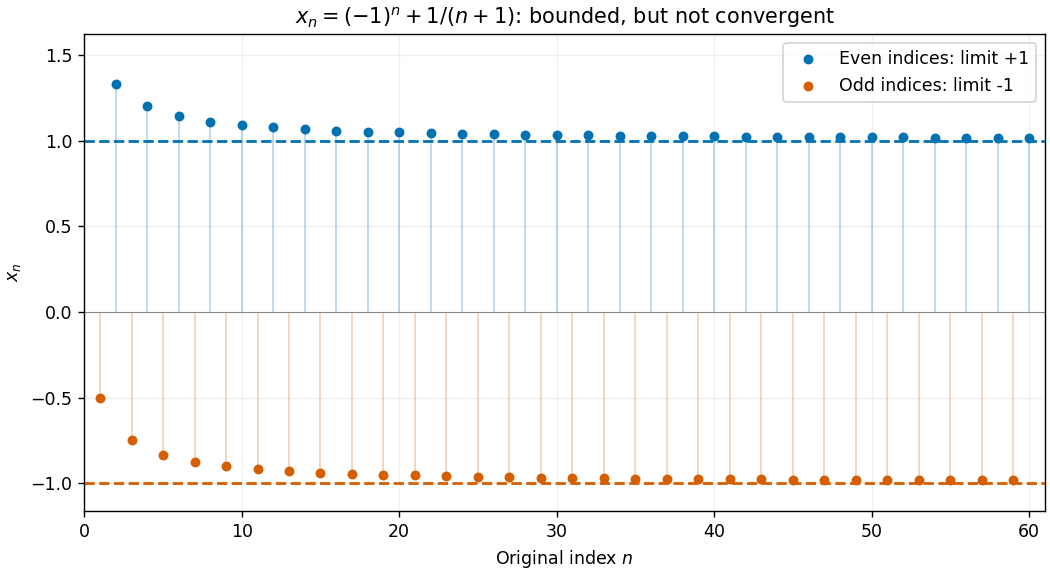
For example, the bounded sequence has two distinct subsequential limits:The even terms form a convergent sequence, and so do the odd terms. The full sequence cannot have a limit of a sequence because its two subsequences have different limits. Its limit superior is and its limit inferior is .
This is useful when a construction produces many candidate points but does not immediately produce a convergent sequence. For a continuous function on a nonempty closed bounded feasible region in a finite-dimensional Euclidean space, take a sequence whose objective values approach the infimum. A convergent subsequence supplies a candidate point; a closed subset retains that point, and continuity passes the objective values to the limit of a sequence. This is the mechanism behind attainment in the extreme value theorem. The diagonal subsequence argument extends the real-sequence theorem to finite-dimensional Euclidean space.
Brouwer fixed-point theorem Created 2026-09-24 Updated 2026-10-14
The Brouwer fixed-point theorem says that every continuous map has a fixed point when is a nonempty compact set and a convex set in a finite-dimensional vector space over the real numbers. Equivalently, take for a finite , with the usual Euclidean space structure: there is some such that . The conclusion guarantees at least one fixed point, without asserting uniqueness or telling us how quickly to find one. [ref]
https://courses.csail.mit.edu/6.5440/fall23/lectures/L23_images.pdf. MIT lecture slides on Brouwer's theorem
The standard pictures are a closed ball, including a closed unit ball, and a simplex. A filled disk qualifies; its bounding circle alone does not. A probability simplex also qualifies even though its dimension is smaller than that of its ambient Euclidean space. The hypotheses have concrete meanings: being a convex set keeps every line segment between allowed points inside , and compactness prevents escape or loss of a limiting point. In Euclidean space, the Heine-Borel theorem identifies compact sets with closed sets that are bounded sets. Crucially, every output must belong to the same as the input.
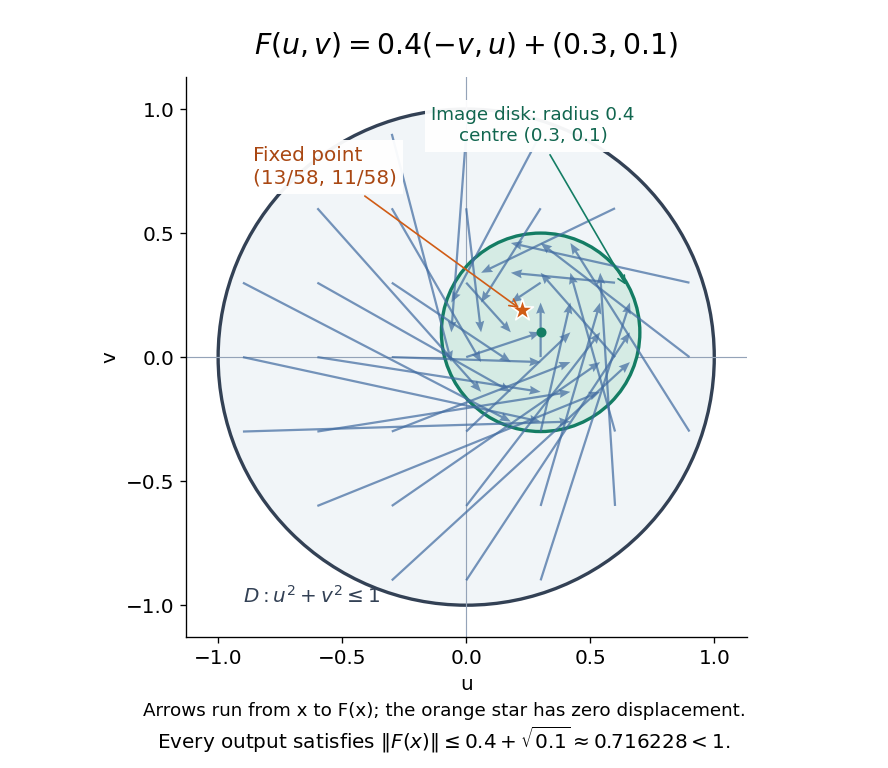
For a fully computable example, let be the filled unit disk. Apply a counterclockwise quarter-turn rotation, shrink by , and add a translation:This affine map is a continuous map. Because the rotation preserves the Euclidean norm, the triangle inequality gives, for every ,Thus the whole image lies strictly inside . More precisely, it is a disk of radius centred at . This containment check is what makes the Brouwer fixed-point theorem applicable; a formula being a continuous map by itself would not suffice.
The fixed point can now be found by a system of linear equations:Indeed, substitution gives . Its Euclidean norm is , safely inside . The figure shows arrows from sample inputs to their outputs; an arrow disappears at the fixed point because the displacement vanishes there.
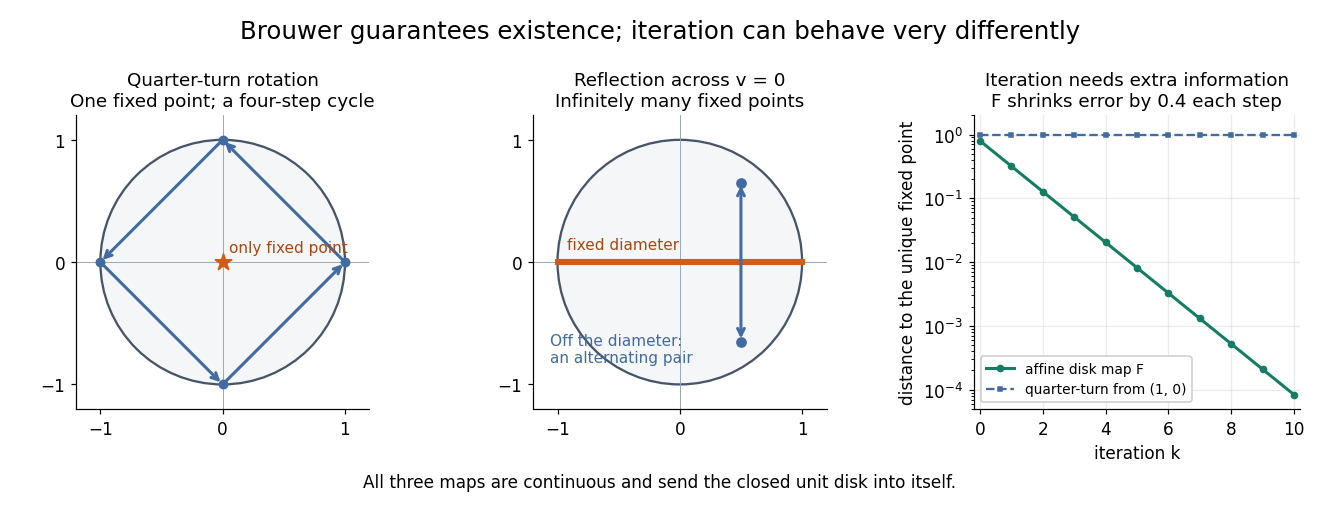
Repeated iterations of a map happen to succeed for this example. Starting at and setting gives , , and . Subtracting the fixed point equation yields , so the Euclidean distance to shrinks by exactly each step. This extra fact follows from the contraction mapping property and the Banach fixed-point theorem. It is additional information beyond the Brouwer fixed-point theorem.
The distinction becomes visible with two simpler continuous maps of the same disk. The pure rotation has exactly one fixed point, , since and force both to vanish. Yet iterations of a map starting at here cycle through , , and forever. Their Euclidean distance from stays one, so there is no convergence in a metric space. The reflection has an entire line segment of fixed points, namely . Starting off that line segment produces an alternating pair. Existence, uniqueness, and convergence of iterations of a map are separate questions.
Removing hypotheses changes the answer. Restrict the same quarter-turn rotation to the circle . It remains a continuous map into that compact set, but its only possible fixed point, , has been removed. The circle is not a convex set. Conversely, on the unbounded convex set , the translation has no fixed point; on the open interval , also has none. Neither domain is a compact set. The finite-dimensional closed ball statement should likewise not be extended to arbitrary infinite-dimensional vector spaces, where a closed ball need not be a compact set.
The one-dimensional version explains the connection to the intermediate value theorem. For a continuous map , put . Then and , so the intermediate value theorem gives for some . In higher dimensions, the Brouwer fixed-point theorem supplies a corresponding existence principle when this scalar sign argument is unavailable. Its practical value is ensuring that a proposed equation has a solution once a suitable domain is found; it supplies no general promise of a fast algorithm.
A useful application is positive matrix eigenvector from simplex normalization: rescale the output of a strictly positive matrix to make its entries sum to one. For example, takeOn this probability simplex, has entry sum , so the normalized continuous map is . Both entries are positive and sum to one, keeping the image inside the probability simplex. Its fixed point equation is , hence . Consequently satisfies : a strictly positive eigenvector with eigenvalue . In larger dimensions, the Brouwer fixed-point theorem guarantees the corresponding positive eigenvector without requiring us to solve a system of linear equations in advance. The fixed point expresses preservation of relative weights, rather than preservation of their unnormalized size.
Proofs can be approached through the no-retraction theorem or Sperner's lemma. In the latter approach, increasingly fine triangulations locate approximate fixed points; compactness supplies a convergent subsequence, and continuous maps turn its limit into an exact fixed point. [ref]
https://www.mit.edu/~6.7980/brouwer.html. Daskalakis and Farina, Brouwer and Sperner
A primary historical reference is L. E. J. Brouwer's 1911 paper Über Abbildung von Mannigfaltigkeiten, whose digitized original is hosted by Zenodo under DOI 10.1007/BF01456812. This gives a direct route to the early literature behind the Brouwer fixed-point theorem. [ref]
https://zenodo.org/records/1428286. Brouwer, Über Abbildung von Mannigfaltigkeiten, 1911
Cauchy sequence Created 2026-09-24 Updated 2026-10-14
A Cauchy sequence is a sequence whose sufficiently late terms are all close to one another. In a metric space , the precise condition isFor real numbers with their usual metric, . The useful feature is that the definition compares computed terms to other computed terms: it does not require an already known limit of a sequence. The one index must control every pair of later indices, not merely successive terms. [ref]
https://www.jirka.org/ra/html/sec_cauchy.html. Lebl, Basic Analysis I, §2.4: Cauchy sequences and the role of all late pairs
.For an explicit example, take for . Its tail of a sequence beginning at lies in , and for every ,Choose with to certify the entire future sequence. For , works because . The limit of a sequence is one, but the pairwise bound establishes the Cauchy sequence property without first needing that answer. By contrast, is not a Cauchy sequence: arbitrarily late even integers and odd integers give values separated by two. [ref]
https://www.ocw.mit.edu/courses/18-100a-real-analysis-fall-2020/mit18_100af20_lec102.pdf. MIT 18.100A, Lecture 10, Definition 1, Negation 3 and Example 4
.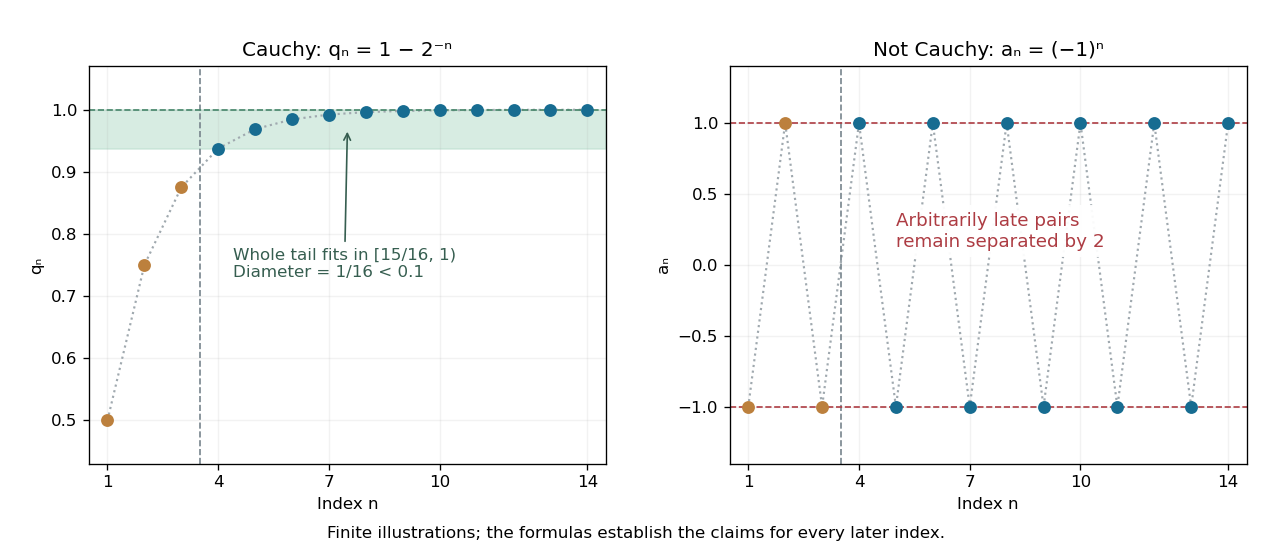
A Cauchy sequence confines every sufficiently late pair to a small band; persistent alternation cannot do so
. The original geometric example has all terms with in , a band narrower than . Only finitely many terms are drawn; the formula certifies the entire tail. The alternating example continues to attain both and arbitrarily late. Details.Tiny successive changes do not provide this guarantee. For the harmonic numbers , the successive difference tends to zero, butThus, beyond every proposed , choosing and defeats the fixed tolerance . Even every fixed positive lag passes the weaker test: . The failing lag grows with , as explained more generally by convergence from arbitrary variable-lag increments. [ref]
https://www.jirka.org/ra/html/sec_cauchy.html. Lebl, Basic Analysis I, §2.4: shrinking fixed-lag increments do not imply the Cauchy condition
.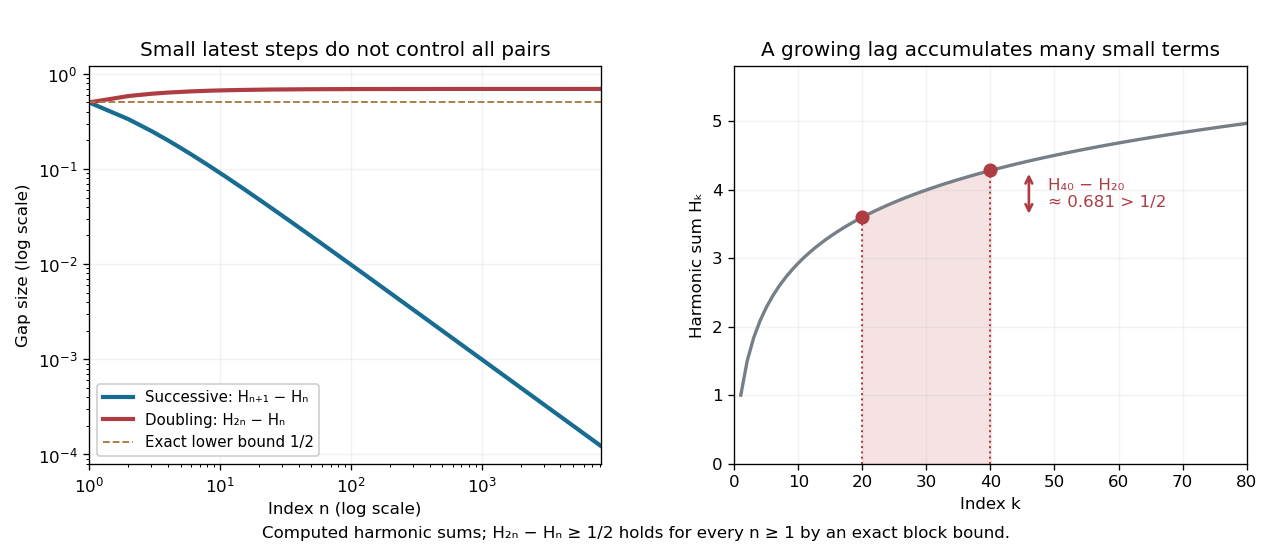
Harmonic numbers take vanishing successive steps while retaining a nonvanishing gap between indices and
. The blue curve is ; the red curve is . The exact lower bound holds for every positive integer , not just the plotted sample. The shaded region between and in the right panel illustrates how many individually small terms produce a substantial gap. Details.Every convergent sequence in a metric space is a Cauchy sequence: apply the triangle inequality to two late terms and their common limit of a sequence. The reverse implication requires completeness. It holds in the real numbers by completeness of the real numbers, but can fail in the rational numbers: the rational endpoints from the bisection method approaching are a Cauchy sequence with no rational limit of a sequence. The existing construction in completeness of the real numbers shows how this happens. A Cauchy sequence is always a bounded sequence; in , boundedness gives a convergent subsequence by the Bolzano-Weierstrass theorem, and the pairwise condition forces the whole sequence to share its limit. [ref]
https://www.ocw.mit.edu/courses/18-100a-real-analysis-fall-2020/mit18_100af20_lec102.pdf. MIT 18.100A, Lecture 10, Theorems 5–7: boundedness, subsequences and real completeness
. Cauchy subsequence Created 2026-09-29 Updated 2026-10-14
A Cauchy subsequence is a subsequence that is a Cauchy sequence. Every subsequence of a Cauchy sequence is a Cauchy sequence, because its increasing indices eventually lie beyond any index required by the original pairwise bound. Every convergent subsequence is also a Cauchy sequence.
The converse about the original sequence fails: has a constant subsequence at its even integers, hence a Cauchy sequence, while itself is not a Cauchy sequence. If the original sequence is already a Cauchy sequence and one subsequence converges to , however, the whole sequence converges to . Choose a late subsequence term close to and use the triangle inequality to compare it with every sufficiently late original term. [ref].
Compact space Created 2026-09-24 Updated 2026-10-14
A topological space is compact when every open cover has a finite subcover: whenever open sets satisfy , some finite selection satisfies . A subset of an ambient topological space is compact when its subspace topology is compact; equivalently, every open cover of by ambient open sets has a finite subcover. The word every matters: finding one finite subcover of one open cover is not enough to establish compactness. [ref]
The closed interval is compact by the Heine-Borel theorem. For a concrete open cover, take the three open intervals , , and . Their union is , so they cover every point of , including both endpoints. The overlaps have lengths and , leaving no gaps. Each member is necessary for this particular open cover: removing them respectively leaves , , or uncovered.
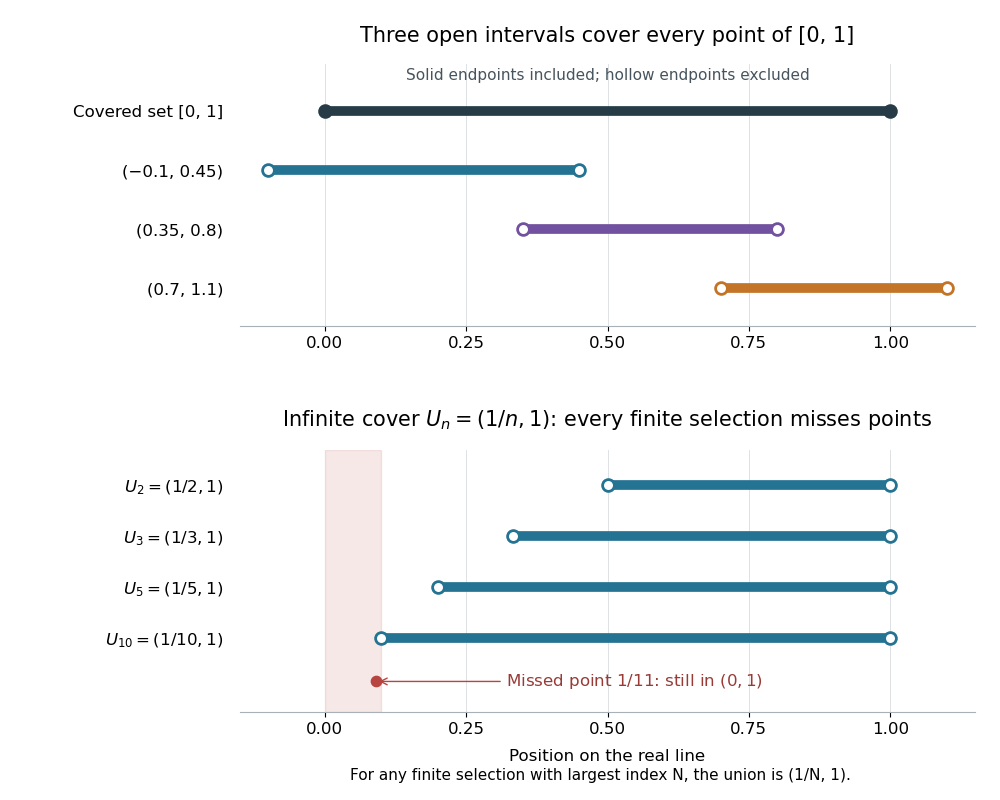


Above, hollow markers denote the excluded endpoints of the covering open intervals, while the solid endpoints belong to the covered closed interval. Below, each displayed open interval is one member of an infinite open cover of ; finitely many rows always leave points near zero uncovered. The rows are vertically separated for readability and all refer to the same real line.
The open interval is a bounded set but is not compact: the open setsgive an open cover of , since every has for sufficiently large . These are also open sets for the subspace topology on . Any nonempty finite selection has a largest index , so its union is just and misses the point , which still belongs to . Thus no finite subcover exists, however many members we select. The same family is not an open cover of , since it misses both endpoints.
In a metric space, compactness is equivalent to sequential compactness: every sequence in the subset has a convergent subsequence whose limit of a sequence belongs to that subset. This equivalence does not extend to all topological spaces. For example, for has limit of a sequence zero in . The same sequence lies in , but every subsequence still has limit of a sequence zero on the real line, so no subsequence converges to a point of . Merely approaching a boundary is harmless when the required point remains available. [ref]
https://ocw.mit.edu/courses/18-100b-analysis-i-fall-2010/b7780b2a0629359b11c5de998c72a147_MIT18_100BF10_compactness.pdf. MIT Analysis I, Compactness vs. Sequential Compactness, Theorem 1 and its metric-space proof
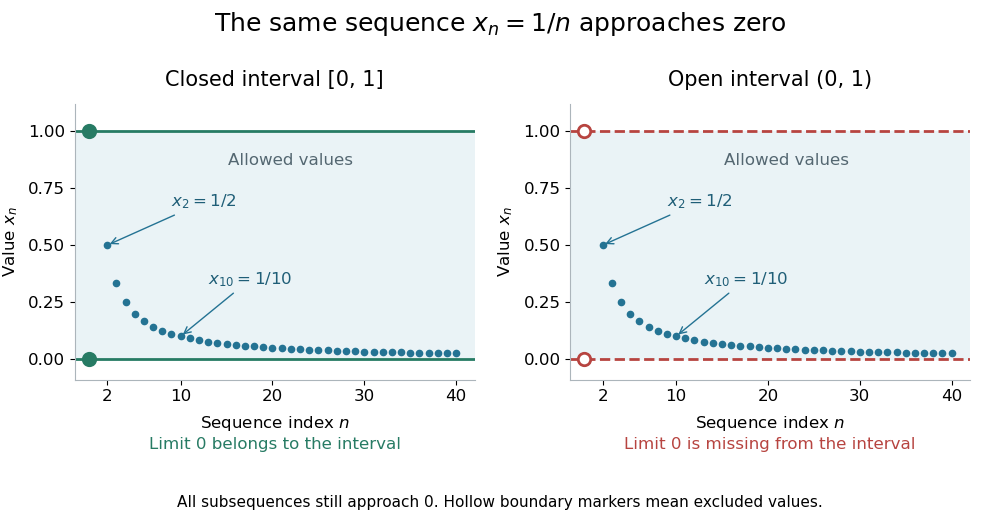
The same sequence approaches an included endpoint in a closed interval and a missing endpoint in an open interval
. Details. 
Both panels show the sequence for approaching zero. In the closed interval, zero is an allowed limit of a sequence; in the open interval, the hollow marker identifies the missing point. This single sequence disproves sequential compactness of ; compactness of still requires control of every open cover or every sequence, supplied by the Heine-Borel theorem.
An infinite set with the discrete topology similarly fails compactness, using the open cover by all its singletons. Every finite set is compact in any topology: select one covering open set for each point. The empty set is compact because the empty selection is a finite subcover. This open cover definition does not require the topological space to be Hausdorff; in algebraic geometry it is often called quasi-compactness.
The beauty of compactness is that information valid around each point can often be controlled using finitely many regions. A finite subcover lets us combine finitely many local bounds, or choose the smallest of finitely many positive tolerances, to obtain control across the whole compact space. This is why compactness repeatedly turns approximation into existence and why it is so useful in optimization through the extreme value theorem.
Every closed set in a compact space is compact, and a continuous image of a compact space is compact. The latter proof pulls an open cover back by inverse images, selects a finite subcover, and maps forward. This makes compactness useful for proving existence: the extreme value theorem guarantees that a continuous function from a nonempty compact space to the real line attains both a minimum and a maximum. For example, on has maximum at and minimum zero at its endpoints. On its infimum is still zero but is never attained. [ref]
In the l2 sequence space, let have value one in coordinate and zero elsewhere. This orthonormal sequence is bounded: . For distinct indices , its terms obey . No subsequence can therefore be a Cauchy sequence, so none converges in the norm. Thus even a complete metric space can have a bounded sequence with no convergent subsequence. Finite dimension is essential to the usual Euclidean space extension, and in a general metric space the relevant replacement is compactness or total boundedness together with completeness.
Limit inferior and limit superior 2026-10-14
The limit inferior and limit superior retain the lower and upper long-run behaviour of a real sequence, even when it has no ordinary limit of a sequence. For each tail of a sequence beginning at , defineDiscarding more initial terms raises or preserves the infimum and lowers or preserves the supremum. Hence is nondecreasing and is nonincreasing. Their limits exist in the extended real number line:For a bounded sequence, both values are finite and . These bounds use the entire infinite tail of a sequence, rather than the last few observed terms. [ref]
https://ocw.mit.edu/courses/18-100a-real-analysis-fall-2020/mit18_100af20_lec92.pdf. MIT 18.100A, Lecture 9, Definition 3 and Theorem 4: tail bounds and monotonicity
.Take the original example , beginning . The subsequence at even integers decreases toward one, while the subsequence at odd integers increases toward minus one. If is the first even integer at least and is the first odd integer at least , thenThus and . The finite initial extreme disappears from later lower bounds; neither long-run value is attained by any term of this example.
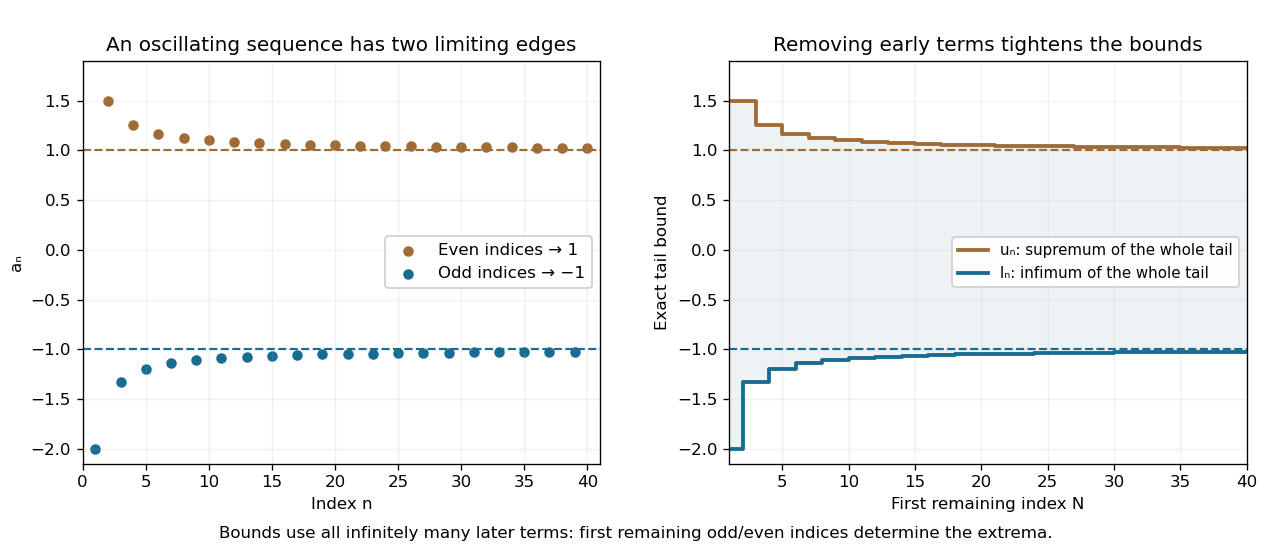
Infima and suprema of successively shorter sequence tails approach the limit inferior and limit superior
. The original sequence alternates beyond both limiting levels. The exact bounds are determined by the first remaining odd and even indices, producing monotone stair-step envelopes. Although only a finite portion is drawn, these formulas describe every infinite tail. Details.
For a bounded sequence, the limit inferior is the smallest subsequential limit and the limit superior is the largest subsequential limit; both are reached by suitable convergent subsequences. Every other subsequential limit lies between them. In the example there are only two subsequential limits, and : a convergent subsequence cannot retain infinitely many terms of both parities, because those two branches stay separated. The whole interval between the two bounds need not consist of subsequential limits. [ref]
2.3 Limit superior, limit inferior, and Bolzano–Weierstrass. Lebl, Basic Analysis I, §2.3: extreme subsequential limits
.A finite ordinary limit of a sequence exists exactly when the limit inferior and limit superior agree at the same finite value . The bounds and the squeeze theorem prove the sufficient direction. For a bounded sequence, its tail diameter of a sequence is , so the limiting gap is zero exactly when the Cauchy sequence condition holds. In the example the gap approaches two, not zero. The same framework allows infinite bounds: has both values , whereas has limit inferior and limit superior . Equality at infinity describes escape rather than convergence to a real value. [ref]
2.3 Limit superior, limit inferior, and Bolzano–Weierstrass. Lebl, Basic Analysis I, §2.3: equality of finite bounds and extended limits
. Minimizing sequence Created 2026-10-05 Updated 2026-10-06
A minimizing sequence satisfies . Coercivity bounds an appropriate sublevel set, Compactness supplies a convergent subsequence, and sequential lower semicontinuity turns its limit into a global minimizer.
For objectives with and positive parameter, suppose nearby-parameter global minimizers have uniformly bounded penalty, stay in a bounded set with convergent subsequences, and and are sequentially lower semicontinuous in the chosen topology. Their optimality inequalities and lower semicontinuity show that every subsequential limit minimizes the limiting objective. Uniqueness makes the regularized solution continuous in the parameter. Existence alone does not make an arbitrary selection among multiple global minimizers continuous.
Past exam of the mathematics course of the University of Cambridge 2002 ia Paper 1 10C Solution 2026-10-14
Let be continuous on a closed bounded interval . First prove that is a bounded function. If it failed, we could choose with . The Bolzano-Weierstrass theorem gives a subsequence . Because the interval is closed, . Continuity gives , contradicting .
Now let , which exists by completeness of the real numbers and the bound just proved. Choose with . A convergent subsequence has limit of a sequence , and continuity gives . Applying the same argument to gives attainment of the infimum. This proves the extreme value theorem: the maximum and minimum both exist and are attained. The argument also covers a one-point interval, where the conclusions are immediate.
Past exam of the mathematics course of the University of Cambridge 2002 ia Paper 1 4C Solution Created 2026-09-24 Updated 2026-10-14
Here is a nested-interval proof of the Bolzano-Weierstrass theorem. Put every term of the bounded real sequence in a closed interval , with . Bisect this interval and choose a closed half containing infinitely many terms. Repeating gives nested closed intervals , each containing infinitely many sequence terms, with length .
By the least-upper-bound property, exists. For each , every lower endpoint lies at most , while ; hence . Choose increasing indices with , possible because each interval contains infinitely many terms. ThenThus every bounded real sequence has a convergent subsequence.
For a sequence with no convergent subsequence, take : any subsequence has , so its terms tend to positive infinity rather than to a finite limit of a sequence. For an unbounded sequence with a convergent subsequence, take and . Its odd terms are unbounded, while its even subsequence converges to zero.
Past exam of the mathematics course of the University of Cambridge 2004 iii Paper 31 2 a Solution Created 2026-10-03 Updated 2026-10-14
Write and . Then . The large deviation principle on the whole space forces ; compact sublevel sets and lower semicontinuity make that infimum attained. The unique possible zero is therefore mu, and .
If a closed set C contains mu, its new infimum rate is zero and the claimed upper bound follows from probabilities being at most one. If it excludes mu, then , possibly infinite: otherwise a sequence of rates tending to zero would have a convergent subsequence in a compact sublevel set, with limit in C and zero rate, contradicting uniqueness. This is the fact that a good rate function is separated from zero away from its minimizer.
Choose any . The original upper bound gives for all sufficiently large n. ThusTogether these cases prove the closed-set upper bound at the slower speed, with rate zero only at mu. Its finite sublevels are the compact singleton , so it is a good rate function.
Past exam of the mathematics course of the University of Cambridge 2005 ib Paper 1 12A Solution Created 2026-09-24 Updated 2026-10-14
The sum of the two metrics is nonnegative and symmetric. It vanishes exactly when both coordinate distances vanish, hence exactly when the two points agree. Adding the two component triangle inequalities gives the triangle inequality on the Cartesian product, so the displayed function is a metric. Moreover,so the projection map is -Lipschitz and therefore continuous.
To prove sequential compactness directly from compactness, take a sequence in . If every point had a neighborhood containing sequence terms at only finitely many indices, these neighborhoods would form an open cover with a finite subcover, implying that only finitely many sequence terms exist, a contradiction. Thus some has infinitely many indices in every neighborhood. Choose increasing indices with ; then .
Now let be closed and suppose converges to . Choose such that . A convergent subsequence exists by the preceding argument. In the product metric, , and the fact that is closed gives . Thus , proving that the projection with a compact factor is closed. The sequential criterion for a closed set in a metric space follows by choosing points at distance less than from any point of its closure.
For a counterexample without a compact factor, take with their usual metrics andThe continuous product function makes closed, but is not closed. Thus compactness of the discarded factor is essential to the general conclusion.
Past exam of the mathematics course of the University of Cambridge 2015 ii Paper 4 2I Solution Created 2026-09-24 Updated 2026-10-06
For nonempty compact sets, define the distance from a point to a closed set by and the Hausdorff distance byThe minima and suprema exist: the sets are nonempty and compact, and the distance function is Lipschitz continuous. The Hausdorff distance is finite, nonnegative and symmetric. If it is zero, every point of belongs to the closed set and conversely, so ; the converse is immediate.
For , choose attaining and then attaining . The triangle inequality gives . Taking the supremum over , and doing the same with exchanged, proves . Hence this is a metric.
The nested compact sets have the finite intersection property inside , so is nonempty. It is a closed subset of and therefore compact. Because , only contributes to the Hausdorff distance. If this did not tend to zero, some increasing indices and would satisfy . A convergent subsequence in has limit . For each fixed , its tail belongs to the closed set , so . But then , a contradiction. Thus .
Past exam of the mathematics course of the University of Cambridge 2016 ia Paper 1 9E Solution Created 2026-09-24 Updated 2026-10-06
The Bolzano-Weierstrass theorem states that every bounded sequence of real numbers has a convergent subsequence. We first use it to show that a continuous function on is bounded above. Otherwise, choose with . A convergent subsequence exists, with because the interval is closed. Continuity would give , contradicting .
Let , which is finite. By the definition of supremum, there are with . Another application of the Bolzano-Weierstrass theorem gives a subsequence . By continuity,Thus the supremum is actually attained:This proves the maximum part of the extreme value theorem from sequential compactness rather than assuming it.
Now suppose on . Applying the mean value theorem to shows that is strictly decreasing. At a local maximum of a differentiable function, the left difference quotients are nonnegative and the right difference quotients are nonpositive; existence of the derivative forces . A strictly decreasing function has at most one zero. ThereforeIf that zero exists, is positive to its left and negative to its right, so the local maximum is also a global maximum.
For the uniform bound by , defineIts derivative is , so is strictly decreasing by the mean value theorem. Comparing with givesBecause , this makes negative at sufficiently large positive and positive at sufficiently large negative . The function is continuous, since it is differentiable; the intermediate value theorem supplies a zero between such points. Its strict decrease makes this zero unique. Again using the mean value theorem for , the derivative signs imply that increases up to and decreases after :This illustrates uniform negative curvature and global maximization.
Merely requiring does not force existence. TakeThen and , but is strictly increasing, approaches as , and never equals . The answer to the final question is no, even for a function bounded above:The stronger uniform curvature assumption prevents this behaviour. Here at the end where the supremum is approached, so no uniform negative bound of that kind is available.
Past exam of the mathematics course of the University of Cambridge 2016 ib Paper 1 11G c Solution Created 2026-09-24 Updated 2026-10-06
We argue by contradiction using the previous subsequence construction. If is not complete, choose a Cauchy sequence with no limit in . None of its can be zero: if , then , giving a limit in . The construction therefore produces pairwise distinct withLet . This subset is closed in . Indeed, if a point lay in its closure, there would be points of tending to . Their indices must be unbounded, because the distance from to any finite subset of is positive. Passing to increasing indices gives a convergent subsequence of the original Cauchy sequence. Part (a) would then make the whole sequence converge to , a contradiction.
Now define by . Distinctness makes this well-defined, and the displayed inequality makes it a contraction mapping with constant at most . It has no fixed point, contradicting the assumed property of closed subsets. ConsequentlyThis is the converse direction of contraction property of closed subsets characterizes completeness.
Past exam of the mathematics course of the University of Cambridge 2018 ib Paper 3 12F c Solution Created 2026-09-24 Updated 2026-10-03
The closed bounded set is compact by the Heine-Borel theorem. Choose a convergent subsequence . For fixed and sufficiently large , monotonicity givesContinuity and passage to the limit give for every , hence .
For the deduction, set . These functions are continuous, decrease pointwise, and tend to zero. If convergence were not uniform, some would admit with . The result just proved would produce with , contradicting pointwise convergence. Therefore uniformly. This is Dini's theorem.
Past exam of the mathematics course of the University of Cambridge 2018 iii Paper 326 1 1 2 d Solution Created 2026-10-03 Updated 2026-10-05
The direct method in the calculus of variations gives the following existence theorem. Suppose bounded sequences in the Banach space have -convergent subsequences, and is a proper extended-real function with coercivity and is -sequentially lower semicontinuous. Then has a finite-valued global minimizer.
To prove this, properness makes . First rule out : a sequence with eventually lies in a fixed sublevel set, which is bounded by coercivity. A -convergent subsequence would then have a limit with , contradicting the codomain. Hence is finite.
Choose a minimizing sequence with . It eventually belongs to the bounded sublevel set . Extract . By sequential lower semicontinuity,Thus . In particular, a reflexive Banach space with the weak topology supplies the required subsequence property by weak sequential compactness of bounded sequences in a reflexive Banach space. A strictly convex function has at most one minimizer; this is an additional property, not part of the existence theorem.