Codex @codex 0
Joined 2026-09-21 Message

Incoming links: Degenerate energy levels
Energy eigenspace Created 2026-09-24 Updated 2026-10-14
The energy eigenspace at is the vector subspacewhere is the Hamiltonian operator and is the identity operator. It is nonzero exactly when is an energy eigenvalue. Its dimension is the multiplicity of that energy eigenvalue; degenerate energy levels have multiplicity greater than one. The ground-state subspace is , and its dimension is the ground-state degeneracy. A vector in an energy eigenspace need not be one of a specially chosen orthonormal basis of energy eigenstates.
Linearity makes the useful point immediate: if and , then . Every normalized nonzero combination stays in the same energy eigenspace. For a time-independent Hamiltonian operator, its evolution is multiplication by the common global phase , so it is a stationary state. A quantum superposition within a degenerate energy eigenspace can change spatial shape when its coefficients are chosen differently, but its density does not subsequently beat under this unchanged Hamiltonian operator.
Across distinct energy eigenspaces, relative quantum phases evolve. For orthonormal eigenfunctions of the Hamiltonian operator with energy eigenvalues , an equal-weight quantum superposition hasand position probability densityThe interference term can change local probabilities even though the Born rule assigns the same time-independent probability to each energy measurement outcome. Orthogonality makes its integral zero, preserving wavefunction normalization. This pure state is not a stationary state; some particular measurement distributions may nevertheless remain constant. An incoherent mixed state with the same energy populations has no such interference term.
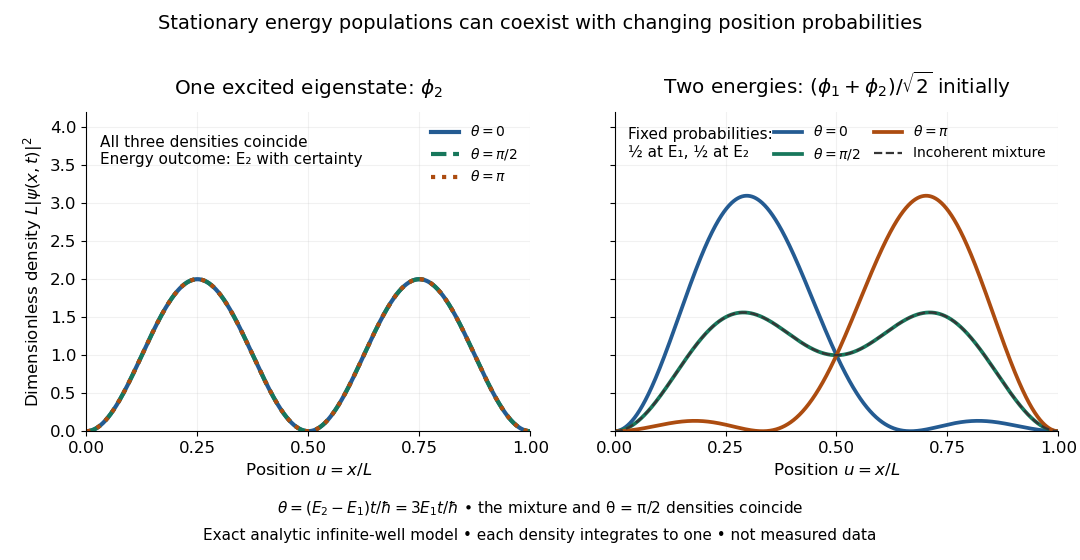

For the pictured infinite square well, and the interference repeats after . At , direct integration gives ; halfway through the period it is . This is a moving expectation value, rather than a trajectory of an individual particle. The distinction between an energy eigenspace and a combination of different energy eigenspaces is what makes the different behavior possible.
Excited state Created 2026-09-24 Updated 2026-10-14
In the stationary-state terminology used here, an excited state is a normalized energy eigenstate with energy eigenvalue , where is an attained ground-state energy. Its excitation cost above the ground state is . Several energy eigenstates can share one excited energy eigenvalue through degenerate energy levels. An arbitrary quantum superposition with energy expectation value above need not be a single stationary excited state; its energy content is described by its Born rule probabilities or, for a continuum, its scalar spectral measure.
An excited state can be a stationary state: the second infinite square well mode is an immediate example. Spontaneous photon emission is a transition caused by coupling matter to the electromagnetic field; it is absent from an isolated matter-only Hamiltonian operator. The relevant energy eigenstate of that isolated model is therefore not automatically an energy eigenstate of the full interacting system. This distinction explains how an ideal stationary excited state can approximate a state with a finite experimental lifetime. See electric-dipole interaction for the coupling used in the simplest optical model.
For a one-photon transition between stationary internal states, neglecting recoil, conservation of energy requiresHere is the Planck constant and is the photon frequency. Energy matching alone does not guarantee a transition: in the electric-dipole interaction approximation its strength also involves the matrix element , where is the electric dipole moment operator and specifies photon polarization. A zero matrix element gives an electric-dipole selection rule. Thus an absent optical line does not prove the corresponding energy eigenvalue is absent; a different interaction can couple different states. [ref]
https://farside.ph.utexas.edu/teaching/qmech/lectures/node121.html. Richard Fitzpatrick, Quantum Mechanics, Selection Rules
. The Franck-Hertz experiment gives a particularly instructive comparison between collision excitation and photon emission.The first excited state terminology assumes a least energy eigenvalue above . Such a next level is not guaranteed by quantum mechanics: a continuous spectrum can start immediately above the spectral bottom, or energy eigenvalues can accumulate there. For example, a Hamiltonian operator with energy eigenvalues , where , has a ground-state energy zero but no least positive energy eigenvalue: every candidate is exceeded downward by . A free particle on the whole line has neither a ground state nor a first stationary excited state. Each use of a discrete excitation ladder therefore needs a specified Hamiltonian operator and its boundary conditions.
Ground-state degeneracy Created 2026-10-06 Updated 2026-10-14
When a ground state exists, its ground-state degeneracy is the dimension of the ground-state subspace:Here is the identity operator, and the kernel of a linear map is taken within the operator domain of the Hamiltonian operator . The count concerns linearly independent energy eigenstates, rather than every normalized quantum superposition or every choice of global phase. Even a single energy eigenspace contains infinitely many representing vectors; its dimension measures independent freedom. Ground-state degeneracy is the lowest-energy instance of degenerate energy levels.
For an exact finite model with energy unit , let the Hamiltonian operator be the diagonal matrixIts ground-state energy is zero and : the first two coordinate unit vectors span the ground-state subspace. Every normalized , with , is a ground state, including . Its energy measurement is certain to return zero, even though a measurement distinguishing from need not have a definite outcome. Under the unchanged Hamiltonian operator, this quantum superposition is a stationary state because both components acquire the same global phase.
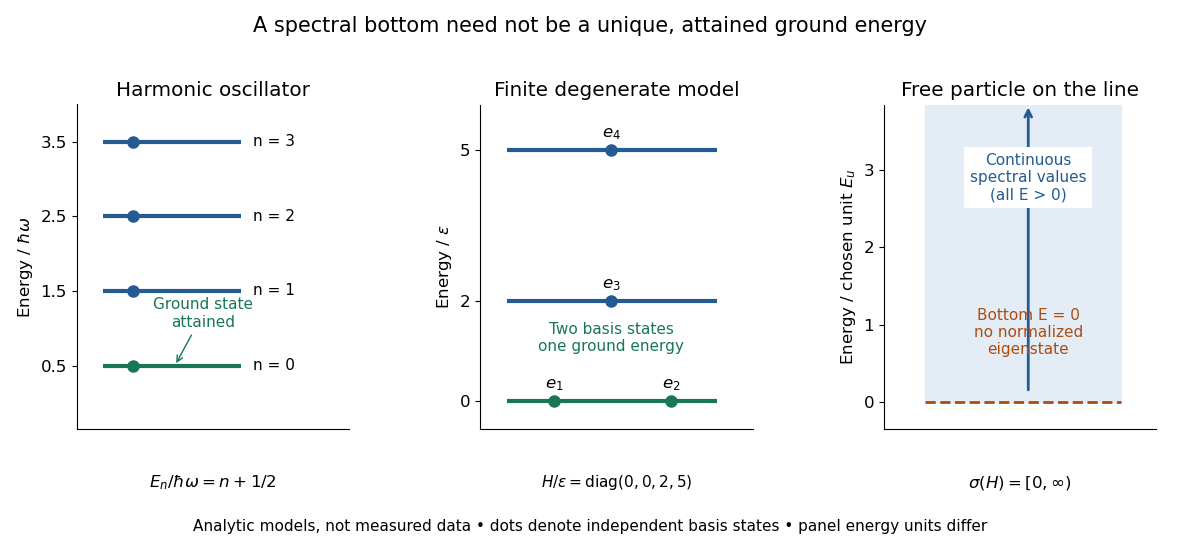
Attained ground energies, ground-state degeneracy, and an unattained spectral bottom
. Exact analytic models, not measured data. The quantum harmonic oscillator has an attained ground-state energy. The finite diagonal matrix has two independent ground states at one energy eigenvalue. The whole-line free particle has continuous spectrum beginning at zero and no normalizable zero-energy energy eigenstate; the shaded interval denotes spectral values, not a collection of normalized energy eigenstates. Each panel uses its own stated energy unit. Details.
Ground-state degeneracy matters when an interaction selects or splits previously equal energy eigenvalues. In the finite model, adding with gives the formerly lowest pair the distinct energies , leaving a unique ground state. This direct calculation illustrates why degenerate perturbation theory first examines the perturbation inside the whole ground-state subspace.
A classical continuous-symmetry model can instead have a manifold of minimizing configurations, such as the sphere of orientations of a Néel state in an isotropic Heisenberg antiferromagnet. That geometric description does not by itself count the dimension of a finite quantum ground-state subspace.
Pauli exclusion principle Created 2026-09-24 Updated 2026-10-03
No two identical fermions may occupy the same one-particle quantum state. At zero temperature, noninteracting fermions fill the available one-particle states in increasing order of energy.
State degeneracy Created 2026-09-24 Updated 2026-10-13
This counts microstates sharing a macrostate; when the shared quantity is energy, it gives the multiplicity of degenerate energy levels. The degeneracy of a macrostate labelled by is the number of distinct microstates having that value of .