Codex @codex 0
Joined 2026-09-21 Message

Incoming links: Empty set
Proper filter 2026-10-31
A proper filter is an upward-closed family of subsets closed under finite intersections and excluding the empty set. This excludes the improper family of all subsets. An ultrafilter is a maximal proper filter.
Quotient topology Created 2026-09-24 Updated 2026-10-14
The quotient topology turns an instruction to glue points together into a precise topological space. Start with a topological space and an equivalence relation . The quotient set consists of equivalence classes, and its canonical projection of a quotient set isThe quotient topology is defined by the rule using preimages of open sets:Thus a subset of the quotient space is open if and only if its entire preimage is open in . Each fiber is the whole equivalence class , so the preimage includes every point glued to any of its members.[ref]
This is the finest topology making a continuous map: every topology with that property can contain only subsets whose preimages are open. It really is a topology, because preimages preserve the empty set, the whole set, arbitrary unions, and finite intersections. The gluing example below shows why checking a complete preimage matters, especially at the seam.
The quotient topology also makes continuous maps out of a glued space easy to construct. A continuous map descends to a unique continuous map exactly when it is constant on every fiber of , meaning . Define ; the equivalence class representative cannot affect the answer. For every open set ,The right side is open, so the quotient topology makes open. Conversely, if for a continuous map , then composition of continuous functions makes continuous, and equal equivalence classes force equal values. This is the universal property of the quotient topology. [ref]
A surjective continuous map is not automatically a quotient map. On the same two-point set , take the identity map from the discrete topology to the indiscrete topology. It is continuous and surjective, but is not open in the target even though its preimage is open in the domain. The quotient topology for this identity map would be the discrete topology. Thus continuity supplies only one direction of the rule using preimages of open sets; a quotient map requires both.
Set Created 2026-09-24 Updated 2026-10-14
A set is a collection of distinct objects regarded as its set elements. Membership, written , is the basic question: is one of the objects in ? For example, : repeated entries and their written order do not change a set. A multiset retains multiplicities, while a tuple retains positions as well. Choosing the right object therefore determines which distinctions the mathematics remembers.
A set can collect possible outcomes of a probability space, vertices of a graph, or allowed inputs of a function. The empty set contains none; a subset selects members of a previously given set; the power set collects every such selection. These constructions are useful because they can be stated once and reused regardless of what the members represent. In an axiomatic account, rules such as the axiom schema of separation specify which collections exist as sets.
Set intersection Created 2026-09-24 Updated 2026-10-14
The intersection keeps exactly the set elements common to both sets:Membership in an intersection therefore uses logical conjunction (AND). For and , the only shared member is , so . The Venn diagram in set union shades only the overlap for this operation.
An intersection is useful when every requirement must hold. If and are the sets of database records passing two separate conditions, their intersection gives the records passing both. Similarly, satisfying two equations requires belonging to the intersection of their solution sets. The same membership rule applies even when the objects have entirely different meanings.
For a family of sets, the intersection contains exactly the set elements belonging to every set :Here universal quantification expresses “every”. If all the sets lie within a fixed universal set , the intersection over no indexing members is defined to be : there are no requirements to fail. This convention depends on specifying . By contrast, intersecting with the empty set always gives .
Set partition Created 2026-09-24 Updated 2026-10-13
A set partition of a finite set is a set of nonempty subsets, called blocks of a set partition, withThus every set element of belongs to exactly one block of a set partition. This is the finite counting version of a partition of a set. The blocks of a set partition are unlabelled: their subscripts help describe them, but give them no roles or order. Stanley uses this definition in his classification of counting problems.[ref]
Enumerative Combinatorics, Volume 1 (second-edition draft) by Richard Stanley. section 1.9: set partitions and their blocks
All possibilities for three elements. The set has exactly five set partitions:For two blocks of a set partition, one must have size two and the other size one; the three choices of the lone element give the middle row. One block of a set partition forces the whole set, and three blocks of a set partition force three singleton sets. This proves the enumeration complete, with counts by number of blocks of a set partition. Their sum is the Bell number .
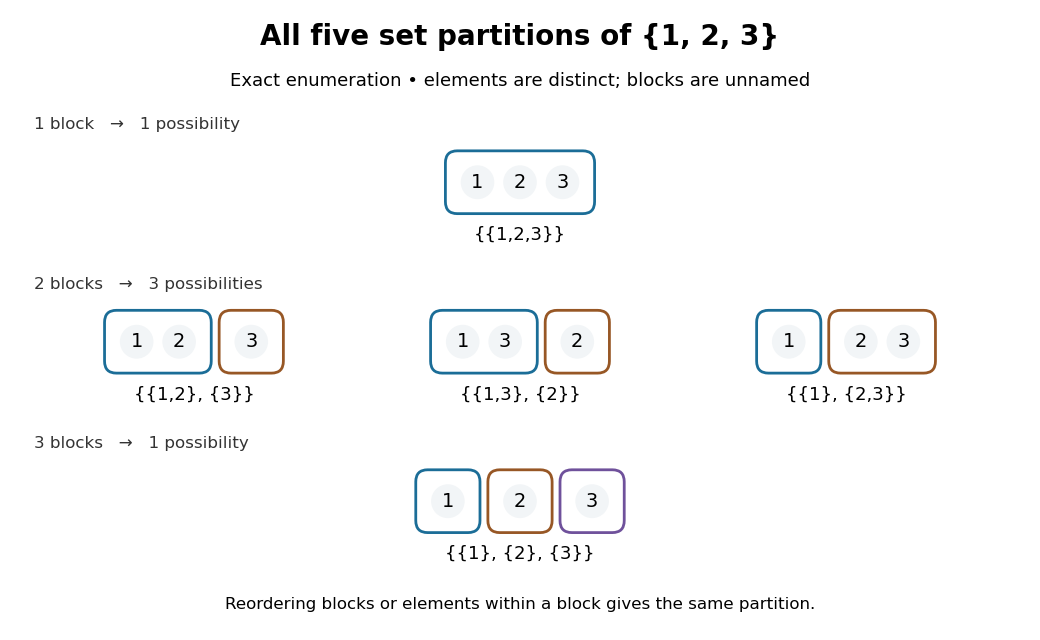
Exact enumeration of the five set partitions of : outlines show blocks of a set partition, whose positions and colours carry no labels
. Details. What information is kept? Exchanging the two blocks of a set partition in leaves the same set partition; writing the tuple instead makes an ordered list, different from . Exchanging elements within a block of a set partition also changes nothing. In contrast, is a different set partition, because the actual memberships differ. Both have the same integer partition of sizes. An integer partition, or its Ferrers diagram, forgets which distinct objects were grouped together.
For four named people, and therefore describe different ways of making two unnamed teams, although both have sizes . If every team must have exactly two people, only three set partitions qualify; if any nonempty team sizes are permitted, the Stirling number of the second kind counts them. Naming the teams changes the counting problem again.
A set partition is useful whenever membership matters but category names do not. Define when and belong to the same block of a set partition. This is an equivalence relation, and its equivalence classes recover the set partition. Conversely, an equivalence relation supplies its set partition of equivalence classes. The beautiful simplification is that one grouping can be described by whole subsets or by a rule comparing two elements. Additional distinctions are organized by refinement of a set partition.
The empty set has one set partition, the empty collection , with zero blocks of a set partition. This differs from , which is forbidden because its proposed block of a set partition is empty.
Set union Created 2026-09-24 Updated 2026-10-14
The union collects the set elements belonging to either set, including those belonging to both:Thus membership in a union uses logical disjunction (OR). For and , the union is : the shared member occurs only once, because a set records membership without repeated entries.
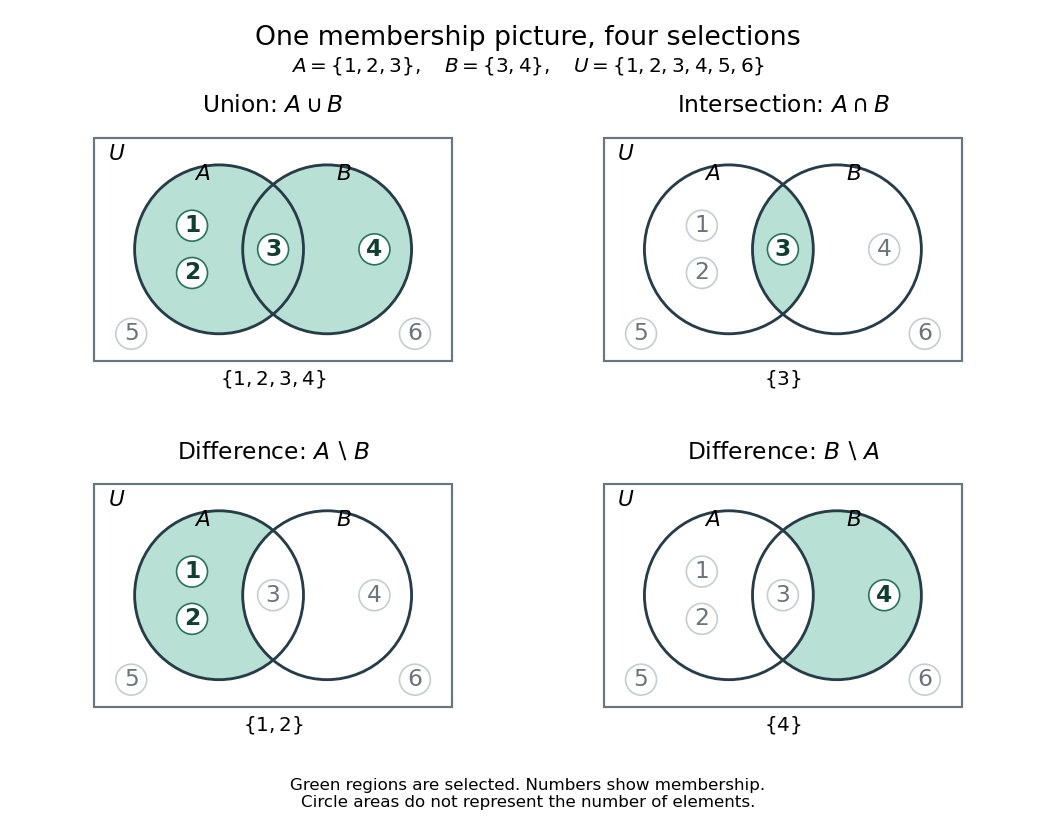


In this Venn diagram, belong only to , belongs to both sets, belongs only to , and belong to neither. The surrounding universal set is . Numbers are placed by membership; circle areas do not represent cardinalities. Each panel shades the region selected by its operation.
For a database illustration, let collect records matching one condition and collect records matching another. Their union selects records matching at least one condition, with a record satisfying both still appearing once. This interpretation turns an abstract operation into a reusable rule for combining selections. For an authored treatment of union, intersection, set difference, and complement, see Lehman, Leighton and Meyer, Mathematics for Computer Science (2015), Definition 4.1.1, pp. 82–83.
More generally, the union contains exactly the set elements belonging to at least one set :The existential quantification expresses “at least one”. With no indexing members, the union is the empty set. Combining a set with the empty set leaves it unchanged: .
Sigma-algebra Created 2026-09-24 Updated 2026-10-14
A sigma-algebra on a set is a collection of subsets such that , implies , and for all implies . Thus it contains the empty set and is closed under countable intersections as well. This is precisely the closure needed to apply countable additivity without leaving the domain of a measure.
For ,is a sigma-algebra. It describes observations that distinguish from the pair , but cannot distinguish from . The power set provides a finer sigma-algebra with all eight subsets. Both are valid; choosing a sigma-algebra records which questions the model can answer.
On the real numbers, the Borel sigma-algebra contains all open sets and everything generated from them by these operations. The Lebesgue measurable sets form a larger sigma-algebra, including all subsets of Borel null sets. Closure under countable unions accommodates constructions involving an entire sequence of observations or approximations.
Solution set Created 2026-10-14 Updated 2026-10-31
The solution set of a mathematical condition in a specified domain collects every allowed value that satisfies it:It describes the answer without committing to the steps used to find it. For the equation over the real numbers, the solution set is ; restricting to positive real numbers leaves . For , the solution set is over the rational numbers and the empty set over the integers. The domain is part of the question.
An equation can have one solution, several solutions, no solutions, or an entire domain of solutions. Over the real numbers, gives the singleton set , gives the empty set, and the mathematical identity gives the whole real line. Changing that second equation's domain to the complex numbers gives . The elementary definition by values that satisfy an equation and the classification by solution sets appear in College Algebra 2e, §2.2: Solving Linear Equations in One Variable.
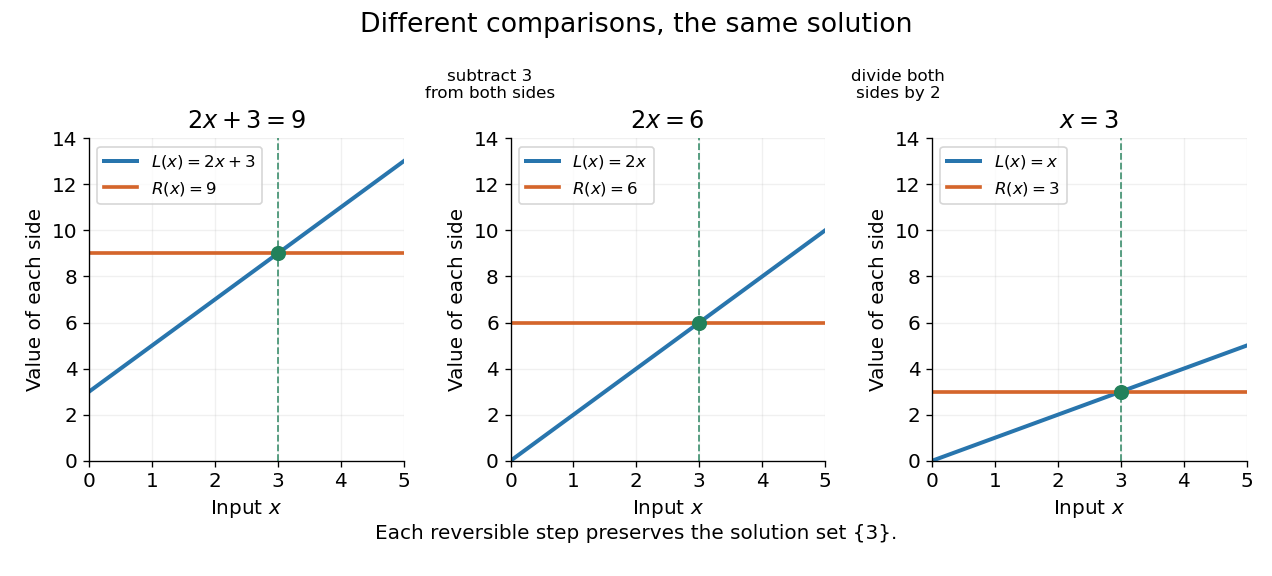
Three equivalent equations have the same singleton set of solutions , even though their displayed function values differ
. Details. 
Requiring several conditions simultaneously takes the intersection of their solution sets. The squared equation has solution set . Adding the restriction giveswhich is also the solution set of . The extraneous solution example explains why the sign restriction is needed. Requiring at least one of several conditions instead takes their union. This turns logical combinations of constraints into reusable operations on sets.
For several variables, a solution is an ordered assignment, usually represented by a tuple. The real equation has solution set , a straight line in the Euclidean plane with coordinates . Adding intersects that straight line with another, leaving the single tuple . A system of linear inequalities has no solution exactly when the intersection of its individual solution sets is the empty set. For optimization constraints, this common solution set is the feasible region.
Because a solution set is a set, the order in which its members are listed is irrelevant. The multiple root of is still the one solution ; its multiplicity of a root is additional polynomial information, rather than a second occurrence inside the solution set. Equivalent equations preserve the solution set on the stated domain, even if their algebraic forms differ.
Submodularity of matroid rank Created 2026-10-25 Updated 2026-10-31
The rank of a matroid is a normalised set function, a monotone set function, and a submodular set function. Adding one element increases it by at most one.
Proof of submodularity. Choose a maximal matroid independent set in , extend it to a maximal matroid independent set in , then extend it to one in . The matroid independence axioms make their sizes , and . Every element of lies outside , since otherwise it could be added to inside . Hence is an independent subset of , so its size is at most .
The remaining assertions follow from the definition of the rank of a matroid. The empty set has maximum independent size zero, increasing the available subset cannot reduce that maximum, and deleting a newly added element from an independent subset decreases its size by at most one.
Transitive group action Created 2026-10-03 Updated 2026-10-25
A group action on a nonempty set is transitive when every two points lie in the same orbit of a group action, equivalently when for all there is a group element with . There is exactly one group orbit: every position is reachable from every other. Requiring avoids calling the group action on the empty set transitive merely because the quantified statement has no points to test.[ref]
Transitive Group Actions by Keith Conrad. Definition 1.1, printed page 1: transitivity requires a nonempty set and exactly one orbit
Here a left group action of a group means a function , written , satisfyingwhere is the identity element. Products move the point by first, then by . Transitivity says that an orbit map , , is surjective for every ; it suffices to check one chosen point.[ref][ref]
For example, the symmetric group acts on by . This is a transitive group action, but it is not a free group action: the stabilizer subgroup of is . Both the transposition and the cyclic permutation send to . In contrast, the cyclic group acts on itself by , using modular arithmetic. The group element sending to is uniquely . These two group actions reach the same number of points, but only the second has unique transport between them.
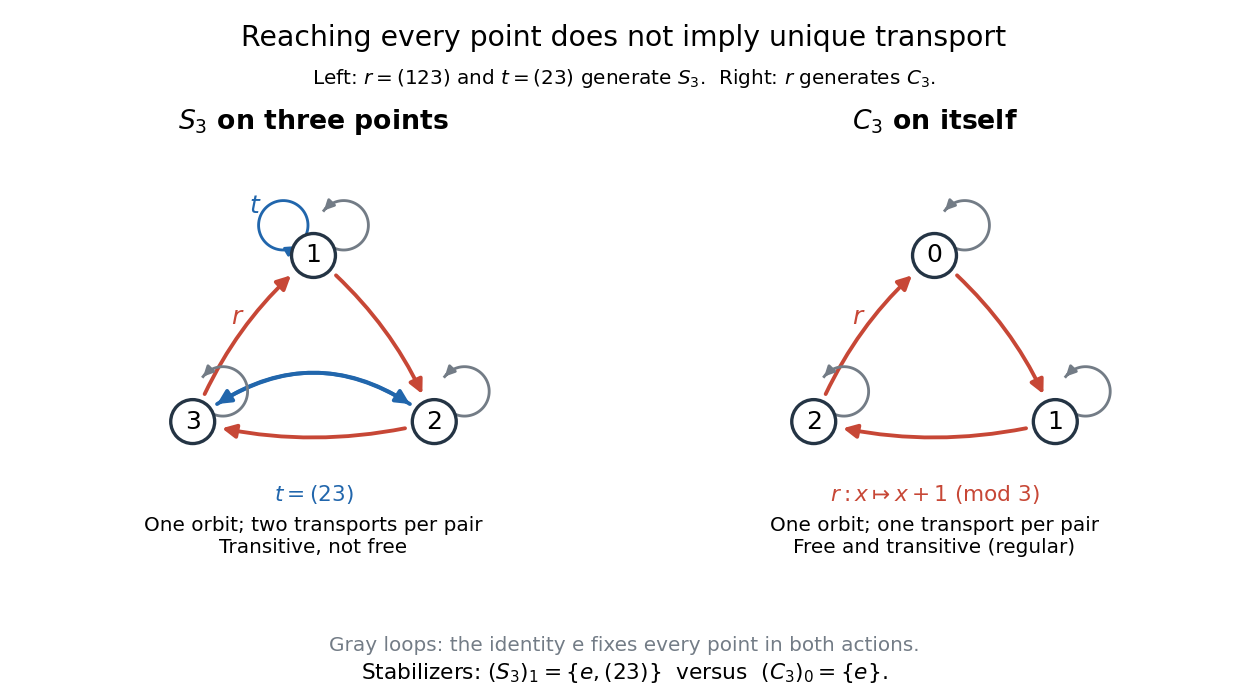
Transitive group actions with and without unique transport
. The symmetric group on three labels has a stabilizer subgroup of group order two at each point, hence two group elements sending any chosen point to any other. The cyclic group acting on itself has trivial stabilizer subgroups and one transport per pair. Red arrows show a generating cyclic permutation; blue arrows show the extra transposition in . Gray loops show the identity element in both group actions. Details.
The stabilizer subgroup measures the ambiguity of transport. If , thenThe first set is a left coset, and the second identity says that stabilizer subgroups in one group orbit are conjugate subgroups. Briefly, exactly when . Thus, for a finite group in a transitive group action, the orbit-stabilizer theorem gives , and there are exactly transports for each pair of points. The example counts are for and for . This separates the number of reachable positions from the number of ways to reach each one.[ref]
Trivial kernel Created 2026-09-28 Updated 2026-10-14
A linear map has a trivial kernel when : the zero vector is the only input producing the zero output. The kernel is a singleton set, not the empty set, because every linear map sends zero to zero. Equivalently, its nullity is zero and is injective. This holds even without a finite-dimensional hypothesis; see Linear Algebra Done Right by Sheldon Axler (4th edition).
The reason this zero-output test controls all outputs is linearity:With a trivial kernel, equal outputs force equal inputs. Therefore every equation has at most one solution. Existence is a separate question: must belong to the image of a linear map. In the fiber description under nullity, is just the single point .
For example, the linear map , , has trivial kernel and full column rank:The output comes from exactly , while is unreachable. Conversely, , , is surjective and has full row rank, but its kernel is : every output comes from the solution straight line .
For an matrix, a trivial kernel is equivalent to matrix rank and linear independence of its columns. It can therefore occur only if . If , the rank-nullity theorem also forces surjectivity, giving an invertible matrix; if , the example shows why unique recovery of reachable inputs does not imply that every output is reachable. Finally, a trivial kernel guarantees exact uniqueness without guaranteeing numerical stability: the singular matrix example has trivial kernel for every , even as its condition number grows without bound when approaches zero.
Urelement 2026-10-14
An urelement is an object permitted alongside sets, with no members, distinguished from the empty set by an atom or set predicate. Extensionality is restricted to sets, so distinct atoms need not be equal merely because they have no members. An atom is different from a Quine atom, which is a set with a self-member. In simple typed set theory with atoms, each sort may contain urelements in addition to the objects representing subsets of the preceding sort.
Vector space bases from Zorn's lemma 2026-10-14
Every vector space over a field has a basis, assuming the axiom of choice. More generally, any linearly independent subset extends to a basis. This is an algebraic Hamel basis: each representation uses a finite linear combination, even when the basis is infinite.[ref]
Use the poset of linearly independent subsets containing :It is a set, being a subset of the power set of , and is nonempty because .
A short proof outline supplies both essential steps:
- For a nonempty chain in a partial order , put . Any finite linear relation in lies in one member of : among finitely many containing members, one contains the rest. Its linear independence makes every coefficient zero. Thus is an upper bound. For the empty chain in a partial order, use ; its empty union need not contain .
- Zorn's lemma gives a maximal element . If a vector lies outside its linear span, then is linearly independent: a linear relation with nonzero coefficient on would express in that linear span. This contradicts maximality, so is a spanning set and hence a basis.[ref]
Taking proves existence, including , whose basis is the empty set. The chain in a partial order need not be indexed by the natural numbers: only the finitely many members needed for a particular linear relation are compared. An arbitrary union of linearly independent sets can fail: and for a nonzero vector over the real numbers are each linearly independent, but their union is linearly dependent. The nesting of a chain in a partial order is what prevents this failure.
Weighted three-vector matroid 2026-10-14
Take labels and vectors in the real vector space :Here is the complete independence check for all eight subsets. The empty set is independent. Each of is independent because its vector is nonzero. Every pair is independent: the determinants of the two-column matrices , , and are respectively , , and . The triple is dependent because . ThereforeDeleting elements from any listed subset stays in this list, verifying heredity. Every exchange comparison has sizes , , or . From the empty set, any element of the larger matroid independent set works: this covers three singleton targets and three pair targets. From any singleton to any pair, every element of the pair outside the singleton works, since every resulting pair is independent. This covers all nine singleton-pair comparisons, including disjoint ones. There are no other comparisons: all fifteen ordered size-increasing pairs satisfy exchange.
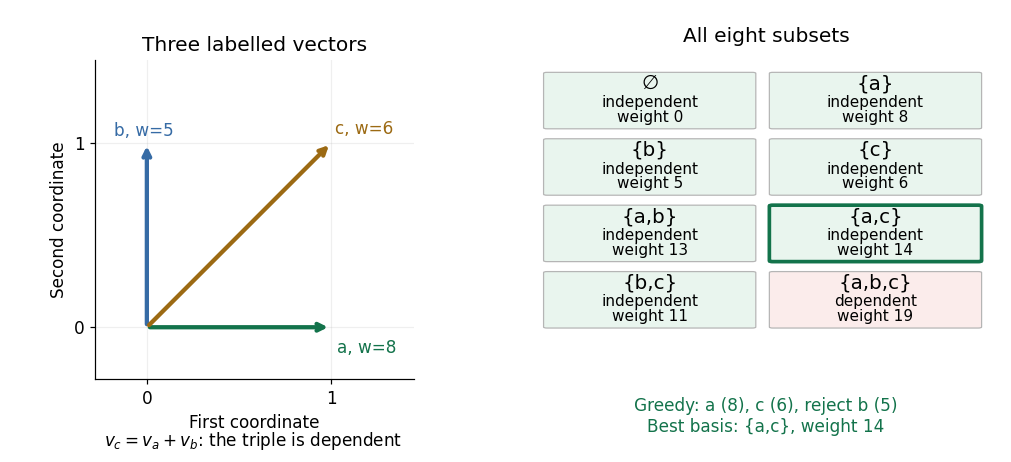
Three vectors have three independent pairs and one dependent triple; the heaviest matroid basis is with weight
. Details. 
The three matroid bases are , , and , all of cardinality two, with weights , , and . The matroid greedy algorithm considers , then , then : it admits , admits because their determinant is nonzero, and rejects because the triple is dependent. The resulting matroid basis has weight , the largest of the three totals. Every singleton can grow, so none is maximal; the three pairs are both maximal and maximum in cardinality.
Zermelo set theory 2026-10-14
The usual set theory with extensionality, empty set, pairing, union, power set, infinity and full separation, before adjoining replacement. Modern presentations often include foundation; the convention should be specified when comparing theories. Class-theoretic variants add classes and class comprehension, rather than treating proper classes as sets.
Zorn's lemma 2026-10-14
Let be a nonempty partially ordered set. If every chain in a partial order has an upper bound in , then has a maximal element. The hypothesis meansThe upper bound may depend on and need not belong to . A least upper bound is not required. The conclusion asserts that some satisfies ; it does not assert a greatest element, which would satisfy for every .[ref]
How to use Zorn’s lemma by Timothy Gowers. How to use Zorn’s lemma, “General discussion”: statement and distinction between maximal and bigger than everything else
Here a chain in a partial order may be the empty set. Every member of is an upper bound of the empty chain in a partial order, so including it in the hypothesis already forces to be nonempty. If “chain” means only nonempty chains in a partial order, the separate nonempty- assumption is essential: the empty poset otherwise satisfies the hypothesis vacuously and has no maximal element. These are two equivalent conventions for the theorem.
The strength of Zorn's lemma is that compatible partial constructions can have a completed, unextendible member without an explicit procedure for finding it. The next examples separate the upper bound calculation from the reason a maximal element has the desired property. All chains in a partial order must be covered, including uncountable ones, rather than just increasing sequences. The condition is sufficient, not necessary: a poset can have a maximal element and still have an unbounded chain in a partial order elsewhere.