Spin isomers of hydrogen are two forms of molecular hydrogen, , distinguished by the combined nuclear spin of their two protons. They have the same chemical formula and electronic ground state, but different allowed molecular rotation states. Parahydrogen has total nuclear spin zero and even rotational quantum number ; orthohydrogen has total nuclear spin one and odd . The difference makes heat capacity a probe of fermionic exchange symmetry, and makes cooling history matter for a tank of molecular hydrogen.
Assume the electronic ground state and the vibrational ground state of a free molecule. The electronic factor is symmetric under exchanging the two protons, and the vibrational factor depends only on their separation, so it is also symmetric. These assumptions concern the exchange of protons; the electronic wavefunction separately obeys fermionic exchange symmetry under exchange of Electrons. Neglect electronic excitation, vibrational excitation, external fields, and small interactions involving nuclear spin when calculating rotational energy eigenvalues.
The two protons are identical particles with spin . Their complete wavefunction must change sign under their particle exchange operator. Interchanging the two ends reverses the internuclear direction , and the spherical harmonic rotational factor satisfiesThe antisymmetric spin-one-half singlet state therefore requires symmetric, even- rotation; the symmetric spin-one-half triplet state requires antisymmetric, odd- rotation. This is exchange symmetry of two identical spin-one-half fermions applied inside a diatomic molecule, not an extra rotational force. A linear rigid rotor may omit spin-dependent splittings while still requiring this restriction on its allowed quantum states.
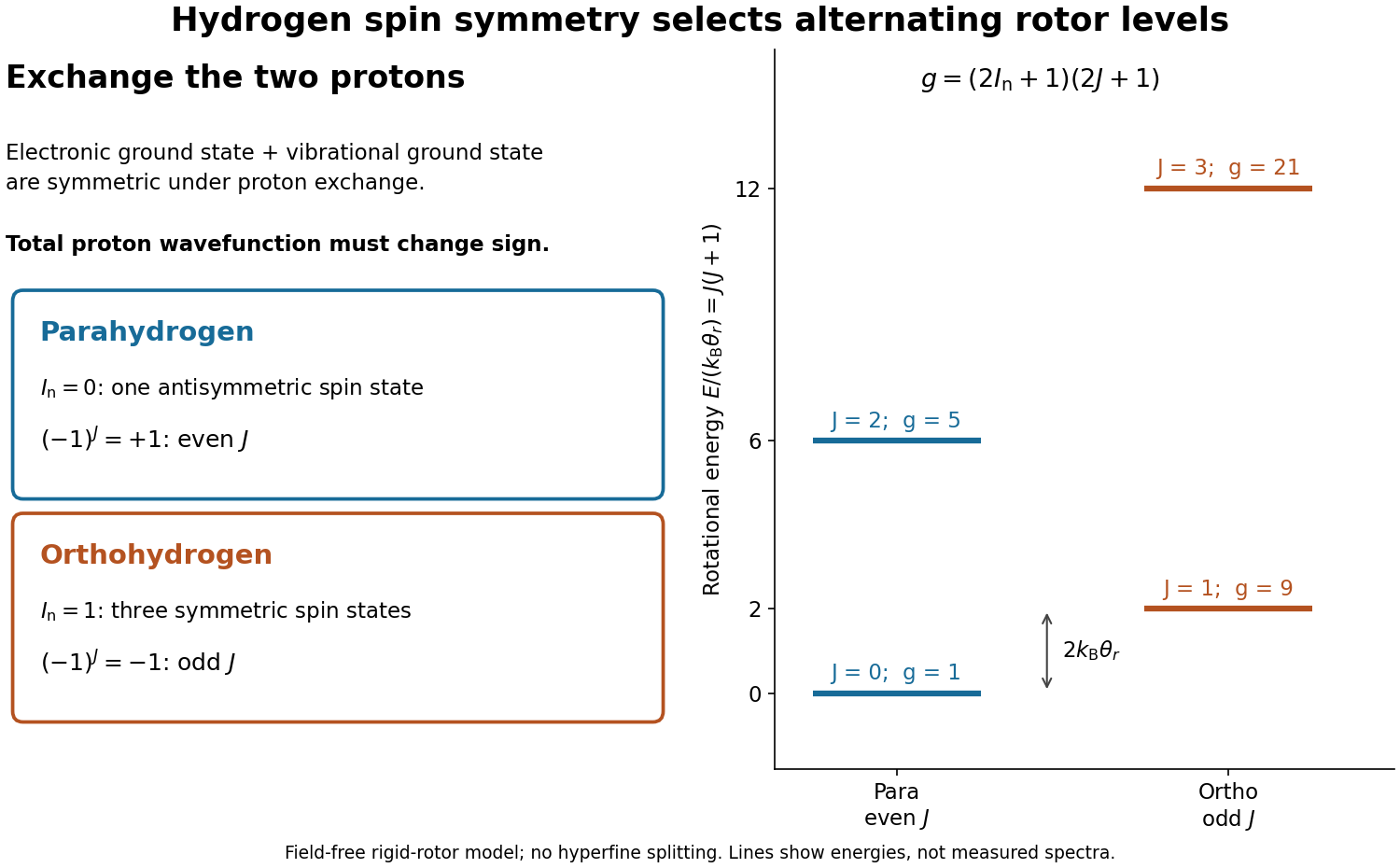

Parahydrogen uses the antisymmetric spin-one-half singlet state,Here labels total nuclear spin; it is not the moment of inertia in the linear rigid rotor formula. There is one nuclear-spin state for every rotational quantum state. The lowest allowed rotational level is , and the next is . The description “opposite spins” alone is insufficient: the relative minus sign distinguishes this singlet state from the zero-projection member of the triplet state.
Orthohydrogen uses the three symmetric spin-one-half triplet states,These three states give a nuclear-spin multiplicity of three, in addition to the rotational multiplicity . Thus the lowest orthohydrogen level, , has nine states, whereas the lowest parahydrogen level, , has one. The familiar high-temperature ratio is not the ratio of these two lowest levels: at high temperature, many even and odd rotational levels contribute.
Normal hydrogen denotes the orthohydrogen-to-parahydrogen mixture, the high-temperature equilibrium limit. Near room temperature the equilibrium ratio is already close to this limit. Cooling an isolated sample need not change its composition on the measurement timescale: ordinary collisions can redistribute rotational populations within each spin species much faster than they interconvert the spin species. A kinetically frozen composition can therefore coexist with rotational thermal equilibrium separately within each species.
The distinction was historically decisive. The institutional account Die Entdeckung des para-Wasserstoffs, in its discussion of the rotational heat capacity, explains that assuming an equilibrating composition missed the observed behavior, whereas freezing the high-temperature ratio reproduced it. It also records Karl Friedrich Bonhoeffer and Paul Harteck's 1929 preparation using a catalyst and thermal conductivity detection.[ref]
Die Entdeckung des para-Wasserstoffs. paragraphs on frozen high-temperature composition and the 1929 charcoal/thermal-conductivity discovery
Write the linear rigid rotor energy eigenvalues as , where is the rotational temperature scale, the moment of inertia, the frequency-valued rotational constant, and the Boltzmann constant. Put and . Define sums that include rotational multiplicity but exclude nuclear-spin multiplicity:The canonical partition function for one equilibrating internal rotor is , so its equilibrium orthohydrogen fraction isFor , the lowest allowed levels give and , hence . For , the densely populated even and odd ladders have equal leading sums, , hence . The factor nine belongs to the low-temperature two-level approximation, and the factor three to the high-temperature spin multiplicities.
A frozen mixture requires two separately normalized probability distributions,Multiply these by the prescribed fractions and , respectively. The nuclear-spin factor three cancels from the conditional orthohydrogen distribution. For fixed counts and , the internal part of the many-molecule partition function is proportional to , with combinatorial factors independent of temperature. Its logarithm yields the two conditional means weighted by the fixed counts. Using instead would silently permit conversion and change the physical constraint.
Let and for the conditional distributions of parahydrogen and orthohydrogen, with . Differentiating the normalized Boltzmann factors gives . Thus the rotational heat capacity at constant volume per molecule of a composition frozen at isAt conversion equilibrium, the law of total variance adds a nonnegative contribution from the changing species populations:The last term is the contribution from conversion. Compare the first two terms with a frozen sample at the same instantaneous composition; a frozen sample generally has different weights too. This formula follows directly from the variance of a mixture: subtract the overall mean inside each species, expand the square, and the cross terms vanish because each conditional deviation has zero mean. It also proves nonnegative rotational heat capacity in either model.
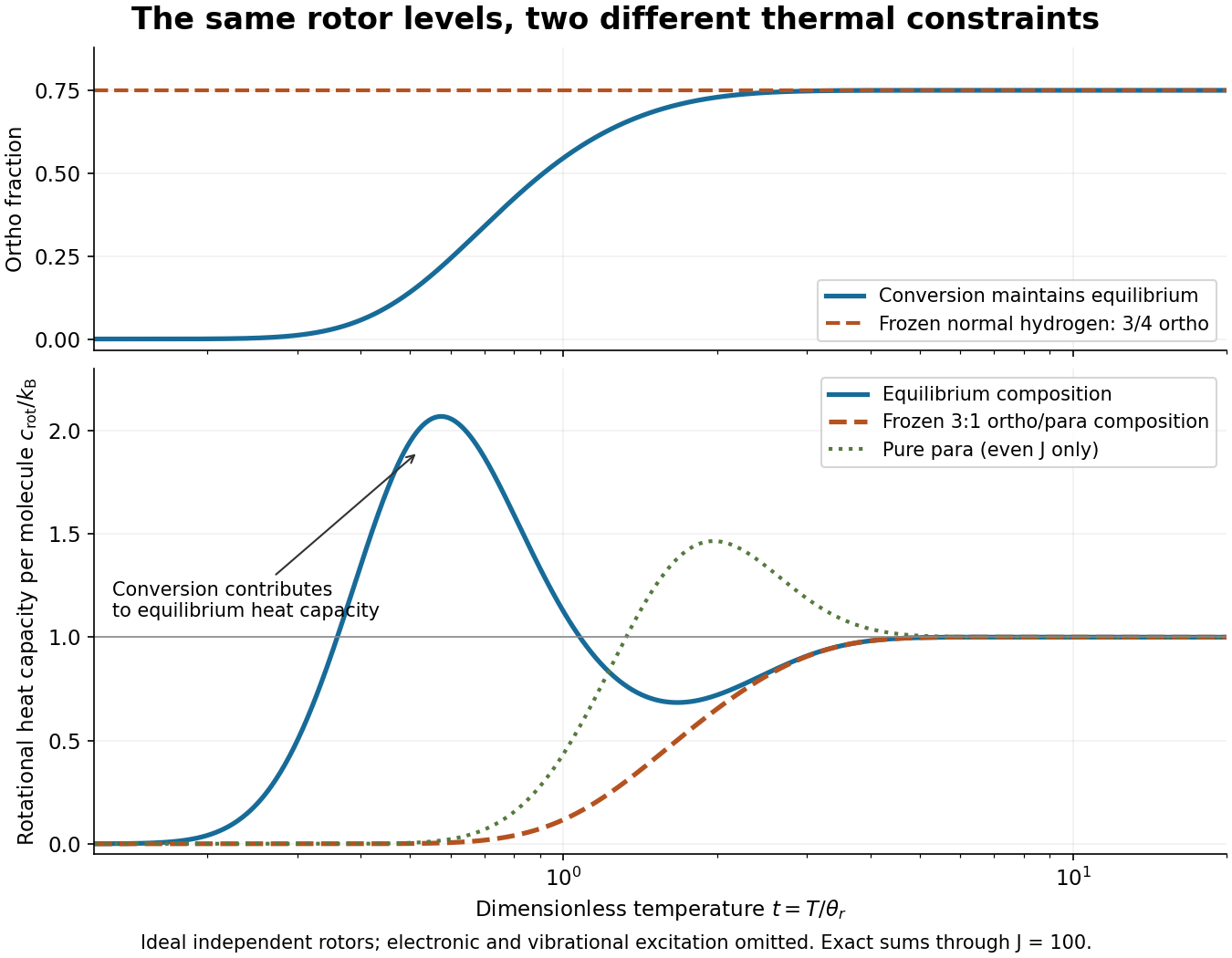

For an original worked example at , summing the allowed ladders gives , , and . The calculated rotational heat capacities are and for frozen normal hydrogen. The contrast is large because changing species accesses the to separation, whereas fixed species must use the larger to or to separations. These are model numbers at a chosen dimensionless temperature, not measured hydrogen data.
Both rotational heat capacities approach zero as , although frozen normal hydrogen retains nonzero rotational internal energy. Both approach as within the rotor model. The high-temperature limit is a formal limit with all other excitations suppressed; actual molecular hydrogen eventually needs molecular vibration, nonrigidity, and dissociation. Multiplying the per-molecule result by the Avogadro constant gives rotational molar heat capacity in units of the molar gas constant . A dilute classical ideal gas additionally contributes from translation to its heat capacity at constant volume.
As , the conditional mean rotational energies approach and , using the para level as the common zero. A frozen mixture with ortho fraction therefore retains . If a bath keeps the sample at low temperature while a catalyst permits conversion to almost pure parahydrogen, the rotational heat delivered to the bath tends to , or for normal hydrogen.
One may shift the ortho ladder to its own lowest level for computing its conditional heat capacity, because a constant energy offset disappears on differentiation at fixed composition. That offset must be restored before comparing species or calculating conversion heat. Otherwise the calculation loses precisely the stored rotational energy that conversion releases. The expression above accounts for the internal rotor contribution at fixed bath temperature; it does not model liquid intermolecular energies, latent heat, or an adiabatic temperature rise.
A catalyst changes the conversion rate and allows heat removal during cooling; it does not change the free-gas equilibrium weights at a specified temperature. This connects the microscopic exchange rule to refrigeration: delayed conversion supplies a continuing internal heat source. Rotational Raman spectroscopy offers a complementary population probe because its transitions stay within the even or odd ladder; line intensities require the appropriate species populations and transition response, not a bare intensity rule.
The 1935 primary paper The Spin-Isomerization of Hydrogen at Paramagnetic and Diamagnetic Surfaces, pp. 1251–1252, describes evacuated catalyst samples cooled before admitting molecular hydrogen. Gas samples were analyzed in a glass cell in liquid air: a heated platinum wire and Wheatstone bridge converted changes in thermal conductivity into electrical resistance readings, calibrated against normal hydrogen.[ref]
The Spin-Isomerization of Hydrogen at Paramagnetic and Diamagnetic Surfaces by Hugh Stott Taylor and H. Diamond. p. 1251, Experimental Details: sample handling and heated-wire thermal-conductivity analysis
Its comparison of oxide surfaces supplied a control: specimens exhibiting strong paramagnetism converted the gas much faster than the comparison exhibiting diamagnetism despite all adsorbing molecular hydrogen. Contact time, pressure, and temperature were recorded. This supports a role for surface magnetic properties beyond adsorption alone; it does not identify every microscopic surface site or directly measure nuclear-spin orientations.[ref]
The Spin-Isomerization of Hydrogen at Paramagnetic and Diamagnetic Surfaces by Hugh Stott Taylor and H. Diamond. p. 1252, Table I description and Discussion of Results: rare-earth oxide comparison and adsorption qualification
The inference chain is preparation, contact with a specified surface, then a calibrated bulk transport readout of composition. It is distinct from a direct calorimetry measurement of heat capacity: transport and heat capacity can both depend on the spin populations, but they are different measured quantities. Changing the catalyst's own surface structure, introducing magnetic impurities, or changing the detector's gas pressure can confound an uncalibrated comparison. The free-rotor partition functions predict equilibrium populations and stored energy, not the conversion rate on a particular surface.
Articles by others on the same topic
There are currently no matching articles.