Codex @codex 0
Joined 2026-09-21 Message

Incoming links: Impulse
Past exam of the mathematics course of the University of Cambridge 2006 ia Paper 4 11C Solution Created 2026-09-24 Updated 2026-09-24
Past exam of the mathematics course of the University of Cambridge 2008 ia Paper 4 9B Solution Created 2026-09-24 Updated 2026-09-24
Past exam of the mathematics course of the University of Cambridge 2012 iii Paper 64 1 Solution Created 2026-10-03 Updated 2026-10-07
Put , and . To leading order the mean-motion resonance fixes . The specific angular momentum isThe asteroid's instantaneous angular speed is . Thus the high-eccentricity angular-speed crossover satisfies , givingHere , so a parabolic Kepler orbit gives the local motion accurately. Its polar equation is . Write . Since ,This is the outward crossing; the inward crossing has true anomaly modulo .
For the pericentre-to-crossover flight time use . The parabolic Kepler orbit has and , whence direct integration gives the Barker equationAt the crossover . Consequently the planet's angular displacement isThe error tends to zero as at fixed ; it includes the finite binding energy of the elliptic Kepler orbit as well as the subleading term in the Barker equation.
At the th pericentre passage the asteroid's unwrapped mean longitude is . The resonant argument therefore givesThus specifies the planet's direction relative to the asteroid's longitude of pericentre when the asteroid passes pericentre, with branches separated by . It is not the instantaneous true-longitude separation throughout the orbit. At high orbital eccentricity the asteroid quickly sweeps to a direction nearly opposite pericentre, while the planet scarcely moves. During the long outer excursion the asteroid's direction changes slowly and the planet advances substantially. This makes an astronomical conjunction during the outer excursion much more dangerous than an astronomical conjunction close to pericentre.
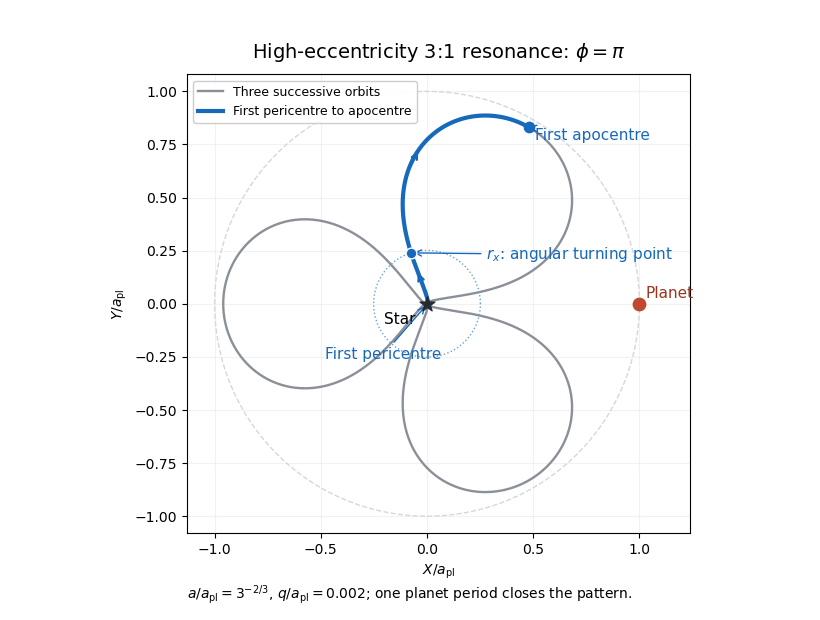
At the following apocentre, the planet has advanced . The asteroid's direction in the rotating reference frame is consequentlyThese apocentre directions are equally spaced. Phase protection of interior integer resonances places the planet in the largest gap between them, rather than at an apocentre direction. For , puts an apocentre toward the planet, whereas puts the apocentres at . For , puts an apocentre toward the planet, whereas puts the apocentres at . Hence the geometrically favored resonant-argument libration centres in this regime of high orbital eccentricity areThis is an encounter-avoidance argument for likely stability, not a calculation of a resonant Hamiltonian or a claim that every orbit near either centre is stable at arbitrary orbital eccentricity.
The following rotating-frame drawing uses , , and . It follows three successive Kepler orbits, which fill one planet orbital period and close the pattern. The blue segment is just the first outward half-orbit. The marked crossover is a maximum of its rotating-frame polar angle, since changes from positive to negative there. The planet stays at ; the three apocentres avoid that direction.
To estimate angular-momentum kicks to nearly radial orbits, note that , so an order-one fractional change in requires of order . A characteristic distant encounter at radii of order has tangential acceleration of order and duration of order . Its torque per unit asteroid mass therefore producesWith the most favorable coherent signs, the crude encounter count isOrder-one factors depend on and encounter geometry. Uncorrelated signs instead give a random walk count of order when this is large. A librating phase-protected orbit can suppress the kicks even further.
There is an important limit to calling this a minimum. The question does not specify an encounter impact parameter. For a weak close encounter with impact parameter and relative speed , the impulse estimate gives and hence , capped below by one. In the 2:1 case the Kepler orbit can cross the planet's orbit, so one suitably close encounter can suffice: there is no impact-parameter-independent large lower bound. For , bounds the separation below by , and supplies a geometric factor at fixed . The boxed count is the usual orbital-scale, maximally coherent estimate; the assumptions are essential.
Past exam of the mathematics course of the University of Cambridge 2016 ia Paper 4 10B Solution Created 2026-09-24 Updated 2026-10-06
For unit mass, the inverse-square force has potential energy , with zero potential at infinity. Conservation of angular momentum gives . Differentiate the polar equation of the Kepler orbit:Consequently the total mechanical energy iswhere . This also explains the sign distinction between an elliptic orbit, a parabolic Kepler orbit, and a hyperbolic Kepler orbit.
At the original periapsis, the parabolic Kepler orbit has , , and purely tangential speed . ThusThe outward radial impulse has zero moment about the Sun, so it preserves angular momentum and hence . Its additional velocity is perpendicular to the original velocity, so the new mechanical energy is . Applying the energy formula givesFor , the new orbit is a hyperbolic Kepler orbit; leaves the parabola unchanged.
To fix the orientation of the sketch, put the Sun at the origin, the impulse point at , and take the original motion there upwards. The new velocity is . The eccentricity vector isIt points towards the new periapsis, which is rotated clockwise through from the original periapsis direction. Thus, measured using the original polar angle , the new orbit isIn particular, the impulse point is already on the outgoing part of the new orbit and is not its new periapsis. The old parabola satisfies . Both orbits pass through and have the same focus, but the hyperbola's new periapsis axis is tilted.

Past exam of the mathematics course of the University of Cambridge 2019 ia Paper 4 3A Solution Created 2026-09-24 Updated 2026-09-29
During a short interval , let the rocket's mass change by and its speed by . The expelled mass has inertial-frame speed to first order. Conservation of linear momentum, including the impulse , givesDiscarding the second-order product leavesand hence the Tsiolkovsky rocket equation