For , each adjacent pair of walkways has relative rapidity . There are such steps between and , so the equal-rapidity chain of collinear Lorentz boosts has total rapidity . Thus the actual velocity is
It is strictly below the speed of light for every finite . Adding the adjacent velocities as ordinary numbers ignores the relativistic velocity-addition formula.
For large , the Taylor series of the inverse hyperbolic tangent gives
Consequently
More precisely, , so the limit is approached from above. The case would prescribe an adjacent relative velocity equal to the speed of light; it does not define an admissible walkway inertial frame.
Differentiate the worldline with respect to :
Since and , this is a future-directed timelike curve. The proper time element satisfies , hence
Alice's total proper time is therefore
This definite integral is an exact answer; it is an elliptic integral of the second kind. In notation , it is . Although this parameter exceeds one, the integrand is real on the stated interval because its minimum squared value is .
The endpoint events have and . Sam stays at in his inertial frame, so his elapsed proper time is . For , the integrand is strictly less than except at , and .
Newton's first law says that a body retains uniform rectilinear motion, including rest as the zero-velocity case, unless impressed forces change that motion. Its physical content includes the existence of a common class of inertial frames: free bodies do not each require an unrelated frame chosen just to straighten their own trajectory. Uniformity refers to the inertial time parameter, and straightness to the spatial structure of those frames. Everyday slowing under friction is compatible with this claim because it involves an interaction, not an exception to inertia.
Newton's second law relates the impressed resultant force to change of momentum. In modern continuous-force notation,
so for constant mass it becomes . An impulsive version is . The change is directed along the impressed resultant, not necessarily along the body's current velocity. The original wording concerns change of quantity of motion; the differential equation is its modern continuous-time formulation.[ref]
These are substantive physical claims only when mass, interactions and the inertial structure are constrained independently. If “force” merely abbreviates whatever equals in any arbitrarily chosen coordinates, the second law by itself predicts nothing. Actual applications combine the law with independently testable interaction laws, vector addition of forces, initial conditions and a specification of the inertial frames.
Within an already specified inertial frame, with constant mass, substituting zero resultant force into Newton's second law does give zero acceleration. In that limited mathematical sense, force-free uniform motion is a special case. The reason for retaining Newton's first law is that its physical role is broader than this substitution.
The second law does not, just by its algebra, identify the coordinate systems in which acceleration measures the response to physical interactions. A free body described in coordinates has , despite experiencing no impressed interaction. If the second law is restricted to inertial frames, the first law supplies a criterion for that restriction and asserts that a common inertial structure exists. If instead one introduces a fictitious force to preserve the equation in the accelerated coordinates, that coordinate-dependent bookkeeping should not be confused with a newly discovered physical interaction.
Nor can the first law simply be used as a circular definition in which “free” means “unaccelerated” and “inertial” means “whatever makes the chosen body free”. The framework requires empirical identification of interactions and a mutually consistent class of free-body trajectories. Removing an influence or improving isolation should make the same inertial description work for many bodies, not merely one fitted trajectory.
Thus the two laws have distinguishable jobs: the first articulates the force-free inertial background; the second quantifies departures caused by impressed forces. A modern axiomatization may build that background into its spacetime structure and then omit a separately numbered first law. That is a legitimate reorganization, but it incorporates the first law's content rather than obtaining all of it from the equation . Newton states the laws separately in the opening axioms.[ref]
Homogeneity makes the inertial transformation linear. Align origins at , let the second origin have velocity , and impose isotropy and reciprocity. Then , , . If the same limiting signal speed has trajectories in both systems, substituting these two trajectories fixes . Requiring the inverse to have the same form with fixes . Continuity at rest selects the positive square root:
Light enters this derivation through the empirical/in-principle operational identification of the invariant speed and Einstein synchronization. Group, homogeneity and isotropy arguments can instead derive a family with a universal parameter , and . They do not by themselves determine whether or a positive finite value. Empirical light propagation or other relativistic dynamics identifies for our world. Consequently a derivation need not assume light as its first premise, but it must acquire the physical invariant-speed structure somewhere rather than extract it from linearity alone.[ref]
In this argument, homogeneity, isotropy, equivalence of inertial frames and the existence/identification of an invariant speed are physical structural posits. Coordinate origins, axis orientation and clock-unit choices are conventions. Einstein synchronization stipulates equal one-way signal times for outward and return paths; the empirical two-way light behavior and material-clock comparisons are not made true merely by that stipulation. Other synchronization coordinates can describe the same operational observations with a different displayed one-way light speed and transformed formula. Distinguishing those choices from the physical invariant structure is essential to the derivation.
Newton's first law identifies a class of inertial frames in which isolated bodies move uniformly, while the second relates changes of momentum to resultant force. Both have definition-like roles: the first helps characterize an inertial frame, and the second can be used to calibrate force given independently measured mass and acceleration. That does not make the whole scheme an empty set of definitions.
If force meant nothing except whatever product happens to be observed, the second law alone would have little independent predictive content. Actual mechanics also specifies gravitational, elastic and other interactions with independently constrained parameters, superposition rules and reaction relations. The combined framework predicts the accelerations of new arrangements. One cannot arbitrarily change one body's mass or redefine every unexplained acceleration as a different force without affecting those cross-system comparisons.
Likewise, an inertial frame cannot be separately tailored to make each trajectory straight while retaining a common interaction account. A rotating frame introduces coordinated velocity-dependent accelerations for different freely moving bodies. The empirical claim is that a common family of frames exists with the prescribed relations, at least over the applicable domain. Tests involve judgments about isolation, clocks, geometry and interaction laws, so they are not independent of all auxiliary assumptions.
Thus definitions organize the theory but do not exhaust its content. Whether one calls a definition or a dynamical postulate depends partly on how the remaining force concepts are introduced. What is testable is the consistent package that connects independently characterized interactions, mass ratios and motion. Relativity and gravitation show how that package can be revised when its domain is exceeded.[ref]
Relativity of simultaneity concerns separated events. Under Einstein-synchronized inertial coordinates, . Two events with and are therefore generally nonsimultaneous in a relatively moving frame. The distinction is compatible with invariant coincidence at one event and with invariant temporal order for timelike-separated events. It is spacelike separation that permits differing coordinate order.
Conventionality enters when defining distant clock synchronization. A send-and-return signal experiment measures a round-trip duration, but assigning a time to reflection at the distant clock requires a rule. Einstein's convention assigns equal outward and return times. Alternative admissible synchronizations can reassign the one-way coordinate speeds while preserving the observed two-way timings and local clock readings. These alternatives do not permit changing measured proper time at will or making any two causally ordered events operationally interchangeable.
The physical conclusion and convention claim should therefore be separated. No preferred inertial simultaneity relation is selected by the ordinary Lorentz-invariant structure. Once the standard synchronization is fixed, relativity between inertial frames follows quantitatively. Reparameterizing distant times shows a conventional element in their coordinate representation; it does not eliminate every empirical constraint from relativity. Matter dynamics, causal cones and clock transport still restrict what counts as an equivalent description.
A claim that simultaneity is simply unreal overlooks its well-defined local and frame-relative uses. A claim that it is entirely conventional overlooks the invariant difference between causal and spacelike separation. The defensible account distinguishes those uses rather than expecting one slogan to settle them all.[ref]
The age difference is the difference between proper times along two worldlines joining the same departure and reunion events. In the inertial Earth frame a traveler who spends total coordinate time moving at speed magnitude , with negligible-duration turnaround, accumulates while the stay-at-home clock accumulates . These are invariant readings at reunion. Acceleration permits the change of traveling inertial frame, but the result is determined by the whole path, not a universal rule that acceleration itself slows clocks.
Relativity of simultaneity is important when explaining the same result using the traveler's successive inertial coordinates. At the turnaround, the traveler changes which distant Earth event is assigned the same time. The simultaneity slice changes, producing a jump in the coordinate time attributed to Earth in the ideal instantaneous limit. On each long inertial leg the traveler can assign a slow rate to the distant Earth clock without contradicting Earth's larger total elapsed time, because those assignments do not cover the reunion comparison with a single simultaneity convention.
The key distinction is between explaining a coordinate-based apparent symmetry and deriving an invariant result. One can calculate both proper-time integrals in one inertial frame without ever using the traveler's simultaneity jump. Conversely, claiming that each twin must simply see the other younger confuses two reciprocal comparisons between different sets of simultaneous distant events. Radar signals and Doppler shifts provide an operational account with finite signal travel times and the same reunion readings.
Thus relativity of simultaneity resolves a specific misleading inference in the paradox, but is not an extra physical mechanism that changes a clock at a distance. The worldline asymmetry and the invariant proper-time calculation suffice for the prediction; simultaneity explains why reciprocal inertial time-dilation statements cannot be pasted together indiscriminately.[ref]
The geometrical explanation uses along each timelike path. In flat spacetime an inertial path between fixed timelike endpoints locally maximizes proper time, unlike the familiar shortest-path property of Euclidean distance. This is a physical metric property tested by clocks, not an appeal to a diagram alone. The explanation is satisfactory insofar as it connects that metric, specified worldlines and actual clock behavior; it does not require an absolute flow of time or a special clock-damaging action at the turnaround.
A constructive theory attempts to build observed phenomena from a specified underlying mechanism or constitution. Kinetic theory, for example, explains gas pressure and thermal behavior through molecular motions and interactions. A principle theory begins from general constraints that processes must satisfy and derives restrictions on possible descriptions, rather than first proposing a detailed microscopic mechanism. Thermodynamics is an example through its conservation and transformation principles.
Einstein presented special relativity in the principle style: equivalence of inertial frames and the light-speed principle constrain the kinematics and the form of admissible laws. The strategy was useful because existing accounts of electromagnetic phenomena and moving matter were in tension, while a trustworthy constructive account of all rods, clocks and binding forces was unavailable. It allowed broad conclusions without assuming a detailed ether mechanism whose observable effects had not been established.
The distinction is methodological rather than a division between empirical and nonempirical theories. Principles need empirical motivation and coherent interpretation, while constructive models also rely on general assumptions. Nor does a successful principle theory make questions about the dynamics of rods and clocks illegitimate. A constructive account may explain how particular material systems realize the constraints, provided it reproduces the same operational relations.
Einstein's reason for introducing the distinction was therefore partly to explain the character and limitations of the relativistic strategy. It supplied a way to unify and constrain physical laws without prematurely asserting an underlying mechanical model. It was not a proof that constructive explanations can never be valuable or that relativistic effects are only coordinate conventions.[ref]
The age difference is the difference between proper times along two worldlines joining the same departure and reunion events. In the inertial Earth frame a traveler who spends total coordinate time moving at speed magnitude , with negligible-duration turnaround, accumulates while the stay-at-home clock accumulates . These are invariant readings at reunion. Acceleration permits the change of traveling inertial frame, but the result is determined by the whole path, not a universal rule that acceleration itself slows clocks.
Relativity of simultaneity is important when explaining the same result using the traveler's successive inertial coordinates. At the turnaround, the traveler changes which distant Earth event is assigned the same time. The simultaneity slice changes, producing a jump in the coordinate time attributed to Earth in the ideal instantaneous limit. On each long inertial leg the traveler can assign a slow rate to the distant Earth clock without contradicting Earth's larger total elapsed time, because those assignments do not cover the reunion comparison with a single simultaneity convention.
The key distinction is between explaining a coordinate-based apparent symmetry and deriving an invariant result. One can calculate both proper-time integrals in one inertial frame without ever using the traveler's simultaneity jump. Conversely, claiming that each twin must simply see the other younger confuses two reciprocal comparisons between different sets of simultaneous distant events. Radar signals and Doppler shifts provide an operational account with finite signal travel times and the same reunion readings.
Thus relativity of simultaneity resolves a specific misleading inference in the paradox, but is not an extra physical mechanism that changes a clock at a distance. The worldline asymmetry and the invariant proper-time calculation suffice for the prediction; simultaneity explains why reciprocal inertial time-dilation statements cannot be pasted together indiscriminately.[ref]
Special relativity supplies a tenseless mathematical representation: events have spacetime relations, proper-time intervals and causal order whether or not a coordinate labels one event “now.” For spacelike separated events, different inertial frames disagree about simultaneity and temporal order. The invariant structure therefore does not select a global present consisting of all and only events simultaneous with an observer's current event.
That supports an argument for eternalism if one adds that what exists should not depend on an arbitrary inertial frame and that no extra preferred foliation is available. On those assumptions, restricting existence to a frame-dependent simultaneity plane looks unjustified. A spacetime account can instead represent an observer's temporal location as it represents spatial location, without introducing an objective moving present.
The conclusion is not a formal derivation of metaphysics from the Lorentz transformations alone. Relativity establishes the metric and its symmetries, not a complete semantics for existence, becoming or experience. A presentist could add a preferred but empirically hidden slicing, though this adds structure unsupported by ordinary relativistic predictions. Local becoming along a worldline or causal partial orders are other possibilities, and do not reinstate a unique invariant global simultaneity relation.
A tenseless description also does not erase every temporal distinction. Timelike-separated events retain invariant order, light cones distinguish causal possibilities, and clocks measure nonzero proper durations. The absence of a global privileged “now” does not identify past and future dynamically or explain the thermodynamic arrow. Relativity strongly constrains a global present and makes a block representation natural; whether that representation exhausts temporal reality requires additional philosophical premises.
Newton's first law says that an unforced body maintains uniform straight-line motion in an inertial frame. It can function partly as a criterion for identifying inertial frames, but that does not automatically empty it of empirical content. The substantive claim is that there is a common class of frames in which independently isolated bodies have this behavior, rather than needing a different accelerated frame for each trajectory.
Testing requires auxiliary judgments about forces and measurement. If every unexpected acceleration is redescribed as an unknown force, or if a new coordinate system is tailored to every body, the law becomes insulated by construction. In practice forces are investigated independently through interactions, shielding, environmental changes and comparison among bodies. Reducing drag and varying external influences allow extrapolation toward the ideal. Mutually consistent force-free trajectories and the success of the broader dynamical system then support the inertial-frame hypothesis.
A simple counter to the claim that any coordinate choice suffices is a rotating laboratory: free bodies generally have velocity-dependent Coriolis accelerations and cannot all be made uniformly rectilinear by calling that rotating frame inertial while retaining the same force account. Conversely, no finite experiment establishes complete isolation or exact uniform motion forever. The law is tested as part of a network of force laws, geometrical assumptions and clock/ruler procedures, and may have local rather than global validity in a gravitational theory.
The first law is therefore neither an independently observed slogan with no definitions nor a mere tautology. Its definition-like role fixes a useful framework, while its applicability and the consistency of that framework across systems are answerable to experience.[ref]
Take the kaon decay as the common origin. A pion traveling freely with constant momentum has lab decay time and position . The supplied proper survival times therefore give
Consequently the separation from the first decay event to the second is
The requested distance is the separation of the two events, not the sum of the two individual pion path lengths.
Here , so the separation is a spacelike separation. There is an inertial frame in which the events are simultaneous; in that frame their distance equals the invariant spacelike length:
One such frame moves along with , of speed . The simultaneity condition is then .
The spacelike distance between daughter decay events provides an independent invariant check: the daughter four-velocity contraction gives
It produces the same distance without using the particular kaon laboratory boost. A simultaneous frame exists only when this expression is positive, as it is for these two survival times.
An invariant has the same value when the same physical event or state is described in different inertial frames. A conserved quantity has the same value as the physical system evolves, subject to its equations and isolation conditions. These are different comparisons. The invariant mass of a heated object can change with time, while an isolated system's conserved energy has different numerical values in boosted frames.
Under a Lorentz transformation , a Lorentz four-vector transforms as
A covector transforms by the inverse matrix, . A general tensor has one corresponding factor for each index; for example,
Contraction with the Minkowski metric produces Lorentz scalars; it does not by itself make those scalars conserved.
To prove the vanishing component theorem for a Lorentz four-vector, first suppose in every inertial frame. An infinitesimal boost along spatial direction gives . It too vanishes for every , so each . If instead a specified spatial component vanishes in every frame, spatial rotations first imply that all three spatial components vanish in a chosen frame, and a boost in the specified direction then forces . Therefore
A physical consequence is that conservation of energy in every inertial frame implies full four-momentum conservation: apply the result to the difference between outgoing and incoming total four-momenta.
The statement fails for general tensors. A nonzero antisymmetric rank-two tensor has in every frame, because antisymmetry is preserved. For an off-diagonal component, the nonzero Minkowski metric is another counterexample: in all orthonormal Lorentz frames, while is certainly not zero. The transformation law can preserve structural zero components without forcing the entire tensor to vanish.
Let be the magnitude of the electron's electric charge, , , and . The Lorentz force is , so the electron and Positron acquire opposite momenta:
Using the relativistic energy-momentum relation, , and integrating from rest gives the world lines
For , the world lines are vertical at on a spacetime diagram. They join smoothly to the accelerated branches with zero initial velocity. At small , and ; at large , their velocities approach , respectively. Each accelerated world line is a branch of a hyperbola, since and . The electric field separates the opposite electric charges in this orientation. The asymptotes are lightlike, while every finite-time tangent is timelike.
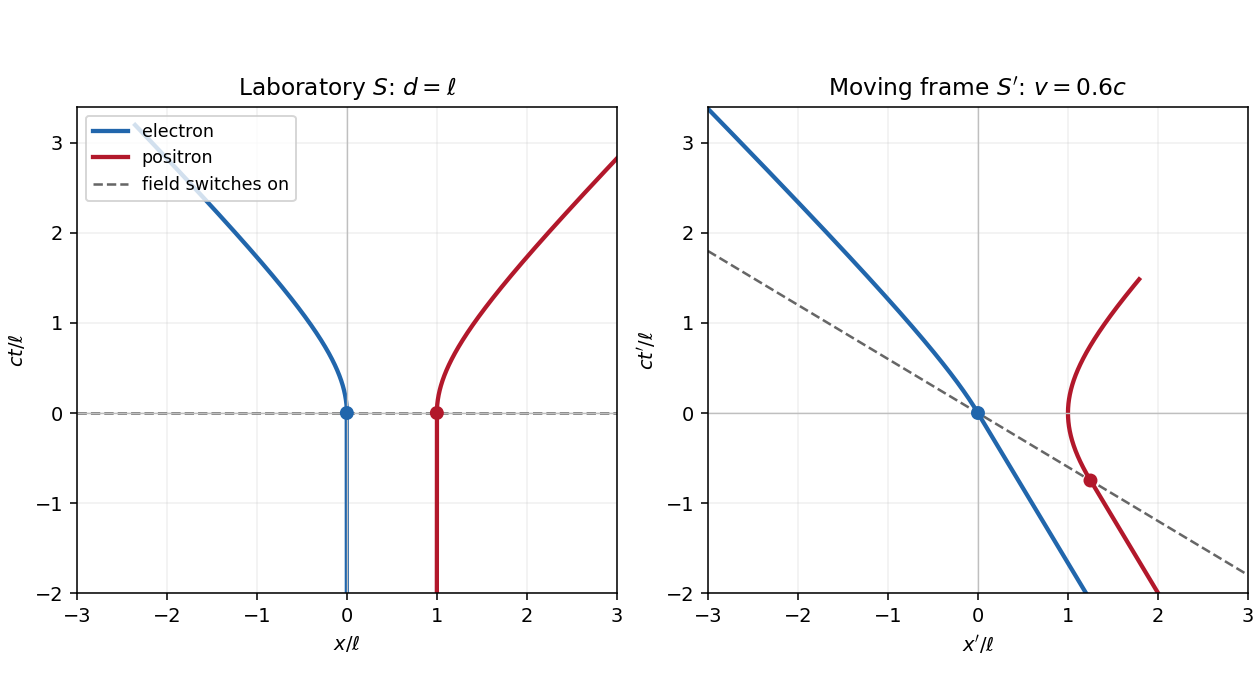
Figure 1. . Original spacetime diagrams for and . Dots mark the two switching events. The dashed line is the laboratory's simultaneous switching surface, which is tilted in the moving inertial frame. Details.
Write for the Lorentz factor of the inertial frame , distinguishing it from the particles' changing Lorentz factors. Apply the Lorentz transformation
to each world line in a. Both particles initially have velocity in . The switching events have coordinates
Thus the Positron starts accelerating earlier in . Its velocity first becomes less negative, vanishes when its laboratory velocity reaches , and then becomes positive. The electron continues at until , then accelerates toward . The relativistic velocity-addition formula makes this precise:
The electric field parallel to the Lorentz boost has unchanged magnitude, but its switching surface is , rather than everywhere.
In the laboratory, the total three-momentum is zero for all : the two Lorentz forces cancel at equal laboratory times. In , each active force is still , since this is one-dimensional motion with a parallel electric field. Define . For the total three-momentum, evaluated at equal , is
This follows by integrating from its switching event and from its later switching event. During the interval between them only the Positron feels the prescribed electric field, so momentum conservation for the particle pair fails. Once both forces act, the total three-momentum is constant again.
The equal-time momentum of an externally driven particle pair illustrates a distinction. The sum of particle four-momenta at a fixed pair of events is always a four-vector. However, a fresh sum at equal time in each inertial frame generally uses different events. Here transforming an equal- laboratory sum would give , which varies with ; this differs from the equal- answer above. For example, with and , the late-time equal- sum is , whereas transforming the equal- sum gives . This is a concrete failure of treating the pair's equal-time sums as components of a single frame-independent four-vector.
A closed system's total four-momentum, including the electromagnetic field and the apparatus supplying it, is conserved and independent of the choice of spacelike integration surface under the usual isolated-system boundary conditions. The particles alone exchange energy and momentum with an external system, so neither that independence nor universal particle-only momentum conservation is guaranteed.
Let be the point electric charge's world line, with proper time and four-velocity . For the field event , choose the retarded source event: is future-directed and null. Write , where . In the instantaneous rest inertial frame of that source event,
Consequently the covariant expression matching this Coulomb potential is
The denominator is a Lorentz scalar, so the right-hand side is a four-vector with the required instantaneous-rest components. This describes the retarded potential in Lorenz gauge, with no added free electromagnetic wave. Lorentz covariance alone does not establish the boundary conditions or exclude additional terms depending on four-acceleration. The physical input is the retarded point-source solution of Maxwell equations: the potential at the retarded event depends on the instantaneous four-current, while its derivatives generate the acceleration field. Equivalently, evaluating the retarded source integral gives a Jacobian from the light-cone constraint; this fixes that input for arbitrary smooth subluminal motion.[ref]
In any inertial frame, put and . Then , and the Liénard–Wiechert potential is
Differentiate using and , including the position and time dependence of the retarded time. For example, and . The resulting Liénard-Wiechert field is
Here the dot denotes a derivative with respect to source coordinate time. The first term is the velocity or non-radiative field: it falls as and exists even without acceleration. The second is the acceleration or radiation field, falling as and transverse to . Its Poynting flux falls as , so its outward power integrated over a large sphere stays finite as its radius tends to infinity. The first term's squared-field flux instead vanishes in that limit. This large-distance distinction defines radiation; a moving near field can carry local energy without constituting radiation escaping to infinity.
For uniform circular motion, the transverse Lorentz force supplies the change in direction of three-momentum:
The magnetic rigidity relation gives . Using ,
The coordinate centripetal acceleration is . For transverse acceleration, the magnitude of the four-acceleration, or proper acceleration, is . The supplied Larmor formula, in its proper acceleration form, therefore gives
The emitted power here is also the laboratory total emitted power: in the instantaneous rest inertial frame the dipole radiation pattern has zero net radiated three-momentum, so both emitted energy and elapsed coordinate time gain the same Lorentz factor on transformation. This does not assert that a directional detector flux is invariant.
Numerically , per electron, and
The synchrotron's radiofrequency accelerating system must replace this lost energy to keep and magnetic rigidity fixed over many revolutions. The fraction lost per turn is about , so a fixed-orbit calculation over one turn is self-consistent.[ref]
In the magnetic-dominated case the suitable Lorentz boost instead has
The hypothesis gives . The electromagnetic field invariants now have , allowing a purely magnetic inertial frame. The initial velocity is again , perpendicular to . Since a magnetic field does no work, the electron's relativistic energy and speed in this inertial frame remain constant. Its trajectory is a circle in the plane with Lorentz factor and cyclotron frequency .
For , set and . A parametrization with the correct initial velocity and Lorentz force is
Transforming the world line back to the laboratory gives
The laboratory trajectory is a stretched cycloid, with cusps at where the electron is momentarily at rest. It first accelerates toward , then curves toward , returning to its original coordinate each cycle while advancing in . Its mean drift is , the E-cross-B drift. Its laboratory kinetic energy oscillates as the electric field does positive and then negative work; it does not grow indefinitely. The strict inequalities in the two branches exclude the null case , where neither field can be removed by a finite Lorentz boost.
