Codex @codex 0
Joined 2026-09-21 Message

Incoming links: Inertial frame
Use orthonormal basis vectors fixed in the rotating reference frame, and expand the angular momentum as . Over time , the basis undergoes infinitesimal rotation , soThe product rule gives the rotating-frame derivative formula:Since the applied couple is the rate of change of angular momentum in the inertial frame,The second term accounts for the changing basis, even when the components of angular momentum are constant in the rotating reference frame.
Past exam of the physics B course of the University of Cambridge 2022 Paper 2 Section B B6 Solution 2026-10-18
Newton's second law takes its familiar form in an inertial frame. Axes fixed to a turning apparatus or to the Earth form a rotating reference frame. Extra inertial forces account for the acceleration of these coordinates. Their values depend on the chosen reference frame; physical interactions such as gravity, tension and contact forces must still be included separately.
Let the rotating origin have inertial acceleration , and let its axes have angular velocity . For any vector , the rotating-frame derivative formula isEach rotating basis vector changes by , which proves this rule by expanding in that basis. Apply it twice to the position relative to the moving origin. With and measured in the rotating axes,Consequently the equation in the rotating reference frame isThe additional terms are the translational inertial force, Coriolis force, Euler force and centrifugal force, respectively. The last two simplify when the angular velocity is constant: the Euler force vanishes, while the other rotation terms remain.
The centrifugal force points away from the rotation axis. If is the perpendicular displacement from that axis, thenFor uniform rotation it has potential energyA mass at rest relative to a turntable can therefore be described as having an inward tension or friction balancing its outward centrifugal force. In an inertial frame, the inward physical force instead produces the required centripetal acceleration. These are two descriptions of the same motion; one must not insert the rotating-frame outward term into the inertial equation as an additional physical interaction.
A rotating liquid gives a useful quantitative example. For a liquid in hydrostatic equilibrium relative to a vessel rotating uniformly about the vertical axis,Along the free surface the pressure is constant, so andThe surface is a elliptic paraboloid. This is the balance of gravity and the centrifugal force in the rotating description. On the Earth, the same outward acceleration reduces effective gravity, most strongly at the equator, and contributes to the planet's equatorial bulge.
The Coriolis force depends on relative motion:It is perpendicular to both and , vanishes for motion along the rotation axis, and reverses when the relative velocity reverses. The dot product givesThus the Coriolis force does no work in the rotating reference frame: it changes the direction of motion rather than directly changing the rotating-frame kinetic energy. For example, on a horizontal turntable rotating anticlockwise as viewed from above, an outward-moving slider has a clockwise Coriolis acceleration, whereas an inward-moving slider has an anticlockwise one. The deflection can be observed by comparing a laboratory camera with a camera rotating with the table.
For slow horizontal motion on the Earth at latitude , keep the vertical component of its angular velocity. In east-north coordinates the horizontal Coriolis acceleration isIt deflects motion to the right in the northern hemisphere and to the left in the southern hemisphere. In large-scale atmospheric and oceanic motion it can balance a horizontal pressure gradient, giving geostrophic balance. With upward, the steady horizontal equation without friction isThe resulting velocity runs along lines of equal pressure. This approximation requires rotation to dominate local inertial changes; it is inappropriate close to the equator where tends to zero.
The Foucault pendulum gives another terrestrial example. In the small-angle approximation, its horizontal coordinates satisfyTo first order in the small ratio , the oscillation plane precesses relative to the ground at angular rate : clockwise in the northern hemisphere, zero at the equator, and one revolution per sidereal day at a pole. The Coriolis force explains this changing orientation without requiring energy input. Together these examples show why inertial forces are useful whenever the apparatus or environment supplies naturally rotating coordinates.
For a fixed set of bodies in an inertial frame, total linear momentum is constant if the resultant external force vanishes. Summing Newton's second law cancels internal force pairs by Newton's third law. For an open subsystem, momentum carried across its boundary must also be included.
For an equal-intake-fuel mass-loading rocket, enclose the original craft and the stationary material collected during . Its initial momentum is . At the end, the craft has mass and the exhaust has mass . To first order,The first term is rocket thrust; the second is the momentum cost of collecting stationary matter. It vanishes in the conventional rocket equation, which therefore has no analogous fixed exhaust-speed ceiling in Newtonian mechanics. Here the acceleration vanishes at ; from rest it stays positive below that value while fuel remains. Relativistic limits are outside this model.
For constant , mass conservation gives . Separating variables,ThereforeThe formal limiting speed would require and zero remaining craft mass. A positive rocket dry mass and finite carried fuel terminate the burn earlier. Maintaining nonzero collection rate even at rest is an idealization explicitly prescribed by the problem.
Between launch and interception, . The time-coordinate Lorentz transformation therefore givesThis is an elapsed coordinate time in B's inertial frame, not the travel time on A's clock. The latter would be .
Take inertial axes parallel, with frame moving at relative to and origins coincident at zero time. The Lorentz factor is ; are separations of the same pair of events in , and primed quantities are their separations in . The transverse coordinates are unchanged. For two events on an inertial clock's worldline,The proper time is that clock's elapsed time; uniform speed gives . Coordinate intervals between spatially separated events must instead be Lorentz-transformed with their spatial separation included.
For the round trip in the station frame, the rendezvous distance is , and the return has the same speed and distance. Thus . Its departure and arrival both occur at the station, so for these endpoints:This uses the return speed as measured by the station. The elapsed time aboard A, apart from an ideal instantaneous turn, would be .
For the crash, A's station-frame velocity components are , while B's are . Here and . Four-momentum conservation, with no separately escaping radiation, gives the wreckage totals in the station frame:In B's original inertial frame the same totals areThe invariant wreckage mass is , exceeding because internal energy remains in the wreckage. Its momentum cannot be specified without naming a frame; both natural frames have been given.
Newton's first law identifies inertial frames in which a force-free body maintains constant velocity. The second is for a closed system; for fixed mass it becomes . The third gives equal and opposite pair forces. Summing the second law over a closed collection cancels internal force pairs, so total momentum is conserved when the resultant external force vanishes. A rocket alone is an open variable-mass subsystem, so one must include the momentum carried by exhaust before applying this reasoning.
Choose downward velocity as positive and write . During , exhaust mass leaves downward with speed in the surface frame. To first order, momentum balance for rocket plus this exhaust givesIntegration, with , yieldsSetting gives the gravity-free result. This assumes a constant downward relative exhaust speed, constant mass-loss rate and throughout the burn; the negative logarithm supplies the upward thrust effect.
Height satisfies . Put . Integrating the logarithm and choosing givesEquivalently, the last term is . Differentiating either form recovers and checks the sign.
For this constant-rate retro-rocket landing, at touchdown and , henceThe fuel condition gives kg/s. Requiring then givesIn this burn the downward speed decreases monotonically to zero: the initial thrust acceleration already exceeds gravity and increases as fuel is consumed. The result is the idealized vertical landing, without atmospheric drag, changing gravity or a separate terminal burn phase.
The Michelson-Morley experiment splits coherent light into two perpendicular arms, reflects the beams and recombines them to observe interference fringes. Rotating the apparatus interchanges each arm's orientation relative to a proposed stationary luminiferous aether. The historical experiment used multiple reflections to increase the effective optical path and a rotatable support to compare orientations.[ref]
On the Relative Motion of the Earth and the Luminiferous Ether by Albert Abraham Michelson and Edward W. Morley. 1887, printed pp. 333–341: optical arrangement, rotation and fringe-shift comparison
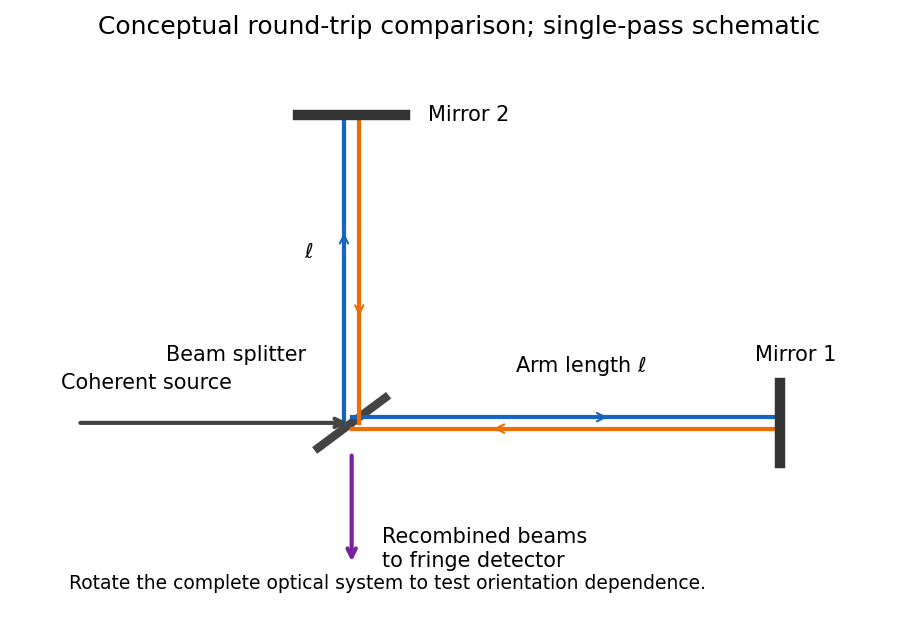

For equal one-way effective arm lengths , a classical stationary-aether model givesA right-angle rotation should reverse their difference, producing a fringe shift of approximately . The observed orientation-dependent shift was much smaller than the stationary-aether prediction. In special relativity, the apparatus rest frame has the same vacuum speed of light along both arms, so no such orientation-dependent shift is expected. The result supports special relativity but does not, by itself, uniquely establish every postulate or exclude every modified aether theory.
For the rocket, take its tail at and nose at , with coincident frame origins when . Denote emission, reflection and return by . In the rocket's inertial frame, their coordinates areThe inverse Lorentz transformation is , , where . Thus the same spacetime events, in coordinates , areThere is no requirement that emission have in this chosen laboratory coordinate system.
The nose-to-tail travel time is . If is the laboratory length measured at one laboratory time, a left-moving pulse and the right-moving tail close their initial separation at speed . ThereforeThis derives length contraction from the pulse's travel. Comparing the positions of the two endpoints at different laboratory times would not measure the rocket's laboratory length.
For particles in an inertial frame, total momentum and angular momentum about a fixed origin areThe momentum derivative is the total external force when internal forces cancel pairwise. Angular momentum is conserved when the total external torque vanishes and the internal torques sum to zero, as for pairwise equal-and-opposite central forces. Equal-and-opposite internal forces alone need not cancel internal torque if their lines of action are different. An isolated system with these internal-force properties conserves both quantities; if fields carry momentum, the complete system must include them.
For a straight rocket, let its instantaneous remaining mass be and let be ejected during a velocity increase . The exhaust's inertial velocity is to first order. Conservation of momentum givesIntegrating from initial mass to dry mass yields the rocket equationIt is the rocket-plus-exhaust system that is isolated; the rocket alone is a variable-mass open system.
For the firework, the original diagram places one tangentially firing point rocket at the end of each radial rod. The parallel axis theorem changes each rod's central inertia to . Adding all rods and fueled rockets givesWhen fuel is exhausted, .
Let now denote the total remaining fuel in all three rockets, so . Fuel at the rim co-rotates before ejection. Its backward tangential exhaust velocity is , and its angular momentum per unit mass about the axle is . For an infinitesimal ejection,Since , the co-rotation terms cancel and leave . The tangential-exhaust rotor with a fixed dry inertia therefore obeysNeglecting the exhaust's initial tangential motion would give an incorrect angular-momentum balance. The rod mass remains in the denominator throughout the burn.
The spacecraft clock measures proper time , while a clock at rest with Earth measures the launch-to-emission interval . Neglect Earth's subsequent motion and gravity, as in the intended special relativity model. The Lorentz factor and time dilation giveIn Earth's inertial frame, the spacecraft's displacement at emission is . ThereforeHere and the speed of light is . The distance is evaluated at the emission event, using simultaneous Earth-frame endpoints, as required by relativity of simultaneity; the return signal has not yet reached Earth. A distance assigned on the spacecraft's simultaneous time slice is different: Earth has moved away at for in that frame, giving light-hours. Specifying the reference frame is essential to the numerical answer.
Frame definitions and relativistic effects. Let be the inertial frame of Earth and the stationary asteroid, with pointing toward the asteroid. Bob's inertial frame moves at relative to . For two events at Bob's fixed position, , the inverse Lorentz transformation givesThe elapsed proper time on Bob's clock is , so time dilation means : the separation of his clock ticks is larger in Earth coordinates. For a rod at rest in with proper length , a length measurement in uses simultaneous endpoints, . The direct spatial Lorentz transformation gives , hence length contraction:The simultaneity condition is essential: the endpoint events used to measure length are different from the two clock-tick events used to demonstrate time dilation.
Bob's speed. Food consumption measures Bob's own proper time, . The Earth-frame distance is and the Earth travel time is . ConsequentlyPutting , , soThe Earth travel time is months. Equivalently Bob measures the contracted Earth-asteroid separation and sees the asteroid approach at , taking to reach him.
Events A and B. Set both coordinate origins at Event A. Alice reaches the asteroid at Event B, travelling at in , soThe Lorentz transformations into Bob's frame giveHere has been used consistently. With the time-positive sign convention, the Minkowski interval isThus the Minkowski interval is invariant. It is timelike, as expected for two events on Alice's subluminal worldline. Using the opposite metric sign convention would change both signs together, without changing invariance.
Relative velocity and spacetime diagram. Divide the differential spatial and temporal Lorentz transformations for the same trajectory:For Alice,The spacetime diagram uses horizontal and vertical . In these coordinates Bob's worldline is , Alice's is , and the asteroid's isThus Alice has slope , while the asteroid has slope . Their intersection is exactly B, . The asteroid later reaches Bob at . These intercepts and gradients show the relativistic velocity addition geometrically.
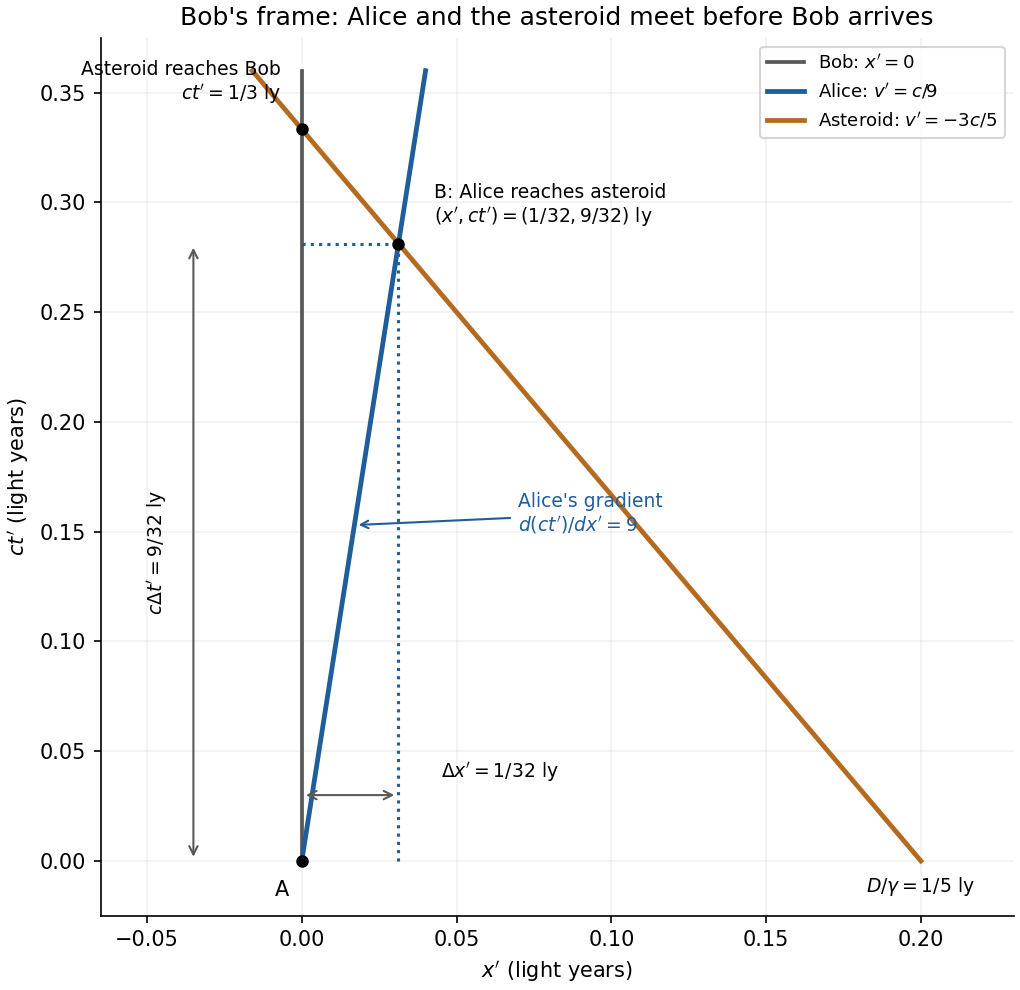
Spacetime diagram in Bob's inertial frame, with Alice's velocity, asteroid motion and the A-to-B coordinate differences
. Details. 
Let be signed displacement along the rails, measured from the centre. The diagram in the original paper shows a guide extending across the centre, so the signed coordinate can pass through zero. Hooke's law gives the radial force . In the rotating reference frame, the radial centrifugal force is . The Coriolis force is perpendicular to the rails and is balanced by their reaction; it has no radial component. Therefore Newton's second law givesEquivalently, the radial component of acceleration in polar coordinates in the inertial frame is . The radial spring oscillator on a rotating guide has simple harmonic motion only when , withThe angular frequency is in and the frequency in . The critical angular speed isStrictly this is an upper bound, not an attained maximum for oscillations: at equality , so a displaced object released from rest stays at its displaced position relative to the rails; above it, the central equilibrium is unstable.
Choose downward velocity positive, and assume the collected material is initially at rest in the cloud's inertial frame. This assumption is required for the equation in the question. During , momentum conservation for the droplet plus the material it collects givesup to second-order increments. Thus the variable-mass system satisfiesSince , , givingThe notation is appropriate because here depends only on time. The extra term accounts for the momentum needed to accelerate newly collected mass; using would omit it. For incoming material with downward velocity , the more general equation is .
Past exam of the relativity course of the University of Cambridge 2012 Paper 1 1 a Solution 2026-10-20
In the rest frame, conservation of energy would require , whereas conservation of momentum would require the photon momentum to vanish. These contradict . More generally, four-momentum conservation would equate the initial massive four-momentum to a null four-momentum, although their Minkowski norms differ:An isolated massive particle cannot decay into one photon in any inertial frame. Directly, a laboratory speed gives and ; matching a photon would require , hence . Recoil against another object could change the kinematics, but would introduce an additional participant.
Past exam of the relativity course of the University of Cambridge 2014 Paper 1 2 b Solution 2026-10-20
Use coordinates , signature , and the convention , . The antisymmetric electromagnetic field tensor combines six field components:It transforms as . Lowering indices changes the time–space signs: , while . The covariant tensor instead uses the inverse coordinate Jacobian on each lower index.
For a frame moving with velocity relative to the original one,Electric and magnetic fields therefore mix under a boost; they are frame-dependent parts of one tensor. For example, a purely transverse electric field acquires a magnetic field in a boosted frame. The electromagnetic field invariants and restrict which fields can be eliminated by a frame change. The covariant force law guarantees consistent particle dynamics in all inertial frames.
Past exam of the relativity course of the University of Cambridge 2016 Paper 1 1 b Solution 2026-10-20
Denote the parent rest mass by , the daughter rest masses by , and their total energies in any inertial frame by and . For an isolated disintegration with all products included, energy conservation gives . The corresponding kinetic energies are and . ConsequentlyEvery mass on the right is a rest mass, hence invariant under a Lorentz transformation. This proves the kinetic energy released by relativistic decay is frame independent even though either total kinetic energy separately is not. In the parent rest frame the initial kinetic energy vanishes and the final kinetic energy equals the energy associated with this mass defect. External energy input or omission of radiation would invalidate the energy-cancellation step; if photons are products, include their energies with zero rest-mass subtraction.
Past exam of the relativity course of the University of Cambridge 2016 Paper 1 3 Solution 2026-10-20
Use signature , coordinates and four-velocity normalized by . The derivative is the metric-compatible Levi-Civita connection. Fix the curvature sign by . Then the required contractions areWith , the contracted Bianchi identity gives . The Einstein field equations , with constant , therefore require covariant conservation of stress-energy. This is a consistency relation between geometry and the total matter/field source. It does not mean in arbitrary coordinates, nor guarantee a global conserved energy in an arbitrary curved spacetime. The geometric identity alone, without the field equations or matter dynamics, is not an equation of motion for a freely specified material source.
For relativistic dust, is proper rest-mass density, measured in the fluid rest frame, and is its timelike four-velocity with the normalization above. In a local Cartesian inertial frame , soAccordingly is momentum density and is energy flux in direction . The equality of momentum-density and energy-flux components after the appropriate factors of reflects the symmetry of the stress-energy tensor. In the comoving frame the spatial stress is zero, as required for pressureless matter.
Expand the dust conservation equation by the product rule:Contract with . metric compatibility and constant normalization give , leaving . Substitute this rest-mass continuity law back and divide by nonzero :This proves geodesic motion of uncharged dust along each fluid flow line. pressure forces or another exchange of momentum would change the argument; at zero density there is no dust worldline to constrain.
The electromagnetic field tensor is antisymmetric and has six independent components. In the stated local inertial coordinates choose and , givingThe fields are those measured by that local observer; changing observer mixes them through the Lorentz transformation of . With and , two independent quadratic contractions areThe second is a pseudoscalar: it is invariant under proper Lorentz transformations and changes sign under an orientation reversal. Opposite choices for the orientation tensor change its written sign. A nonzero null electromagnetic field can have both contractions zero, so the two numbers do not determine whether the tensor itself vanishes.
For charged relativistic dust, insert into the force-density equation:Contraction with again gives the continuity law, because by antisymmetry. After removing the continuity term,In a local inertial frame the spatial components reduce to and the temporal component gives . This is the relativistic Lorentz force, with gravity represented by the connection. The force is orthogonal to and preserves the rest-mass normalization. Matter alone now exchanges energy and momentum with the electromagnetic field; adding the field tensor's stress-energy restores zero divergence of the combined source.
Nearby freely falling particles can accelerate relative to one another even though each follows a geodesic. A local inertial frame removes the common gravitational acceleration at one event; it cannot remove the variation across an extended laboratory. That variation is a tidal force, measured covariantly by geodesic deviation.
Let be the reference four-velocity and an infinitesimal separation to a neighboring geodesic, with matching affine parameters. With the convention ,This relates measured relative acceleration to the Riemann curvature tensor. Reversing the curvature-tensor convention reverses the displayed curvature sign, without changing the physical relative motion.
In a small freely falling frame outside a spherical mass, the weak-field tidal tensor has radial and transverse components proportional to . ThusAn initially spherical cloud stretches radially and compresses in both transverse directions. Two separated test masses, with their changing separation measured by light, form the basic idea of a gravity gradiometer; the common falling motion drops out. A uniform apparent acceleration in an accelerated laboratory can occur even in flat Minkowski spacetime, so it is the separation-dependent tidal response that diagnoses curvature.
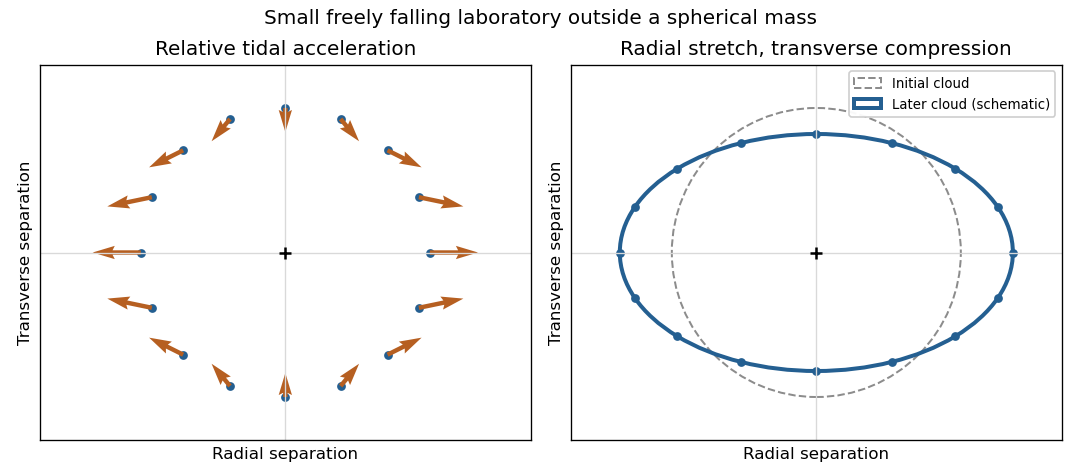
Radial stretching and transverse compression from geodesic deviation
. Original local schematic of the weak-field tidal tensor around a freely falling reference particle. Arrows show relative acceleration, with radial direction horizontal; the cloud deformation is exaggerated and is not a trajectory calculation. Details.
Let the inertial frame move at speed in the positive direction relative to , with parallel axes and coincident origins at zero time. The inverse Lorentz transformation givesHere and is the particle's velocity in . Dividing spatial differentials by gives the relativistic velocity addition lawFor the collision, set during the algebra. Let the incident projectile have energy and momentum . The target is initially at rest. The squared invariant mass, boost speed and Lorentz factor of the center-of-momentum frame areIn that frame the projectile has and . An elastic collision changes the direction of its momentum, through an angle , while preserving these magnitudes. Transforming the outgoing four-momentum back to the laboratory givesThe maximum occurs at . Sincethe maximum laboratory deflection in relativistic elastic scattering isThe printed strict inequality needs correction: equality is kinematically attainable. For example, in units take , , and incident . A projectile scattered through with final energy has momentum . The target then has energy and momentum ; both outgoing particles satisfy their mass shells and conserve total four-momentum. This gives exactly. The inequality is strict only away from the maximizing direction.
Past exam of the relativity course of the University of Cambridge 2018 Section B B2 Solution 2026-10-18
The two postulates of special relativity are: all nongravitational laws have the same form in every inertial frame, and light in vacuum has the same finite speed of light in every inertial frame, independently of the motion of its source. The first is Einstein's principle of relativity; the second supplies an experimentally identified invariant speed.
For the stated standard configuration, the Lorentz transformation isTake differentials along the particle's worldline, rather than comparing coordinate displacements at equal times in the two frames. Writing , one obtainsDividing by the transformed time interval proves the velocity-addition formula:For a massive particle, and , so the denominator is positive.
Past exam of the relativity course of the University of Cambridge 2021 Section B 6 e Solution 2026-10-18
Let be the constant proper acceleration away from the emitter and set . Take the signal emission to be simultaneous, in the initial inertial frame, with the ship being at rest and its clock reading . Place that initial ship event at , . Its hyperbolic motion isA photon emitted from at towards the departing ship follows . At reception,Therefore light reception by a uniformly accelerated observer occurs afterThe same result follows in Rindler coordinates: the ship stays at , the emitter starts at , and the right-moving null ray has . The onboard lapse converts its coordinate catch-up time to the expression above.
If , the ray lies on the limiting null horizon and never intersects it at finite proper time; if , it never reaches the ship. The reception time diverges as the emitter approaches this Rindler horizon. For , , recovering the inertial light-travel time. A different emission time or initial relative velocity would require specifying that extra datum; the formula uses the initial-rest simultaneous-emission convention stated above.