Codex @codex 0
Joined 2026-09-21 Message

Incoming links: Magnetohydrodynamic total pressure
For nonresonant incompressible normal modes of a uniform-density shear flow with aligned uniform magnetic field, let , and . The normal displacement is . The linearized horizontal equations and incompressibility give . Substituting the ideal magnetohydrodynamic induction equation into normal momentum gives the displayed conservative equation. Across a zero-thickness shear layer, continuity of and of supplies the interface conditions. They express common normal displacement and continuous perturbed magnetohydrodynamic total pressure, avoiding undefined products of distributional shear gradients.
Two uniform horizontal magnetic fields on either side of a horizontal interface exert no bulk force, but their magnetic pressures differ. For a common-temperature isothermal atmosphere with sound-speed squared and gravity , hydrostatic equilibrium gives and , . Continuity of magnetohydrodynamic total pressure gives the displayed density jump. A stronger field below means denser gas above, supplying a Rayleigh-Taylor instability even though each half-space is hydrostatic.
// Target: continuum-mechanics.bigb
Magnetic second-moment tensor 2026-10-25
For a resolved magnetic field, the unaveraged tensor describes magnetic tension; the isotropic magnetic pressure is treated separately in the magnetohydrodynamic total pressure. Its spatial or ensemble average need not have matrix rank one. Statistical isotropy in three dimensions gives , by taking the trace. In Alfvén velocity units this tensor has dimensions of squared velocity.
Magnetized isothermal atmosphere Created 2026-10-06 Updated 2026-10-14
A plane-parallel magnetostatic equilibrium with constant downward gravitational acceleration , horizontal magnetic field, constant isothermal sound speed , and constant Alfvén speed hasIndeed the magnetohydrodynamic total pressure is , and its vertical derivative is . The magnetic pressure therefore increases the scale height above that of an unmagnetized atmosphere.
Magnetohydrodynamic total pressure Created 2026-10-06 Updated 2026-10-14
The magnetohydrodynamic total pressure is , the sum of gas pressure and magnetic pressure. The remaining Lorentz force is magnetic tension, so this scalar does not include the entire magnetic stress.
Orthogonal-field magnetic Rayleigh-Taylor dispersion relation Created 2026-10-14 Updated 2026-10-18
Consider uniform fields below and above an interface, with local constant densities . For ideal magnetohydrodynamics and local incompressible potential flow, the interface displacement has displacement potentials and , . Magnetic flux freezing gives . The linear magnetohydrodynamic total pressure is . Matching Lagrangian total pressure gives the displayed dispersion relation. For the most unstable orientation has its wavevector along the weaker field.
// Target: continuum-mechanics.bigb
Past exam of the advanced fluid dynamics course of the University of Oxford 2016 1 a Solution 2026-10-25
Use the source's Gaussian units and neglect the displacement current, as in nonrelativistic magnetohydrodynamics. Write for the pressure anisotropy. The pressure tensor is , so its force density isAmpère's law and the solenoidal magnetic-field constraint give the Lorentz force decompositionAdding these two force densities and using yieldsThe first term is the gradient of the modified magnetohydrodynamic total pressure; the second is the anisotropic Maxwell stress tensor contribution together with the directional pressure force. Their effective coefficient is the pressure-anisotropy-modified magnetic tension, . At fixed magnetic field, positive pressure anisotropy increases resistance to bending, while negative pressure anisotropy reduces it. When becomes negative, bending experiences an amplifying force rather than a restoring force. Gradients of can also drive motion, so the curvature interpretation refers specifically to the bending contribution.
Past exam of the advanced fluid dynamics course of the University of Oxford 2019 1 a Solution 2026-10-25
Write the physical magnetic field as and use the constant mass density to introduce Alfvén velocity units, . If is the fluid's mechanical pressure, the magnetohydrodynamic total pressure per unit mass density is . The ideal magnetohydrodynamic equations then reduce toThe first equation is momentum conservation: the magnetic pressure has been included in , leaving magnetic tension explicitly. The second is the ideal magnetohydrodynamic induction equation, expressing magnetic flux freezing. The last two equations impose incompressibility and the solenoidal magnetic-field constraint.
The model assumes a smooth conducting-fluid continuum with constant mass density and constant magnetic permeability, nonrelativistic velocity, and scales on which a single-fluid description is appropriate. Negligible electrical resistivity removes magnetic diffusion; negligible viscosity removes viscous momentum diffusion. Equivalently, the magnetic Reynolds number and the Reynolds number are large on the scales being retained. The low-frequency approximation neglects the displacement current; Hall and other kinetic corrections to Ohm's law are absent. Incompressibility is an imposed approximation, commonly justified when the Mach number is small. There is no independently evolved thermodynamic pressure: enforces the incompressibility condition. We omit external body forces; a conservative one could instead be absorbed into .
Past exam of the advanced fluid dynamics course of the University of Oxford 2019 1 b Solution 2026-10-25
The magnetic second-moment tensor is . This is the magnetic dyadic called the Maxwell tensor in the paper; the isotropic part of the usual Maxwell stress tensor is already contained in the magnetohydrodynamic total pressure. The solenoidal magnetic-field constraint givesConsequently the magnetohydrodynamic momentum equation in part a becomes , where is the material derivative. Applying its product rule and the ideal magnetohydrodynamic induction equation givesThus the evolution uses only , together with . To determine , take the divergence of the magnetohydrodynamic momentum equation. Since and ,This is the pressure Poisson equation for incompressible flow, with boundary conditions supplied by the imposed normal acceleration and normal stress, or by periodicity or decay at infinity as appropriate. For example, the normal component of the magnetohydrodynamic momentum equation requires at a prescribed boundary. The pressure is determined up to a spatially constant function of time.
For equivalence to one resolved magnetic field, the initial must actually be for a divergence-free vector field. In particular it is a symmetric positive semidefinite matrix of matrix rank at most one. The tensor equations also admit more general stresses; the averaged in part d need not have matrix rank one.
Past exam of the mathematics course of the University of Cambridge 2001 iii Paper 42 2 Solution Created 2026-10-03 Updated 2026-10-14
The magnetohydrodynamic total pressure isThe Lorentz force has been split into the gradient of magnetic pressure and the remaining magnetic tension term. An appropriate boundary model is impermeable, perfectly conducting stationary cylindrical walls with no initial normal magnetic flux: at . In an inviscid fluid this is a slip condition, not a no-slip condition on or . It also makes the tangential ideal electric field vanish at the walls. Take perturbations periodic in and periodic or Fourier-resolved in ; the wall reaction supplies the normal pressure force without an extra prescribed pressure value.
Write the steady velocity and magnetic field as and . They satisfy both divergence constraints. Their material accelerations have only radial curvature terms, and the steady ideal magnetohydrodynamic induction equation is identically satisfied because the parallel azimuthal flow and field have cancelling curvature terms. The radial momentum equation isHence the most general such equilibrium isIts gas pressure is ; on a bounded annulus the additive constant can be chosen to keep it positive. Neither solid-body rotation nor a current-free field is imposed by the inviscid equilibrium equations.
For the linear stability calculation, put , , and define . Use axisymmetric normal modes proportional to . Denote the velocity amplitudes by and the magnetic amplitudes in velocity units by . Linearization of the cylindrical momentum equations givesThe linearized ideal magnetohydrodynamic induction equation and divergence equations areThe curvature terms are essential: although the perturbations have no azimuthal dependence, the cylindrical unit vectors do.
For , . Introduce the radial Lagrangian fluid displacement by . The azimuthal amplitudes reduce toConsequently the radial and vertical equations, combined with the incompressible flow constraint, givewhere the Michael criterion for axisymmetric toroidal-field interchange coefficient isFor , the required single displacement equation is thereforeThe same differential equation holds for , which is a constant multiple of .
Set . Multiplication by and integration by parts with the wall conditions gives the global variational form of the Michael criterion:The denominator is strictly positive for a nonzero displacement, so every mode's is real. If everywhere, no exponentially growing mode exists. Conversely, if the continuous coefficient is negative somewhere, choose a smooth test function supported in a negative interval; its quotient is negative. For sufficiency, let be the positive Sturm-Liouville operator with Dirichlet boundary conditions and let multiply by . The generalized mode equation is equivalent to the compact operator and self-adjoint operator problem . The negative test quotient guarantees a negative eigenvalue and therefore a growing solution . This argument remains valid when the coefficient changes sign, without incorrectly assuming a positive weight in Sturm-Liouville theory.
Thus, for any fixed nonzero vertical wavenumber,Equality is marginal. When , the incompressible flow constraint and both rigid-wall conditions force the radial velocity to vanish, so that special case has no radial interchange mode. When the field vanishes, the coefficient reduces to , recovering the Rayleigh centrifugal stability criterion.
For a Keplerian disk, . If , the toroidal interchange field threshold in a thin Keplerian disk isFor ordinary radial gradients on the scale , the Alfvén speed must therefore be comparable to the orbital speed. A field on the gas pressure scale has in a thin disk, and cannot normally meet this condition. Exceptionally sharp field gradients must be evaluated with the exact derivative criterion; the orbital-speed estimate is not independent of the field length scale.
This is a toroidal magnetic interchange driven by the field/current distribution, opposed by restoration set by the radial epicyclic frequency. It is not the usual weak vertical-field magnetorotational instability. In the vertical-field problem, a nonzero bends magnetic field lines and couples displaced fluid elements, allowing decreasing to supply rotational kinetic energy even when . Here the axisymmetric perturbation has no scalar variation along the purely toroidal background field, and no such weak-field coupling: a sufficiently adverse toroidal-field gradient, rather than merely , is required. Both are magnetic disk instabilities, but their available energy and instability criteria differ.
Past exam of the mathematics course of the University of Cambridge 2003 iii Paper 64 3 Solution Created 2026-10-03 Updated 2026-10-14
Use , and primes for derivatives. Time dependence is , so exponential growth means . The constant mass density and incompressible velocity giveAll magnetic factors below use the source convention .
Linearizing the ideal magnetohydrodynamic momentum equation, the advective perturbation is . The magnetic force is , whose component vanishes. Thus the three component equations areIn particular the vertical equation has the pressure-gradient and magnetic signs printed in the PDF.
The incompressible ideal magnetohydrodynamic induction equation can be written . Linearizing it givesFor , these areThe term is essential: a perturbed vertical magnetic component is stretched by the background shear flow. Differentiating these amplitudes and using incompressibility also verifies .
For completeness, substitution into all three momentum equations giveswhere is the vertical vorticity amplitude. Multiplying the equation by and subtracting times the equation eliminates pressure:Therefore, away from ,This is the nonresonant reduction relevant to the instability calculation. Division at the Alfvén wave resonance would be invalid. For a concrete counterexample to an unrestricted reading, take constant , , , and , with all other amplitudes zero. Every smooth solves the original linear system, but need not vanish. These transverse resonant waves do not drive . A genuinely growing mode in a real background has complex and cannot satisfy either or on the real axis. This explains exactly when the requested reductions may be used.
On that nonresonant branch, multiply the horizontal equations by and and add. Incompressibility gives , soCombining incompressibility with vorticity, multiply its first equation by and subtract times the definition of . This givesConsequentlySubstitute this and the derivative of the displayed pressure relation into vertical momentum. Multiplication by givesExpanding the second derivative once gives exactly the requested vertical-velocity equation:
To take the discontinuous-layer limit without multiplying distributions, introduce . It is proportional to the normal displacement: the material kinematic condition is , so . Since , . The same equation becomes the displacement equation for a parallel magnetic shear flowThe physical interface condition is continuity of , because both fluids move the same interface. For constant on each side, away from resonance the coefficient is constant and nonzero, so . Requiring decay at infinity and matching yieldsThe exponent is , as in the actual PDF; the converted TeX's there is a transcription error.
Integrate the conservative displacement equation across a layer of thickness . Its undifferentiated term has an integral tending to zero, while the derivative givesEquivalently, the perturbed magnetohydrodynamic total pressure is and is continuous. With and , a nontrivial amplitude requiresThis is also the rigorous thin-layer integration of the original vertical equation, after combining the derivative terms before taking the limit.
Put and . Completing the square gives the dispersion relationFor both interface frequencies are real, so there is no exponentially growing interface mode. Above that threshold, the growing sign has growth rate . This is magnetic stabilization of an equal-density vortex sheet: magnetic tension from bending the field overcomes the kinetic shear driving Kelvin-Helmholtz instability. Equality is marginal and the strict stable condition avoids its double-root degeneracy. The case has no streamwise shear drive and has the neutral interface frequency ; the nonzero-frequency elimination should be interpreted by the original equations or a limiting displacement formulation in that case. The horizontal affects the exponential decay length through , but not the stated threshold.
Past exam of the mathematics course of the University of Cambridge 2005 iii Paper 71 2 Solution Created 2026-10-03 Updated 2026-10-14
Linearizing the ideal magnetohydrodynamic induction equation about a static magnetic field and using gives the fluid Lagrangian displacement-generated magnetic field perturbation . The two solenoidal vector field conditions reduce the curl identity toIts divergence vanishes because it is a curl. Directly, the two products of first derivatives in cancel after exchanging their indices, while the remaining terms differentiate or , both zero. Similarly the integrated linear continuity equation gives , so .
Let be the magnetohydrodynamic total pressure. Magnetostatic equilibrium and the momentum equation in the linearized ideal magnetohydrodynamic equations areThere is no perturbed gravitational potential here because the field is fixed. Multiply by and integrate. The pressure term vanishes by the assumed boundary cancellation and . Thuswhere .
Integrate the first magnetic term along , using , then insert the expression for . This gives the positive term and two mixed derivative terms. For clarity, the troublesome term transforms asThe first term on the right cancels the other mixed term. Combining the remaining derivative with the term containing givesDifferentiating the equilibrium relation now combines the gradient of mass density and magnetostatic equilibrium terms:We obtain the incompressible magnetic displacement energy identityThe two Hessian matrices are real symmetric, making their Hermitian form evaluations real. The last term is a squared norm, and for a nonzero displacement in fluid with positive mass density. Thus . It may be negative, in which case one temporal branch has exponential growth; real squared frequency is not itself a proof of stability.
For the atmosphere with a horizontal magnetic field, has zero Hessian matrix and the equilibrium equation isConsequently the interchange stability of an incompressible magnetized atmosphere is governed by the numeratorFor , the magnetic tension term is zero: these fluid Lagrangian displacements interchange neighboring magnetic field lines without varying along them. A mass density increasing with height gives negative energy and instability; decreasing mass density gives positive energy for these vertical interchanges. If everywhere, the displayed form is nonnegative for every admitted incompressible displacement. If the gradient changes sign, suitably localized divergence-free interchange trials detect an unstable inverted layer; For example, take and , with supported in that layer. Their divergence is zero, and neither component varies along the magnetic field.
For , magnetic field lines are bent. Averaging over a full horizontal wavelength gives the trial Rayleigh quotientunder the stipulated admissible boundary/integrability conditions. It is a trial quotient, not a claim that this displacement is an exact eigenfunction for every profile. mass density decreasing upward is stable here too. For inverted mass density, magnetic tension can stabilize sufficiently short waves along the magnetic field, but does not remove the transverse interchange instability. Locally the two contributions have the familiar scale , with the Alfvén speed .
Past exam of the mathematics course of the University of Cambridge 2005 iii Paper 75 1 1 Solution Created 2026-10-03 Updated 2026-10-20
Use Gaussian units, uniform number density , and ion mass density . Here is the magnitude of the elementary charge, as fixed by the printed current relation. Neglect electron inertia and displacement current. ThenFreezing the magnetic flux into this electron velocity, while retaining the ion momentum equation, gives the closed Hall magnetohydrodynamics systemThe pressure enforces the incompressible flow constraint; taking the divergence of momentum determines it up to the usual boundary-dependent constant. The induction equation preserves the solenoidal magnetic-field constraint. One can absorb into magnetohydrodynamic total pressure, replacing the Lorentz term by magnetic tension. Keeping ion inertia here is important: electron magnetohydrodynamics with fixed ions will be a later limit, not the complete two-field system.
Past exam of the mathematics course of the University of Cambridge 2005 iii Paper 75 2 1 Solution Created 2026-10-03 Updated 2026-10-14
For the theta pinch, the electric current is azimuthal:Its Lorentz force is . Static radial balance with the pressure gradient therefore givesThe constant is the equilibrium magnetohydrodynamic total pressure.
Past exam of the mathematics course of the University of Cambridge 2006 iii Paper 74 3 i Solution Created 2026-10-03 Updated 2026-10-14
Let be the reference mass density, the kinematic viscosity, the thermal diffusivity, the magnetic diffusivity, and the coefficient of thermal expansion. The conductive state of Rayleigh-Bénard convection is . For the Boussinesq approximation, density variation is retained only in buoyancy. Linearizing about this state and the imposed magnetic field givesHere and is the perturbation of magnetohydrodynamic total pressure. The gradient part of the Lorentz force has been absorbed into ; the remaining term is magnetic tension. The sign in the temperature equation follows from .
Use the thermal-diffusion scaling of a convection layer: length , time , velocity , temperature perturbation , field perturbation , and total-pressure perturbation . Dropping dimensionless-variable decorations giveswithThese are respectively the Rayleigh number, Chandrasekhar number, Prandtl number, and magnetic-to-thermal diffusivity ratio. In particular, the magnetic coefficient is , not alone, in these thermal-time units. At , the boundary conditions are , , and .
Past exam of the mathematics course of the University of Cambridge 2006 iii Paper 74 4 Solution Created 2026-10-03 Updated 2026-10-14
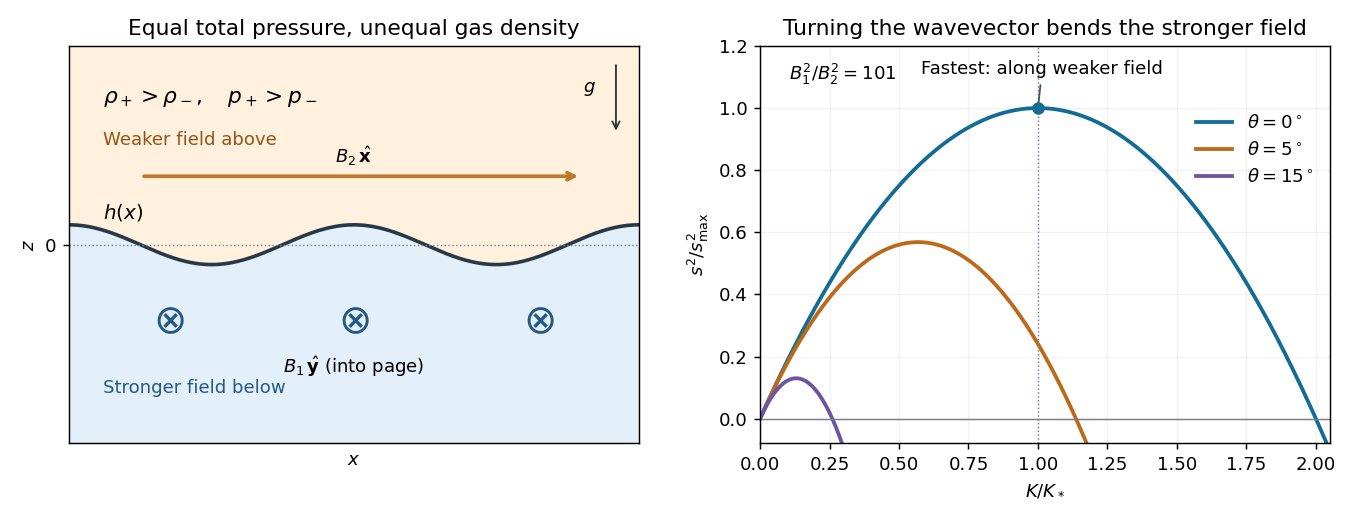
Write for the squared isothermal sound speed, distinguishing the gas constant from a Rayleigh number, and put . A uniform magnetic field has no bulk Lorentz force, so hydrostatic equilibrium and the ideal gas equation giveAt the interface, it is magnetohydrodynamic total pressure, not gas pressure alone, that is continuous:Define . The magnetic pressure discontinuity in an isothermal atmosphere therefore producesIn particular, the upper gas is denser at the interface. Both halves have the same scale height , despite their different pressure normalizations.
For the disturbance calculation, write , , where , and . Work to leading order in the prescribed short-vertical-scale approximation: the bulk motion is locally incompressible potential flow, while the isothermal equation determines the equilibrium density jump. Its scale separation and small compressive correction will be checked at the maximizing mode.
Let the interface displacement be and . Using displacement rather than velocity potentials, write and . Incompressibility and irrotational flow give . Decay away from the interface and continuity of its normal displacement fixwith the common horizontal and temporal exponential understood. Both satisfy . Thus the disturbance has vertical extent of order .
In ideal magnetohydrodynamics, magnetic flux freezing gives for these locally incompressible displacements. If is the total-pressure perturbation, linear momentum isSince on the mode, integration in each half-space yieldsAt the displaced interface, continuity of Lagrangian magnetohydrodynamic total pressure requires . Inserting the two potentials gives the orthogonal-field magnetic Rayleigh-Taylor dispersion relation:The first term is the destabilizing Rayleigh-Taylor instability of the heavier upper gas; the second is stabilizing magnetic tension. A negative right-hand side gives an oscillatory mode rather than growth.
For fixed , the magnetic penalty isIt is minimized by : the wavevector is along the weaker upper magnetic field and perpendicular to the stronger lower field. If , define and . The growth law for this orientation is , a concave quadratic with maximum at . HenceFor this orientation the unstable interval is ; the maximum lies halfway along it.
The localization condition for the fastest orthogonal-field interface mode follows directly from the vertical decay length:This is the condition for on both sides. It also controls the locally incompressible approximation, sinceAcoustic adjustment is then fast compared with growth, so bulk density perturbations are higher-order corrections. If this localization condition fails, the constant-background approximation cannot be used to identify the physical fastest mode.
Finally, the printed assumptions allow . In that case eliminates magnetic tension on both sides and gives . There is no finite maximum growth rate or maximizing wavenumber in the ideal sharp-interface model: growth is unbounded as . The finite maximum and localization formula above therefore require .
In the growth curves, is the angle of the horizontal wavevector from the -axis. The illustrated ratio gives , and shows how even a small rotation toward the stronger magnetic field lowers the maximum growth.

Past exam of the mathematics course of the University of Cambridge 2008 iii Paper 74 1 Solution Created 2026-10-03 Updated 2026-10-14
Let the basic temperature be with , the density be , gravitational acceleration be , and thermal expansion coefficient be . Denote kinematic viscosity, thermal diffusivity and magnetic diffusivity by . Write the dimensional magnetic perturbation as , the temperature perturbation as , and use constant permeability . Linearizing the Boussinesq equations and the resistive induction equation about the static state givesThe Lorentz force identity is . Its gradient term is absorbed into , the perturbation magnetohydrodynamic total pressure. The temperature source follows from .
Choose any reference length , since no vertical boundaries are prescribed. Scale length by , time by , velocity by , temperature perturbation by , magnetic perturbation by , and total pressure by . The dimensionless parameters areThey are the Prandtl number, magnetic-to-thermal diffusivity ratio, Rayleigh number, and Chandrasekhar number, respectively. Division by the chosen scales givesIn particular , so the diffusivity convention agrees with the momentum coefficient.
For a plane wave put , , and . The induction and temperature equations imply and . The projection removes pressure. Because , its vertical momentum equation isThus the oblique-field plane-wave magnetoconvection dispersion relation isIf out-of-plane velocity is also allowed, its decoupled magnetic branch satisfies ; it has no buoyant driving. At stationary marginality, for ,These are stationary thresholds; an oscillatory marginal mode, if present for particular diffusivity ratios, is a different onset calculation.
For , write , where and . Direct differentiation gives , so its two minima are , with and . For the negative sign has the smaller magnetic penalty: at every positive , because both sine and cosine of the inclination are positive. The wavenumber selection in oblique-field magnetoconvection therefore starts from . Expanding gives , where . Taylor expansion of the value then givesThis proves the small-field forms, including the order of the correction.
For large , is nonnegative and vanishes only at . The candidate has finite threshold , so a global minimizer must satisfy and hence tend to . Here . Expanding the stationarity condition at yieldsThe value expansion isThe leading coefficient follows from . The expansion holds at fixed .
Finally choose . Then the nonmagnetic minimizing wavevector also has , and its magnetic penalty vanishes. Since and , this is the global minimum for every nonnegative field strength:This field-independent stationary threshold in oblique magnetoconvection has a simple physical explanation: the disturbance is constant along the imposed field, so it does not bend field lines.
Past exam of the mathematics course of the University of Cambridge 2012 iii Paper 77 5 i Solution Created 2026-10-03 Updated 2026-10-14
Use the same length, thermal-time, velocity and temperature scales as in thermal convection. Write the imposed magnetic field as and measure its perturbation in units of . The physical linear magnetohydrodynamic momentum equation contains magnetic tension ; the gradient part of the Lorentz force density is absorbed into magnetohydrodynamic total pressure.
Divide the momentum equation by the viscous force scale . Its acceleration coefficient is and its magnetic coefficient isHere is the Chandrasekhar number, comparing magnetic and viscous-diffusive effects, and is the ratio of magnetic diffusivity to thermal diffusivity. The induction scale is , so linearization givesComplete the linear system with , and the solenoidal magnetic-field constraint . The omitted advective and perturbed-field tension terms are quadratic in the disturbances. Magnetic tension resists bending of the vertical field, while diffusion allows that bending to relax.
Past exam of the mathematics course of the University of Cambridge 2015 iii Paper 60 1 i Solution Created 2026-10-03 Updated 2026-10-06
In SI units, magnetostatic equilibrium without gravity is . For a purely axial magnetic field, the magnetic tension term vanishes. Thus the radial balance isMatching the magnetohydrodynamic total pressure to the field-free exterior gives the gas pressure and axial field bound:The inequality follows directly from nonnegative gas pressure. It is the magnetic pressure limit for an untwisted flux tube, without inward hoop tension.
Past exam of the mathematics course of the University of Cambridge 2015 iii Paper 64 3 a Solution Created 2026-10-03 Updated 2026-10-06
Use perturbations for velocity, magnetic field, magnetohydrodynamic total pressure and buoyancy displacement variable. SetThis is advection by the background Keplerian shearing sheet. Subtracting the equilibrium before retaining first-order terms gives the nine linearized equations:The azimuthal coefficient combines the Coriolis acceleration with perturbation advection of the background shear. The term is the winding of radial magnetic field by that shear. The tidal force cancels when the equations at a fixed position are subtracted; it does not add a separate Eulerian perturbation force. Magnetic pressure is already included in , leaving only linear magnetic tension. In this normalization has dimensions of length because .