The orthogonal projection PF onto a closed subspace of a Hilbert space F sends x to its component in the orthogonal decompositionThe residual r is orthogonal to every permitted direction. For any z∈F, the Pythagorean theorem givesThus PFx uniquely minimizes the distance to F. It is a linear map, is idempotent, and is nonexpansive: ∥PFx−PFy∥≤∥x−y∥; taking y=0 gives ∥PFx∥≤∥x∥.
x=PFx+r,PFx∈F,r∈F⊥.
∥x−z∥2=∥r∥2+∥PFx−z∥2.
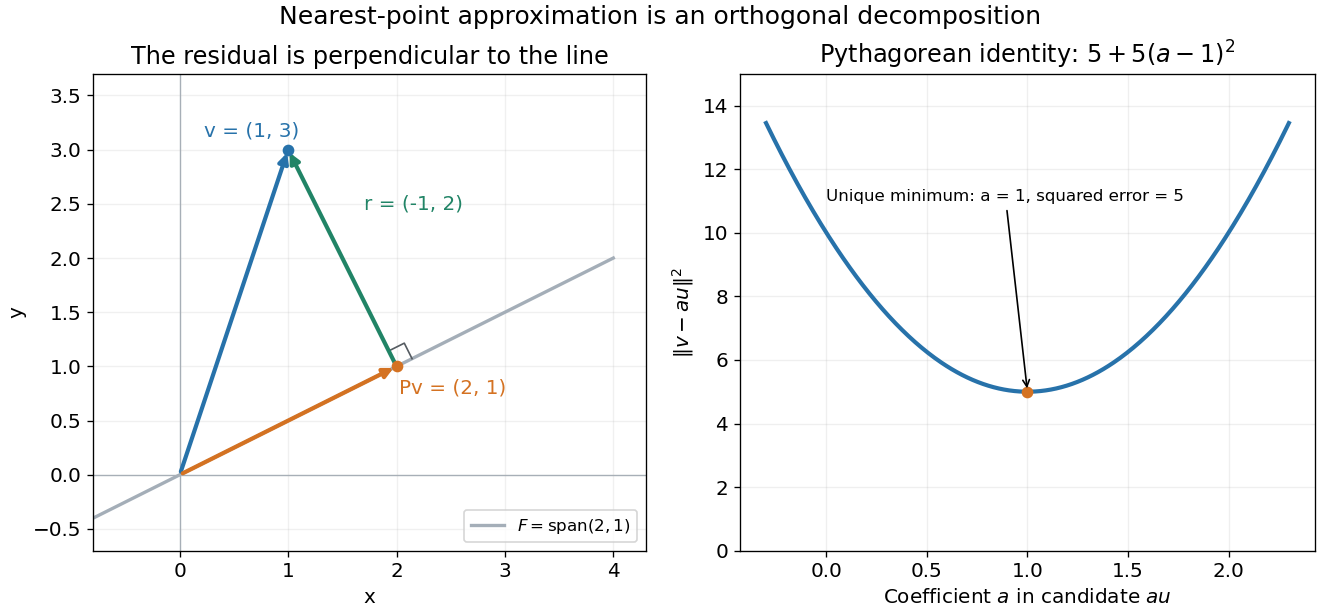
In R2, project v=(1,3) onto the line spanned by u=(2,1). The inner product givesThe check ⟨r,u⟩=−2+2=0 confirms orthogonality, and ∥v∥2=10=5+5=∥PFv∥2+∥r∥2. Projecting again changes nothing, since the result already lies on the line.
PFv=⟨u,u⟩⟨v,u⟩u=55u=(2,1),r=(−1,2).

For a finite orthonormal basis e1,…,em of F, the same operation is PFx=∑j⟨x,ej⟩ej, using the convention linear in the first argument. Replacing coordinate vectors by functions gives exactly the same approximation principle. For f(x)=x2 in the real L2 space on [−1,1] and F=span{1,x}, the directions are orthogonal, with squared norms 2 and 2/3. Their inner products with f are 2/3 and zero, soDirect integration gives the squared error ∥x2−1/3∥2=8/45. For any competing affine polynomial, the orthogonal residual yieldsEvery deviation from a=1/3, b=0 adds a nonnegative error. The best function need not pass through any selected data point: it minimizes an integrated error across the whole interval.
PFf=22/3⋅1+2/30⋅x=31.
∫−11(x2−a−bx)2dx=458+2(a−31)2+32b2.
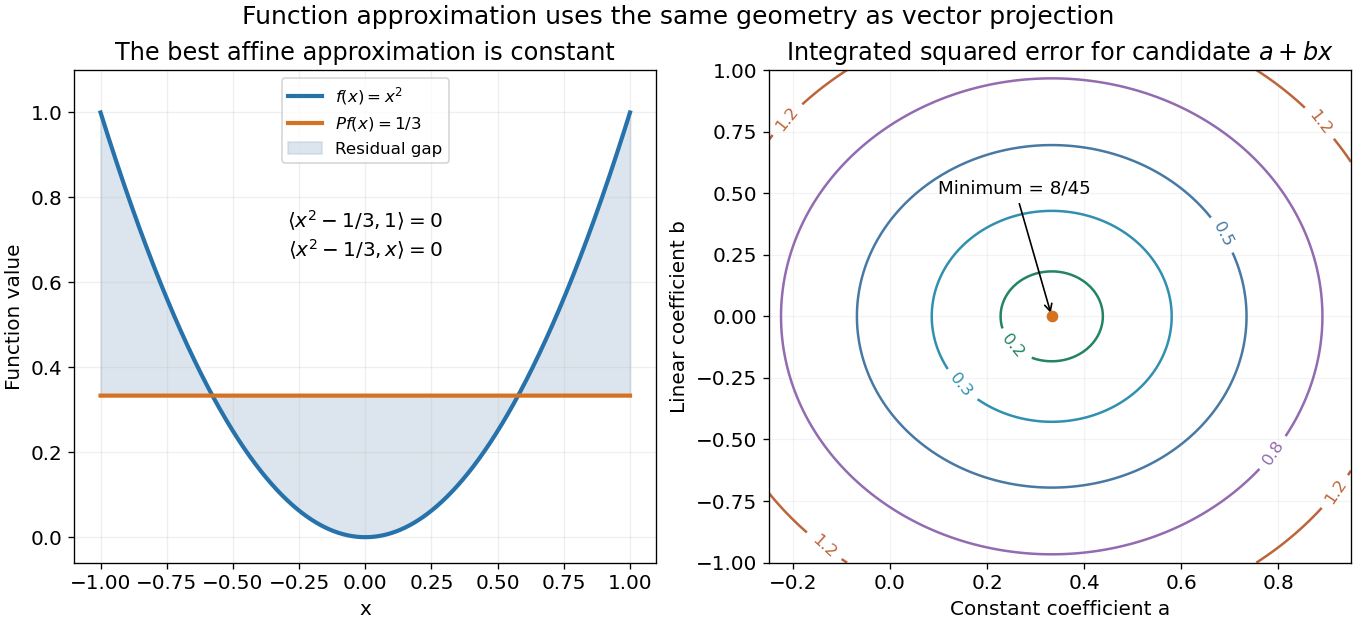
Projecting x squared onto affine functions gives the constant one third and minimum integrated squared error 8/45
. Details. 
If idempotent matrices P1,…,Pk satisfy PiPj=0 whenever i=j, then (∑iPi)2=∑i,jPiPj=∑iPi. Thus the sum is idempotent. For a real orthonormal set qi, the matrices Pi=qiqiT meet this condition. Their sum is the orthogonal projector onto their span; the symmetric matrix property follows by transposing the sum. Arbitrary sums of idempotent matrices need not be idempotent.
The foot from c to the line a+tu, with u=0, is its orthogonal projection onto that line. Solving (c−a−tu)⋅u=0 gives the displayed formula and proves uniqueness. It belongs to the line segment with endpoints a and a+u exactly when 0≤(c−a)⋅u≤∥u∥2.
For a nonzero closed subspace of a Hilbert space V and a closed subspace of a Hilbert space W, this angle measures the worst loss under projection from V to W. Its positive cosine is a uniform lower bound for PW∣V. The order of the subspaces matters in general. This is distinct from the smallest angle between two subspaces, whose cosine is a supremum. For equal finite dimensions the cosine is the smallest singular value of the cross Gram matrix of orthonormal bases. When V is zero, the infimum is over an empty unit sphere and does not define an angle in [0,π/2]; use a lower-bound formulation instead.
For closed subspaces of a Hilbert space, set T=PV⊥∣W. The two positive cosines bound T and its adjoint operator PW∣V⊥ below. The first bound gives a closed range and injectivity; the second makes the range dense by image-kernel orthogonality for an adjoint. Thus T is a bounded bijection, and w=T−1PV⊥f yields the unique direct sum decomposition f=w+v. In equal finite dimensions, a lower bound on T alone suffices by the rank-nullity theorem.
For two nonzero finite-dimensional subspaces with projections P,Q, define cosϑ=sup∥u∥=∥v∥=1∣⟨u,v⟩∣=∥PQ∥, with vectors drawn from the respective subspaces. The angle is zero when they intersect nontrivially. To measure separation after removing a common intersection, restrict both subspaces to its orthogonal complement. The resulting angle controls sums of positive operators in the Kitaev geometrical lemma. For a zero subspace, the vector supremum is empty; the projection-norm convention cosϑ=∥PQ∥=0 is still usable when explicitly adopted.
Let A,B be positive operators on a finite-dimensional Hilbert space, with every nonzero eigenvalue at least γ>0. Let P,Q be the orthogonal projections onto kerA,kerB and define cosϑ=∥PQ∥. ThenWhen the kernels have no common nonzero vector, this gives a positive lower bound. The projection formula also covers a zero kernel without taking a supremum over an empty unit sphere.
A+B≥γ(1−cosϑ)I=2γsin2(ϑ/2)I.
Indeed, A≥γ(I−P) and B≥γ(I−Q). For p∈ranP, q∈ranQ, ∣⟨p,q⟩∣≤∥PQ∥∥p∥∥q∥. The map (p,q)↦p+q consequently has squared operator norm at most 1+∥PQ∥, so P+Q≤(1+∥PQ∥)I. Combining these inequalities proves the result. With common kernel N, restrict to N⊥ and use the kernel projections there to bound the positive spectral gap.
In infinite dimension, replace the eigenvalue condition by the actual operator inequalities A≥γ(I−P) and B≥γ(I−Q). An assertion only about eigenvalues can be vacuous in the presence of continuous spectrum, and does not ensure this uniform gap.
For orthogonal projections P,Q with ∥PQ∥≤q<1, the identity (PQ)r=PQ(QPQ)r−1 and ∥QPQ∥=∥PQ∥2 imply ∥(PQ)r∥≤q2r−1 for r≥1. When the projections have a common fixed subspace, first remove its orthogonal projection. This estimate is stronger than generic submultiplicativity and is useful for alternating local projection layers.
Ancestors (8)
- Orthogonal decomposition by a closed subspace
- Hilbert projection theorem
- Hilbert space
- Functional analysis
- Analysis
- Area of mathematics
- Mathematics
- Home
Incoming links (427)
- 2-summing norm of a finite-dimensional identity
- Active spectrum of the power method
- Admissible polynomials for a singular inverse-linear weight
- Average pure-source fidelity after typical projection
- Axial normal modes of an octahedral spring framework
- Best affine state estimate
- Best linear prediction from a finite past
- Best linear prediction from an infinite past
- Binary rank-one qubit POVM
- Bipartite Szemerédi regularity lemma
- Block coordinate gradient
- Born rule
- Borsuk-Ulam theorem
- Canonical gradient
- Cartesian basis under rotation
- Cauchy-Schwarz inequality
- Cell-average projection
- Centering matrix
- Character orthogonality for compact groups
- Classical Gram-Schmidt
- Closed subspace of a Hilbert space
- Closest points on two line segments
- Coarse-grid correction
- Completeness forces orthogonality of measurement projections
- Conditional variance
- Coordinate subspace
- Cross product equation with a fixed unit vector
- Cyclic eigenvector obstruction to invariant vectors
- Dan Margalit (mathematician)
- Decoupled coefficients of orthogonal polynomial projections
- Degenerate perturbation theory
- Density matrix
- Detectability lemma
- Directional stretch
- Double commutant theorem for star-algebras
- Drift rejection by contrast orthogonality
- Efficient score
- Efficient score in independent-error regression
- Elliptical polarization
- Equality in the projected Cauchy-Schwarz inequality
- Expectation value
- Finite-dimensional Hilbert sampling reconstruction
- Finite element method
- Finite oscillator commutator boundary defect
- Finite-past innovation
- Finite-rank projection kernel
- Fitted values
- Foot of a perpendicular
- Fredholm index
- Galerkin orthogonality
- Gaussian Johnson–Lindenstrauss transform
- Gaussian posterior in the zero-noise limit
- Geometric data analysis
- GNS representation of a vector state
- Gram-Schmidt process
- Haar projection
- Half-turn
- Hardy space of the circle
- Hermitian effect variational principle
- Hermitian inner product
- Hilbert projection theorem
- Hilbert space
- Householder transformation
- Idempotent matrix
- Incidence pseudoinverse decomposition
- Inner product
- Inner product adapted to an idempotent linear map
- Innovation process
- Input penalty of a history Hamiltonian
- Interior dihedral angle of a convex polyhedron
- Intersection of a plane and a sphere
- Inverse of an axis-angle linear map
- Isotonic least squares estimator
- Johnson–Lindenstrauss lemma
- Kac collision operator
- Kernel-image identities for complementary projectors
- Kitaev geometrical lemma
- Lagrange lattice reduction
- Law of total variance
- Least-squares existence criterion
- Legendre least-squares projections of a cubic
- Linear regression
- Local projector cone in a frustration-free chain
- Malus's law
- Microtomy
- Mixed state
- Modified Gram-Schmidt
- Moore--Penrose inverse of a Hilbert-space operator
- MRA projection Fourier identity
- Mutual conditional expectation rigidity in L2
- Nearest least-squares solution
- Nested linear model
- Normal and tangential components
- Normal component
- Normal equations for linear least squares
- Normalized velocity-reset projection
- Norm bound for a Fourier multiplier on L2
- Oblique projection
- Orthogonal basis
- Orthogonal direct sum
- Orthogonal projection matrix
- Orthogonal projection of a circle between planes
- Orthogonal projection onto a finite-dimensional subspace
- Orthogonal projection onto an intercept plane
- Orthogonal projection residual
- Orthogonal splitting of a vector subbundle
- Partial F-test for nested linear models
- Past exam of the advanced quantum physics course of the University of Cambridge / 2022 / Section B / 6 / b / Solution
- Past exam of the algebra, analysis and differential equations 1 course of the University of Oxford / 2013 / Algebra / 2 / b / Solution
- Past exam of the algebra, analysis and differential equations II course of the University of Oxford / 2009 / Algebra / 2
- Past exam of the algebra and analysis I for mathematics and philosophy course of the University of Oxford / 2013 / Algebra / 2 / b / Solution
- Past exam of the analysis course of the University of Oxford / 2007 / B / 7 / Solution
- Past exam of the analysis course of the University of Oxford / 2008 / B / 7 / Solution
- Past exam of the analysis course of the University of Oxford / 2010 / B / 6 / a / ii / Solution
- Past exam of the anyons and topological quantum field theories course of the University of Oxford / 2025 / 2 / c / Solution
- Past exam of the approximation of functions course of the University of Oxford / 2011 / 2 / b / Solution
- Past exam of the approximation theory and finite element methods course of the University of Oxford / 2007 / B / 8 / ii / Solution
- Past exam of the approximation theory and finite element methods course of the University of Oxford / 2007 / B / 8 / i / Solution
- Past exam of the approximation theory and finite element methods course of the University of Oxford / 2009 / A / 2 / d / Solution
- Past exam of the approximation theory and finite element methods course of the University of Oxford / 2010 / A / 2 / a / Solution
- Past exam of the approximation theory and finite element methods course of the University of Oxford / 2010 / A / 2 / b / Solution
- Past exam of the computer science course of the University of Oxford / 2019 / Quantum information / 1 / a / Solution
- Past exam of the continuous martingales and stochastic calculus course of the University of Oxford / 2023 / 1 / c / Solution
- Past exam of the elasticity and plasticity course of the University of Oxford / 2011 / 2 / b / Solution
- Past exam of the field theories and collective phenomena in condensed matter course of the University of Oxford / 2025 / 3 / a / Solution
- Past exam of the finite element methods for partial differential equations course of the University of Oxford / 2011 / 3 / Solution
- Past exam of the introduction to quantum information course of the University of Oxford / 2015 / 2 / a / Solution
- Past exam of the introduction to quantum information course of the University of Oxford / 2015 / 2 / e / Solution
- Past exam of the mathematical methods I course of the University of Oxford / 2014 / 10 / a / iii / Solution
- Past exam of the mathematical methods I course of the University of Oxford / 2014 resit / 6 / ii / Solution
- Past exam of the mathematical methods I course of the University of Oxford / 2015 / 10 / a / Solution
- Past exam of the mathematical methods I course of the University of Oxford / 2015 resit / 8 / Solution
- Past exam of the mathematical methods I course of the University of Oxford / 2018 / 10 / b / Solution
- Past exam of the mathematical methods I course of the University of Oxford / 2019 / 11 / c / v / Solution
- Past exam of the mathematical methods I course of the University of Oxford / 2019 resit / 5 / Solution
- Past exam of the mathematical methods I course of the University of Oxford / 2021 / 5 / b / Solution
- Past exam of the mathematical methods I course of the University of Oxford / 2021 / 8 / d / Solution
- Past exam of the mathematics course of the University of Cambridge / 2001 / ia / Paper 1 / 1C / Solution
- Past exam of the mathematics course of the University of Cambridge / 2001 / iii / Paper 1 / 4 / Solution
- Past exam of the mathematics course of the University of Cambridge / 2001 / iii / Paper 22 / 1 / Solution
- Past exam of the mathematics course of the University of Cambridge / 2001 / iii / Paper 6 / 5 / Solution
- Past exam of the mathematics course of the University of Cambridge / 2001 / iii / Paper 7 / 5 / Solution
- Past exam of the mathematics course of the University of Cambridge / 2002 / ib / Paper 2 / 5B / Solution
- Past exam of the mathematics course of the University of Cambridge / 2002 / iii / Paper 36 / 1 / i / Solution
- Past exam of the mathematics course of the University of Cambridge / 2002 / iii / Paper 39 / 2 / Solution
- Past exam of the mathematics course of the University of Cambridge / 2002 / iii / Paper 50 / 3 / Solution
- Past exam of the mathematics course of the University of Cambridge / 2002 / iii / Paper 58 / 1 / ii / Solution
- Past exam of the mathematics course of the University of Cambridge / 2002 / iii / Paper 61 / 7 / 2 / Solution
- Past exam of the mathematics course of the University of Cambridge / 2002 / iii / Paper 61 / 7 / a / Solution
- Past exam of the mathematics course of the University of Cambridge / 2003 / ib / Paper 2 / 12H / Solution
- Past exam of the mathematics course of the University of Cambridge / 2003 / ib / Paper 3 / 19G / c / Solution
- Past exam of the mathematics course of the University of Cambridge / 2003 / iii / Paper 27 / 5 / Solution
- Past exam of the mathematics course of the University of Cambridge / 2003 / iii / Paper 32 / 1 / a / ii / Solution
- Past exam of the mathematics course of the University of Cambridge / 2003 / iii / Paper 42 / 1 / ii / Solution
- Past exam of the mathematics course of the University of Cambridge / 2003 / iii / Paper 68 / 1 / Solution
- Past exam of the mathematics course of the University of Cambridge / 2003 / iii / Paper 69 / 7 / a / Solution
- Past exam of the mathematics course of the University of Cambridge / 2004 / ia / Paper 1 / 1B / Solution
- Past exam of the mathematics course of the University of Cambridge / 2004 / ib / Paper 4 / 1E / Solution
- Past exam of the mathematics course of the University of Cambridge / 2004 / iii / Paper 43 / 4 / Solution
- Past exam of the mathematics course of the University of Cambridge / 2004 / iii / Paper 60 / 1 / c / Solution
- Past exam of the mathematics course of the University of Cambridge / 2005 / ia / Paper 1 / 7A / Solution
- Past exam of the mathematics course of the University of Cambridge / 2005 / ib / Paper 2 / 18F / a / Solution
- Past exam of the mathematics course of the University of Cambridge / 2005 / iii / Paper 41 / 3 / i / Solution
- Past exam of the mathematics course of the University of Cambridge / 2005 / iii / Paper 47 / 2 / Solution
- Past exam of the mathematics course of the University of Cambridge / 2005 / ii / Paper 2 / 27I / ii / Solution
- Past exam of the mathematics course of the University of Cambridge / 2005 / ii / Paper 3 / 5I / b / Solution
- Past exam of the mathematics course of the University of Cambridge / 2006 / ia / Paper 1 / 5C / Solution
- Past exam of the mathematics course of the University of Cambridge / 2006 / ia / Paper 1 / 6C / Solution
- Past exam of the mathematics course of the University of Cambridge / 2006 / iii / Paper 39 / 1 / Solution
- Past exam of the mathematics course of the University of Cambridge / 2006 / iii / Paper 56 / 3 / Solution
- Past exam of the mathematics course of the University of Cambridge / 2006 / iii / Paper 58 / 4 / c / Solution
- Past exam of the mathematics course of the University of Cambridge / 2006 / iii / Paper 59 / 3 / Solution
- Past exam of the mathematics course of the University of Cambridge / 2006 / iii / Paper 66 / 1 / Solution
- Past exam of the mathematics course of the University of Cambridge / 2006 / iii / Paper 66 / 3 / b / Solution
- Past exam of the mathematics course of the University of Cambridge / 2007 / ia / Paper 1 / 5B / i / a / Solution
- Past exam of the mathematics course of the University of Cambridge / 2007 / ia / Paper 1 / 5B / ii / Solution
- Past exam of the mathematics course of the University of Cambridge / 2007 / ia / Paper 1 / 5B / i / Solution
- Past exam of the mathematics course of the University of Cambridge / 2007 / ia / Paper 1 / 6C / iii / Solution
- Past exam of the mathematics course of the University of Cambridge / 2007 / iii / Paper 10 / 5 / Solution
- Past exam of the mathematics course of the University of Cambridge / 2007 / iii / Paper 34 / 2 / c / Solution
- Past exam of the mathematics course of the University of Cambridge / 2007 / iii / Paper 34 / 5 / c / Solution
- Past exam of the mathematics course of the University of Cambridge / 2007 / iii / Paper 58 / 1 / a / Solution
- Past exam of the mathematics course of the University of Cambridge / 2007 / iii / Paper 58 / 2 / c / Solution
- Past exam of the mathematics course of the University of Cambridge / 2007 / iii / Paper 60 / 1 / c / Solution
- Past exam of the mathematics course of the University of Cambridge / 2007 / iii / Paper 60 / 2 / e / Solution
- Past exam of the mathematics course of the University of Cambridge / 2007 / iii / Paper 9 / 3 / Solution
- Past exam of the mathematics course of the University of Cambridge / 2008 / ib / Paper 4 / 19H / i / Solution
- Past exam of the mathematics course of the University of Cambridge / 2008 / iii / Paper 1 / 3 / a / Solution
- Past exam of the mathematics course of the University of Cambridge / 2008 / iii / Paper 1 / 6 / Solution
- Past exam of the mathematics course of the University of Cambridge / 2008 / iii / Paper 1 / 8 / b / Solution
- Past exam of the mathematics course of the University of Cambridge / 2008 / iii / Paper 1 / 8 / c / Solution
- Past exam of the mathematics course of the University of Cambridge / 2008 / iii / Paper 30 / 3 / Solution
- Past exam of the mathematics course of the University of Cambridge / 2008 / iii / Paper 63 / 1 / Solution
- Past exam of the mathematics course of the University of Cambridge / 2008 / iii / Paper 75 / 6 / 2 / Solution
- Past exam of the mathematics course of the University of Cambridge / 2008 / ii / Paper 3 / 5J / Solution
- Past exam of the mathematics course of the University of Cambridge / 2008 / ii / Paper 4 / 22F / Solution
- Past exam of the mathematics course of the University of Cambridge / 2008 / ii / Paper 4 / 22F / v / Solution
- Past exam of the mathematics course of the University of Cambridge / 2009 / iii / Paper 17 / 1 / c / Solution
- Past exam of the mathematics course of the University of Cambridge / 2009 / iii / Paper 17 / 4 / c / Solution
- Past exam of the mathematics course of the University of Cambridge / 2009 / iii / Paper 33 / 3 / Solution
- Past exam of the mathematics course of the University of Cambridge / 2009 / iii / Paper 34 / 1 / b / Solution
- Past exam of the mathematics course of the University of Cambridge / 2009 / iii / Paper 50 / 1 / a / Solution
- Past exam of the mathematics course of the University of Cambridge / 2009 / iii / Paper 50 / 2 / a / Solution
- Past exam of the mathematics course of the University of Cambridge / 2009 / iii / Paper 50 / 3 / d / Solution
- Past exam of the mathematics course of the University of Cambridge / 2009 / iii / Paper 8 / 2 / c / Solution
- Past exam of the mathematics course of the University of Cambridge / 2009 / iii / Paper 8 / 7 / b / Solution
- Past exam of the mathematics course of the University of Cambridge / 2009 / ii / Paper 4 / 25J / Solution
- Past exam of the mathematics course of the University of Cambridge / 2010 / iii / Paper 28 / 3 / a / Solution
- Past exam of the mathematics course of the University of Cambridge / 2010 / iii / Paper 31 / 3 / Solution
- Past exam of the mathematics course of the University of Cambridge / 2010 / iii / Paper 32 / 1 / Solution
- Past exam of the mathematics course of the University of Cambridge / 2010 / iii / Paper 51 / 2 / c / Solution
- Past exam of the mathematics course of the University of Cambridge / 2010 / iii / Paper 7 / 2 / b / Solution
- Past exam of the mathematics course of the University of Cambridge / 2010 / iii / Paper 7 / 4 / d / Solution
- Past exam of the mathematics course of the University of Cambridge / 2010 / ii / Paper 3 / 5J / Solution
- Past exam of the mathematics course of the University of Cambridge / 2011 / ia / Paper 1 / 5C / Solution
- Past exam of the mathematics course of the University of Cambridge / 2011 / ia / Paper 1 / 6A / b / Solution
- Past exam of the mathematics course of the University of Cambridge / 2012 / iii / Paper 36 / 1 / c / Solution
- Past exam of the mathematics course of the University of Cambridge / 2012 / iii / Paper 36 / 2 / d / Solution
- Past exam of the mathematics course of the University of Cambridge / 2012 / iii / Paper 36 / 4 / b / Solution
- Past exam of the mathematics course of the University of Cambridge / 2012 / iii / Paper 36 / 4 / d / Solution
- Past exam of the mathematics course of the University of Cambridge / 2012 / iii / Paper 38 / 2 / Solution
- Past exam of the mathematics course of the University of Cambridge / 2012 / iii / Paper 70 / 5 / a / Solution
- Past exam of the mathematics course of the University of Cambridge / 2012 / iii / Paper 70 / 6 / a / Solution
- Past exam of the mathematics course of the University of Cambridge / 2012 / iii / Paper 7 / 3 / e / Solution
- Past exam of the mathematics course of the University of Cambridge / 2012 / iii / Paper 7 / 3 / f / Solution
- Past exam of the mathematics course of the University of Cambridge / 2013 / iii / Paper 29 / 1 / Solution
- Past exam of the mathematics course of the University of Cambridge / 2013 / iii / Paper 33 / 3 / Solution
- Past exam of the mathematics course of the University of Cambridge / 2013 / iii / Paper 36 / 4 / a / Solution
- Past exam of the mathematics course of the University of Cambridge / 2013 / iii / Paper 36 / 4 / c / Solution
- Past exam of the mathematics course of the University of Cambridge / 2013 / iii / Paper 6 / 3 / d / Solution
- Past exam of the mathematics course of the University of Cambridge / 2013 / iii / Paper 6 / 3 / e / Solution
- Past exam of the mathematics course of the University of Cambridge / 2013 / iii / Paper 6 / 3 / f / Solution
- Past exam of the mathematics course of the University of Cambridge / 2013 / iii / Paper 8 / 1 / ii / Solution
- Past exam of the mathematics course of the University of Cambridge / 2013 / iii / Paper 8 / 1 / i / Solution
- Past exam of the mathematics course of the University of Cambridge / 2014 / iii / Paper 33 / 1 / Solution
- Past exam of the mathematics course of the University of Cambridge / 2014 / iii / Paper 5 / 1 / e / Solution
- Past exam of the mathematics course of the University of Cambridge / 2014 / iii / Paper 5 / 1 / f / Solution
- Past exam of the mathematics course of the University of Cambridge / 2014 / iii / Paper 61 / 2 / ii / Solution
- Past exam of the mathematics course of the University of Cambridge / 2014 / iii / Paper 61 / 2 / i / Solution
- Past exam of the mathematics course of the University of Cambridge / 2014 / iii / Paper 63 / 1 / c / Solution
- Past exam of the mathematics course of the University of Cambridge / 2015 / iii / Paper 14 / 1 / Solution
- Past exam of the mathematics course of the University of Cambridge / 2015 / iii / Paper 33 / 1 / Solution
- Past exam of the mathematics course of the University of Cambridge / 2015 / iii / Paper 36 / 2 / Solution
- Past exam of the mathematics course of the University of Cambridge / 2015 / iii / Paper 37 / 3 / a / Solution
- Past exam of the mathematics course of the University of Cambridge / 2015 / iii / Paper 67 / 1 / b / ii / Solution
- Past exam of the mathematics course of the University of Cambridge / 2015 / iii / Paper 67 / 1 / b / i / Solution
- Past exam of the mathematics course of the University of Cambridge / 2015 / iii / Paper 67 / 2 / b / i / Solution
- Past exam of the mathematics course of the University of Cambridge / 2015 / iii / Paper 67 / 4 / a / Solution
- Past exam of the mathematics course of the University of Cambridge / 2015 / iii / Paper 69 / 1 / ii / Solution
- Past exam of the mathematics course of the University of Cambridge / 2015 / iii / Paper 76 / 3 / a / Solution
- Past exam of the mathematics course of the University of Cambridge / 2015 / ii / Paper 4 / 10J / Solution
- Past exam of the mathematics course of the University of Cambridge / 2016 / iii / Paper 115 / 4 / Solution
- Past exam of the mathematics course of the University of Cambridge / 2016 / iii / Paper 118 / 3 / c / Solution
- Past exam of the mathematics course of the University of Cambridge / 2016 / iii / Paper 206 / 2 / b / Solution
- Past exam of the mathematics course of the University of Cambridge / 2016 / iii / Paper 323 / 2 / ii / Solution
- Past exam of the mathematics course of the University of Cambridge / 2016 / iii / Paper 323 / 2 / i / Solution
- Past exam of the mathematics course of the University of Cambridge / 2016 / iii / Paper 324 / 2 / a / Solution
- Past exam of the mathematics course of the University of Cambridge / 2016 / iii / Paper 326 / 1 / ii / Solution
- Past exam of the mathematics course of the University of Cambridge / 2016 / iii / Paper 326 / 1 / i / Solution
- Past exam of the mathematics course of the University of Cambridge / 2017 / iii / Paper 103 / 4 / c / i / Solution
- Past exam of the mathematics course of the University of Cambridge / 2017 / iii / Paper 106 / 5 / Solution
- Past exam of the mathematics course of the University of Cambridge / 2017 / iii / Paper 205 / 5 / Solution
- Past exam of the mathematics course of the University of Cambridge / 2017 / iii / Paper 326 / 1 / 1 / b / Solution
- Past exam of the mathematics course of the University of Cambridge / 2017 / iii / Paper 331 / 4 / b / Solution
- Past exam of the mathematics course of the University of Cambridge / 2017 / iii / Paper 340 / 2 / a / Solution
- Past exam of the mathematics course of the University of Cambridge / 2017 / ii / Paper 2 / 5J / b / Solution
- Past exam of the mathematics course of the University of Cambridge / 2017 / ii / Paper 4 / 27K / c / ii / Solution
- Past exam of the mathematics course of the University of Cambridge / 2018 / ia / Paper 1 / 2A / ii / Solution
- Past exam of the mathematics course of the University of Cambridge / 2018 / iii / Paper 106 / 2 / a / Solution
- Past exam of the mathematics course of the University of Cambridge / 2018 / iii / Paper 106 / 2 / b / 3 / Solution
- Past exam of the mathematics course of the University of Cambridge / 2018 / iii / Paper 326 / 1 / 1 / d / Solution
- Past exam of the mathematics course of the University of Cambridge / 2018 / iii / Paper 338 / 1 / a / ii / Solution
- Past exam of the mathematics course of the University of Cambridge / 2018 / iii / Paper 340 / 1 / b / Solution
- Past exam of the mathematics course of the University of Cambridge / 2018 / iii / Paper 340 / 2 / b / Solution
- Past exam of the mathematics course of the University of Cambridge / 2018 / iii / Paper 340 / 3 / a / Solution
- Past exam of the mathematics course of the University of Cambridge / 2018 / iii / Paper 341 / 6 / Solution
- Past exam of the mathematics course of the University of Cambridge / 2019 / iii / Paper 147 / 3 / ii / Solution
- Past exam of the mathematics course of the University of Cambridge / 2019 / iii / Paper 323 / 4 / i / Solution
- Past exam of the mathematics course of the University of Cambridge / 2019 / iii / Paper 324 / 2 / a / Solution
- Past exam of the mathematics course of the University of Cambridge / 2019 / ii / Paper 1 / 17G / c / Solution
- Past exam of the mathematics course of the University of Cambridge / 2019 / ii / Paper 1 / 29J / e / Solution
- Past exam of the mathematics course of the University of Cambridge / 2020 / ii / Paper 3 / 21I / b / Solution
- Past exam of the mathematics course of the University of Cambridge / 2020 / ii / Paper 3 / 5J / c / Solution
- Past exam of the mathematics course of the University of Cambridge / 2022 / iii / Paper 218 / 3 / e / Solution
- Past exam of the mathematics course of the University of Cambridge / 2022 / iii / Paper 326 / 1 / b / iii / Solution
- Past exam of the mathematics course of the University of Cambridge / 2023 / iii / Paper 324 / 3 / i / Solution
- Past exam of the mathematics course of the University of Cambridge / 2024 / iii / Paper 318 / 5 / 1 / b / Solution
- Past exam of the mathematics course of the University of Cambridge / 2024 / iii / Paper 324 / 2 / a / Solution
- Past exam of the mathematics course of the University of Cambridge / 2024 / iii / Paper 325 / 1 / Solution
- Past exam of the mathematics course of the University of Cambridge / 2024 / iii / Paper 343 / 1 / c / Solution
- Past exam of the mathematics course of the University of Cambridge / 2024 / iii / Paper 358 / 1 / c / Solution
- Past exam of the mathematics course of the University of Cambridge / 2024 / iii / Paper 358 / 2 / a / Solution
- Past exam of the mathematics course of the University of Cambridge / 2025 / iii / Paper 106 / 3 / a / Solution
- Past exam of the mathematics course of the University of Cambridge / 2025 / iii / Paper 201 / 3 / b / Solution
- Past exam of the mathematics course of the University of Cambridge / 2025 / iii / Paper 323 / 3 / ii / b / Solution
- Past exam of the mathematics course of the University of Cambridge / 2026 / iii / Paper 359 / 1 / b / i / Solution
- Past exam of the mathematics course of the University of Cambridge / 2026 / iii / Paper 359 / 2 / a / i / Solution
- Past exam of the mathematics course of the University of Oxford / 2021 / Prelims / Mathematics IV / 1 / a / i / Solution
- Past exam of the mathematics course of the University of Oxford / 2021 / Prelims / Mathematics IV / 2 / b / Solution
- Past exam of the mathematics course of the University of Oxford / 2021 / Prelims / Mathematics IV resit / 1 / b / Solution
- Past exam of the mathematics course of the year 1 of the natural sciences course of the University of Cambridge / 2005 / Paper 2 / 4 / b / Solution
- Past exam of the mathematics course of the year 1 of the natural sciences course of the University of Cambridge / 2007 / Paper 1 / Section B / 8 / b / i / Solution
- Past exam of the mathematics course of the year 1 of the natural sciences course of the University of Cambridge / 2008 / Paper 1 / 11 / Solution
- Past exam of the mathematics course of the year 1 of the natural sciences course of the University of Cambridge / 2009 / Paper 2 / 11 / c / Solution
- Past exam of the mathematics course of the year 1 of the natural sciences course of the University of Cambridge / 2014 / Paper 1 / 11 / d / Solution
- Past exam of the mathematics course of the year 1 of the natural sciences course of the University of Cambridge / 2016 / Paper 1 / 14 / a / iii / Solution
- Past exam of the mathematics course of the year 1 of the natural sciences course of the University of Cambridge / 2016 / Paper 1 / 14 / a / i / Solution
- Past exam of the mathematics course of the year 1 of the natural sciences course of the University of Cambridge / 2021 / Paper 2 / 11 / c / i / Solution
- Past exam of the mathematics course of the year 1 of the natural sciences course of the University of Cambridge / 2021 / Paper 2 / 11 / d / iii / Solution
- Past exam of the mathematics course of the year 1 of the natural sciences course of the University of Cambridge / 2023 / Paper 1 / 12 / b / i / Solution
- Past exam of the mathematics course of the year 1 of the natural sciences course of the University of Cambridge / 2024 / Paper 2 / 11 / a / Solution
- Past exam of the mathematics course of the year 1 of the natural sciences course of the University of Cambridge / 2024 / Paper 2 / 11 / b / Solution
- Past exam of the mathematics course of the year 1 of the natural sciences course of the University of Cambridge / 2024 / Paper 2 / 11 / d / iii / Solution
- Past exam of the mathematics course of the year 1 of the natural sciences course of the University of Cambridge / 2024 / Paper 2 / 11 / e / Solution
- Past exam of the mathematics course of the year 1 of the natural sciences course of the University of Cambridge / 2024 / Paper 2 / 18 / b / ii / Solution
- Past exam of the mathematics course of the year 1 of the natural sciences course of the University of Cambridge / 2025 / Paper 1 / 11 / b / ii / Solution
- Past exam of the mathematics course of the year 1 of the natural sciences course of the University of Cambridge / 2025 / Paper 1 / 11 / b / i / Solution
- Past exam of the mathematics course of the year 1 of the natural sciences course of the University of Cambridge / 2025 / Paper 1 / 11 / c / ii / Solution
- Past exam of the mathematics course of the year 1 of the natural sciences course of the University of Cambridge / 2025 / Paper 1 / 17 / c / Solution
- Past exam of the mathematics course of the year 2 of the natural sciences course of the University of Cambridge / 2003 / Paper 2 / 6 / a / ii / Solution
- Past exam of the mathematics course of the year 2 of the natural sciences course of the University of Cambridge / 2003 / Paper 2 / 6 / a / i / Solution
- Past exam of the mathematics course of the year 2 of the natural sciences course of the University of Cambridge / 2005 / Paper 1 / 5 / Solution
- Past exam of the mathematics course of the year 2 of the natural sciences course of the University of Cambridge / 2007 / Paper 2 / 6 / Solution
- Past exam of the mathematics course of the year 2 of the natural sciences course of the University of Cambridge / 2012 / Paper 1 / 5 / ii / c / Solution
- Past exam of the mathematics course of the year 2 of the natural sciences course of the University of Cambridge / 2012 / Paper 2 / 2 / Solution
- Past exam of the mathematics course of the year 2 of the natural sciences course of the University of Cambridge / 2019 / Paper 2 / 1 / c / Solution
- Past exam of the mathematics course of the year 2 of the natural sciences course of the University of Cambridge / 2022 / Paper 2 / 6 / b / Solution
- Past exam of the mathematics course of the year 2 of the natural sciences course of the University of Cambridge / 2025 / Paper 2 / 1 / c / Solution
- Past exam of the numerical analysis course of the University of Oxford / 2014 / 2 / b / Solution
- Past exam of the numerical analysis course of the University of Oxford / 2021 / 2 / a / iii / Solution
- Past exam of the numerical analysis course of the University of Oxford / 2021 / 2 / b / ii / Solution
- Past exam of the numerical linear algebra and continuous optimisation course of the University of Oxford / 2010 / A / 1 / a / Solution
- Past exam of the numerical linear algebra and continuous optimisation course of the University of Oxford / 2010 / A / 1 / c / Solution
- Past exam of the numerical linear algebra course of the University of Oxford / 2025 / 1 / a / i / Solution
- Past exam of the numerical linear algebra course of the University of Oxford / 2025 / 2 / a / ii / Solution
- Past exam of the numerical linear algebra course of the University of Oxford / 2025 / 2 / b / iii / Solution
- Past exam of the numerical linear algebra course of the University of Oxford / 2025 / 2 / b / ii / Solution
- Past exam of the numerical linear algebra course of the University of Oxford / 2025 / 2 / b / iv / Solution
- Past exam of the numerical linear algebra course of the University of Oxford / 2025 / 2 / b / v / Solution
- Past exam of the optics and electrodynamics course of the University of Cambridge / 2021 / Section B / B4 / c / Solution
- Past exam of the optics and electrodynamics course of the University of Cambridge / 2021 / Section B / B4 / g / Solution
- Past exam of the optics and electrodynamics course of the University of Cambridge / 2022 / Section B / 4 / c / Solution
- Past exam of the options I course of the University of Oxford / 2004 / O / O2 / ii / Solution
- Past exam of the options I course of the University of Oxford / 2009 / P / P2 / Solution
- Past exam of the options II course of the University of Oxford / 2008 / P / P3 / d / Solution
- Past exam of the options II course of the University of Oxford / 2008 printed variant / P / P3 / d / Solution
- Past exam of the options II course of the University of Oxford / 2009 / P / P4 / a / Solution
- Past exam of the options II course of the University of Oxford / 2011 / P / P3 / b / Solution
- Past exam of the options II course of the University of Oxford / 2011 / P / P3 / d / Solution
- Past exam of the physics A course of the University of Cambridge / 2015 / Paper 1 / Section C / C10 / Solution
- Past exam of the probability, measure and martingales course of the University of Oxford / 2023 / 3 / b / i / Solution
- Past exam of the Probability, statistics and options II course of the University of Oxford / 2008 / P / 3 / c / Solution
- Past exam of the Probability, statistics and options II course of the University of Oxford / 2008 / P / 3 / d / Solution
- Past exam of the Probability, statistics and options II course of the University of Oxford / 2008 / P / 3 / e / Solution
- Past exam of the Probability, statistics and options II course of the University of Oxford / 2011 / O / O5 / c / Solution
- Past exam of the quantum information course of the University of Cambridge / 2012 / Paper 1 / 3 / a / Solution
- Past exam of the quantum theory course of the University of Oxford / 2021 / 1 / c / iv / Solution
- Past exam of the quantum theory course of the University of Oxford / 2023 / 1 / b / iv / Solution
- Past exam of the quantum theory course of the University of Oxford / 2023 / 1 / b / v / Solution
- Past exam of the solid mechanics course of the University of Oxford / 2010 / 2 / b / Solution
- Past exam of the theoretical physics II course of the University of Cambridge / 2019 / 4 / b / Solution
- Past exam of the year 1 of the computer science course of the University of Oxford / 2017 / Digital systems, linear algebra, introduction to formal proof / 4 / g / Solution
- Past exam of the year 1 of the computer science course of the University of Oxford / 2018 / Digital systems, linear algebra, introduction to formal proof / 6 / a / i / Solution
- Past exam of the year 1 of the computer science course of the University of Oxford / 2019 / Digital systems, linear algebra, introduction to formal proof resit / 6 / b / ii / Solution
- Past exam of the year 1 of the computer science course of the University of Oxford / 2021 / Digital systems, linear algebra, introduction to formal proof / 6 / b / Solution
- Past exam of the year 2 of the earth sciences (geology) course of the University of Oxford / 2024 / Paper 3 / 7 / b / Solution
- Perfect fluid in general relativity
- Petrov-Galerkin method
- Phase retardation
- Plane
- Poisson convergence on expanding balls in a homogeneous Sobolev space
- Polynomial least-squares approximation
- Positive operator
- Positive operator-valued measure
- Power iteration direction error
- Powers of a product of two orthogonal projections
- Probability: Theory and Examples (fifth edition) by Rick Durrett / 4.1 Conditional Expectation
- Projected ambient connection
- Projected Chern connection
- Projection in a C-star algebra
- Projection (linear algebra)
- Projection-valued measure
- Projective measurement
- Projector phase rotation
- Pythagorean theorem
- QR decomposition
- Quantum measurement
- Quantum state
- Quantum typical subspace
- Quantum Zeno effect
- Quotient Hermitian metric
- Rank-sum form of Cochran's theorem
- Reduced QR least-squares solution
- Regression coefficient test power ignores nuisance coefficients
- Regression leverage
- Repeated projective-measurement survival probability
- Representer theorem
- Robin diffusion with a growing mode
- Scalar-measure construction of a projection-valued measure
- Schrieffer-Wolff transformation
- Section orientation
- Sergey Bravyi
- Shortest distance between skew lines
- Signal-subspace preservation for several spectral amplitudes
- Sobolev inner product
- Spectral projection
- Spectral projection of a diagonalizable matrix
- Spectral projection of a self-adjoint matrix
- Sphere-plane intersection
- Spin measurement
- Statistical tangent space
- Strong operator topology
- Symmetric tensor decomposition relative to an axis
- Tangential component
- Ternary tie-line consistency residual
- Three projections summing to the identity
- Transmission through a sequence of linear polarizers
- Two-strand Kirby projector
- Uniform norm bound for B-spline orthogonal projection
- Unilateral shift
- Unitary dilation of a measurement instrument
- Vector projection
- Von Neumann mean ergodic theorem
- Wavelet projection
- Weighted centering matrix
- Weighted Hilbert structure of velocity-reset relaxation
- Zeeman populations from an unpolarized angular-momentum multiplet
Synonyms (1)
Discussion (0) New discussion
There are no discussions about this article yet.
Articles by others on the same topic (0)
There are currently no matching articles.