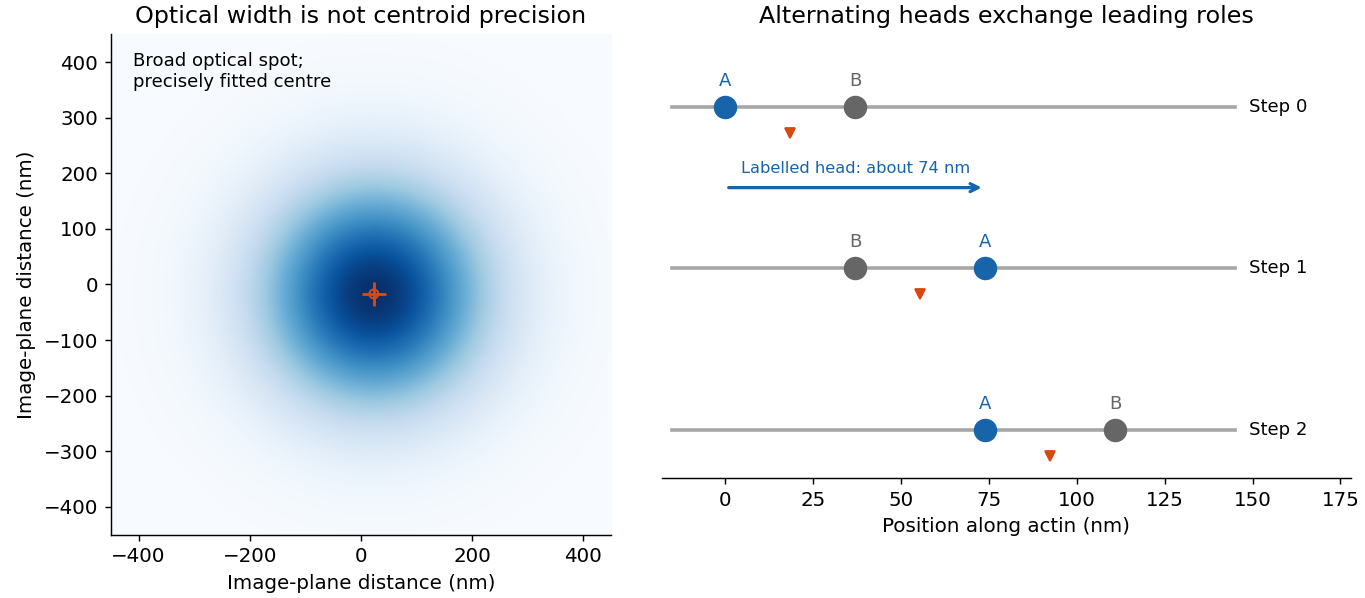
A single fluorophore creates a diffraction-broadened point-spread function, but its centre can be fitted much more precisely than that function's width. With Gaussian width and detected independent photons, the shot-noise limit is . Pixelation, background photons, dye orientation, motion blur, drift and label-to-target geometry impose additional uncertainty and systematic error. Localization precision is therefore not identical to either optical resolution or position accuracy.[ref]
Precise nanometer localization analysis for individual fluorescent probes by Russell E. Thompson and others. 2002 localization analysis, photon-number scaling and effects of pixelation/background
In myosin-V tracking, localizing a label on one head or its lever arm distinguishes the paths of individual motor parts from the average motion of the whole motor. A trailing head that becomes the leading head travels roughly twice the stalk advance: about versus a roughly motor stride. A near-head label can therefore alternate a large movement with a pause while the partner head advances. Other lever-arm label positions give unequal alternating steps whose sum is approximately twice the stride. Those patterns support hand-over-hand walking rather than a simple inchworm model in which the same head remains in front. The label geometry is needed when interpreting individual step sizes.[ref]
Myosin V Walks Hand-Over-Hand: Single Fluorophore Imaging with 1.5-nm Localization by Ahmet Yildiz and others. 2003 study, labelled lever-arm step patterns and hand-over-hand versus inchworm discrimination

Super-resolution localization microscopy extends the same principle to a map containing many molecules by separating otherwise overlapping emitters in time. Sparse activation, blinking or transient binding yields individually fitted positions, which are accumulated. Dense sampling, registration and labelling specificity determine the final structural resolution; merely taking more photons from an unresolved simultaneous pair does not make it a single isolated emitter.
In PAINT, fluorescent probes bind transiently so that separated binding events can be localized and accumulated. DNA-PAINT uses reversible complementary-strand recognition at docking sites on a DNA nanostructure. The bound probe supplies a localized spot while freely diffusing probes contribute background; repeated visits build up a positional map, with replenishment rather than permanent reliance on one fluorophore. This is an imaging principle, not a requirement for a particular target sequence or preparation protocol.[ref]
Single-Molecule Kinetics and Super-Resolution Microscopy by Fluorescence Imaging of Transient Binding on DNA Origami. 2010 primary report, transient DNA binding and accumulated localization imaging of DNA nanostructures
Usable biological free energy has several interconvertible forms. At approximately fixed temperature and pressure, chemical reactions are described by chemical potentials, , and . ATP hydrolysis, for example, has under the specified biochemical standard-state convention. The activities and proton/ion convention matter. Breaking a bond alone costs energy; the net free-energy change includes the products, solvent and all bond changes, not a store released simply by snapping one bond.
Redox reactions provide free energy when electrons move between donors and acceptors with a favourable potential difference: . Electron-transfer chains can couple that drop to ion transport, building an electrochemical gradient. For transfer from an outer to an inner reservoir,Both concentration difference and electrical potential contribute. ATP synthase couples downhill ion flow to nucleotide free energy; driven pumps can perform the reverse conversion and maintain gradients used by transporters and excitability.
Mechanical work appears as or torque times angle, and can be stored elastically, for example . Molecular motors convert chemical free energy into movement or force; mechanically driven reactions can conversely reshape chemical transitions. Electrical energy can also be stored in membrane capacitance, while bulk ionic concentration gradients store additional chemical free energy. Light supplies photon energy , which photosynthetic machinery can convert into redox and chemical potential differences.
Coupling is essential: an overall favourable reaction can drive an unfavourable one only when their processes are linked, rather than merely present in the same cell. At fixed conditions the extracted work is bounded by the consumed free-energy decrease. Dissipation produces heat and entropy, so energy conservation does not mean all energy remains available for work. Thermal fluctuations can drive random motion, but a persistent directional cycle requires a nonequilibrium free-energy source; an equilibrium asymmetric structure alone is not a free motor.
A point mutation changes a nucleotide at one genomic position. Replication errors and chemical damage can generate substitutions; repair and other proofreading processes influence the retained mutation rate. A coding change may be synonymous or alter an amino acid, while a noncoding change can affect regulation. Its evolutionary effect depends on context, so mutation, functional consequence and eventual fixation are distinct events.
Mutation supplies new variants, while genetic drift, selection and population history determine their persistence. Under a simple neutral model, increasing population size raises the number of new variants but lowers each one's fixation probability; the neutral substitution rate is approximately the mutation rate. Selective constraint, generation time and lineage-specific processes can therefore complicate a universal molecular clock. Molecular evolution is not directed towards anticipated needs.
To infer a phylogeny, compare homologous positions in appropriately chosen orthologous sequences and estimate the tree and branch lengths under a substitution model. Shared derived characters support common ancestry, but reversals and parallel substitutions mean raw mismatches underestimate evolutionary distance. In a simple equal-rates four-state illustration, a mismatch fraction gives corrected pairwise distance . The formula's strong divergence as reflects saturation and loss of reliable historical information, not arbitrarily precise evidence for an ancient split.
The molecular-clock calibration and rate-time identifiability issue is fundamental: branch lengths first measure expected substitutions per site. A clock relates them to time by ; for two equal-rate lineages separated for time , pairwise distance is , so . Absolute times require external information, such as independently dated fossils or geological constraints, or informative sampling dates when the data contain a temporal signal. Sequence differences alone generally identify only rate-times-time, not both quantities separately.
Time-calibrated inference should propagate uncertainty in topology, substitution rates, ancestral-state reconstruction and calibration bounds. Relaxed clocks permit different lineage rates. Fossil minima are not automatically exact split dates; orthology mistakes, incomplete lineage sorting, recombination, horizontal transfer and selection can cause discordance between one gene tree and species history. Multiple independent loci and well-justified calibrations make a stronger historical argument than a single uncalibrated sequence comparison. No unique numerical tree or date can be constructed here without actual sequence observations and calibration data.
Articles by others on the same topic
There are currently no matching articles.