The two-involution characterization of a dihedral group uses the extended convention that includes and the infinite dihedral group; the two generators need not be distinct. Put and . The inversion relation givesIf , both are involutions and generate the original group. If , then and the group is ; choose the same nonidentity element twice. Thus two elements of order two generate the group, including the degenerate case allowed here. The distinction between square equal to the identity and order of a group element exactly two is essential.
Let be the generating involutions. If , set and . Then , so its order of a group element is at least two or infinite, andTherefore generate the group and satisfy the required dihedral inversion relation. If , the group is and gives its permitted degenerate description. This proves the two-involution characterization of a dihedral group without excluding either or the infinite dihedral group.
Let be a normal subgroup and let be the quotient group homomorphism. By the first part, for involutions , so the quotient group is generated by , whose squares are the identity. If both images are nonidentity, they are involutions and the second part applies. If only one image is nonidentity, it generates ; choose it twice. Both images cannot be trivial because the quotient group is nontrivial. Hence every nontrivial quotient is dihedral in the stated extended convention. This is the nontrivial-quotient closure of two-involution groups.
Every finite cyclic subgroup of order has exactly generators, where is the Euler totient function: if has order , then generates precisely when . Each element generates exactly one cyclic subgroup. Thus counting cyclic subgroups by their generators amounts to counting elements by order of a group element and dividing by .
Use the cycle decomposition of a permutation in . A permutation with cycles of length occurs times: order the five letters, then divide by the cyclic choices of starting point and the orderings of equal-length cycles. Its order is the least common multiple of the cycle lengths. The resulting count isThe two subgroups and are both isomorphic to by a group isomorphism. They are not conjugate subgroups: conjugating their unique nonidentity elements would have to preserve cycle type, whereas a transposition and a product of two disjoint transpositions have different cycle types.
For the positive Euclidean norm , the chain rule givesRepeated indices use the Einstein summation convention. The origin is excluded because the Euclidean norm is not differentiable there. Another derivative, useful below, is , with the Kronecker delta.
Use the Einstein summation convention, with divergence and curl , where is the Levi-Civita symbol. For the first vector field,The derivative matrix is symmetric, so its contraction with the Levi-Civita symbol vanishes. For the second vector field,For the third vector field, . Its divergence is zero because the Levi-Civita symbol contracts with symmetric products. For its curl, either contract two Levi-Civita symbols or use the vector triple product:ThusAll formulas hold on , the domain where the radial unit vector is defined.
For a regular curve parametrized by , put and orient arc length in the direction of increasing . Since , the unit tangent vector isRegularity is the condition that permits division by .
Differentiate the unit tangent vector with and . This givesThe curvature of a space curve is . Squaring the displayed expression and simplifying givesThe last equality is the cross product norm identity. Equivalently, the hinted vector triple product rewrites .
This plane curve is an Archimedean spiral. Put and , so and . ThenTherefore the curvature of a plane curve isThe parametrization is regular even at , where the curvature of a plane curve is .
A left group action is a map with and . The group orbit and stabiliser subgroup areThe identity belongs to . If , then ; also . Thus is a subgroup.
For the orbit-stabilizer theorem, the map from left cosets to the group orbit is a bijection: if and only if , which is precisely . Each left coset has elements, since multiplication by is a bijection from to , and the left cosets partition . For finite this proves
The identity permutation fixes every multivariate polynomial. With permutation composition , substitution givesThus this is a left variable-permutation action on polynomials. The substitution acts on variable names; using the displayed definition avoids reversing the composition order.
For the given multivariate polynomial, the group orbit corresponds to the three partitions of four indices into two unordered pairs:These three polynomials are distinct, and every pairing occurs under a permutation. The orbit-stabilizer theorem givesThe eight elements of the stabiliser subgroup independently interchange the members of each pair, and may also interchange the two pairs.
Applying a permutation to the elements of an -element subset preserves its cardinality. The identity fixes each subset andso this is the symmetric group action on subsets. For two -element subsets , choose a bijection and a bijection between their complements; together they define a permutation of the full -element set. Hence the action is transitive.
A member of the stabiliser subgroup must permute internally and its complement internally, with independent choices. ThusThis also agrees with the orbit-stabilizer theorem; handles .
A group homomorphism satisfies for every . Its kernel of a group homomorphism is . The homomorphism equation gives by cancellation, and . Therefore contains the identity and is closed under multiplication and inverses, so it is a subgroup.
For and ,Thus conjugation carries into itself, and applying the inverse conjugation gives equality: is a normal subgroup. If , conjugation cannot send to the identity because it is injective. ConsequentlyThis proves directly the normal subgroup of order two is central principle for kernels, including the kernel facts needed below.
True. The determinant gives a group homomorphismFor an orthogonal matrix, implies , and a reflection has determinant , so the target has order two and the map is onto. Its kernel of a group homomorphism is exactlyThis is the defining special orthogonal group inside the orthogonal group.
True. The sign of a permutation is a group homomorphism , as follows, for example, from the multiplicative determinant of permutation matrices. Its kernel of a group homomorphism is the alternating groupA transposition maps to , so this homomorphism is onto.
True. Use the odd-dimensional orthogonal determinant splitting:Scalar matrices commute with every matrix, so . Its output is orthogonal andEvery satisfies , proving surjectivity. The equation forces , whenceIn odd dimension has determinant , which is the sign needed in this construction.
False. Any supposed kernel of a group homomorphism of order two would have a nonidentity central element by the introductory proof. Every element of order two in is a transposition, and none is central: conjugating by a suitable three-cycle gives a different transposition. Thus the center of a group for is trivial, and such a kernel is impossible. This argument does not assume that an arbitrary order-two subgroup is normal.
Lagrange's theorem says that, for a finite group and subgroup ,Here is the number of left cosets. Every lies in . If and meet, write ; then , so . Hence the left cosets partition . The bijection makes each coset have elements. Adding their cardinalities proves Lagrange's theorem.
Every lies in , since both subgroups contain the identity. If two double cosets intersect, chooseThen , so every element of lies in . Reversing the argument gives equality. Thus the double cosets partition the group.
Unlike single cosets, double cosets can have different cardinalities. For finite , decompose into left cosets of , or apply the orbit-stabilizer theorem to the action of on . Its stabiliser subgroup is , givingThis formula explains the counterexamples in the following parts.
False. Let and . For , direct multiplication gives the double cosetIt has four elements, and . This is a concrete example of double-coset sizes not dividing group order; Lagrange's theorem applies to subgroups, not to arbitrary double cosets.
False. Use the same subgroups of . The double coset has two elements, while has four. Thus even a fixed pair of subgroups can give different double-coset sizes. Their disjoint union is all six elements of .
False. Realize the symmetries of a square as a dihedral group of order eight, generated by and , with and . Take . Its double cosets are preciselyThese are disjoint and exhaust the eight symmetries. There are three double cosets, and . This proves that double-coset counts need not divide group order. Specifying the order-eight realization avoids competing conventions for the notation of a dihedral group.
The identity belongs to the center of a group. If commute with every , then does too; rearranging also shows that commutes with . Hence is a subgroup. Moreover for , so it is a normal subgroup.
Suppose . The conjugation action partitions into conjugacy classes. The orbit-stabilizer theorem gives class size , where is the centralizer of . By Lagrange's theorem, this size is a power of ; it is one exactly when is central. Thus the class equation has the formIt follows that . Since the identity is central, , and thereforeThis is the nontrivial-centre property of a finite p-group.
Write the Heisenberg group element as . Matrix multiplication and inversion giveAll matrices have determinant one. They contain , are closed under multiplication and inverses, and inherit associativity from matrix multiplication; hence they form a subgroup of .
Two such matrices commute precisely when . Requiring this for every forces . ConsequentlyThe map is a surjective group homomorphism to the additive group , with kernel of a group homomorphism . Equivalently, it gives the explicit quotient group isomorphismIt is well-defined because multiplying by a central element changes only . It is injective because equal imply that the quotient of the two matrices is central, and surjectivity follows by taking . This also proves the needed instance of the first isomorphism theorem directly.
For the modular Heisenberg group, the three independent entries each have choices, soThe multiplication and commutation calculations work over the finite field exactly as over . Taking and shows thatLet . Its powers exhaust the centre and has order , giving the group presentationLet and . Their images in the quotient group translate the entries independently. They commute modulo the centre, have order , and generate distinct pairs. ThereforeFor context, , with central. All conclusions above include ; one must not infer that every nonidentity element of has order two, since .
In cylindrical coordinates, and . The chain rule gives and . ThereforeThis is cylindrically radial divergence, valid for .
The bounded domain is outside the unit cylinder, below the inverse-square surface and above the lower plane:The upper plane touches only the rim ; it is not an extra positive-area top face. Revolving the shaded meridional region below around the axis gives the three-dimensional domain.
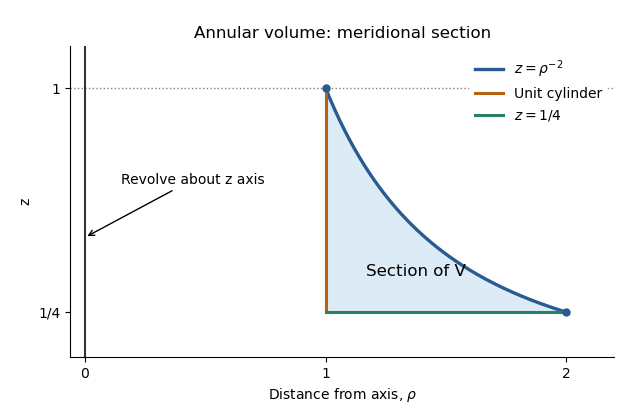
With the Jacobian determinant of cylindrical coordinates,Zero divergence gives , hence the most general solution on the positive radial interval isAlthough this vector field is singular on the axis if , the entire closure of lies at , so it is smooth on a neighbourhood of and the divergence theorem applies.
Its volume integral of divergence is zero. Compute the outward surface integral directly. On the inner cylinder, , , and the flux is . On the curved roof , the outward vector surface element of a graph isTherefore its flux isThe horizontal bottom has zero flux and the top rim has zero surface area. Summing giveswhich verifies the divergence theorem with every boundary contribution accounted for.
Stokes theorem equates the circulation around the induced boundary orientation of an oriented surface to the normal flux of curl:The usual version requires a piecewise smooth oriented surface and a vector field continuously differentiable on a neighbourhood of it. We use the upward orientation wherever the surface is a graph; each outer circle is counterclockwise viewed from above, and an inner circle is clockwise.
Write . The surface of revolution has with . For , it is a disk-shaped cap of a two-sheeted hyperboloid, running from to . For , it is a right circular cone, , including its apex. For , it is an annular strip of a one-sheet hyperboloid, between the circles and .

Disk cap, cone and annular hyperboloid strip in the three positive-parameter regimes of Stokes' theorem
. For , differentiation of the graph gives and , so the upward vector surface element of a graph and its scalar area areFor this graph expression is singular at the lower circle because the surface has a vertical tangent there, rather than a singular geometric surface. A regular parametrization isIt proves that the graph surface integral is interpreted by its integrable endpoint limit. The same parametrization works away from the pole or apex in the other regimes.
Direct differentiation of the first vector field givesIts surface integral is twice the projected area, namely for and for . On an oriented circle of radius , . The outer circulation is ; an inner circle, when present, contributes . ThusAt , excise a small apex circle of radius , apply Stokes theorem to the smooth truncated cone, and let . The removed flux and its inner circulation are both , so the limiting equality holds. This avoids silently applying a smooth-surface theorem at the cone's nonsmooth apex.
The second vector field is the azimuthal inverse-radius vector field, . Away from the axis,The other two curl components vanish because the field is independent of and has zero component. On any positively oriented circle around the axis, , so its circulation is , independent of radius. ThereforeFor the surface avoids the axis, so Stokes theorem applies directly and returns zero curl flux. For the disk cap meets the axis, and for the apex lies on it: is undefined there, so the neighbourhood hypothesis of Stokes theorem fails. Removing a small circle gives cancelling inner and outer circulations; the inner circulation remains as its radius tends to zero. Hence it cannot be discarded as it could for . A nonzero circulation here is compatible with zero curl away from the excluded axis.
Apply the divergence theorem to , for functions smooth enough on the closure of the bounded piecewise smooth volume. The product rule givesThus Green's first theorem, also called Green's first identity, isThe normal is outward. This identifies the boundary term and its sign directly from the divergence theorem.
For the usual Dirichlet problem on a bounded regular volume, suppose both satisfy the stated data. Their difference is a harmonic function, with in and on . In Green's first identity, choose both functions equal to :The nonnegative continuous integrand forces . Thus is constant on each connected component, and its zero boundary values force each constant to vanish. This proves uniqueness for the Dirichlet problem.
If the boundary value is a constant , the constant function is itself a harmonic function with those data. Uniqueness therefore yieldsBoundedness, or an appropriate condition at infinity replacing it, is essential. On the upper half-space both and are harmonic functions with zero data on its boundary plane. They show why unrestricted uniqueness must not be asserted for an unbounded volume.
Put , with . The Jacobian determinant in spherical coordinates gives , soDifferentiation under this fixed-domain integral yieldsThe last step is the divergence theorem and the Laplace equation. Hence is constant on radii for which the closed ball lies inside . Continuity at the origin gives , proving the mean value property for harmonic functions:
The continuous harmonic function has on the compact sphere. Integrate these inequalities over its area and use the mean value property for harmonic functions:The centre value is an average with positive weights, so it lies between the smallest and largest boundary-sphere values.
Use the Cartesian second-rank tensor transformation convention , where is the orthogonal matrix converting components to the new orthonormal basis. The coordinate half-turns areFor a diagonal rotation , invariance gives , with no summation in this equation. For each , one of the listed half-turns makes , so . ThusThis is coordinate half-turn invariance of a second-rank tensor. It does not force equal diagonal entries; invariance under all rotations would be the stronger isotropic second-rank tensor condition.
The first index of the printed Levi-Civita symbol is fixed at . Thus the matrix in the first orthonormal basis isThe specified matrix in the other basis is , with determinant one. If this array were a Cartesian second-rank tensor, an orthogonal basis change would give , andThe determinants disagree, proving the array is not a tensor. The fixed index matters: the TeX aid drops it, but the original PDF clearly prints .
True. In all four tests, an array is understood to have components specified in each rotated orthonormal basis; being a scalar means that the contraction is invariant under those changes. Write the Frobenius inner product as . Every test Cartesian second-rank tensor obeys . The assumption saysChoosing the elementary matrices as , or choosing , gives . Thereforewhich is the required Cartesian second-rank tensor transformation law. This is the scalar contraction test for a Cartesian tensor.
False. Tests against symmetric second-rank tensors see only the symmetric part , because the Frobenius inner product of a symmetric matrix and an antisymmetric matrix is zero:An arbitrary basis-dependent antisymmetric part is invisible to these tests. For example, prescribein one basis, and in another rotated basis, choosing antisymmetric arrays in every remaining basis. Every contraction with any symmetric second-rank tensor is the invariant scalar zero. But an invertible rotation cannot transform this nonzero matrix to zero, so the array is not a Cartesian second-rank tensor. This is the blindness of symmetric contraction tests to antisymmetric arrays.
False. The counterexample just given is antisymmetric in every basis and has zero contraction with every symmetric second-rank tensor. It still fails the Cartesian second-rank tensor transformation law, because its value is nonzero in one basis and zero in another. Thus antisymmetry alone, together with symmetric tests, proves no tensor transformation law. The same blindness of symmetric contraction tests to antisymmetric arrays applies even when the array is assumed antisymmetric.
True. Since and are antisymmetric, the matrix is antisymmetric. Invariance of contractions with every antisymmetric second-rank tensor gives for every antisymmetric test matrix . Such a matrix can be freely prescribed in one basis and then transformed to define a valid test tensor. Choose in that basis. Thenso and . Together with the given antisymmetry, this proves that is an antisymmetric second-rank tensor. The antisymmetric contraction test for an antisymmetric tensor works because the Frobenius inner product is nondegenerate on the antisymmetric subspace.
Articles by others on the same topic
There are currently no matching articles.