Use , the Einstein field equations with zero cosmological constant, and metric signature . Write for the differential one-form dual to the axial Killing vector field. To fix the sign of the volume formula, use the component Hodge star operator convention and . The Killing equation gives , and its contracted curvature identity givesTo see the curvature step, tracing the Killing equation gives . The second covariant derivative of a Killing vector then gives , while commuting the covariant derivatives gives . Subtracting these two terms is precisely above. The component Hodge star operator converts this divergence to with the displayed minus sign.
In a vacuum spacetime region , so . If and are enclosing spacelike submanifolds in the same homology class bounding a vacuum three-dimensional region , Stokes theorem yieldsThus the Komar angular momentum is independent of the enclosing vacuum spacelike two-manifold, provided the surfaces have the same orientation and enclose the same sources and inner boundaries. The vacuum region need not be stationary: an axial Killing vector field suffices.
For a regular filling hypersurface with , the Einstein field equations giveThe pullback of to vanishes because is tangent to : the dual three-form measures the normal component, which is zero. ThereforeThis is the stress-energy current from a Killing vector integrated over the slice, with the signs fixed by the stated Hodge star operator convention.
There is a necessary boundary qualification omitted from the printed formulation. If the slice has inner boundaries , orient them so . The actual Komar angular momentum with inner boundaries identity isFor a vacuum Kerr black hole, on the exterior slice but ; its horizon supplies precisely the inner boundary contribution. Thus the matter-only formula is false for arbitrary exterior slices. It is valid when a nonsingular filling with no inner boundaries exists, or when all omitted inner charges vanish. The Komar angular momentum independence likewise concerns homologous surfaces in the same vacuum region, not an unrestricted comparison of differently enclosed objects.
A gravitational wave can propagate through a region with vanishing stress-energy tensor; its gravitational field is not a matter current . Nevertheless, exact axisymmetry gives an axial Killing vector field, and the vacuum identity makes the Komar angular momentum equal on enclosing spacelike submanifolds in the same homology class. Applying the same identity to the spacetime tube between surrounding spacelike submanifolds at different times gives zero net flux of this charge through the tube.
Consequently gravitational waves in exact axisymmetry carry no net angular momentum about the symmetry axis. They can still carry energy and decrease the total mass. In a mode description, rotationally invariant radiative data have zero azimuthal mode number; exact axisymmetry therefore excludes the axial angular momentum flux present in nonaxisymmetric merger radiation. This does not mean there are no gravitational waves, or that radiation cannot transport angular momentum when the exact symmetry is absent. The relevant conserved charge includes any horizon contributions identified in the preceding Komar angular momentum with inner boundaries identity.
The common axial Killing vector field fixes the same sign convention for both spins. Initial rest and alignment of the separation with the symmetry axis give no orbital angular momentum. At large separation, the total axial charge is therefore . Since axisymmetric radiation carries no axial angular momentum, all of this charge remains in the remnant after the radiation has escaped and the exterior has settled:Here the spins are signed quantities about the same axis, not their magnitudes. The conclusion assumes the exact axisymmetry stipulated throughout the merger and no remaining exterior matter carrying angular momentum; the final stationary vacuum remnant is a Kerr black hole under the usual uniqueness hypotheses.
Assume the classical black-hole area theorem applies: the null energy condition and the required global regularity or strong asymptotic predictability hypotheses hold. The disconnected initial horizon sections then give . DefineFor any regular Kerr black hole, , so . The irreducible mass identity obtained by inverting the Kerr area relation isIndeed, implies , which gives this expression. At fixed , its derivative with respect to is on the physical branch. Therefore the area bound for an axisymmetric Kerr merger isThis uses the ideal limit of infinite initial separation, in which the initial total energy is . At finite separation it is the initial total gravitational energy, including binding energy, that replaces this sum. The inequality is an upper limit, not a prediction or a guarantee of saturation; real mergers increase the horizon area.
Changing only a spin sign leaves unchanged, whereas the square of the final angular momentum changes. For fixed nonzero , same-sign spins give , and opposite signs give . The remnant must retain more rotational energy in the same-sign case, so its minimum allowed mass is larger and the radiated-energy upper limit is smaller. Cancellation of opposite spins permits more of the initial rotational energy to be radiated while respecting the same initial total area.
For example, equal extremal initial holes have and . Same-sign spins allow at most , a fraction of the initial energy; opposite signs allow at most , a fraction . These are geometric bounds under exact axisymmetry, not achievable-efficiency claims.
A null geodesic congruence is a smooth family of null geodesics filling a region without crossings there. Choose a smooth future-directed tangent and an affine parameter , soThe space orthogonal to is degenerate because it contains itself. To measure genuine transverse separation, introduce an auxiliary null vector with and the screen-space projectorIn four dimensions has a positive-definite two-dimensional image and annihilates and . The optical tensor is the transverse part of the velocity derivative,Its irreducible decomposition defines the three optical quantities:The null expansion is the fractional rate of change of a small transverse area, . The symmetric trace-free null shear distorts the shape of the transverse beam without changing its area at first order. The antisymmetric null twist, also called rotation of the congruence, describes the rotational part of its transverse deformation. These are properties of the screen quotient ; the auxiliary vector chooses a convenient representative of that quotient. For an affinely parametrized null geodesic congruence, the contraction constraints also give .
Parallel transport the auxiliary null vector and a screen basis along each generator of the null geodesic congruence. This keeps the screen-space projector fixed under the corresponding transported derivative. Use the curvature convention .
With , differentiation of the affine geodesic equation givesHere the first term comes from commuting the derivative past , and the second from the curvature commutator. The constraints follow respectively from the null normalization and affine geodesic equation. Projecting onto the screen therefore yields the optical matrix equationThe trace of the tidal matrix is ; extra terms from replacing the screen trace by the spacetime trace vanish by curvature antisymmetry. Taking the trace givesDecompose the optical tensor as . The null shear is symmetric and trace-free and the null twist is antisymmetric. Their cross traces vanish, andThe negative sign in the last term is the identity on the positive-definite screen. Substitution proves the four-dimensional Null Raychaudhuri equation:The coefficient is in spacetime dimensions; the factor here belongs to the four-dimensional congruence in this question, not the five-dimensional geometry of the next question.
The Einstein field equations and the null energy condition imply the null convergence condition:The scalar-curvature and any cosmological constant terms vanish because . For generators of the null hypersurface, the supplied twist-free property gives . The null shear squared is nonnegative on the screen. Thus the Null Raychaudhuri equation impliesStarting from , the null expansion remains negative for as long as the regular congruence exists. HenceBefore the right-hand side reaches zero, inversion of the negative quantities givesSince the inverse of a finite negative null expansion cannot be nonnegative, the regular congruence cannot continue through the proposed upper limit. The null focusing theorem therefore givesProvided the geodesic itself extends this far, the transverse area collapses and at or before this bound. An earlier end of the affine geodesic would instead be geodesic incompleteness. A divergence of the null expansion marks a caustic or a conjugate point to a spacelike surface; it does not by itself establish a curvature singularity.
The relevant Penrose singularity theorem states: a connected time-oriented four-dimensional globally hyperbolic spacetime with a noncompact Cauchy hypersurface, a nonempty compact orientable boundaryless trapped surface, and the null convergence condition is future null-geodesically incomplete. Under the Einstein field equations, the null energy condition supplies the curvature hypothesis. A trapped surface here is spacelike and has both future normal null expansions strictly negative. The conclusion is an incomplete null geodesic, not necessarily a divergent curvature invariant at an identifiable point.
Suppose, for contradiction, that every future null geodesic is complete. Write for the trapped surface andThe equality follows because the causal future of a compact set is closed in a globally hyperbolic spacetime. This future horismos is a closed achronal boundary. It is nonempty: the restriction of a Cauchy time function to compact has a minimum, and a point at that minimum cannot be chronologically preceded by another point of .
Normalize the two future null normal directions along against a smooth future timelike field, fixing the affine scale continuously. Their initial null expansions are continuous and strictly negative. Compactness of the normalized normal bundle gives a uniform with everywhere on . The preceding null focusing theorem forces a conjugate point to a spacelike surface along each normal generator within affine length .
By the supplied boundary-generator result, every point of is reached by an orthogonal future null geodesic which has no earlier conjugate point. No such boundary generator can remain on the boundary beyond its first focal point. Every point of therefore lies inThe parameter set is compact. Future null completeness makes its geodesic flow defined throughout this common finite interval, and smooth dependence on initial data makes its image compact. Since is closed and contained in , it is compact. This is the compactness of the future horismos of a trapped surface step; a merely pointwise finite bound would not suffice without compactness and uniform normalization.
Choose a smooth complete timelike vector field, obtained if necessary by positive rescaling against a complete auxiliary Riemannian metric. Its inextendible integral curves of a vector field meet a chosen smooth Cauchy hypersurface exactly once. Projection along those curves defines a continuous map . The achronal set property makes this map an injective function: two boundary points on the same timelike integral curve of a vector field would be timelike related.
An achronal boundary is a topological hypersurface without boundary, even at nonsmooth generator junctions; the submanifold property allowed in the question supplies this fact. Thus domain and codomain are both three-dimensional topological manifolds without boundary. Invariance of domain makes open in . Compactness makes it closed in the Hausdorff space , and it is nonempty. Connectedness of the spacetime gives connectedness of , so this image is all of . That would make compact, contradicting the noncompact Cauchy hypersurface hypothesis. The completeness assumption is false, proving the theorem.
The noncompactness hypothesis and strict trapping are essential to this version. Global hyperbolicity cannot simply be omitted in the compactness and projection steps, and nonpositive initial expansion with zeros does not supply the uniform focusing bound used here.
Put and . Expanding the metric tensor in the stationary direction gives the useful exact identitiesTaking the exterior derivative givesThe fibered form of the metric tensor has determinant . Its inverse components needed for the flux areThereforesince . This calculation includes the rotational mixed term; dropping it prematurely would miss the exact cancellation.
With the stipulated negative coordinate orientation, . The pullback of the Hodge star operator to the constant- three-dimensional spacelike submanifold is consequentlyThe coordinate ranges and standard sphere identifications giveThus the five-dimensional Komar mass, in the normalization given and , isThe flux is already independent of in the vacuum region, so its limit at infinity has the same value. The negative orientation in the question is crucial for the positive sign; reversing that orientation reverses the flux.
Consider the discrete mapIt is an isometry: and both change sign, leaving unchanged, while and are also unchanged. A local component of its fixed-point set is , .
If a geodesic starts tangent to that component, the isometry fixes both its initial position and its initial tangent. Applying the isometry therefore gives a geodesic with the same initial data. Uniqueness of the geodesic equation makes it the same curve, so it remains in the fixed component. This proves that the selected submanifold is a totally geodesic submanifold; it has dimension three, not two. The proof continues through a horizon when expressed in regular coordinates, so coordinate singularities of the original chart do not invalidate it.
The geodesic conserved quantities from Killing vectors associated with and areDots denote derivatives with respect to an affine parameter. On the chosen submanifold and , so . Requiring also givesMore generally, away from the polar-coordinate axes, both displayed angular charges being zero imply and the same relation. In particular, zero conserved angular momentum does not imply constant : the motion follows the local dragging of the angular coordinate by the rotating geometry.
For the zero-angular-momentum curves, the fiber term in the induced metric tensor vanishes along the tangent, leavingfor a null geodesic. In the exterior, a future geodesic has positive conserved energy . Its equations areDefine the tortoise coordinate, separately on intervals bounded by horizon radii, byFor an outgoing curve ,for an ingoing curve , . Thus and are the respective constant labels. The derivative , with its sign, is required for continuation; taking would give the wrong labels between the horizons.
For a nonextremal horizon , the tortoise coordinate has leading behaviorAt the double root of the extremal black hole it instead has a pole. These singularities are coordinate effects at a regular Killing horizon; they are not the curvature singularity at . To cross the future horizon, the ingoing coordinatesgive the regular induced metric tensorThis also fixes the future branch used in the causal argument below.
Relative to a chosen asymptotically flat end, define the black hole region bywhere is that end's future null infinity in a conformal completion. It consists of events unable to send a future causal signal to that infinity; its boundary is the corresponding future event horizon.
For , and on . The gradient of has norm , so it is timelike there. Use the future extension regular in the ingoing coordinates above, reached by an exterior future ingoing null geodesic with . This determines to be future timelike in the inter-horizon block. Every nonzero future causal tangent therefore obeysAt the future outer horizon the gradient becomes future null and gives the corresponding one-way inequality . No future signal can cross that horizon outward to the selected exterior. The future inter-horizon block is consequently within ; a future-directed path can leave it only through the inner horizon, not return through the outer horizon to the selected infinity.
This statement requires a branch and an end. The maximal extension also contains time-reversed inter-horizon blocks, where future-directed curves have increasing and emerge into an exterior: they are white holes, not the selected black hole region. Thus the unqualified claim for every copy of in an arbitrary extension is false. Analytic continuation past a Cauchy horizon can also introduce other asymptotic ends; the displayed definition explicitly refers to the chosen component of infinity.
To sketch the causal structure, suppress the spacelike circle by its orbit-space projection. The induced three-dimensional metric tensor isThe causal projection along a spacelike circular fiber is exact: any causal curve projects to a -causal curve, and every base curve has a lift with exactly its base norm. The diagrams therefore represent this two-dimensional orbit space, not a constant- slice of the three-dimensional submanifold.
There are three nonextremal block types. For , spans the full real line from the outer horizon to infinity, producing an exterior diamond. For , spans the full line with the time and space roles reversed; these diamonds contain the future black-hole or past white-hole branches. For , is finite at zero and diverges at the inner horizon, producing a static half-diamond with a timelike singular edge. The supplied Kretschmann scalar diverges as at , and on the inner side, so that edge is a genuine timelike curvature singularity. In contrast, both horizon radii are regular in horizon-adapted coordinates.
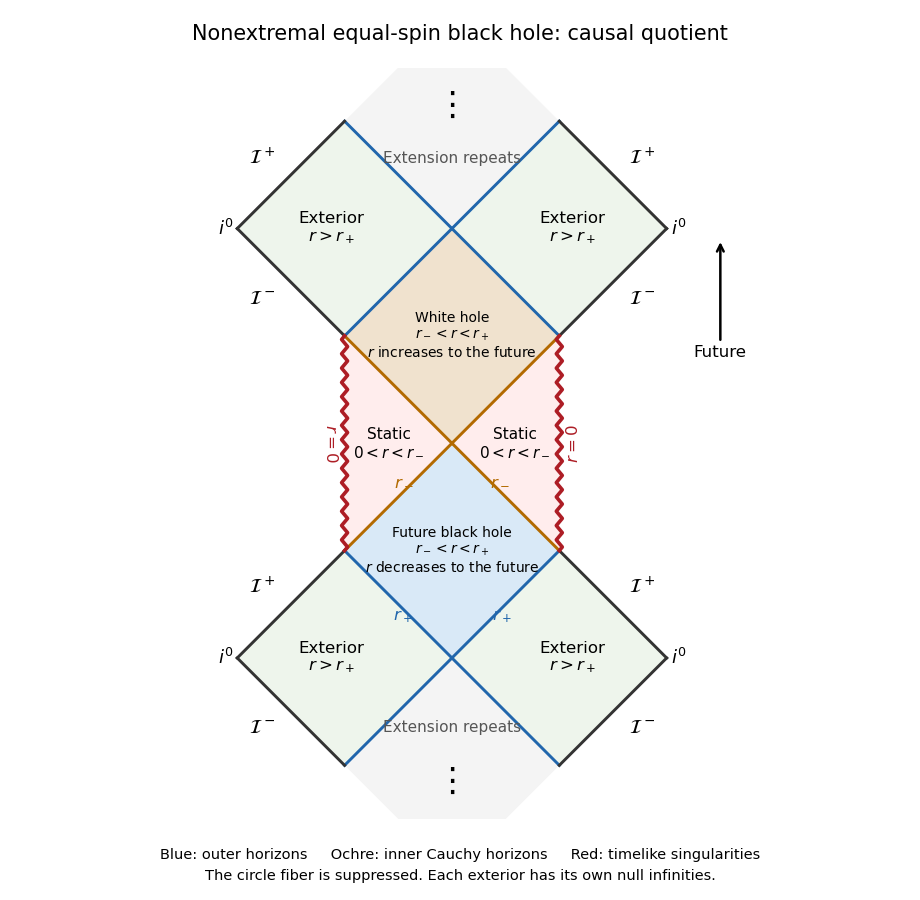
The finite strip shows two exterior levels, a future trapped block, an inner static level with timelike singularities, and the next emerging block. Continuing through the inner Cauchy horizons repeats this pattern upward and downward in the maximal analytic extension. The inner boundary is not a spacelike Schwarzschild-type singularity. Such an ideal extension need not describe a physical collapse past its unstable inner horizon.
At , put . Then , , and the interval is empty. The lapse is positive on both sides, so there is no inter-horizon trapped diamond. The horizon is a degenerate Killing horizon, with . In the exterior as , while inside as ; more precisely its leading pole is . Static proper distance to the horizon is infinite. Future ingoing rays still cross it at finite affine parameter, as the regular ingoing metric tensor shows.
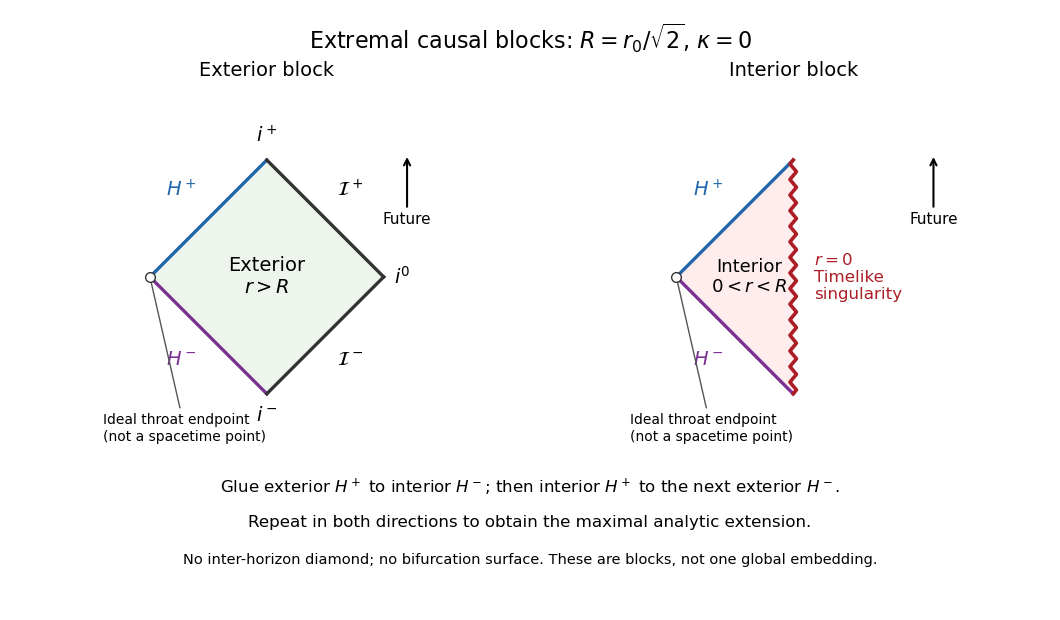


The extremal sketch gives the exterior diamond and singular interior half-diamond, with the complete gluing prescription: the exterior future horizon attaches to the interior past horizon; the interior future horizon attaches to the past horizon of another exterior. Repeating these attachments gives the maximal extension. The marked throat endpoints are conformal ideal endpoints, not bifurcation points of the spacetime. This block representation avoids incorrectly treating the extremal geometry as two transverse horizons with a collapsed trapped region.
Work first in units . Black-hole thermodynamics starts with the laws of black-hole mechanics. For a connected stationary regular Killing horizon, the Zeroth law of black-hole mechanics makes its surface gravity constant when the Einstein field equations and dominant energy condition hold. This parallels uniform equilibrium temperature. For neighboring stationary asymptotically flat four-dimensional Einstein-Maxwell black holes, the First law of black-hole mechanics iswhere is the horizon angular velocity and its electric potential relative to infinity. The last terms are rotational and electromagnetic work, analogous to the work terms in . The second law of black-hole mechanics, expressed by Hawking's area theorem, makes the total future horizon area nondecreasing for classical matter obeying the null energy condition and global assumptions such as strong asymptotic predictability. The third law of black-hole mechanics is an unattainability statement: subject to the usual regularity assumptions, the weak energy condition, and a bounded stress-energy tensor, no finite physical process reduces the surface gravity of a regular horizon to zero. It does not assert that extremal black holes have zero area or zero entropy.
Classical geometry alone fixes an analogy, not a nonzero physical temperature. Quantum field theory supplies Hawking temperature . Comparing the area term of the first law with gives for nonextremal holes, and hence the standard Bekenstein-Hawking entropy. Restoring physical constants,Here restored is the physical acceleration surface gravity and is the squared Planck length. The first-law comparison determines the area coefficient, leaving an additive entropy constant unspecified; the displayed formula is the usual convention. Its area scaling, rather than ordinary volume scaling, signals that the available thermodynamic degrees of freedom of a gravitating system are constrained by the horizon geometry.
Particle production explains the quantum input. For a real scalar field obeying the massless covariant wave equation, the Klein-Gordon inner product on solutions isThe wave equation makes its current divergence-free, so the product is independent of a Cauchy hypersurface when the boundary flux vanishes. Use suitably normalized wave packets or the appropriate continuum distributions. Asymptotic past and future Minkowski spacetimes give preferred positive-frequency solution mode bases and , normalized by , and . Between those regions, a nonstationary geometry generally has no preferred positive-frequency splitting.
The mode bases are related by a Bogoliubov transformation,The last identities follow from conservation of the Klein-Gordon inner product and are the canonical identities for a bosonic Bogoliubov transformation. Expanding the field in either complete basis and extracting its positive-frequency coefficient givesThus the state annihilated by every hasThis particle number from Bogoliubov coefficients is nonzero when time evolution mixes positive and negative frequencies. It describes one state as vacuum in the early particle basis and populated in the late basis; it does not require an arbitrary choice of a vacuum at each intermediate time. For a finite implementable transformation the state remains a squeezed pure quantum state. In infinitely many modes, a common unitary bosonic Fock space implementation requires additional conditions, such as the beta map being a Hilbert-Schmidt operator; finite wave packet observables need not share every global divergence of an ideal continuum calculation.
For gravitational collapse, the future is not globally Minkowski: it contains a black hole. The relevant late out-basis includes modes reaching future null infinity together with modes entering the future event horizon. Modes on infinity alone are not a complete Cauchy basis. Nevertheless the same mode-mixing calculation determines the outgoing particle flux. Near a nonextremal horizon, the logarithm in the tortoise coordinate converts regular early null coordinates into the Hawking exponential ray mapwhere is the early affine null coordinate and is late retarded time at infinity. Backward propagation of a late outgoing mode gives a factor for . Its positive- and negative-frequency Fourier integrals differ by analytic continuation around the logarithmic branch. With a convergence regulator they reduce toTaking gives the thermal ratio of Hawking Bogoliubov coefficients, . Combining this with the canonical normalization yields the bosonic occupation . Late-time wave packets turn formal continuum coefficients into a finite number flux.
A Schwarzschild black hole has , so this spectrum has . The exterior curvature potential partly reflects the outgoing modes. Its transmission probabilities are the greybody factors, giving, for one massless scalar species in the stationary late-time approximation,Thus the horizon temperature is universal, while the spectrum received at infinity is not a perfect featureless blackbody radiation spectrum. The derivation assumes the near-horizon quantum state inherited from a regular collapse vacuum and ignores rapid backreaction over the timescale of the packets. Exponentially blueshifted precursor frequencies indicate the usual short-distance assumption in the semiclassical calculation, not an independently demonstrated quantum-gravity description of the endpoint.
The outgoing positive energy flux drives black-hole evaporation. At leading order for a large isolated Schwarzschild black hole, area scales as and temperature as , giving and a lifetime of order , with the coefficient depending on species and transmission factors. Its negative heat capacity of a Schwarzschild black hole, , means that it heats up as it loses mass and cannot be in stable canonical equilibrium with an unlimited thermal reservoir. The approximation fails when quantum-gravitational scales are reached and does not fix whether the endpoint is complete evaporation, a remnant, or something else.
Area loss does not contradict the classical area theorem, because the quantum stress-energy tensor need not obey the classical null energy condition; negative horizon energy accompanies the positive outgoing flux. The appropriate thermodynamic statement is the generalized second law, involving . Finally, Hawking radiation raises the black hole information paradox: if a pure quantum state completely evaporates into an exactly thermal mixed quantum state and its partners disappear, the result conflicts with ordinary unitary time evolution. Early outgoing radiation can be mixed simply because of its entanglement with interior modes while the complete state remains a pure quantum state; that fact alone is not information loss. Resolving the fate of all correlations through the evaporation endpoint requires more than the leading semiclassical flux calculation.
Articles by others on the same topic
There are currently no matching articles.