A muonic atom binds a negative muon in the nuclear Coulomb potential. The muon is a spin one-half lepton with the electron's charge but about 207 times its mass. For a point nucleus of mass and charge , the reduced mass and nonrelativistic hydrogenic scales, with fine-structure constant , areFor a heavy nucleus , giving a radius roughly of the corresponding electronic radius and transition energies roughly 207 times larger. For hydrogen, nuclear recoil matters: gives and rather than the infinite-nuclear-mass value about .
A slowed negative muon is captured into an excited orbit and undergoes a radiative cascade, ejecting atomic electrons and emitting muonic X-rays. Inner orbits penetrate the nuclear charge distribution, particularly at large . Replacing a point charge by an extended charge makes the central attraction less singular and shifts states with substantial nuclear overlap. Measured transition energies consequently constrain the nuclear charge radius. Sensitivity is particularly strong for states, whose contact density scales as .
An instructive experiment is Randolf Pohl's team's muonic-hydrogen spectroscopy. A stopped-muon target prepared a metastable population; a tunable pulsed laser drove a transition, followed by a detectable X-ray. Scanning laser frequency located a resonance whose interpretation included the proton finite-size contribution to the Lamb shift. Delayed detection selected the long-lived population against prompt cascade backgrounds. Laser-off or detuned measurements provide a background control; energy and time selection alone would not establish a laser-induced resonance.[ref]
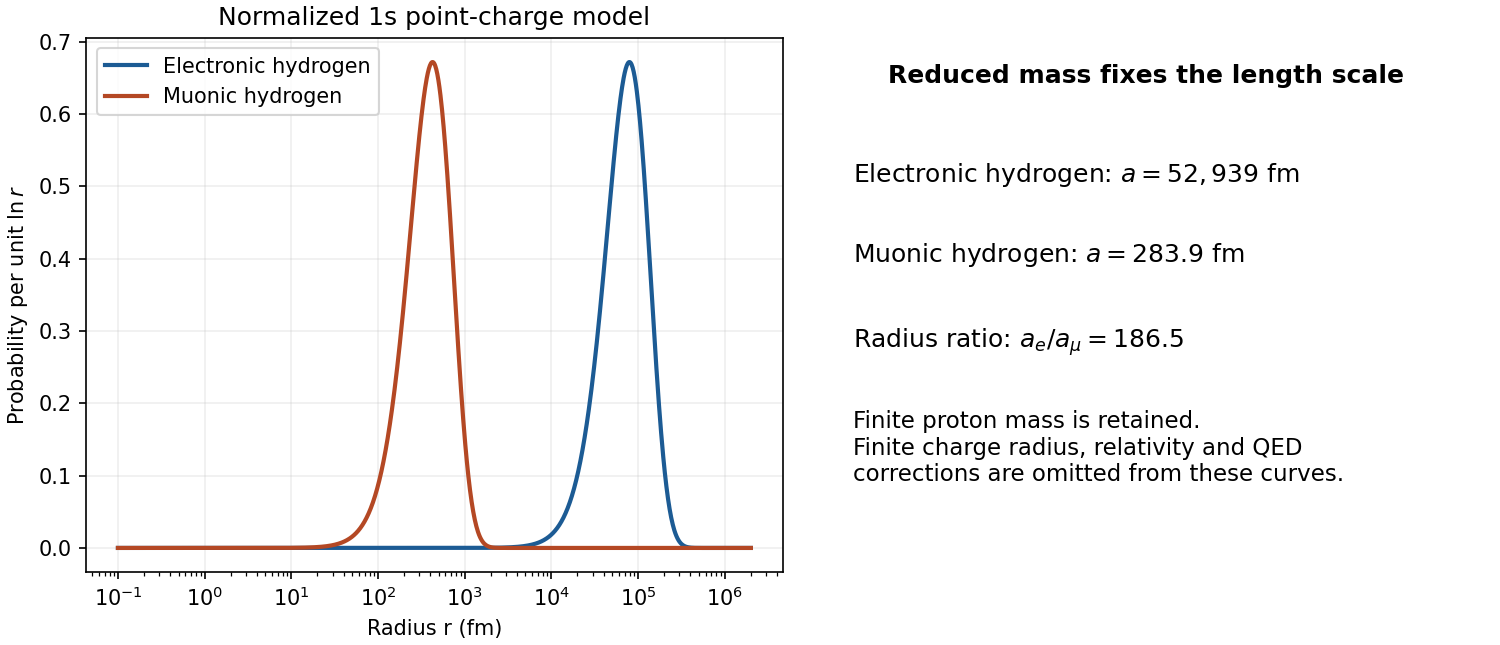
reduced mass changes the orbital scale and nuclear-size sensitivity
. Original calculated hydrogenic radial probabilities, plotted against physical radius with probability measured per logarithmic interval. The Bohr radii are stated alongside; these are point-nucleus model curves, not measured nuclear densities. Details.
Extracting a radius requires quantum electrodynamics, including vacuum polarization, recoil and nuclear-structure corrections. A free muon decays on a microsecond timescale; a bound negative muon can instead undergo muon capture, for example . These processes limit observation time. In heavy atoms, relativistic motion and nuclear overlap make the simple Bohr formulas only qualitative. Muonic spectroscopy converts a smaller orbital scale into enhanced sensitivity to nuclear charge structure, provided atomic and nuclear corrections are controlled.
The nuclear Fermi gas model treats protons and neutrons as two species of spin one-half fermions moving approximately independently in a confining nuclear mean field. At a temperature small compared with their Fermi temperature, the Pauli exclusion principle fills the lowest available momentum states. It does not allow all nucleons to sit at zero momentum.
For species , two spin states occupy each momentum-space cell . Counting a filled sphere giveswhere . The Fermi energy is measured from the mean-field well bottom; it need not equal the energy needed to remove a nucleon into vacuum. Occupied-state averaging givesEven at zero temperature there is kinetic energy and degeneracy pressure. As an explicitly illustrative input, total density and give and . These numbers illustrate the formula; they are not additional data supplied by the paper.
Separate proton and neutron seas explain a kinetic contribution to nuclear symmetry energy. At fixed , put and define at . ThenIncreasing one species' population raises its Fermi surface and costs energy, favoring similar populations before electrostatic and interaction terms are included.
pauli blocking suppresses collisions deep in a filled sea because scattering needs unoccupied final states. An energetic external probe can knock a nucleon into an empty state and reveal its initial Fermi motion, making the model useful for broad inclusive scattering distributions. A finite surface can be approximated using a position-dependent nuclear mean field.
A free gas cannot produce nuclear binding or saturation: those require an attractive interaction and its density dependence. The smooth gas picture also omits discrete nuclear shells, nuclear spin-orbit splitting, nuclear pairing, short-distance correlations and deformation. It cannot assign all ground-state spins from a momentum sphere. Its useful prediction is the scale and occupancy of nucleon motion, with a surrounding mean field supplied separately.
The Standard Model is a gauge theory with group , matter quarks and leptons, gauge bosons and a Higgs field. It combines Quantum chromodynamics with the electroweak interaction. Its successes do not make its field content a complete account of nature. Established missing phenomena should be distinguished from theoretical questions about its parameters.
neutrino oscillation demonstrates nonzero mass-squared differences and mixing of flavor states. The minimal renormalizable Standard Model has no right-handed neutrino and no neutrino mass term. The atmospheric experiment compared zenith-angle distributions of muon-like and electron-like events in a large water Cherenkov detector. A direction-dependent muon-neutrino deficit, with different path lengths through Earth and comparison samples, discriminated against a uniform flux-normalization error.[ref]
Evidence for oscillation of atmospheric neutrinos by Y. Fukuda and others. Abstract and zenith-angle distributions, Physical Review Letters 81, pp. 1562–1567 (1998)
One extension adds right-handed neutrinos and small Dirac Yukawa couplings; another has a Majorana mass term and seesaw mechanism, with light eigenvalue of order . Oscillations alone do not decide whether neutrinos are Majorana neutrinos.dark matter is inferred from gravitational observations such as galactic motions and gravitational lensing; Standard Model particles do not supply the required dominant cold component. Active neutrinos contribute some matter but cannot constitute all the cold dark matter. A new stable weakly interacting particle, an axion, or other hidden-sector states are possible explanations, with different scattering, production and astrophysical signals. Dark-matter evidence does not identify a particular new particle. The institutional account distinguishes gravitational evidence from proposed particle candidates.[ref]
Dark matter by CERN. Gravitational evidence and candidate-particle discussion
The matter-antimatter imbalance poses a different problem. Dynamical baryogenesis needs Sakharov conditions, including baryon-number violation, CP violation and departure from thermal equilibrium. Although the Standard Model contains relevant ingredients in principle, they do not generate the observed asymmetry in its conventional thermal history with measured parameters. Additional CP phases, a stronger electroweak transition, or leptogenesis from heavy Majorana neutrinos are possible extensions. Each needs a quantitative mechanism.
gravity is absent as a dynamical quantum interaction, motivating quantum gravity and unification. The hierarchy problem asks why the Higgs mass scale is small compared with much higher scales when scalar masses receive sensitive quantum corrections. supersymmetry can cancel particular contributions between partner fields if its breaking pattern is suitable; compositeness gives another interpretation of the Higgs sector. Neither motivation proves that the corresponding new particles exist. The Strong CP problem asks why the allowed QCD CP-violating parameter is so small; an axion mechanism is one possible answer.
A grand unified theory embeds the separate gauge factors in a larger group and can relate couplings or fermion representations, sometimes predicting proton decay. Its tests differ from dark-matter or neutrino-mass searches. A useful extension must explain a specified deficiency, preserve successful low-energy predictions and supply distinguishable experimental consequences. Attractive new symmetries alone are not evidence.
Articles by others on the same topic
There are currently no matching articles.