For the usual hollow rectangular electromagnetic waveguide, let the propagation axis be and the interior be , . A transverse magnetic polarization has and . At a perfect conductor wall the tangential electric field vanishes. Since is tangential to all four side walls, it satisfies a homogeneous Dirichlet boundary condition around the rectangle.
Separating the transverse Helmholtz equation therefore gives the transverse magnetic mode of a rectangular waveguideA zero value of either index makes identically zero, rather than producing a nonzero field uniform along that direction. The transverse electric and magnetic fields of this TM family are obtained from transverse derivatives of , so they also vanish. Thus both TM indices must be nonzero: neither nor exists in this rectangular hollow-guide model. In contrast, transverse electric modes obey a Neumann boundary condition on and may have one zero index. The claim is about this waveguide geometry, not all possible guides.
Use absolute temperatures and . Let be the heat extracted from the ground, the heat delivered indoors, and the electrical input power. For a reversible heat pump, the entropy transferred per unit time balances:Consequently the coefficient of performance isThe requested heat delivery is a rate, since the duration is unspecified:Of this, comes from the ground and from the electricity. A coefficient of performance greater than one is consistent with conservation of energy because the heat pump transports heat as well as converting electrical energy.
Let the particle have mass , and assume its force is derived from a time-independent potential energy during the stated interval. Differentiation givesFor , choose a branch on which is real. Conservation of energy is the quickest integration of Newton's second law:The additive constant is arbitrary. For instance, the displayed expression applies directly for , and , without raising a possibly negative to a fractional power. Its derivative gives along the trajectory, as required. The second term has units of kinetic energy because has units .
For , the velocity is constant, so the potential energy is constant on the visited interval; the expression above reduces to such a constant. For , or , the particle is stationary: the trajectory only fixes to vanish at its position and does not determine the potential energy elsewhere. These exceptional cases cannot determine a unique nonconstant function.
Model air as a dilute ideal gas of molecules described by the hard sphere model. The number density and mean free path areThe factor accounts for the relative motion of the colliding molecules. A molecular collision diameter has to be estimated because none is supplied. Taking , appropriate as an order-of-magnitude size for the main constituents of air, givesThus the mean free path is about , or . A slightly smaller assumed diameter gives about , illustrating the intended precision of the estimate.
The appropriate quantity to minimize is the energy including exchange of particles with the Electron reservoir, . The occupation of an interacting localized electron level follows fromFor repulsion , the first Electron costs and the second costs . Comparing all three grand energies givesFor attraction , the singly occupied state never minimizes the grand energy. At the crossing of the empty and doubly occupied states, , its grand energy is , while both competing states have zero grand energy. HenceFor the two thresholds coincide at , giving a direct step. At a threshold, distinct occupations are degenerate; zero-temperature minimization alone does not select a unique occupation. A grand canonical ensemble at small positive temperature smooths the steps, withIn particular, the equal-weight empty/pair limit for gives mean occupation one exactly at its crossing; this is not a finite-width singly occupied plateau.
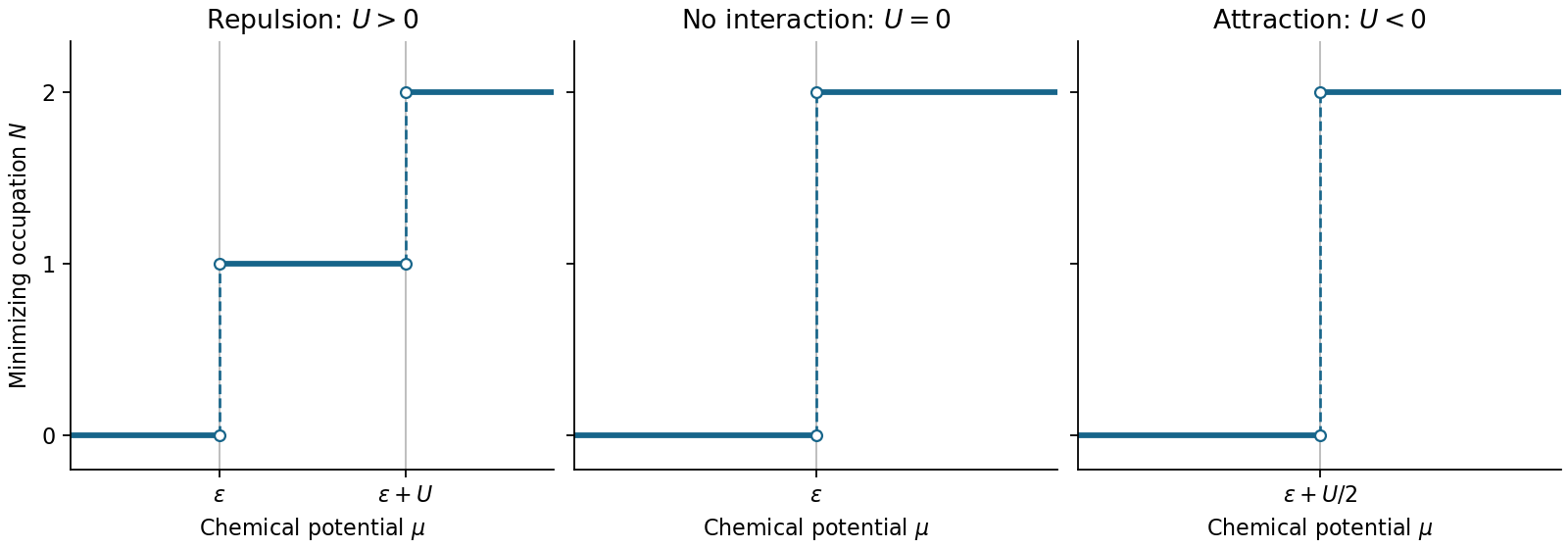
Zero-temperature occupation of a localized impurity level in a crystal with repulsive, zero and attractive interaction
. Original plots of the minimizing occupation away from degeneracy points. Dashed vertical lines mark the chemical potentials at which different occupations have equal grand energy. Their vertical segments indicate jumps, not intermediate stable states. Details.
Articles by others on the same topic
There are currently no matching articles.