For the usual hollow rectangular electromagnetic waveguide, let the propagation axis be and the interior be , . A transverse magnetic polarization has and . At a perfect conductor wall the tangential electric field vanishes. Since is tangential to all four side walls, it satisfies a homogeneous Dirichlet boundary condition around the rectangle.
Separating the transverse Helmholtz equation therefore gives the transverse magnetic mode of a rectangular waveguideA zero value of either index makes identically zero, rather than producing a nonzero field uniform along that direction. The transverse electric and magnetic fields of this TM family are obtained from transverse derivatives of , so they also vanish. Thus both TM indices must be nonzero: neither nor exists in this rectangular hollow-guide model. In contrast, transverse electric modes obey a Neumann boundary condition on and may have one zero index. The claim is about this waveguide geometry, not all possible guides.
Use absolute temperatures and . Let be the heat extracted from the ground, the heat delivered indoors, and the electrical input power. For a reversible heat pump, the entropy transferred per unit time balances:Consequently the coefficient of performance isThe requested heat delivery is a rate, since the duration is unspecified:Of this, comes from the ground and from the electricity. A coefficient of performance greater than one is consistent with conservation of energy because the heat pump transports heat as well as converting electrical energy.
Let the particle have mass , and assume its force is derived from a time-independent potential energy during the stated interval. Differentiation givesFor , choose a branch on which is real. Conservation of energy is the quickest integration of Newton's second law:The additive constant is arbitrary. For instance, the displayed expression applies directly for , and , without raising a possibly negative to a fractional power. Its derivative gives along the trajectory, as required. The second term has units of kinetic energy because has units .
For , the velocity is constant, so the potential energy is constant on the visited interval; the expression above reduces to such a constant. For , or , the particle is stationary: the trajectory only fixes to vanish at its position and does not determine the potential energy elsewhere. These exceptional cases cannot determine a unique nonconstant function.
Model air as a dilute ideal gas of molecules described by the hard sphere model. The number density and mean free path areThe factor accounts for the relative motion of the colliding molecules. A molecular collision diameter has to be estimated because none is supplied. Taking , appropriate as an order-of-magnitude size for the main constituents of air, givesThus the mean free path is about , or . A slightly smaller assumed diameter gives about , illustrating the intended precision of the estimate.
The appropriate quantity to minimize is the energy including exchange of particles with the Electron reservoir, . The occupation of an interacting localized electron level follows fromFor repulsion , the first Electron costs and the second costs . Comparing all three grand energies givesFor attraction , the singly occupied state never minimizes the grand energy. At the crossing of the empty and doubly occupied states, , its grand energy is , while both competing states have zero grand energy. HenceFor the two thresholds coincide at , giving a direct step. At a threshold, distinct occupations are degenerate; zero-temperature minimization alone does not select a unique occupation. A grand canonical ensemble at small positive temperature smooths the steps, withIn particular, the equal-weight empty/pair limit for gives mean occupation one exactly at its crossing; this is not a finite-width singly occupied plateau.
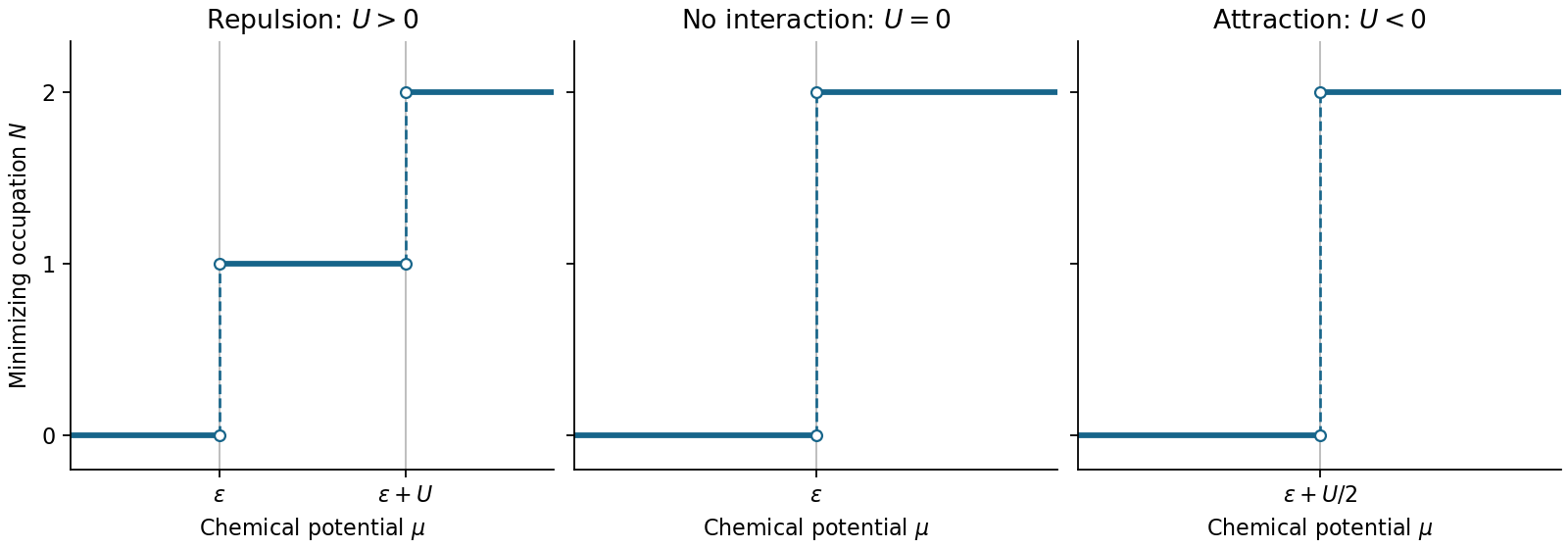
Zero-temperature occupation of a localized impurity level in a crystal with repulsive, zero and attractive interaction
. Original plots of the minimizing occupation away from degeneracy points. Dashed vertical lines mark the chemical potentials at which different occupations have equal grand energy. Their vertical segments indicate jumps, not intermediate stable states. Details.
Magnetic field and force. A steady electric current produces a magnetic field. In vacuum the Biot-Savart law givesThe Lorentz force on the charge carriers transfers force to the material carrying them. The resulting force on a current element of another circuit is , or, for a continuous current distribution, the magnetic force per unit volume is .
For two long parallel straight wires a distance apart, Ampère's law gives . ThereforeThe force is attractive for parallel currents and repulsive for opposite currents, by the cross product rule. Its units are . This approximation neglects wire thickness and end effects; a complete circuit includes its return current. Element-by-element forces need not form an isolated Newton's-third-law pair, but complete stationary circuits have balanced mutual forces when the entire system is included.
Energy description. For two linear coupled circuits the magnetic energy isHere is a mechanical coordinate and the signed mutual inductance. At prescribed currents, the generalized force is if the self-inductances do not vary. This positive derivative is obtained from magnetic coenergy, or by including the electrical sources' work; differentiating with a minus sign at fixed currents would omit that source work. At prescribed flux linkages the force instead equals the negative derivative of stored magnetic energy with those linkages fixed. The geometry thus determines both inductance and mechanical force.
Integral conservation. Electric charge cannot be created by ordinary transport. For a fixed volume , outward current reduces the enclosed charge:Here has units and has units . Applying the divergence theorem to an arbitrary volume gives the local continuity equationIt is local charge conservation: a net outflow must be accompanied by depletion. In a steady state, . Integrating over a small circuit junction then gives Kirchhoff's current law. During a transient the junction can accumulate charge and the incoming and outgoing conduction currents need not yet match.
Consistency with Maxwell's equations. In vacuum, take the divergence of the Ampère-Maxwell equation:Gauss's law, , reproduces the continuity equation. The displacement current term makes these equations consistent for time-dependent charge distributions, such as a charging capacitor. It is not a stream of free charges across the insulating gap. In matter, and give the analogous conservation law for free charge; total charge also includes bound charge.
An electrical transformer transfers alternating electrical power between windings through a shared changing magnetic flux. A core with large magnetic permeability confines most of the flux, so both windings link approximately the same flux . Faraday's law gives induced electromotive forcesFor an ideal electrical transformer, negligible winding resistance and leakage flux imply the terminal-voltage magnitude ratioThe relative phase depends on the winding sense and terminal convention. At a loaded secondary, Lenz's law makes the secondary current oppose the flux change. The primary draws an additional current which approximately cancels the secondary magnetomotive force: in magnitude when the magnetizing current is negligible. Consequentlyfor a resistive load, using root mean square values. More generally the ideal device conserves instantaneous power, with the appropriate current signs. A load impedance appears at the primary as , enabling impedance matching and electrical isolation.
For sinusoidal flux, gives . At a given supply voltage, reducing frequency increases the required peak flux and can drive the core into magnetic saturation. Real losses include winding Joule heating, magnetic hysteresis, eddy currents and leakage flux; a laminated core suppresses eddy-current loops. A steady direct current produces no continuing secondary electromotive force, while its small winding resistance can allow a damaging primary current after switching transients.
The absence of magnetic monopoles is expressed by . In a regular simply connected region, a magnetic vector potential may be introduced so thatIts units are . It is not unique: adding a gradient leaves the magnetic field unchanged because . In time-dependent electromagnetism,is a gauge transformation preserving both physical fields. Stokes theorem gives for a contour bounding an appropriate surface.
For localized steady currents, choose the Coulomb gauge . Substitution into Ampère's law and the curl-of-curl identity givesBoundary conditions are needed in addition to the gauge choice. For a uniform magnetic field one convenient choice is . For a magnetic dipole, outside its source. The magnetic vector potential simplifies field calculations and appears directly in the Lagrangian of a charged particle, . In multiply connected regions, a field-free region can retain nontrivial circulation of , relevant to the Aharonov-Bohm effect; a local gauge argument cannot remove every global circulation.
From molecular dipoles to macroscopic fields. A dielectric contains charges which remain bound to its atoms or molecules. An applied electric field displaces positive and negative charge centres and can orient permanent electric dipoles. The electric polarization is electric dipole moment per unit volume, in . Its associated bound charge isat the boundary of the polarized material, where points outward. A uniform electric polarization has no volume bound charge, but generally has surface bound charge. The electric field remains the force per unit test charge; it includes the fields of both free and bound charges.
Introducing the electric displacement field packages the free-charge source separately:For a homogeneous linear isotropic dielectric,The electric susceptibility is dimensionless; the permittivity has units . This is a constitutive approximation. An anisotropic dielectric requires a permittivity tensor, while a nonlinear dielectric need not have electric polarization proportional to electric field. The field in these equations is the macroscopic field, not necessarily the local field at an individual molecule.
Interfaces. Let point from medium 1 into medium 2. Integrating Gauss's law over a thin pillbox, and the electrostatic curl equation around a thin loop, gives the electrostatic interface boundary conditionsThus normal electric displacement is continuous when there is no free surface charge, whereas tangential electric field is continuous even if the permittivity changes. Normal electric field generally jumps because the interface carries bound charge. The electric potential is continuous for an ordinary interface without an ideal dipole sheet. These conditions, together with Laplace's equation in each homogeneous charge-free region, determine the field.
Energy and electrical sources. Reversibly assembling free charge requires incremental work . For a linear dielectric whose response can be reversibly integrated from zero field, the electrostatic energy isThis includes the material polarization response, rather than simply using everywhere. In a capacitor, . Inserting a dielectric increases capacitance. At fixed charge the stored energy decreases. At fixed voltage the stored field energy increases, but the voltage source supplies ; the appropriate mechanical energy including that source changes by . Both cases predict attraction of dielectric into the capacitor. A force calculation must state which electrical quantity is fixed. A lossy or hysteretic dielectric also dissipates energy, so the reversible quadratic expression does not describe its full history.
Shape and depolarization. Suppose the dielectric is surrounded by vacuum and the distant imposed electric field is . Bound surface charge produces a depolarization field. For a uniformly polarized ellipsoid, along a principal axis,Here is the depolarization factor of a dielectric ellipsoid. This self-consistent field explains why the same material responds differently in different shapes.
An infinite slab with electric field normal to its faces has , giving ; its opposite surface bound charges reduce the internal field. For electric field parallel to the faces, , giving . End effects are neglected.
A very long circular rod in an axial electric field has negligible depolarization away from its ends, so . In a transverse electric field the infinite-cylinder solution has , giving . To see the latter directly, take the applied field along . The interior and exterior electric potentials can be written and . Continuity of potential and normal electric displacement at gives .
For a sphere of radius , andFor example, write and . Continuity of potential gives , and continuity of normal electric displacement gives . Solving yields and . The potential is that of the electric dipole moment above. For all these induced effects vanish; as becomes very large the normal-field sphere and slab approach the corresponding conductor field exclusion. The ideal infinitely long rod in an exactly axial imposed field has a different, singular end-free limit.
A Hohmann transfer orbit connects two coplanar circular orbits using two tangential, effectively instantaneous velocity changes. Take outward transfer radii , and write for the central body's gravitational parameter. The intervening ellipse has periapsis , apoapsis , semimajor axis and orbital eccentricity .
The circular speed is . Conservation of orbital energy gives the vis-viva equation . Therefore the transfer speeds at the two impulses areThe first prograde impulse raises the far side of the orbit; the second prograde impulse raises the near side to circularize at . Their magnitudes areThe transfer takes half an ellipse period. Kepler's third law givesFor inward transfer the same ellipse is traversed from apoapsis to periapsis and both burns are retrograde. A rendezvous also needs the correct initial phase of the target: for outward transfer its initial angular lead is modulo . The method assumes a two-body gravitational field, negligible atmospheric drag and burns short compared with an orbit. It is an economical two-impulse transfer between these circles; it is not universally the least- transfer if additional impulses and very large intermediate radii are permitted.
Let a coordinate frame rotate with angular velocity relative to an inertial frame. For any vector ,Applying this twice to position, with coincident nonaccelerating origins, givesNewton's second law written using rotating coordinates therefore contains the Coriolis forceThe other inertial corrections are the centrifugal force and, for changing rotation rate, the Euler force. An accelerating origin introduces an additional translational fictitious force.
The Coriolis force depends on velocity and is perpendicular to it, so : the Coriolis force does no work in the rotating frame. It bends trajectories without directly changing their rotating-frame speed. It is absent for motion parallel to the rotation axis.
For locally horizontal motion on Earth at latitude , take east, north and up. Keeping the vertical component givesHorizontal motion is deflected right in the northern hemisphere and left in the southern hemisphere. In the ideal absence of other horizontal forces these equations give inertial circles with angular frequency . The same velocity-dependent correction explains the precession of a Foucault pendulum, whose precession-rate magnitude is . Terrestrial vertical motions also involve Earth's horizontal rotation component, so the reduced horizontal equations are not the full force law.
In Lagrangian mechanics, generalized coordinates describe the independent configurations allowed by the constraints. For particles with ordinary conservative forces in an inertial frame, use , with kinetic energy and potential energy . Holonomic constraints can often be built into the coordinates, avoiding explicit constraint forces.
The principle of stationary action makes the action stationary for variations vanishing at the endpoints. Integrating the velocity variation by parts givesSince each independent variation is arbitrary, the Euler-Lagrange equations areIf nonconservative generalized forces are present, their components appear on the right. The formalism is invariant under suitable coordinate changes and adding a total time derivative to leaves the fixed-endpoint equations unchanged.
The generalized momentum is . If is cyclic, and is conserved. If has no explicit time dependence, the conserved energy function isFor a kinetic energy quadratic in velocities and a velocity-independent potential energy, this equals . This connects symmetry to conservation laws.
For example, a simple pendulum of mass and length hasIts tension does not appear because the fixed-length constraint is already imposed. Expanding for small gives simple harmonic motion with . More generally, expansion of and to quadratic order about a stable equilibrium leads directly to the normal-mode eigenvalue problem.
For a slender elastic beam undergoing small bending, assume plane cross-sections remain plane and normal to the neutral axis. Fibres a signed distance from that axis have longitudinal strain , where is the local radius of curvature. Hooke's law gives stress , where is Young's modulus. Zero resultant axial force places the neutral axis through the section's centroid for a homogeneous beam.
The bending moment is the moment of this stress distribution. Its magnitude isThe second moment of area has units , and the bending stiffness has units . A rectangular section of width and depth has , so placing more material far from the neutral axis strongly resists bending. This is the purpose of an I-section.
For small deflection , the signed curvature is approximately . A consistent variational sign convention follows from the elastic energy and a transverse load :For constant bending stiffness this is the Euler-Bernoulli beam equation . A clamped end fixes ; a simply supported end has and zero bending moment; an unloaded free end has zero moment and shear, for uniform . Endpoint loads replace the corresponding zero-force boundary conditions.
For a cantilever of length carrying a tip force , choose positive deflection along . The internal bending gives , with . Two integrations giveThis approximation requires small slopes, elastic strains and a length large compared with section dimensions. Shear deformation, rotary inertia, plastic yielding and large rotations require extensions. Adding inertia gives flexural waves with for a uniform beam, where is mass per unit length.
Definition and equations. A normal mode is a motion in which every component of a linear system has the same time dependence with fixed amplitude ratios and phases. For a conservative system near equilibrium, the most useful form isThe vector describes the mode shape, while is its angular frequency. Linear combinations of modes describe arbitrary sufficiently small motions when the modes form a complete basis.
Let be displacements of independent generalized coordinates from equilibrium. Expand the Lagrangian to quadratic order:The mass matrix defines a positive-definite quadratic form on the independent coordinates, while the stiffness matrix is the Hessian of the potential energy. Substituting a mode gives the generalized eigenvalue problem for small oscillationsA practical calculation identifies the equilibrium, chooses independent coordinates, computes the quadratic kinetic and potential energies, solves for the eigenvalues and then obtains their eigenvectors. One can equivalently diagonalize the real symmetric matrix . This guarantees real and a complete orthogonal basis in mass-weighted coordinates.
For distinct eigenvalues, the fact that and are real symmetric matrices impliesThus distinct modes are orthogonal in the inner product weighted by the mass matrix. Choosing decouples the motion into , with total energy . A positive-definite matrix gives positive eigenvalues and oscillatory stability. Zero modes can describe rigid translations or rotations without restoring force; a negative eigenvalue gives exponential instability rather than an oscillatory mode.
Symmetry. A symmetry preserving both quadratic energies maps modes into modes of the same frequency. Coordinates adapted to symmetry divide the eigenvalue problem into smaller independent blocks. For two identical subsystems, exchanging them gives symmetric and antisymmetric modes. The degeneracy of normal modes means that independent modes share one frequency. Higher-dimensional group representations of a symmetry can enforce such degeneracies; symmetry does not require every pair of modes to be degenerate, and accidental degeneracies can also occur. Within a degenerate eigenspace, orthogonal linear combinations are equally valid mode shapes.
For two equal masses , each attached to a fixed support by a spring of stiffness and coupled to the other by a spring of stiffness ,The symmetric mode leaves the coupling spring unstretched and has . The antisymmetric mode stretches it and has . Superposing the two gives beats when their frequencies are close.
Continuous systems. The same idea replaces matrices by differential operators and mode vectors by functions satisfying boundary conditions. For a taut string of length , tension and mass per unit length , the wave equation and fixed endpoints giveOrthogonality of the sine functions allows an arbitrary initial displacement to be decomposed into modes. Changing the endpoints changes the spectrum: boundary conditions are part of the physical mode problem.
A uniform chain of equal masses joined by springs , with spacing , has travelling normal modes withTheir quantization gives phonons; the long-wavelength limit is a sound wave. Rectangular electromagnetic cavity modes satisfy Maxwell's equations and conductor boundary conditions, with in vacuum. An elastic beam instead has a fourth-order spatial equation and flexural dispersion . These examples show how restoring forces and geometry determine the frequency spectrum.
Real systems. Small-amplitude motion is often approximately linear even when the full equations are nonlinear. Large amplitudes produce frequency shifts, mode coupling and transfer of energy between modes. Friction broadens resonances and makes free oscillations decay. A damping matrix proportional to or can retain the undamped mode shapes; general damping need not, and the appropriate eigenfrequencies and modes can be complex. External periodic forcing predominantly excites modes near resonance, with amplitude set by coupling to the forcing and dissipation. Imperfections split ideal degeneracies, while radiation or coupling to a surrounding fluid can remove energy from the chosen subsystem. Normal modes remain useful when linearization, the boundary conditions and the treatment of damping accurately describe the motion being measured.
Treat the film at fixed material content, with area the coordinate conjugate to the surface tension in the stated work term. The Helmholtz free energy is a Legendre transform of the internal energy:Its natural independent variables are therefore , soEquality of mixed second partial derivatives gives the Maxwell relation for the thermodynamics of a liquid film:The area convention matters: the supplied fundamental relation already specifies the coefficient of . There is no additional factor of two unless one changes from total interfacial area to a projected film area and changes the work term consistently.
Write . The Maxwell relation givesThus isothermal stretching increases the entropy. For an infinitesimal increase, ; if the derivative is independent of area, this integrates to at fixed temperature. Mechanical energy used to create extra surface is not, in general, identical to the increase of internal energy at fixed temperature, because the stretching can also absorb heat.
The definition of heat capacity at constant area and the Maxwell relation give the entropy differentialFor a reversible adiabatic process, . Hencefor positive heat capacity . Reversible adiabatic stretching cools the film. Reversibility, or negligible entropy production, is essential to this inference. Adiabatic isolation alone only sets the heat transfer to zero; an irreversible stretch can generate entropy, so its temperature change is not fixed by this isentropic derivative.
Substitute the entropy differential into the fundamental relation:ThereforeThe coefficient of is the change of internal energy per added area at fixed temperature, whereas is the change of Helmholtz free energy per added area. Their difference is the heat absorbed per added area in a reversible isothermal stretch. Both and have units .
Reading the original PDF graph gives approximatelyFor example, the points near and are about and , respectively, giving this slope. The graph supports approximate values rather than exact fitted constants. The area increment is .
At fixed temperature, the surface tension is constant during this stretch. The work done on the film is positive:For a reversible isothermal process, the heat supplied is . ThusThe film absorbs heat while its temperature stays constant. The first law gives the useful consistency check , agreeing with .
Over the plotted range, approximate the surface tension by with constant positive , and take . A reversible adiabat hasIntegrating givesThe arbitrary fixed reference temperature makes the logarithm dimensionless; changing it only shifts the integration constant. This is the dimensionally precise version of writing as constant. Each term has units of entropy. Between two states,If the graph had substantial curvature, the entropy differential would still hold, but this particular constant- exponential would no longer follow.
For the specified increment,Using the adiabat, or its first-order Taylor expansion,This is a very small cooling, about . There is no heat exchange, and the film is stretched against positive surface tension, so the internal energy increases, withThe cooling does not contradict this increase. In the linear model, , soCreation of surface raises the internal energy more than the cooling lowers its temperature-dependent part. The change in surface tension during this tiny temperature fall changes the work only at a negligible higher order.
Equilibrium radiation and cavity frequencies. A blackbody absorbs all incident radiation at every frequency and direction. In thermal equilibrium its emission spectrum depends only on its temperature. Radiation inside an isothermal absorbing cavity, sampled through a small aperture that hardly disturbs equilibrium, realizes black-body radiation to a good approximation. Microscopic absorption and emission establish the equilibrium distribution; a perfectly reflecting wall is the convenient idealization used to count the modes once that distribution is specified.
In a rectangular electromagnetic cavity, the wave equation and perfect conductor wall boundary conditions select component wavenumbers , , . Combining the vacuum dispersion relation and givesFor example, electric-field components can have the spatial dependenceFor three positive indices, Gauss's law requires , leaving two independent polarizations of an electromagnetic wave.
Index qualification. The original paper describes the indices as positive integers. That describes the three-nonzero-index family but omits valid electromagnetic modes with exactly one zero index, which have one polarization of an electromagnetic wave. For instance, with , , only above remains; it is normal to the top and bottom faces and vanishes at the side walls. Two zero indices give no nontrivial cavity field. The omitted one-zero-index family does not affect the leading three-dimensional mode count, but is essential to the thin-cavity limit below. Retaining the paper's strict positivity restriction for every mode would instead give a thickness gap and would not yield its requested two-dimensional power law.
Three-dimensional mode count. A lattice cell in positive space has volume , where . In a continuum approximation, a shell of radius and thickness contains its positive octant, multiplied by two polarizations:Using givesFor a finite cavity the exact density of states is discrete; this formula is its bulk continuum limit, appropriate when many modes contribute and wall corrections are small.
Mean photon number. A mode is a quantum harmonic oscillator with thermal excitation energies , . The zero-point energy does not enter its thermal occupation. Put . Its partition function and mean occupation areThis is the Bose-Einstein distribution with zero photon chemical potential: equilibrium absorption and emission do not conserve photon number.
Thermal energy. Multiply the density of states by the mean excitation energy and integrate:The substitution isolates all the dependence on cavity dimensions and temperature:Expanding gives an integral . HenceThis is the thermal energy only, excluding the zero-point contribution. The three-dimensional continuum regime requires large compared with the geometric level spacings in all three directions.
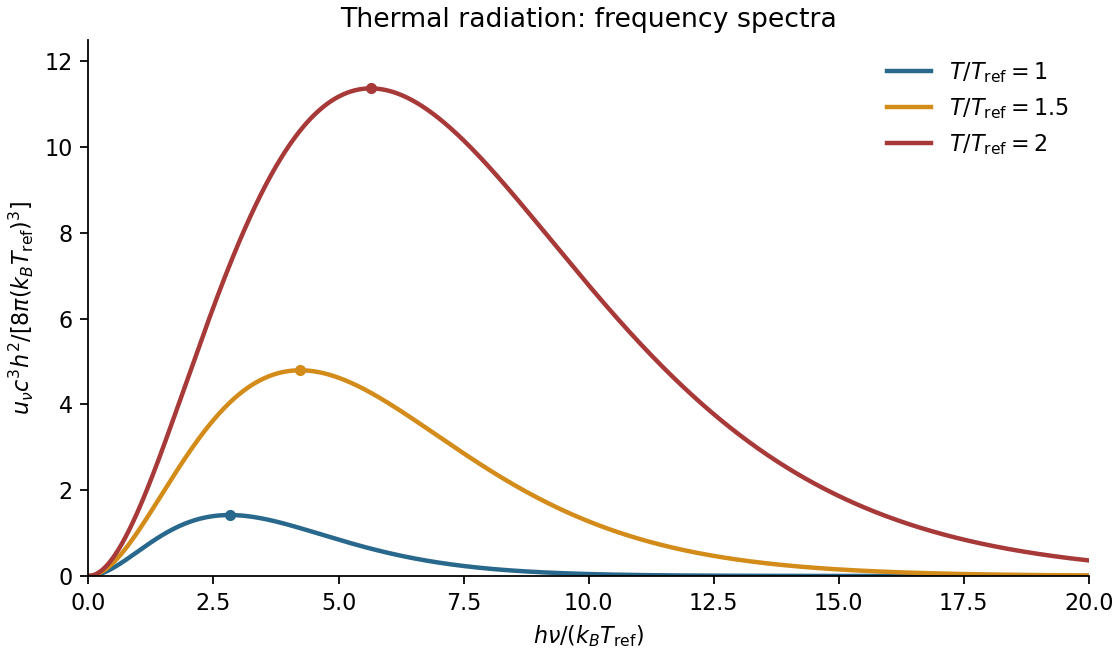
Spectral sketch. The spectral energy density per unit ordinary frequency is Planck's law,At small frequency it rises as , while at large frequency it decays exponentially. Raising temperature increases the spectrum at every fixed positive frequency, moves the peak to larger frequency in proportion to , and increases the integrated area in proportion to . A plot per unit wavelength has a different peak position because the integration variable changes.

Thin-cavity radiation. Let . The relevant low-temperature window isNonzero thickness indices are then thermally suppressed, while many in-plane modes are populated. The family has one polarization of an electromagnetic wave. Its allowed in-plane wavenumbers form a lattice of cell area ; a quarter of a circular shell therefore containsThus the dimensional crossover of thermal cavity radiation givesThe integral is by the same geometric-series argument. A model with a different number of independent polarizations of an electromagnetic wave changes the prefactor but not the scaling. For a cavity with fixed finite , cooling still further eventually freezes its lowest in-plane mode as well: the strict thermal energy is exponentially suppressed. The requested area law is the intermediate quasi-two-dimensional regime, not an arbitrarily low-temperature continuum limit.
Origin of diffusion. In a material near local thermal equilibrium, microscopic carriers transfer energy from hotter regions to colder regions. On distances long compared with their mean free path and times long compared with relaxation times, the local constitutive law is Fourier's law,Combining this temperature-gradient-driven flux with local conservation of energy produces a diffusion equation. This description assumes diffusive thermal conduction; it is not generally valid for ballistic transport, and flow would add advective transport.
Energy balance with heating. Choose any fixed volume , let be its uniform volumetric heat capacity and its heat generation rate per unit volume. The rate of increase of internal energy equals heat generation minus outward heat flux:Since is arbitrary, for constant thermal conductivityThe ratio is the thermal diffusivity in . Here is in , in and in , so both right-hand terms have units . If thermal conductivity varies with position or temperature, the divergence must be retained rather than replacing it by .
Distinguish electrical current density from heat flux . Uniform current across the circular section givesby Ohm's law. The local Joule heating rate is electrical work per unit volume and time:For a segment of length , integration gives , confirming the usual resistor power. The model takes electrical conductivity constant and ignores temperature-induced current redistribution.
In a long wire away from its ends, the steady temperature is independent of axial position and azimuth. The heat equation reduces toMultiplying by and integrating givesA finite temperature and nonsingular flux at the axis require . Applying determines . ThereforeThis is the steady temperature of a uniformly heated cylindrical wire. Its hottest point is at the centre, with . The outward heat flux is , so the power crossing a cylindrical surface per unit length, , equals the heating generated inside it.
Replacing the fixed surface temperature by Newton's law of cooling changes the boundary condition but not the radial derivative in steady state. At the surface,HenceHere is a surface heat transfer coefficient in , unrelated to the surface tension symbol used in C10. An independent energy-balance check uses a length : the electrical input must equal the surface loss , which gives the same answer.
The complete temperature profile isThermal conductivity controls the internal gradient, but cancels from the surface-temperature rise because all generated power must eventually cross the prescribed surface. This assumes positive constant , uniform electrical conductivity and negligible end or additional radiative losses; temperature-dependent material properties could make the heating and boundary problem nonlinear.
Entropy at absolute zero. The Third law of thermodynamics concerns the low-temperature limit of equilibrium states. In the zero-entropy formulation, the entropy of a perfect crystal with a nondegenerate ground state tends to zero as . The statistical interpretation is : a unique accessible ground state has . The entropy-difference formulation of the Third law of thermodynamics states that entropy differences associated with regular changes of mechanical parameters tend to zero as absolute zero is approached. These statements require equilibrium and appropriate ground-state assumptions; a frozen disordered material or a degenerate ground state can carry residual entropy.
For a phase of fixed composition and pressure,A finite limiting entropy constrains this integral. Ordinary equilibrium heat capacities therefore vanish as temperature approaches zero, with familiar examples for three-dimensional acoustic phonons and for a normal degenerate Fermi liquid. A constant positive heat capacity extrapolated to zero would give a logarithmically divergent entropy difference and is impossible in this regime. Discontinuous transitions and anomalous limits need separate treatment rather than extending a high-temperature approximation indefinitely.
Gibbs free energy. For fixed particle numbers,Thus, when , the Gibbs free energy approaches its zero-temperature value with a horizontal tangent:The equality uses the enthalpy ; neither limiting value needs to be zero. The low-temperature Gibbs free-energy expansion makes the approach quantitative. For with and ,The second derivative is , although it need not tend to zero. For a reaction between such equilibrium phases, , and and approach one another. If a genuine residual entropy is retained instead, has limiting slope . A horizontal tangent cannot be asserted without the zero-entropy condition.
Why helium remains a liquid. Helium atoms attract each other weakly and are exceptionally light. Their zero-point energy is large compared with the binding that would localize them in a solid. Both helium-4 and helium-3 can therefore remain liquid down to the lowest temperatures at low pressure; substantial applied pressure is needed to solidify them. This is not a violation of the third law. A quantum liquid can have a unique low-entropy ground state, and zero-point motion does not itself imply thermal entropy. The third law does not require every substance to crystallize at atmospheric pressure.
A helium-4 atom has integer spin zero and is a boson. Below the lambda point near at saturated vapor pressure, its liquid is superfluid. Its strong interactions mean that it is not quantitatively an ideal Bose gas, and the condensate fraction need not equal the superfluid fraction. The two-fluid model of superfluidity separates an entropy-carrying normal component of a superfluid from the superfluid component, whose entropy is zero. At sufficiently low temperature the dominant thermal excitations are acoustic phonons: their linear dispersion in three dimensions gives , and . Higher-energy rotons are exponentially suppressed. Thus the normal component of a superfluid and entropy disappear as , while superfluid flow and quantum motion can persist.
A helium-3 atom has spin and is a fermion. Well below its Fermi temperature, but above its superfluid transition, liquid helium-3 is a degenerate interacting Fermi liquid. Only quasiparticles close to the Fermi surface are thermally excited, giving and . At temperatures of order a millikelvin, helium-3 also becomes superfluid through formation of Cooper pairs of fermions. This is not Bose-Einstein condensation of individual helium-3 atoms. Pairing reorganizes the low-energy excitation spectrum; in the fully gapped bulk B phase, the fermionic quasiparticle contribution to heat capacity is exponentially suppressed at temperatures well below the pairing gap. Gapless collective modes can still give thermal terms following a power law. The entropy nevertheless tends to zero. The normal Fermi-liquid law cannot be extrapolated through its pairing transition unchanged.[ref]
The Extraordinary Phases of Liquid 3He by David Morris Lee. 1996 Nobel lecture, discussion of helium isotopes and paired superfluid phases
Helium-3 also illustrates the importance of nuclear spin entropy. Over an intermediate low-temperature range, localized spins in the solid can retain approximately of entropy per atom, while the degenerate liquid has much less. Reversible conversion of liquid to the higher-entropy solid then absorbs heat; adiabatic compression along the melting curve can cool the sample. This is Pomeranchuk cooling. At still lower temperature, interactions between the nuclear spins remove this nearly free-spin entropy, so a constant cannot be extrapolated to absolute zero.[ref]
The Pomeranchuk Effect by Robert Coleman Richardson. 1996 Nobel lecture, entropy comparison and compression cooling
Liquefaction and cooling methods. A gas must be below its liquid-gas critical point to form a distinct liquid phase by compression. Compression above the critical temperature alone cannot achieve ordinary liquid-vapour coexistence. Practical liquefaction removes the compression heat, cools the compressed gas in a heat exchanger and uses expansion to lower its temperature further.
A throttling valve operates approximately at constant specific enthalpy when kinetic-energy changes and heat leakage are negligible. The Joule-Thomson coefficient isusing consistent molar quantities, or consistent total quantities for a fixed amount. A pressure drop cools the gas if . An ideal gas has zero Joule-Thomson coefficient; real intermolecular interactions are essential. In particular, room-temperature helium warms on throttling, so it must first be brought into a region of positive Joule-Thomson coefficient. Expansion through an engine or turbine can instead remove work and produce approximately isentropic cooling.
A regenerative liquefier sends the cold returning gas through a counterflow heat exchanger to precool the incoming compressed gas before its next expansion. Expansion engines and external precooling can supply the initial cooling; repeated operation then produces liquid. Modern helium liquefaction commonly combines work-producing expansion with a final throttle. [ref]
https://trc.nist.gov/cryogenics/Papers/Review/2020-Review_of_Refrigeration_Methods.pdf. Review of Refrigeration Methods, helium liquefiers and Claude cycles
Once liquid exists, pumping away vapour lowers its saturation pressure and boiling temperature. The escaping vapour carries latent heat away, cooling the remaining liquid. At still lower temperatures, a dilution refrigerator exploits the different entropy carried by helium-3 in concentrated and dilute helium mixtures; adiabatic demagnetization and Pomeranchuk cooling provide other routes.
Approaching zero. The unattainability formulation of the third law states that regular cooling operations with finite resources cannot reach absolute zero in finitely many stages. As the entropy available to remove becomes small and thermal couplings weaken, each method loses its ability to take the final step. An isentropic cooling trajectory starting at nonzero entropy cannot reach a common zero-entropy endpoint through regular finite changes of parameters. A fully general finite-time claim also requires assumptions about available controls and heat-transfer rates. Quantum liquids and refrigeration methods can approach while remaining consistent with vanishing equilibrium entropy; they do not provide a finite-operation route to absolute zero.
Articles by others on the same topic
There are currently no matching articles.