The relation describes the slope of the phase coexistence curve of a pure substance in the pressure-temperature plane:Here is the common equilibrium pressure of the two phases, is their common absolute temperature in kelvins, and the derivative is taken along their coexistence curve. Choose a direction of transformation from phase 1 to phase 2. Then is the reversible latent heat for that transformation and is the corresponding volume change, using the same amount of substance for both quantities.
In the molar convention used below, has units and has units , so the right-hand side has units . For vaporization, both and are positive. The displayed general relation is also called the Clapeyron equation; the ideal-vapor approximation used in (c) gives its usual Clausius form.
At coexistence, the two phases of a pure substance have equal chemical potential, or equivalently equal molar Gibbs free energy:For either phase, . Move an infinitesimal distance along the coexistence curve, where the equality must remain true. Subtracting the two differentials givesA reversible transformation at this common temperature absorbs latent heat . ThusThe derivation assumes thermodynamic equilibrium between two bulk phases of a single pure substance, with the same temperature and pressure, and only ordinary pressure-volume work. Surface-curvature shifts, additional external-field work and composition changes are omitted. It applies to a first-order phase boundary where the latent heat and volume discontinuity are defined. No ideal-gas assumption and no constant- assumption are needed for this differential relation. At the critical endpoint both discontinuities vanish, so their ratio requires a limiting treatment rather than direct substitution of two zeros.
For liquid-vapor equilibrium, use molar quantities. At low vapor pressure the gas is dilute, approximately ideal, and has a much larger molar volume than the liquid. HenceSubstitution into the Clapeyron equation givesIf the molar latent heat varies sufficiently slowly to be treated as constant over the temperature interval, integration givesThe positive constant has pressure units and is an integration constant. It is not necessarily a real infinite-temperature pressure, since the approximations fail before that limit.
For mercury between and , the original plot places this range above the triple point and below the normal boiling and critical temperatures. Its vapor pressure is low relative to the critical pressure, making a dilute-gas description reasonable; the vapor's molar volume greatly exceeds that of the dense liquid. The interval is also far from the critical region where tends to zero, so a roughly constant latent heat is a useful first approximation. The approximations are not exact: Kirchhoff's law of thermochemistry gives, at fixed pressure, the temperature derivative of a transformation enthalpy as the difference between the two molar heat capacities, so a precise fit over a wide interval would allow to vary.
Taking a derivative of the logarithmic form gives a direct way to use the plot's base-ten vertical axis:Alternatively, use two nearby readings and eliminate the unknown :Reading the original PDF graph approximately gives at and at . These bracket the requested temperature and give an average latent heat near :Thus a suitable graph-based estimate isThe graph does not warrant several significant figures; a local tangent or different reasonable nearby readings give a comparable estimate. The factor is essential when using a base-ten logarithmic axis.
The phase diagram must contain three coexistence curves meeting at the triple point: a solid-gas sublimation curve, a solid-liquid melting curve and a liquid-gas vaporization curve. The vaporization curve ends at a liquid-gas critical point; beyond it liquid and gas are continuously connected as a supercritical fluid.
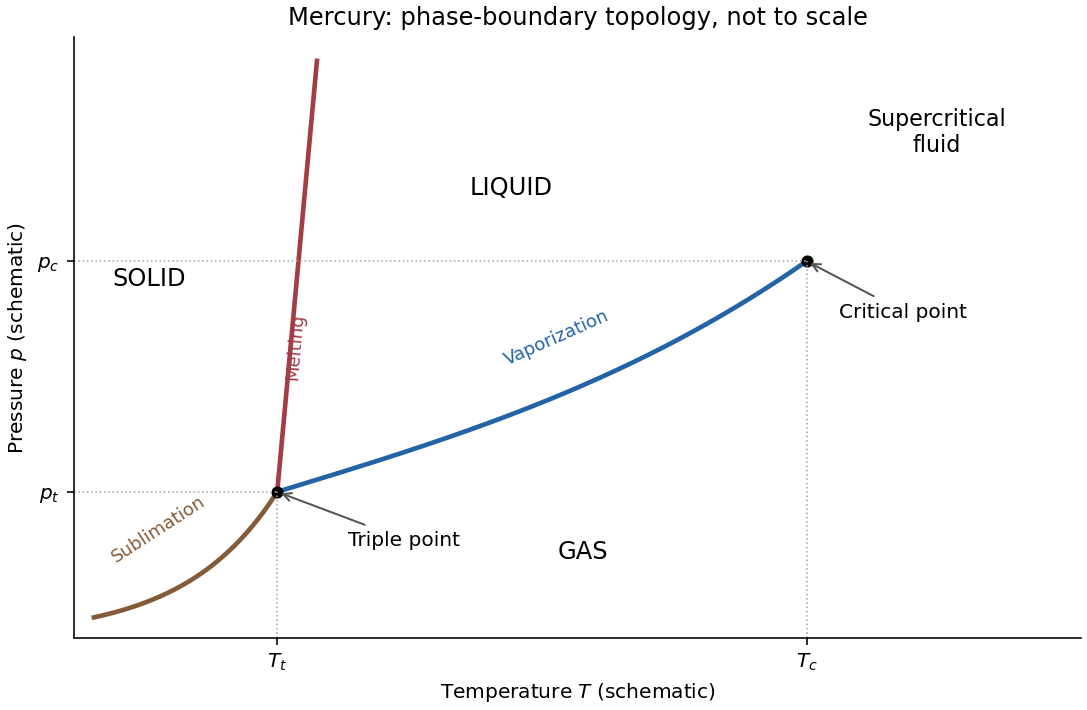

The imposed contraction on freezing means . Melting therefore has and . The Clapeyron equation then requiresThus raising the pressure raises the melting temperature. The liquid-gas and solid-gas slopes are also positive because the transformations into gas increase both entropy and volume. The liquid region lies between the positively sloping melting line and the vaporization curve, while gas occupies the low-pressure side. The figure is a qualitative solution sketch, not a reproduction or fit of the paper's vapor-pressure measurements; its axes are schematic.
The expression is the canonical partition function for a system in thermal equilibrium with a large heat bath at fixed temperature . The system exchanges energy with the bath, while its particle number and external mechanical parameters, such as volume, are fixed. The bath is large enough that its temperature is not appreciably changed by this exchange.
The system has allowed energy levels . The index labels distinct energy values, and the integer degeneracy factor counts distinct quantum states with that same energy. is the Boltzmann constant, and is a state's Boltzmann factor. The dimensionless sum normalizes the probabilities:Thus the degeneracy multiplies the probability of occupying the level, not the probability assigned to each individual state within it.
The canonical model is not restricted to a classical ideal gas. It applies to a quantum rotor, for example, provided the sum counts all of that system's allowed states with their proper degeneracies. For a many-particle system, would be the energy of a many-particle state, with any quantum-statistical restrictions already built into the state count.
The internal energy is the canonical mean of the energy:Holding the external mechanical parameters fixed, so that the spectrum and degeneracies do not change when differentiating with respect to , givesComparison yieldsAn explicitly temperature-dependent effective Hamiltonian would require care: differentiating its partition sum would also differentiate the assigned energy levels. The stated result uses the fixed physical spectrum of the canonical system.
For the supplied linear rigid rotor spectrum, sum over every nonnegative integer and include all magnetic substates:It is convenient to introduce the rotational temperatureso that the first terms are . Here is the moment of inertia and is the reduced Planck constant, as confirmed in the original PDF. The stipulated degeneracies are used as given, without adding nuclear-spin weights or omitting selected values.
At low temperature, , retain the ground level and the first excited level. Their energies are and , with degeneracies and . Thereforeso in the notation of the question, is dimensionless and has units of kelvins. The first omitted level has three times the first excitation energy, explaining the exponent in the error term.
At high temperature, , many rotational levels are occupied and the sum can be replaced to leading order by an integral:Set , so that . ThenThusThe high-temperature approximation here concerns the rotational spectrum. For a real molecule it should still be used below temperatures where neglected vibrational excitation or dissociation invalidates the rigid-rotor model.
Using givesThe internal-energy identity from (b), followed by differentiation with respect to temperature at fixed moment of inertia, yieldsFor one mole of independent rotors, the rotational energy is and the rotational molar heat capacity is .
This agrees with the equipartition theorem. The given spectrum describes a linear rotor with two independent rotational degrees of freedom, each contributing to the high-temperature mean energy. Rotation about the molecular axis is not an additional degree of freedom of this ideal linear-rotor model, so the result is rather than per rotor. These are rotational contributions alone; translational and vibrational heat capacities have not been included. At low temperature the discrete excitation gap freezes rotational excitation out, so the rotational heat capacity tends to zero instead of remaining at its classical value.
Articles by others on the same topic
There are currently no matching articles.