Source: released examination bundle,
Part A 2007 11-1.pdf, pages 158–170. All questions in every printed section are covered. No mark allocations are printed.The splitting field in is the smallest subfield containing and every root of the polynomial. The sixth roots of unity are powers of , so the splitting field of is .
For , the roots are exactly the primitive ninth roots of unity, all powers of . Thus its splitting field is . The supplied irreducibility makes the displayed degree-six polynomial the minimal polynomial of , giving
Replacing by in the irreducible polynomial from part (i) gives . This substitution is an invertible automorphism of , so it preserves irreducibility. The roots are the primitive eighteenth roots, and the splitting field is . They are all powers of one such root, so its irreducible degree-six polynomial givesIn fact this is the same field as in part (i): and .
A finite soluble group is one whose derived series , reaches the trivial group. Equivalently it has a finite normal series with abelian factors. If , induction using commutator containment gives for every . Thus termination for implies termination for , proving every subgroup of a soluble group is soluble.
For , the chainhas abelian factors , and . Here consists of the identity and the three double transpositions. It is normal because conjugation permutes those double transpositions. Hence is soluble.
An example neither soluble nor simple is . Its subgroup is proper, nontrivial and normal, so is not simple. The group is nontrivial and perfect: its generating three-cycles are commutators of double transpositions, using two additional symbols, so . For example the commutator of and is a three-cycle, and conjugation and inversion give all three-cycles. Thus is not soluble, and subgroup inheritance then proves is not soluble either.
Fermat's little theorem states that for a prime and any integer ,If , the equivalent multiplicative form is .
Wilson's theorem states that an integer is prime if and only ifIn particular the congruence holds for every prime , including two.
Combine the preceding congruences: and . Therefore , and . This proves both stated divisibilities for every integer , with no assumption that is coprime to .
Modulo , the term is zero and Fermat's little theorem gives , since . Modulo , the roles reverse. Hence the sum minus one is divisible by both distinct primes. Their coprimality gives
The Lebesgue outer measure of is the infimum of over countable coverings by open intervals. A set is a null set when this infimum is zero, equivalently when it has such a cover of total length less than every prescribed positive number.
The Cantor set is obtained from by deleting the open middle third of every remaining interval at each stage. After stages it lies inside closed intervals of length . Slightly enlarging these finitely many intervals to open intervals shows its outer measure is at most for every , hence zero.
For the modified construction, let be the total length of the intervals in . The removed fraction at stage is exactly , soThe product telescopes because , givingSince , the same finite interval-cover argument gives for every . Taking the infimum provesOnly interval lengths and the definition of outer measure were used; the three numbered clauses in the source describe the construction rather than separate requests to prove additional statements.
A useful differentiation under the integral sign theorem is this: if is integrable, is differentiable in almost everywhere, and on every compact parameter interval is bounded by an integrable function of , then , under the usual pointwise continuity hypotheses. It follows by applying dominated convergence to difference quotients. The theorem can be iterated when a corresponding bound holds for the second derivative.
On a compact interval , the original integrand is bounded by , using . Its first and second parameter derivatives arewith integrable bounds and . Thus is twice differentiable. Subtracting the integrals givesThe final integral is finite: its integrand tends to one at zero and is absolutely bounded by at infinity. Consequentlywhich establishes the required parameter-independent constant without needing an explicit Fresnel integral evaluation.
The closed sets contain the empty set and the whole space, are closed under arbitrary intersections, and are closed under finite unions. These conditions are equivalent, by complements, to the open-set axioms of a topology.
A map is continuous when the inverse image of every open set is open. Equivalently, the inverse image of every closed set is closed.
The definition of convergence of a sequence in a topological space to is that every open neighborhood of contains all sufficiently late terms: there exists such that for every .
The empty set is countable, and the whole space contains , so both belong to the proposed closed family. A finite union contains if any member does; otherwise it is a finite union of countable sets and remains countable. For an arbitrary intersection, if every member contains , so does the intersection. Otherwise some member excludes and is countable, and the intersection is a subset of it, hence countable. Thus all closed-set topology axioms hold.
Let be countable. For a closed subset of the real line, if , its inverse image contains and is closed by definition. If , its inverse image lies inside and is countable, hence is again closed. Every closed inverse image is therefore closed, proving is continuous.
The set is countable, hence closed, and does not contain . Its complement is an open neighborhood of . Convergence therefore places every sufficiently late term outside , which is possible only if those terms equal . Thus the sequence is eventually constant at its limit, and the set of exceptional indices is finite. This conclusion concerns repeated indices as well as distinct values.
A subset is compact if every family of open sets covering it has a finite subfamily still covering it. Equivalently, its subspace topology has the finite-subcover property.
Let be an open cover of . By continuity the inverse images are open and cover . Compactness provides finitely many of them covering , and the corresponding then cover . Thus a continuous image of a compact space is compact.
The family contains the whole space and the empty set. A finite intersection of nontrivial members is . A nonempty union of rays is when the infimum is finite, and is the whole line when the infimum is . Empty unions and unions involving the whole space are already included. Hence is a topology. This is the upper-ray topology on the real line.
If has a smallest element , any open cover has a member containing . This member is either the whole line or a ray with , so it already contains all of . Thus a single member suffices and is compact.
If has no smallest element, the family covers : each point has another point of below it. A finite subfamily has union , which misses its smallest listed endpoint, itself a point of . No finite subcover exists. Therefore a nonempty subset is compact exactly when it has a smallest element in this topology.
The full-rank constraint qualification gives a multiplier vector such thatEquivalently the gradient of the objective lies in the span of the two constraint gradients. The point also satisfies .
The constraint intersection is nonempty, closed and bounded, hence compact, so extrema exist. The two constraint gradients are and . If the first were times the second, the plane condition would give , so and all coordinates would vanish, contradicting the ellipsoid equation. Their rank is therefore two at every feasible point, justifying the Lagrange multiplier equations.
These equations areEliminating gives and . The first equation makes ; subtracting twice the first from the second forces . Hence , and the ellipsoid gives . ThusAll candidates were found, and compactness ensures they include the extrema.
Take an admissible variation with on the boundary. Differentiating the functional at an extremum givesIntegration by parts removes the derivatives from ; the boundary term vanishes. The fundamental lemma of the calculus of variations yieldsFor the specified squared-gradient energy this is , so is harmonic. The affine function is harmonic and satisfies the boundary data.
To verify a global minimum, write with zero boundary trace. ThenThe middle term vanishes by integration by parts, since and at the boundary. Hence , andThis proves minimality directly, rather than relying only on a necessary Euler-Lagrange equation.
The Lagrangian is . Away from a collision, its equations of motion areSumming forces proves conservation of total linear momentum. The total mechanical energy is also conserved: its derivative is , because .
For the first proposed angular momentum,which need not vanish. Thus particle one's angular momentum about the fixed origin is not generally conserved. Its force is central relative to particle two, not necessarily relative to that origin.
The derivative of the pair's total angular momentum is , since is parallel to the separation vector. Therefore the combined angular momentum of particles one and two is conserved, despite the possible exchange between them individually.
For an observation point in the wire's plane, both and lie in that plane. Their cross product is normal to it, and the Biot-Savart law integrates only such normal vectors. Thus the field is perpendicular to the plane at every point off the wire.
At the centre, all four sides contribute in the same normal direction by the right-hand rule. A single side is distance from the centre, so its contribution isMultiplying by four giveswhere is the oriented normal fixed by the current.
For incompressible planar flow define the streamfunction by , . A velocity potential satisfies , when the flow is irrotational; the differential condition is . The complex potential of a two-dimensional potential flow is , with derivative .
For , its derivative is . This gives outward radial velocity , whose flux across a circle is . It is therefore the stated line source.
Superposition givesFor positive , the stagnation points areThey lie on the real axis, one upstream of the source and the other downstream of the sink. Streamlines are level sets of . The dividing streamline passes through both stagnation points and forms a Rankine oval enclosing the source and sink; outside, streamlines tend to uniform horizontal flow.
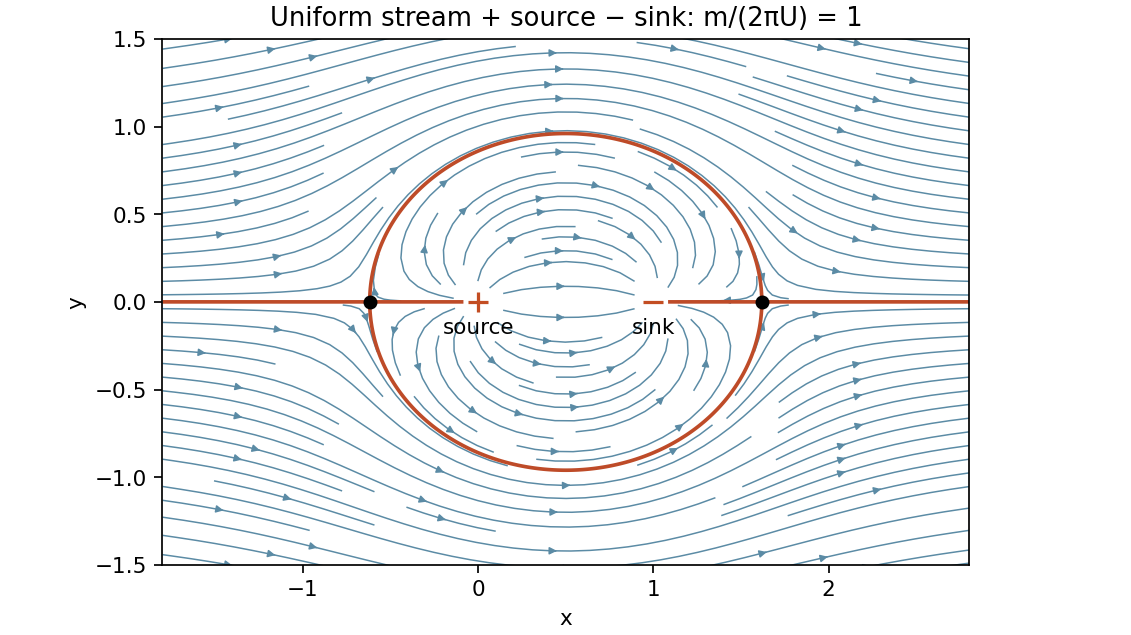
A representative source-sink pair in a uniform stream, with two stagnation points and a dividing Rankine oval
. Details. 
Writing gives and . Constant streamfunction means constant radius, so streamlines are circles. The tangential velocity is , and its anticlockwise circulation is .
Use an opposite vortex at as the image of the vortex at one:On the two distances are equal, so and the wall is a streamline. Its velocity follows from : at the wall and .
The Bernoulli equation gives . Relative to the ambient pressure force, the fluid's excess force on the wall is in the positive direction. Using the supplied integral,Thus the wall is attracted toward the fluid and vortex. Subtracting the uniform ambient pressure isolates the finite force due to the vortex.
The joint density of is for positive . Inverting the transformation gives , , with absolute Jacobian determinant and domain , . The change of variables for probability densities givesThe joint density factors into the gamma density of and the uniform density of on , so these two transformed variables are independent.
Part (b) gives , so and . Independence yields and . Apply part (a) to :This is a direct Chebyshev inequality for the sample mean.
For , the identity matrix gives the assertion. Suppose it holds at . Conditioning on the state at time and using the Markov property givesThe nonnegative countable sum is justified by the law of total probability. Induction proves the -step transition matrix is .
Let . Conditioning on the previous state gives , with . Its fixed point is ; subtracting it leaves a geometric recursion. Therefore
After the first step, a chain starting at one enters the closed class with probability , starting at two, or enters with probability and can never reach three. Within the first class, the probability of going from its first state to its second in steps is the complement of the formula in part (b). ThusAt this correctly gives zero.
The total eventual mass of the closed class is . The other closed class cannot contribute to state five. Since , the two-state chain within the last class converges to its stationary distribution, with state-five mass . Therefore
The iid central limit theorem states that if are independent and identically distributed with finite mean and variance , thenEquivalently, its cumulative distribution functions converge at every real argument to the standard normal cumulative distribution function.
The joint density of is . The polar-coordinate Jacobian is , soIntegration over the angular coordinate gives for and zero otherwise. Thus has the Rayleigh distribution, while is uniform and independent of .
Articles were limited to the first 100 out of 160 total.
Articles by others on the same topic
There are currently no matching articles.