Use the Christoffel symbol formula with its first index raised:The diagonal metric tensor has and , with inverse components and . Since and all angular derivatives vanish,For example, . The other components vanish. The formula supplied in the paper gives the first-kind coefficients ; multiplication by the inverse metric tensor is needed for the requested second-kind coefficients. These polar coordinates are understood away from .
For a scalar field, . Apply the product rule to the stress-energy tensor, using metric compatibility to pass the covariant derivative through :The middle terms cancel because the Levi-Civita connection gives a symmetric Hessian of a scalar field. Thus, with the sign conventions of this question, the scalar stress-energy divergence identity becomesThe last equality is the Klein-Gordon equation. This stress-energy conservation follows from the field equation and metric compatibility; it does not require imposing the Einstein field equations.
Take metric signature and the supplied covariant electromagnetic field tensor, so and . Raising both indices reverses the time-space components but leaves the spatial components unchanged. Its complete contraction is thereforeDefine the dual electromagnetic field tensor by , with . Direct contraction givesThese electromagnetic field invariants are complete tensor contractions. The second is a pseudoscalar: it is invariant under proper Lorentz transformations and changes sign under spatial inversion.
For the metric trace term vanishes. Since ,Consequently the Poynting vector is exactly the time-space row in the stated units:
The three classic tests probe orbital motion, the propagation of light, and clock rates in a gravitational field.
Schwarzschild perihelion precession. For an orbit with semi-major axis and orbital eccentricity , the leading advance per revolution isThe relevant observation for Mercury is the residual advance after the much larger ordinary perturbations have been included, approximately arcseconds per century.[ref]
https://ntrs.nasa.gov/api/citations/19870009701/downloads/19870009701.pdf. Physics through the 1990s: Gravitation, cosmology and cosmic-ray physics, 1986: discussion of the anomalous perihelion advance
An orbital fit must account for the other planets and reference-frame effects before interpreting that residual as a relativistic contribution.Schwarzschild light deflection. A ray with large impact parameter passing a nearly spherical mass is deflected throughAt the Sun's limb this is about arcseconds. The Eddington experiment used the 1919 solar eclipse to photograph background stars near the obscured Sun, then compared their positions with reference photographs. The measured effect is an apparent outward displacement of the background stars, not a direct photograph of a curved light path. Telescope focus, plate scale and atmospheric effects must be controlled when extracting such small shifts.[ref]
A determination of the deflection of light by the Sun's gravitational field by Frank Watson Dyson and others. 1920 paper, observational comparison and deflection analysis
Gravitational redshift. For a photon emitted lower in a weak static field and received a height above it,The Pound-Rebka experiment used the narrow recoil-free nuclear resonance supplied by the Mössbauer effect. A controlled source motion supplies a small Doppler shift that compensates the gravitational shift, allowing a change in resonant absorption to reveal it across a laboratory tower.[ref]
Apparent Weight of Photons by Robert Vivian Pound and Glen Rebka. 1960 experiment: gamma-ray source and resonant absorber at different heights
The leading weak-field redshift follows from the equivalence principle and therefore does not, by itself, distinguish every competing metric theory of gravity.Nearby freely falling particles can accelerate relative to one another even though each follows a geodesic. A local inertial frame removes the common gravitational acceleration at one event; it cannot remove the variation across an extended laboratory. That variation is a tidal force, measured covariantly by geodesic deviation.
Let be the reference four-velocity and an infinitesimal separation to a neighboring geodesic, with matching affine parameters. With the convention ,This relates measured relative acceleration to the Riemann curvature tensor. Reversing the curvature-tensor convention reverses the displayed curvature sign, without changing the physical relative motion.
In a small freely falling frame outside a spherical mass, the weak-field tidal tensor has radial and transverse components proportional to . ThusAn initially spherical cloud stretches radially and compresses in both transverse directions. Two separated test masses, with their changing separation measured by light, form the basic idea of a gravity gradiometer; the common falling motion drops out. A uniform apparent acceleration in an accelerated laboratory can occur even in flat Minkowski spacetime, so it is the separation-dependent tidal response that diagnoses curvature.
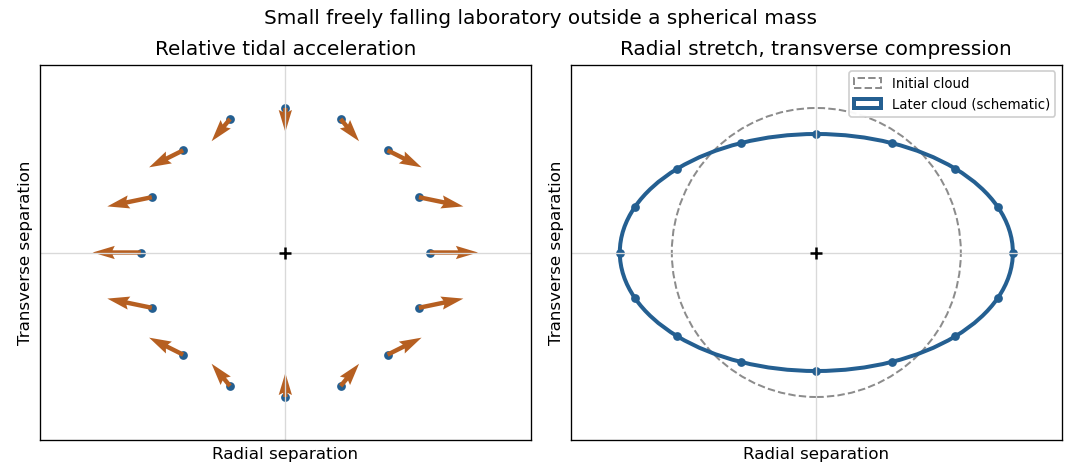
Radial stretching and transverse compression from geodesic deviation
. Original local schematic of the weak-field tidal tensor around a freely falling reference particle. Arrows show relative acceleration, with radial direction horizontal; the cloud deformation is exaggerated and is not a trajectory calculation. Details.
Write and . The Schwarzschild tortoise coordinate satisfies and can be chosen as . Define the advanced time . Substituting into the Schwarzschild metric gives the ingoing Eddington-Finkelstein coordinates formThe coefficients are regular at and the radial-block determinant is , so the exterior Schwarzschild-time divergence is a coordinate singularity at the future event horizon. The physical curvature singularity at remains.
The two families of radial null trajectories in ingoing Eddington-Finkelstein coordinates obeyOutside the event horizon, the outgoing family increases ; at the horizon it generates the horizon itself; inside, even the outgoing future-directed family decreases . An infaller crosses the future horizon at finite and finite proper time. The chart makes this causal geometry visible without mistaking Schwarzschild coordinate time for the infaller's clock.
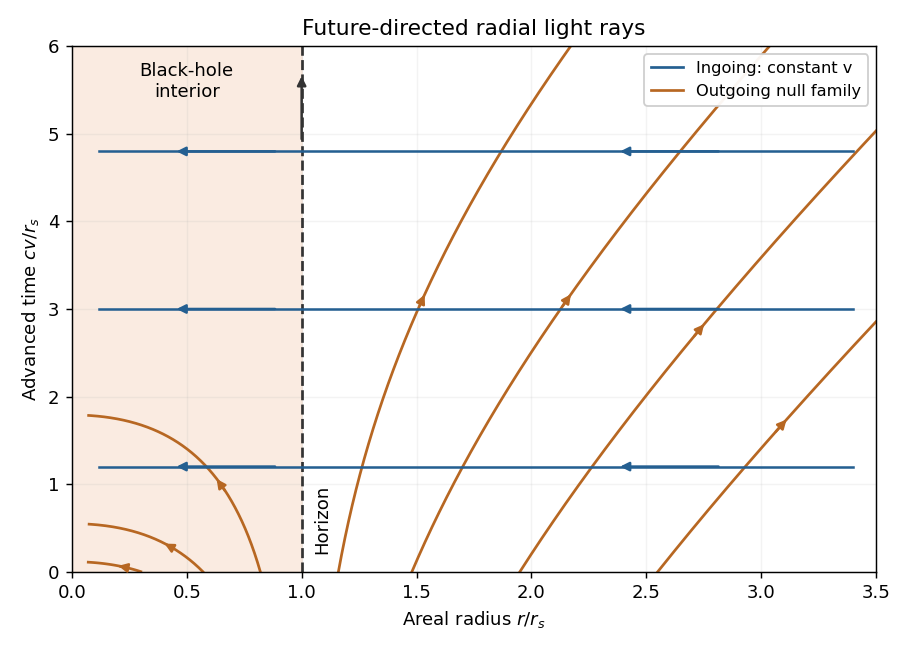
Radial null rays in advanced Eddington-Finkelstein coordinates
. Original plot of ingoing rays and outgoing rays in dimensionless units. Arrows indicate the future direction. Both families move toward smaller areal radius inside the Schwarzschild event horizon; this is an uncompactified coordinate diagram. Details.
Let denote the spacetime coordinates, with dots meaning differentiation with respect to an affine parameter; for a massive particle take proper time . The metric tensor determines the quadratic geodesic Lagrangian . The Euler-Lagrange equations areSymmetry of the metric tensor gives . Hence the covariant four-momentum is . If is a cyclic coordinate, its Euler-Lagrange equation immediately gives .
For the rotating metric, are all cyclic. ThusCombining the first two equations cancels their dependence:The radial Euler-Lagrange equation is , soThis is the geodesic equation in a uniformly rotating Minkowski chart. With inertial angle , is the inertial axial angular momentum. The outward radial-coordinate acceleration expresses the familiar centrifugal term associated with angular motion: the underlying free trajectory is a straight line in Minkowski spacetime. It does not imply an external radial force. Holding a particle at rest in the rotating reference frame instead requires a real inward force.
Let the inertial frame move at speed in the positive direction relative to , with parallel axes and coincident origins at zero time. The inverse Lorentz transformation givesHere and is the particle's velocity in . Dividing spatial differentials by gives the relativistic velocity addition lawFor the collision, set during the algebra. Let the incident projectile have energy and momentum . The target is initially at rest. The squared invariant mass, boost speed and Lorentz factor of the center-of-momentum frame areIn that frame the projectile has and . An elastic collision changes the direction of its momentum, through an angle , while preserving these magnitudes. Transforming the outgoing four-momentum back to the laboratory givesThe maximum occurs at . Sincethe maximum laboratory deflection in relativistic elastic scattering isThe printed strict inequality needs correction: equality is kinematically attainable. For example, in units take , , and incident . A projectile scattered through with final energy has momentum . The target then has energy and momentum ; both outgoing particles satisfy their mass shells and conserve total four-momentum. This gives exactly. The inequality is strict only away from the maximizing direction.
Curvature contractions. Use the index contraction stipulated in the question. In three dimensions,The same contraction in four dimensions givesThen the Ricci scalar is and the Einstein tensor is . Thus is precisely the vacuum Einstein field equations .
The static solution. For , and . The given Ricci tensor components becomeEach equals times the corresponding metric tensor component. ThereforeThis is Anti-de Sitter spacetime in static coordinates on anti-de Sitter spacetime, with curvature radius . The overall metric signature is opposite to the convention used in some descriptions of those coordinates; the geodesic constants below use the question's convention.
Conserved quantities and radial motion. In the equatorial plane, the geodesic Lagrangian is . Its cyclic coordinates giveFor rest mass , is the conserved Killing energy and is the axial angular momentum. Timelike normalization givesFor purely radial motion , differentiating away from a turning point gives , and continuity extends that equation through the turning point. An outward launch from the origin at hasThis is the radial timelike geodesic in anti-de Sitter spacetime. Its first return to the origin isindependent of the outward launch speed for every nontrivial launch . The coordinate is nonnegative, so this sine expression describes the excursion up to that return; subsequent passage through the origin requires changing the radial direction or using a signed diameter coordinate. The speed changes the amplitude, not the harmonic frequency.
Circular periods. The effective radial potential is . For a circle at , gives , and normalization gives . Thus and . A stable circular timelike geodesic in anti-de Sitter spacetime therefore hasindependently of radius. This is the same isochronous behavior as the central harmonic radial equation. A static clock placed at the orbit's radius instead measures , which does depend on radius; it is a different clock from the orbiting particle's proper time.
Articles by others on the same topic
There are currently no matching articles.