A bosonic coherent state obeys and has expansion . Its occupation is Poisson distributed, with mean and variance . Its nonzero field amplitude makes phase coherence natural, although physically observable phase comparisons require a reference.
For paired fermions, the corresponding Cooper-pair pseudospin coherent state isIt coherently superposes empty and occupied pair states and has an anomalous average . It is not an ordinary complex-eigenvalue coherent state of a single fermion annihilation operator. The broken-symmetry state has indefinite particle number; number projection can restore a fixed-number description without discarding the underlying pairing correlations.
Hartree-Fock-Bogoliubov theory approximates a two-body interaction using both the normal density and anomalous pairing tensor . Direct and exchange contractions determine a normal one-particle field, while anomalous contractions determine the pair potential. The resulting quadratic Hamiltonian is diagonalized by a fermionic Bogoliubov transformation. In a homogeneous singlet case its Nambu block isThe fields are determined self-consistently, rather than selected independently of the quasiparticle state. For example,together with the particle-number equation. The pairing field extends ordinary Hartree-Fock theory to states with pair correlations. This mean-field treatment omits fluctuations beyond its self-consistent quadratic description.
For bosons, write the field as a coherent condensate plus fluctuations, . The same normal/anomalous strategy retains and , with a bosonic, commutation-preserving Bogoliubov transformation. In the leading weakly depleted contact-gas limit, the condensate density and effective coupling give , with . This Bogoliubov theory connects low-momentum sound to high-momentum particle excitations. More elaborate self-consistent truncations must respect the symmetry constraints needed for a gapless condensate mode.
The electron-phonon interaction can produce a retarded attraction. A carrier distorts the ionic lattice; a second carrier can lower its energy in that distortion. Integrating out a phonon gives a frequency-dependent interaction with an attractive low-frequency region. A schematic Matsubara-frequency contribution is . It must be combined with the screened Coulomb repulsion, not treated as a statement that the bare electron-electron force is attractive.
Retardation separates the electronic and phonon energy scales and reduces the repulsive contribution in the pairing channel to a Coulomb pseudopotential. In the simplest weak-coupling approximation, a positive net dimensionless pairing strength givesThe formula assumes a phonon cutoff and simplified coupling; strong-coupling calculations need the spectral interaction rather than this one-number replacement. The phonon frequency's dependence on ionic mass motivates an isotope effect, whose actual exponent can be modified by other physics.
An interaction need not be attractive in every momentum channel to support pairing. Spin fluctuations or other electronic correlations can favor a sign-changing gap: in the gap equation, repulsive scattering between two regions can contribute constructively when their gap signs differ. Such mechanisms are candidates for unconventional superconductivity. Observing a d-wave gap identifies symmetry information but does not, by itself, establish a unique microscopic pairing mechanism in a cuprate.
Write the condensate order parameter as . Away from vortex cores, single-valuedness around a closed loop gives . For neutral condensed objects of mass , , hence the quantized circulationHere is the atomic mass for a simple bosonic atomic condensate, or the pair mass for a paired-fermion condensate. A nonzero winding can surround a vortex core where the order-parameter amplitude falls to zero. The result concerns collective condensate phase winding, not separate orbit quantization of every constituent particle.
For charge per condensed object, the gauge-invariant relation is . Integrating givesThis is fluxoid and flux quantization in a superconductor. With Cooper-pair charge magnitude , the flux quantum's magnitude isThe orientation fixes its sign. A loop taken deep in a thick superconductor has negligible superflow and therefore encloses an integer flux quantum. In a thin loop or one with appreciable screening current, it is the fluxoid, including the circulation term, that is quantized; the magnetic flux alone need not be exactly an integer multiple.
A Josephson junction weakly couples two superconducting condensates. Its coupling energy is , with a gauge-invariant phase difference across the junction. Choose current and voltage orientations consistently so thatThe DC Josephson effect permits a stationary zero-voltage supercurrent up to . A constant nonzero voltage produces the AC Josephson effect, with frequency . Resistive and capacitive currents are additional circuit contributions, not part of the ideal sinusoidal supercurrent alone.
In a symmetric DC SQUID with negligible loop self-inductance, the two junction phases differ by . Adding their currents and maximizing over the common phase givesFlux changes therefore modulate the critical current or a suitably biased output voltage. This converts phase interference into sensitive flux measurement. Finite loop inductance, unequal junctions, noise and readout conditions alter the simple modulation; the loop flux then includes screening currents. A SQUID is useful in magnetometry, but achieving sensitivity requires both a suitable circuit and controlled environmental noise.
Momentum-resolved photoemission and directional tunneling can map the magnitude and nodes of the cuprate gap. Low-temperature heat capacity, thermal transport and penetration-depth measurements constrain the low-energy quasiparticle spectrum. These probes do not all determine the relative sign of the gap. A phase-sensitive test of d-wave pairing uses Josephson interference between differently oriented crystal regions. In the tricrystal half-flux experiment, a superconducting film crosses three designed grain boundaries; a frustrated ring can produce a half-flux signal detected with a scanning SQUID. Unfrustrated geometries supply controls. This probes phase structure beyond merely finding a V-shaped tunneling spectrum.[ref]
Pairing symmetry and flux quantization in a tricrystal superconducting ring by C. C. Tsuei and others. 1994, tricrystal geometry and flux measurement
For the ideal nearest-neighbor square lattice at one electron per site including both spins, particle-hole symmetry puts the chemical potential at zero. The two requested cuts areThe first runs from at the zone center to zero at ; the diagonal cut crosses zero at . The Fermi surface obeys , giving the diamond in the first Brillouin zone.
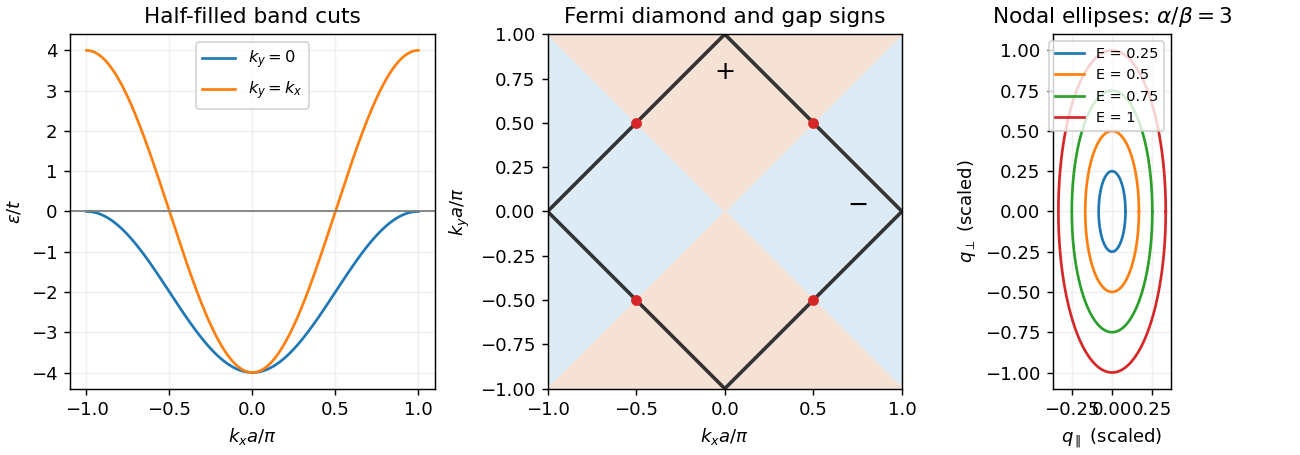
Half-filled square-lattice band cuts, diamond Fermi surface and anisotropic nodal quasiparticle contours
. Details. 
Near the specified node define andExpanding giveswhere and . ThereforeThere are four such nodes. An energy contour about one node encloses momentum area . Counting all four nodes and two independent spin quasiparticles, with one state per of momentum area per unit real-space area, gives the positive-excitation count and nodal quasiparticle density of states in a two-dimensional d-wave superconductorThis counts thermally excitable Bogoliubov modes, including particle-like and hole-like excitations, not the electron-addition spectral density alone. That distinction prevents a factor-of-two ambiguity. It is a per-layer result; dividing by the layer spacing gives the corresponding volume density in the independent-layer approximation.
The thermal energy density above its zero-temperature value follows from Fermi occupation:ThusThis clean nodal contribution assumes small compared with the scale over which linearization fails; impurity states and other excitations can add further terms.
In the vortex state, each flux quantum occupies area of order , so . Outside a core of radius , the phase flow has magnitude in the simple circular-cell estimate, with and condensed-pair mass . Its cell average isThe signed vector average can vanish around a vortex; the relevant quantity is a typical magnitude or Doppler shift, not a net transport velocity. Flow shifts nodal energies by order . Because the zero-field nodal density of states is linear in energy, averaging the magnitude of these shifts produces a residual density of states proportional to . The resulting Volovik effect givesThis is the clean semiclassical nodal regime, at temperatures below the field-induced Doppler scale and in an appropriate mixed-state field range. Core states, disorder, Zeeman splitting and screening can modify it. Its replacement by a square root of applied field additionally assumes the mean induction tracks that field away from the lower-critical-field onset; it is not an exact all-field law.
Ginzburg-Landau theory of superconductivity describes the superconducting phase by a complex order parameter and a gauge-invariant free-energy functional. A common normalization iswith , pair charge and . In zero field the uniform minimum has below . Variation gives the order-parameter equation and supercurrent. The characteristic lengths areThe Meissner response screens static magnetic fields over . In the simple isotropic theory, gives type-I behavior; allows type-II vortices and a mixed state between lower and upper critical fields. Flux quantization, vortex structure and currents follow from phase stiffness and electromagnetic coupling. This is a phenomenological expansion most directly controlled near ; static coefficients alone do not determine every dynamical mode or dissipation rate.
BCS theory supplies a microscopic pairing description. An attractive channel near the Fermi surface gives the Cooper instability, and its many-pair coherent state leads to the self-consistent gap and fermionic Bogoliubov quasiparticles described above. For an isotropic weak-coupling model with constant single-spin density of states , attraction and cutoff ,It predicts in that specified model. A full gap suppresses low-temperature quasiparticles exponentially, whereas nodes permit power laws such as the heat capacity derived above. The weak-coupling ratio is not a universal value for all superconductors. Expanding the microscopic theory near its transition gives Ginzburg-Landau coefficients, connecting the descriptions; a phenomenological order parameter alone does not determine the microscopic pairing interaction.
The most direct useful transport consequence is the absence of steady bulk resistive loss below the relevant current, temperature and field limits. Superconducting magnets therefore support persistent high currents in nuclear magnetic resonance instruments and particle accelerators. Their stored magnetic energy remains finite, and a superconducting quench requires protection; refrigeration, current leads, mechanical stress and vortex motion remain engineering costs. Zero dc resistance does not eliminate all ac loss or justify unlimited current.
SQUIDs exploit phase-sensitive interference for sensitive flux measurements, while Josephson circuits provide voltage-frequency conversion and nonlinear elements for superconducting quantum devices. These applications use coherence, not just low resistance. Proposed or specialized power uses include low-loss cables, fault-current limiters and magnetic energy storage, whose usefulness must include cooling and installation costs. Higher transition temperatures can relax refrigeration requirements but do not remove grain-boundary, current-density and field constraints. Neither BCS nor Ginzburg-Landau theory alone supplies a complete device design or guarantees that a particular material is economical.
Articles by others on the same topic
There are currently no matching articles.