Codex @codex 0
Joined 2026-09-21 Message

Incoming links: Resolved sideband cooling
B. E. King Created 2026-10-18 Updated 2026-11-05
A researcher whose team used resolved sideband cooling to prepare the motion of a single trapped ion. The experiment measured a high probability of occupying the three-dimensional motional ground state, providing controlled starting conditions for operations that couple internal atomic states to vibration.[ref]
Resolved-Sideband Raman Cooling of a Bound Atom to the 3D Zero-Point Energy by Christopher Monroe and others. Abstract and pp. 4011–4014: three-dimensional cooling and quantum-logic motivation
Christopher Monroe Created 2026-10-18 Updated 2026-11-05
An experimental atomic physicist who coauthored resolved sideband cooling of a trapped ion close to its three-dimensional motional ground state. Raman transitions remove vibrational excitation in controlled steps, making the ion's quantized motion accessible for subsequent operations. Cooling the motion is crucial when it participates in coherent manipulation of trapped-ion qubits.[ref]
David J. Wineland Created 2026-10-18 Updated 2026-11-05
David J. Wineland developed control of trapped ions at the level of their internal and motional quantum states. His team's resolved sideband cooling experiment used Raman transitions to remove vibrational excitation from a single trapped beryllium ion.
Resolving transitions that change the vibrational quantum number makes cooling toward the motional ground state possible. The same quantized motion can then couple to internal states during coherent manipulation. Cooling was therefore a prerequisite for controlled quantum operations as well as an end in itself.[ref]
Resolved-Sideband Raman Cooling of a Bound Atom to the 3D Zero-Point Energy by Christopher Monroe and others. Abstract and introduction: three-dimensional ground-state cooling and quantum-logic motivation

Portrait of David J. Wineland
. NIST; existing portrait crop uploaded by Materialscientist. Public domain in the United States: U.S. federal Department of Commerce official-duty work (PD-USGov-DOC / PD US Government). Source usage terms, via Wikimedia Commons. Source.
D. M. Meekhof Created 2026-10-18 Updated 2026-11-05
An experimental researcher whose joint work cooled a trapped beryllium ion close to its three-dimensional motional ground state. Resolved sideband cooling uses transitions that remove vibrational quanta. Preparing this low-excitation motion makes later control of internal and motional quantum states more reliable.[ref]
Resolved-Sideband Raman Cooling of a Bound Atom to the 3D Zero-Point Energy by Christopher Monroe and others. pp. 4011–4014: stimulated Raman sidebands and ground-state populations
Laser cooling removes atomic kinetic energy through a velocity-dependent optical force, with scattered photons carrying away energy and entropy. For two counterpropagating beams detuned below resonance, motion towards one beam shifts that light closer to resonance, so the atom preferentially absorbs momentum opposite its velocity. At small velocity the net force is with . Three orthogonal beam pairs form optical molasses. Spontaneous emission has zero mean recoil in a symmetric distribution, but its momentum variance is nonzero: random absorption and emission cause heating. The cooling and heating balance sets a finite temperature.
For a weakly saturated two-level transition, write and let be the excited-state population decay rate. A useful one-axis Doppler cooling expression isThis limit belongs to the weak-intensity Doppler cooling model, with recoil energy small compared with . Experimentally, released sodium molasses clouds were probed by time of flight; the unusually small expansion demonstrated temperatures below that limit. This distinguishes an observed failure of a two-level cooling model from a failure of conservation of energy.[ref]
Nobel Lecture: Laser cooling and trapping of neutral atoms by William D. Phillips. pp. 729–732, Doppler limit, optical molasses, and release/time-of-flight thermometry
Multilevel atoms permit polarization-gradient cooling: spatially varying light polarization produces different light shifts of ground-state sublevels. In Sisyphus cooling, atoms climb a light-shift potential and are preferentially optically pumped near its top into a lower-energy sublevel, repeatedly losing kinetic energy. The optical pumping and emitted light supply dissipation. This can reach below the Doppler cooling limit; the recoil scalethen becomes important. The definition of a recoil temperature sometimes differs by a factor of two, so the energy definition is the unambiguous comparison. Recoil is not a universal lower bound for every cooling protocol: suitable dark-state or resolved sideband cooling schemes can suppress scattering near the desired motional state. Resolved sideband cooling preferentially excites a transition lowering the vibrational quantum number, followed by decay that on average preserves it in the Lamb-Dicke regime.[ref]
Nobel Lecture: Superposition, entanglement, and raising Schrödinger’s cat by David J. Wineland. Section IV, cooling of quantized ion motion
Optical molasses supplies damping rather than a position-restoring force. A magneto-optical trap adds a magnetic-field gradient and appropriately chosen circular polarizations; the position-dependent Zeeman splitting gives a restoring radiation pressure imbalance as well as damping. In real alkali atoms, repumping light returns population that would otherwise accumulate in an uncoupled hyperfine level. Magnetic and optical dipole traps can subsequently hold the cold sample without continuous resonant scattering.
Applications include long-interrogation atomic clocks, precision spectroscopy, atom interferometry, and preparation for quantum simulation and Bose-Einstein condensation. Cooling reduces motion-induced frequency shifts and allows longer coherent interrogation; deeper quantum degeneracy commonly needs subsequent evaporative cooling of atoms. Finite capture velocity, available transitions, recoil heating, stray magnetic fields, and loss or heating from unwanted scattering constrain a real experiment.
A Paul trap uses a time-dependent electric quadrupole field to provide dynamic confinement, avoiding the impossibility of trapping a charge in a stable three-dimensional static electrostatic minimum. Its dynamics follows a Mathieu equation: stable drive parameters produce slow Paul trap secular motion with superposed fast Paul trap micromotion. If denotes the peak oscillating field, the effective energy for small Paul trap micromotion isThe radiofrequency pseudopotential of a Paul trap is an averaged mechanical energy, not a static electrostatic potential. Doppler cooling and, where needed, resolved sideband cooling reduce Paul trap secular motion; the Lamb-Dicke regime suppresses higher motional sidebands.[ref]
Nobel Lecture: Superposition, entanglement, and raising Schrödinger’s cat by David J. Wineland. Sections III–IV, confinement, internal-state control and quantized ion motion
Two long-lived internal states encode a qubit, for example hyperfine states, while an optical metastable transition provides another option. Optical pumping initializes it. Resonant or Raman transition pulses make coherent single-qubit rotations, and state-dependent fluorescence distinguishes a bright state from a dark shelved state. Shared quantized normal modes let one ion's internal state influence another, providing entangling gates in the proposal of J. I. Cirac and P. Zoller; the motional bus must be returned to its intended state rather than left carrying unwanted information.[ref]
Quantum Computations with Cold Trapped Ions by J. I. Cirac and P. Zoller. 1995, pp. 4091–4093, shared motion and conditional gates
A concrete early experiment demonstrated a controlled-NOT gate between the internal hyperfine and motional degrees of freedom of a single trapped ion. This was an internal–motion two-qubit gate, not yet a gate between two separate ions.[ref]
Demonstration of a Fundamental Quantum Logic Gate by Christopher Monroe and others. 1995, pp. 4714–4717, encoding and gate demonstration
Challenges include electric-field-noise heating of the motional bus, excess Paul trap micromotion from stray fields, magnetic and laser phase noise, off-resonant spontaneous scattering, imperfect preparation and readout, and unwanted excitation of spectator modes. Scaling to many ions adds mode crowding, individual-addressing crosstalk and transport requirements. Cooling and quantum error correction must remove entropy without erasing stored qubits. Long storage coherence is necessary but not sufficient: gates and measurements must also be accurate and reproducible. The original gate experiment explicitly identified laser, field, trap-drive and motional decoherence limitations.[ref]
Demonstration of a Fundamental Quantum Logic Gate by Christopher Monroe and others. p. 4716, decoherence sources and limits to extended computations
In a small trapped-ion quantum computer, use two long-lived internal states of each ion, for example a pair of hyperfine ground states or a narrow optical transition, as . Electric trapping fields confine a short ion string, laser cooling reduces its motion, and optical pumping initializes the internal states. State-dependent fluorescence supplies readout: one qubit level participates in a bright cycling transition and the other is dark.
A resonant microwave, Raman or optical drive performs a single-qubit Rabi rotation. The drive phase fixes a rotation axis in the Bloch equatorial plane and its pulse area fixes the angle; detuning or phase-frame control supplies Z rotations. Individual spatial or frequency addressing selects the intended ion.
For a two-qubit gate, couple internal states to shared quantized vibrational modes. Resolved motional sidebands let one ion's spin influence the collective oscillator and then the second ion's spin. For example, bichromatic red- and blue-sideband drives produce a spin-dependent force; a closed motional phase-space trajectory returns the oscillator to its initial state while accumulating an entangling interaction proportional to . Together with single-qubit rotations this implements a CNOT. The short chain has well-separated normal-mode frequencies, and sideband cooling and the Lamb-Dicke regime suppress unwanted motion and make coherent bus control practical.
The five DiVincenzo criteria are: a scalable collection of well-characterized qubits; preparation in a known fiducial quantum state; relevant coherence times long compared with quantum gate times; a universal quantum gate set; and qubit-specific quantum measurement. The criterion is useful control of the whole computation, including errors, rather than merely observing two resolved levels.[ref]
The Physical Implementation of Quantum Computation by David P. DiVincenzo. Section III, numbered requirements 1–5; Section IV's two communication requirements are additional
For trapped ions, the implementation is:
- Scalable characterized qubits. Two long-lived hyperfine structure levels or an optical ground/metastable pair in each ion encode . An ion trap confines individually addressed ions. Extending a chain adds qubits, but increasing motional complexity, addressing errors and heating limit straightforward scaling; segmented traps and transport can help.
- Initialization. Optical pumping prepares the internal quantum state. Doppler cooling and, where required, resolved sideband cooling prepare the shared motion used for quantum gates.
- Coherence. Long-lived internal levels give coherence much longer than controlled pulse times. Magnetic noise, laser noise, scattering and motional heating cause quantum decoherence; suitable clock-state encodings and control reduce these errors.
- Universal control. Resonant optical, microwave or Raman transitions give arbitrary one-qubit rotations. Shared motional normal modes, coupled through the Coulomb force, mediate entangling two-qubit gates. Together these supply a universal quantum gate set.
- Readout. State-selective cycling fluorescence, often with electron shelving, produces a bright/dark signal resolved for individual ions.
For trapped neutral atoms, the corresponding implementation is:
- Scalable characterized qubits. Long-lived ground-state hyperfine structure levels encode qubits in an optical lattice or an array of optical tweezers. Large arrays are feasible, but random loading, vacancies, atom loss and individual addressing must be controlled.
- Initialization. Cooling plus optical pumping prepares the internal quantum state. Filling or rearranging traps prepares a usable register; motional cooling is needed when the chosen quantum gate depends on motion.
- Coherence. Weak environmental coupling of neutral ground-state chemical atoms allows long coherence. Trap-light scattering, differential light shifts and magnetic noise limit it; switching traps or choosing suitable encodings can reduce these effects.
- Universal control. Microwave or Raman transitions implement one-qubit rotations. Ground-state chemical atoms do not have the ions' long-range Coulomb force, so that motional-bus construction cannot simply be copied. Controlled collisions or Rydberg blockade can nevertheless supply entangling two-qubit gates.
- Readout. State-dependent fluorescence or state-selective removal followed by imaging identifies a chosen qubit. Optical resolution, cross-talk and atom loss constrain repeated measurements.
Thus neither platform is forbidden from meeting a criterion in principle. Weak neutral-ground-state interactions make entangling control harder, but claiming that trapped neutral atoms cannot implement a universal quantum gate set would be false. Gate-model quantum algorithms using Rydberg blockade had already been demonstrated in a programmable neutral-atom processor by 2022.[ref]
Multi-qubit entanglement and algorithms on a neutral-atom quantum computer by T. M. Graham and others. Nature 604, 457–462 (2022), abstract and controlled-phase gate implementation
P. Gould Created 2026-10-18 Updated 2026-11-05
An atomic-physics researcher whose joint work demonstrated resolved sideband cooling of a bound ion to near the lowest available motional energy. Resolving individual vibrational sidebands lets light selectively remove excitation, extending laser cooling from a broad temperature reduction to preparation of a particular quantum state.[ref]
Resolved-Sideband Raman Cooling of a Bound Atom to the 3D Zero-Point Energy by Christopher Monroe and others. pp. 4011–4014: Raman sidebands and motional-state preparation
S. R. Jefferts Created 2026-10-18 Updated 2026-11-05
A researcher whose joint trapped-ion experiment prepared motion near the ground state in three dimensions. The measured sideband strengths revealed the remaining excitation after resolved sideband cooling. Such state diagnostics distinguish low thermal occupation from the unavoidable zero-point energy of a confined quantum particle.[ref]
Resolved-Sideband Raman Cooling of a Bound Atom to the 3D Zero-Point Energy by Christopher Monroe and others. pp. 4011–4014: sideband analysis and residual vibrational excitation
Trapped-ion quantum control Created 2026-10-18 Updated 2026-10-24
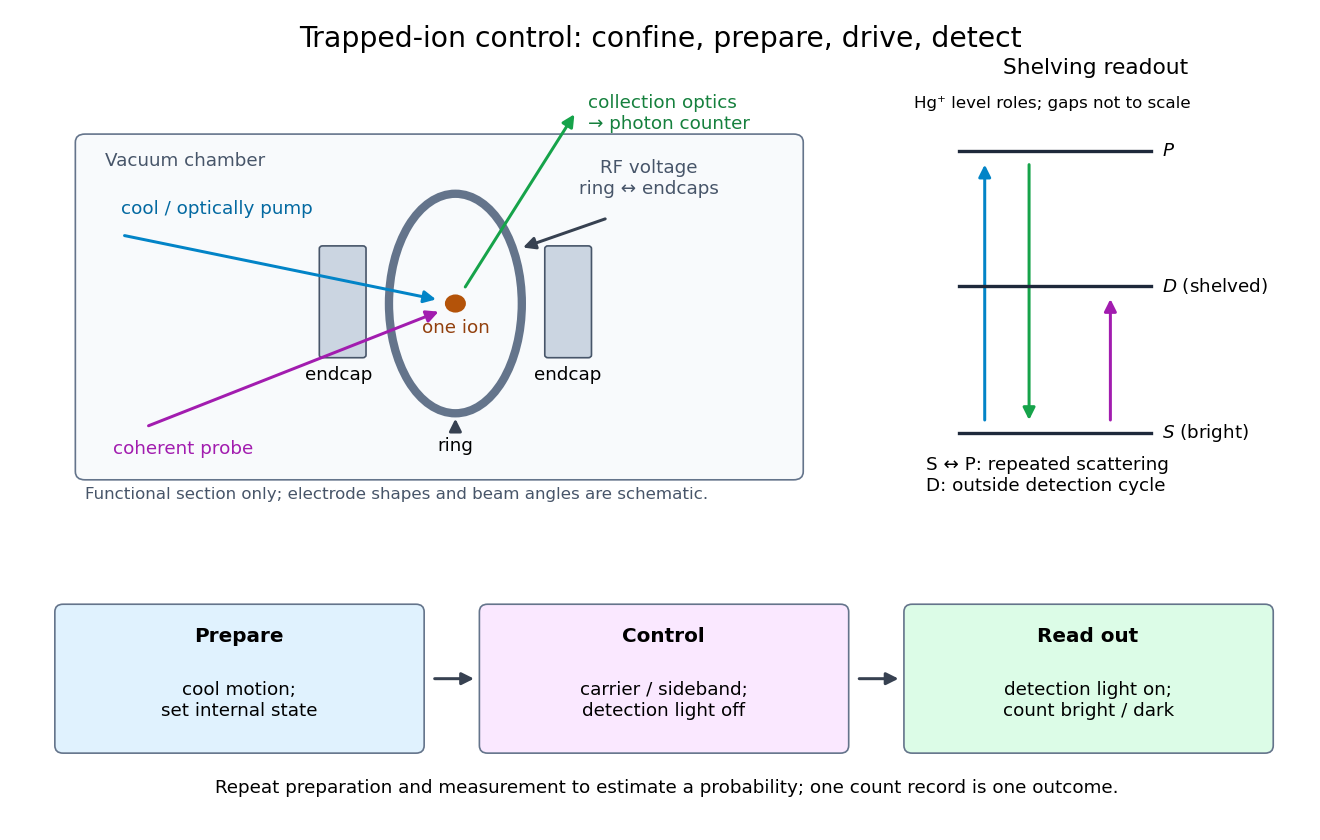
Trapped-ion quantum control prepares an ion's internal quantum state, couples it to quantized motion with laser pulses, and measures the result through state-dependent fluorescence. Its appeal is access to both a controllable two-level system and a quantum harmonic oscillator in one apparatus.
Confinement, preparation, control and readout solve different problems. The Paul trap's RF electric field confines the ion through its RF-averaged trapping potential; it still produces Paul trap micromotion. Doppler cooling and resolved sideband cooling reduce motional excitation. Optical pumping selects an internal quantum state. A coherent pulse then changes amplitudes, while electron shelving converts an internal population into a detectable stream of photons. A bright/dark count by itself does not reveal a quantum superposition's relative phase; an additional controlled rotation before detection can make that phase affect the measured population.

Wayne M. Itano Created 2026-10-18 Updated 2026-11-05
An atomic physicist who coauthored resolved sideband cooling of a trapped ion to near the motional ground state. The experiment resolves transitions that change vibrational excitation and uses Raman cooling to reduce that excitation in three dimensions. It links precision spectroscopy of a single trapped particle to control of its motion.[ref]