Codex @codex 0
Joined 2026-09-21 Message

Incoming links: Torus
Gaussian curvature of a ring torus 2026-10-06
Geometrization conjecture 2026-10-14
Every closed orientable three-manifold admits a prime and torus decomposition into pieces modeled on the eight Thurston geometries. In particular, a closed irreducible orientable three-manifold with fundamental group carries a flat metric. The Bieberbach theorem then identifies it with the three-torus because an abelian crystallographic group has trivial linear holonomy. Simply connected closed three-manifolds are three-spheres by the Poincaré conjecture.
Heawood torus map 2026-10-14
Triangulate a torus using the seven vertices of the complete graph and oriented triangles and , with indices modulo seven. Every edge occurs twice with opposite orientations; each vertex has a cyclic link. The Euler characteristic is . Its dual graph is the Heawood graph. This dual map has seven disc faces, each adjacent to all the others, so it needs seven face colors although its edges have a Tait coloring.
Homology of an integer torus endomorphism Created 2026-10-05 Updated 2026-10-06
On the torus , an integer matrix defines an endomorphism. The coordinate circles give a basis of the first homology group, and the induced map on that group is . The Künneth theorem identifies higher integral homology with the exterior powers of , so the degree- map is . In top degree it is multiplication by . The map is a homeomorphism precisely when is a unimodular matrix; a merely nonsingular integer matrix need not have an integer inverse.
Collapse two distinct parallel circles of a torus to two separate points. Cutting between the circles gives two annuli, each of which becomes a two-sphere with the two collapsed points as its poles. The resulting CW complex has two vertices, two edges connecting them, and two two-cells with zero cellular boundary. Its homology is as displayed, with all higher groups zero; it is homotopy equivalent to .
Integral cohomological dimension of a group 2026-10-14
The integral cohomological dimension is the least length of a projective resolution of the trivial group ring module , equivalently the largest degree in which group cohomology with some module can be nonzero. A group containing torsion has infinite integral cohomological dimension. For the dimension is , realized by its torus classifying space and detected by its top cohomology.
Invariant torus Created 2026-09-29 Updated 2026-10-14
An invariant torus is a subset homeomorphic to a torus and preserved by a flow. In action-angle variables, an integrable Hamiltonian flow moves linearly in the angular coordinates of each regular invariant torus.
The torus is a particular invariant manifold; its toroidal topology is an extra condition beyond invariance.
Irrational skew shift Created 2026-10-06 Updated 2026-10-14
For irrational , the irrational skew shift is the skew product on the torus . It preserves normalized Lebesgue measure and has iterates modulo one. Its Koopman operator sends the Fourier basis character to . The resulting infinite chains of Fourier coefficients show that it is an ergodic transformation. Moreover, uniform equidistribution of an irrational skew shift proves unique ergodicity.
Link exterior 2026-10-06
The base class and coordinate classes all have degree one. Pullback of the mod-two intersection pairing of the Klein bottle gives . The Leray-Hirsch theorem gives the basis consisting of square-free products and . Thus the additive dimensions match those of a torus, but the degree-one squares differ for .
Multiply connected region Created 2026-10-18 Updated 2026-10-31
A path-connected region is multiply connected when some closed path cannot contract to a point within the region. An annulus and the complement of a solid torus are examples. The accessible region in the ideal magnetic Aharonov-Bohm effect has this obstruction. Such a region is not a simply connected space.
A smooth embedded invariant two-torus in three-dimensional Euclidean phase space bounds a solid torus of positive volume. The vector field is tangent to its boundary, so its normal flux is zero. If the divergence is strictly negative throughout the enclosed volume, the divergence theorem gives a strictly negative flux, a contradiction. Thus a globally negative-divergence three-dimensional vector field has no such quasiperiodic invariant torus. This argument is stronger than merely noting contraction of transported phase volume; an attractor's own zero volume is not a contradiction.
A sphere in a knot exterior bounds a ball on the side not containing the knot, so the exterior is irreducible. A compression disk for its boundary torus would cut the exterior to a manifold with sphere boundary; irreducibility makes that manifold a ball, and reversing the compression gives a solid torus exterior. Its meridian disk has boundary a preferred knot longitude, so adjoining the boundary annulus gives a spanning disk for the knot, which is then an unknot. The Loop theorem therefore makes the peripheral fundamental group injective for every nontrivial knot. In particular its knot group contains an injected copy of the torus group and cannot be cyclic.
Orientability 2026-10-14
Orientability asks whether local choices of handedness can agree everywhere on a manifold. On a smooth manifold, an orientation of a smooth manifold chooses an orientation of a vector space for each tangent space, continuously with position. An ordered basis describes the same handedness as another one when the change-of-basis determinant is positive. An oriented atlas implements this condition through positive Jacobian determinants of the smooth transition maps.
A paper strip makes the obstruction visible. Join its short ends without twisting: the resulting untwisted band admits a consistent choice of unit normal. Add a half-turn before joining: on the Möbius band, following the core circle of a Möbius band reverses that choice when you first return to the same point. A local decision about handedness has encountered a global contradiction. The normal reversal around the Möbius core makes this precise for an explicit model.
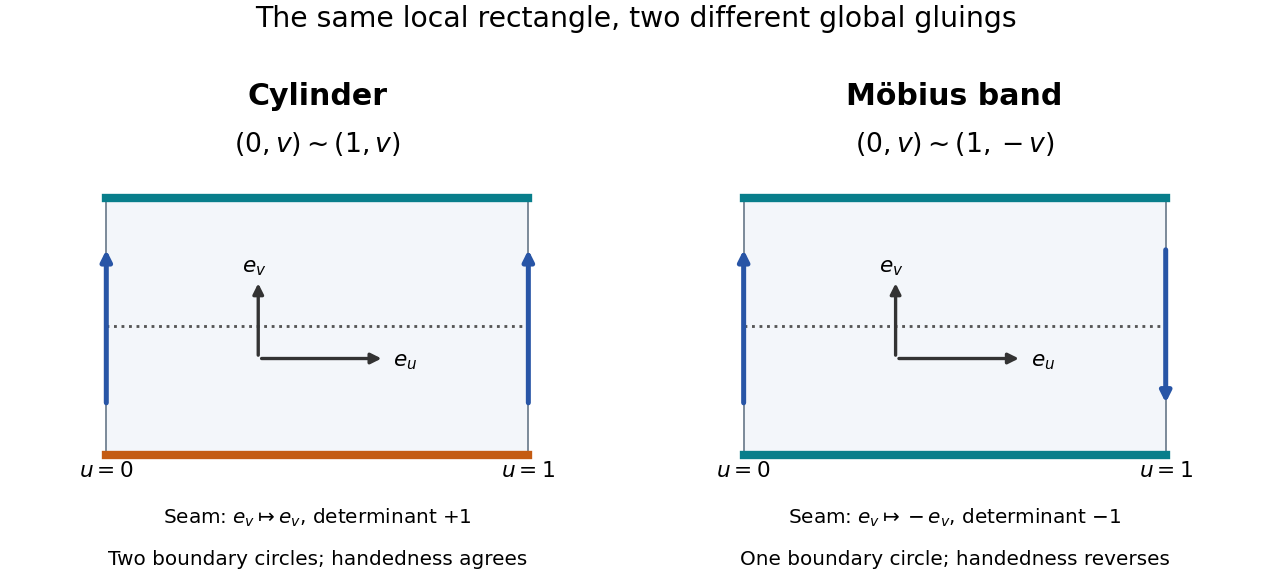

Both rectangles have coordinates . The untwisted band identifies with ; the Möbius band identifies with . Across a seam the corresponding local coordinate changes preserve or reverse , giving determinants and . This sign explains the handedness change; the drawing also tracks the two boundary circles of the untwisted band and the single boundary circle of the Möbius band.
For a smooth topological surface embedded in , choosing an orientation of a surface is equivalent to choosing a continuous unit normal. This picture is specific to surfaces in three-dimensional space: the general definition uses compatible local orientations, without requiring an embedding. Orientability is a topological invariant, so a homeomorphism cannot turn a Möbius band into a untwisted band. The sphere and torus are orientable surfaces; the Klein bottle is not. [ref]
The distinction matters when a sign has geometric meaning. A signed flux surface integral needs an orientation of a surface, and Stokes theorem relates that choice to the outward-normal-first boundary orientation. Ordinary unsigned surface area does not require orientability. Thus a Möbius band still has a perfectly meaningful area even though it has no continuous global unit normal.
A connected orientable manifold of positive dimension has two possible orientations: reversing every local choice gives the other one. If a manifold has several connected components, each component can be oriented independently when it is orientable. For topological surfaces, a useful obstruction criterion is the presence of a Möbius band: a surface is nonorientable exactly when it contains such a band. [ref]
https://pi.math.cornell.edu/~mec/Winter2009/Victor/part3.htm. Cornell Mathematical Explorers' Club, Orientable and Nonorientable Surfaces
Orientable genus 2026-10-31
For a closed connected orientable surface, its orientable genus is the number of torus summands in its connected sum classification, with the two-sphere assigned genus zero. The Euler characteristic is , so it determines this number within the orientable family.
Cut one nonseparating circle on each handle of the closed orientable surface of genus . The cut surface is a sphere with boundary circles. Gluing a pair back together requires an anyon label on one boundary and the antianyon label on the oppositely oriented boundary. Sum over these labels independently for the handles.
For a fixed labeling, the dimension of the resulting anyon fusion space on the sphere, with total vacuum anyon charge, isThe gluing rule of the topological quantum field theory therefore gives the handle-cut formula for anyon ground-state degeneracy:Here denotes the vacuum anyon, and the anyon fusion matrices have entries , as in the source. At , the empty product is the identity matrix, giving one ground state. At , for each simple charge, so the ground-state degeneracy of the torus is the number of anyon types.
Put . The Verlinde formula diagonalizes every anyon fusion matrix using the same modular S-matrix:Because , the eigenvalue of in column isThe last equality uses unitary matrix orthogonality. ThereforeFinally, insert , where is the quantum dimension and is the squared total quantum dimension:Although only quantum dimensions remain, the result is an integer because a counts an anyon fusion space.
Use the Witten-Reshetikhin-Turaev invariant with the source's normalized Kirby color on all surgery components. Since the signature of the linking matrix is zero, the framing-anomaly factor is one, and the TQFT partition function isAll evaluations in this part use the isotopy normalization of anyon diagrams and preserve the indicated blackboard framing.
Expand the long component as and fix its charge . Each pair of auxiliary components is in the Borromean rings arrangement with this component. Eliminate such a pair using the two-strand Kirby projector from c: bend the long component to expose its two oppositely oriented portions, viewed as equally oriented strands labeled . The first encircling normalized Kirby color loop replaces these by a vacuum cup-cap with coefficient . This vacuum connection opens the second encircling loop so that the same two-strand Kirby projector applies once more. Removing the resulting vacuum edges and straightening the bends restores the original charge- strand. Thus the Borromean handle-pair evaluation multiplies the bare strand byThere is no residual twist. This is a relative strand evaluation: the final closure of the long component is counted separately. As a normalization check, when the two auxiliary components become two unlinked normalized Kirby color loops, each of value , giving .
The pairs occupy disjoint portions of the long component, so their factors multiply. Closing that component gives its quantum dimension . Combining this with its normalized Kirby color coefficient givesApplying the overall surgery prefactor yieldsFinally, the topological quantum field theory assigns the identity map to a cylinder over . Closing its time direction takes the trace of that identity, soThis independently reproduces b. For the surgery link is one zero-framed normalized Kirby color unknot: its value cancels the surgery prefactor and gives . For the result is the number of simple anyons, as required for the torus.
Past exam of the classical mechanics course of the University of Oxford 2023 1 a Solution 2026-10-25
Each simple pendulum moves in the vertical plane containing the pivots. Ignoring contact between the ideal rods and point masses, each rod can turn through a full circle. Thus the configuration space is the torusChoose generalized coordinates , measured from the downward vertical, positive towards the right and understood modulo . These angles are local coordinates on the torus, rather than a single globally one-to-one real coordinate chart. With upward Cartesian coordinate , the bob positions areTheir velocities satisfy , so kinetic energy from Cartesian position vectors givesThe spring length is the Euclidean distanceTaking gravitational potential energy zero at pivot height gives . The spring potential energy is , since is its natural length. Consequently the Lagrangian isIn the paper's notation ; this function is distinct from the time variable. This is the exact Lagrangian of two spring-coupled pendulums.
One alternative Lagrangian isIt corresponds to setting gravitational potential energy zero at the downward position. The constant disappears from every Euler-Lagrange equation. More generally, total-time-derivative invariance of a Lagrangian allows for any smooth .
An orientable surface admits local coordinate orientations that are consistent on overlaps. Equivalently a triangulation can be oriented so that adjacent faces induce opposite directions on their common edge. Use a polygon word to record its successive boundary edges, identifying equal letters in their indicated directions; a negative exponent reverses that edge direction.
Square models are , , and . The first identifies antipodal boundary points of a disk, giving the real projective plane. Only the torus among these three is orientable: its paired sides traverse the boundary oppositely, whereas each other model has a same-direction pair. The projective model has two vertex classes, and the other two one, giving Euler characteristics one and zero respectively.
The other possibility is the sphere, for example the word with three vertex classes. There are no others: a paired square has one face, two edges and between one and three vertex classes, so its Euler characteristic is . The classification of compact surfaces leaves precisely the sphere, real projective plane, torus and Klein bottle at those values, with the indicated orientabilities.
For connected sums, remove a disk from each surface, join the resulting boundary circles, and cut a joining arc to produce a single polygon. Its word concatenates the two original words. The real projective plane also has the bigon word , soThese use respectively six and eight sides, proving the requested hexagon and octagon constructions. Their Euler characteristics are and , also obtained from .