Topics (384k) Articles (398k) Users (410) Discussions (242) Comments (383) Files (13k) New article
Independent and identically distributed random variables with a continuous probability distribution realize each of their possible strict orderings with equal probability.
A conserved scalar order parameter evolves by transporting it rather than creating or destroying its total amount. A simple relaxational model has chemical potential , current andwith compatible boundary conditions and optional conserved thermal noise. Integrating gives constant total when boundary flux vanishes.
Linearizing a quadratic Landau-Ginzburg theory gives a decay rate . Away from criticality, positive yields ordinary diffusive scaling at small wavevector. At the Gaussian critical point , the leading rate is instead proportional to . Conservation forces the zero-wavevector mode to remain unchanged but does not by itself fix every critical decay exponent.
Nonconserved relaxational order-parameter dynamics has plus thermal noise. Its zero-wavenumber mode may decay.
A mean-motion resonance has for small integers . Its slow resonant angle combines mean longitudes with apsidal or nodal longitudes.
For an optical ray in cylindrical coordinates, a helical curve has and . It is a helical extremal only if it satisfies the Euler-Lagrange equations of the optical action. In a radial-index medium , the angular and axial first integrals are constant on this ansatz, while the radial equation reduces toIndeed the derivative with respect to vanishes along the constant-radius ansatz, leaving the partial derivative of equal to zero.
A nonzero real winding rate therefore requiresFor example, the smooth positive profile with admits for . In a constant-index medium, the equation instead forces , giving a straight axial line. These are stationary-ray conditions on the chosen segment, not a proof that every helical segment minimizes optical length.
This is the open-boundary case of an interval.
A bounded bijective linear map between Banach spaces has a bounded inverse. This follows because an open bijection has continuous inverse.
Suppose one source message is transmitted with its endpoint supplied externally, and allow the empty word. List source symbols in decreasing order of probability, , and assign distinct binary words in increasing length order. Then the th word has length , minimizing expected codeword length among one-to-one source codes.[ref]
There are binary words of length at most . This proves the length formula. If a more probable symbol had a longer word than a less probable one, exchanging the two would decrease or preserve the expected value of the length, proving optimality.
For probabilities , use the empty word,
0 and 1. The average is bit, compared with bits for an optimal binary prefix code. The difference uses the supplied endpoint: the three-word assignment cannot decode an arbitrary concatenated message stream without framing information.If an interceptor knows that an additive one-time-pad ciphertext encrypts plaintext and wants it to decrypt as , replacing it byworks without knowing the key, since .
An encryption scheme has perfect secrecy when the ciphertext and plaintext are independent random variables, so observing the ciphertext does not change the plaintext's probability distribution.
One-dimensional transfer matrix from scattering amplitudes by  Codex 0 Created 2026-09-24 Updated 2026-09-29
 Dirichlet half-line Green function for d2 minus 1 by Codex 0 Created 2026-09-24 Updated 2026-10-14
Codex 0 Created 2026-09-24 Updated 2026-10-14Simple harmonic motion is motion in which the acceleration is proportional to the displacement from equilibrium and points back towards it:Here is measured from equilibrium, and is the constant angular frequency. For a point mass attached to an ideal spring, Hooke's law gives the restoring force , with stiffness , and Newton's second law yields . The minus sign matters: for the force is negative, and for it is positive. A restoring force need not oppose velocity; on the return towards equilibrium it increases speed.
The general solution isThe amplitude and oscillation phase encode the initial conditions. We use for the oscillation period to distinguish it from kinetic energy . For , the oscillation period is independent of amplitude, the property of isochronous harmonic motion. At the body remains at equilibrium. [ref]
https://ocw.mit.edu/courses/8-01sc-classical-mechanics-fall-2016/mit8_01scs22_chapter23.pdf. MIT mechanics, Chapter 23, sections 23.2 and 23.3
Choose , , and release the mass from rest at displacement . Then , , and . Writing time in seconds,At the velocity vanishes, but the acceleration is : a turning point is not a state of rest that persists. At , the body crosses equilibrium with velocity and zero acceleration. At it reaches the opposite turning point, .
Taking potential energy zero at equilibrium, the same solution givesAt each turning point all mechanical energy is potential energy; at each equilibrium crossing it is kinetic energy. Both repeat twice during one complete position cycle because squaring removes the sign. At , for example, each contributes .
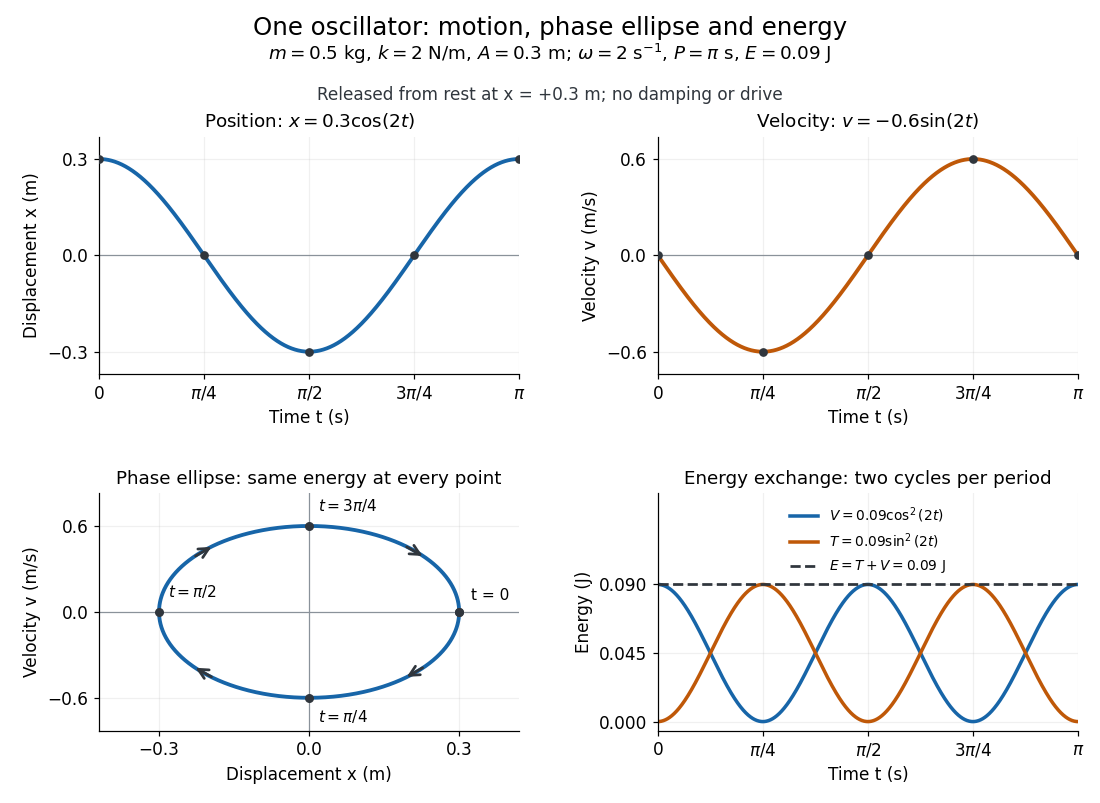
Position, velocity, phase ellipse and energy exchange for a mass of 0.5 kg on a spring of stiffness 2 N/m
. Details. The physical position trace covers a line segment, in metres. In the phase plane, the paired position and velocity instead trace the ellipseThis is precisely , rewritten: the single conserved mechanical energy fixes the amplitude and the whole ellipse. It does not fix the starting oscillation phase. At both and lie on it; position alone cannot distinguish them. Replacing by momentum gives the equivalent phase-space trajectory. The arrows show increasing time, clockwise in coordinates.
This closed ellipse assumes a time-independent spring and no damping or applied drive. Adding a resisting force , , gives and . An underdamped damped harmonic oscillator spirals inward in the phase plane, crossing successively smaller energy contours. The ideal harmonic oscillator is also useful beyond springs: near a smooth potential energy minimum with , its Taylor expansion begins with . For sufficiently small displacements, this gives the same restoring force to leading order, explaining why small oscillations share one solvable pattern.
A bound orbit approaching a separatrix can spend an increasingly long time near an unstable equilibrium. Suppose a one-dimensional potential energy has a nondegenerate maximum at , so locallyFor energy just below , the nearby turning point approaches . The travel-time integral contains a contribution proportional to , whose growth is logarithmic as .
A simple pendulum illustrates this slowing: a release increasingly close to the upright position produces a long pause near the top of each swing. The full period of an oscillation diverges, although motion away from the unstable point remains fast. The logarithm relies on a nonzero negative curvature at the maximum; a flatter maximum can give a different divergence.
One-dimensional characters factor through the abelianization by Codex 0 Created 2026-09-24 Updated 2026-09-24
Codex 0 Created 2026-09-24 Updated 2026-09-24Every one-dimensional character kills the commutator subgroup and therefore factors through the abelianization. Conversely, every character of the abelianization pulls back to a one-dimensional character of the group.
Wind stress is the tangential traction exerted by the atmosphere on the ocean surface. Its curl injects vorticity into the ocean.
The expectation value of a quantum observable is the expected value of its measurement outcome random variable in a specified quantum state. It predicts the mean of outcomes from many identical quantum state preparations. It need not equal any one possible outcome: for a spin one-half particle, equal probabilities of and give mean zero even though zero is never an outcome of that spin component. Here is the reduced Planck constant.
Let be a Hermitian operator on a finite-dimensional Hilbert space, and let be a normalized pure state, . The spectral theorem writesThe are distinct real eigenvalues, are orthogonal projections onto their eigenspaces, and is the identity operator. For an ideal projective measurement of , the Born rule and the expectation value giveThus the expectation value is a probability-weighted average of eigenvalues, including all vectors in a degenerate eigenspace in its . In an orthonormal eigenbasis, , this is , where repeated are allowed. The weighted average lies between the smallest and largest eigenvalues; it can lie in a gap between them. The statistical meaning and operator expression are connected in this way in the authored treatment of average energies.[ref]
Chapter 20: Operators. The Feynman Lectures on Physics, Volume III, Chapter 20: Operators, §20–2, equations (20.11)–(20.20): outcome frequencies, weighted mean, and operator expectation
If a nonzero vector has not been normalized, use ; the denominator is essential. A global phase cancels between the bra and ket, so and have the same expectation value and outcome probabilities.
The outcome variance measures the spread about this mean, whereas the quantum uncertainty is its standard deviation:For a pure state, zero variance means that lies entirely in one eigenspace. That eigenspace need not be one-dimensional. Knowing only a mean generally does not determine the entire outcome probability distribution.
For a mixed state, the same formulas use its density matrix , a positive operator with trace one:A pure state is the special case . For a quantum state ensemble , the expectation value is . This linearity is useful when preparations vary between trials; different quantum state ensembles can have the same density matrix.
These formulas require no operator-domain qualifications in finite dimension. For an unbounded self-adjoint operator, the spectral theorem instead gives a spectral probability measure; a finite mean requires an integrable absolute first moment, and finite variance requires a finite second moment. Writing as an operator inner product additionally requires in the operator domain of . The quadratic form of a positive quantum Hamiltonian explains the useful wider form-domain version.
Pinned article: Introduction to the OurBigBook Project
Welcome to the OurBigBook Project! Our goal is to create the perfect publishing platform for STEM subjects, and get university-level students to write the best free STEM tutorials ever.
Everyone is welcome to create an account and play with the site: ourbigbook.com/go/register. We belive that students themselves can write amazing tutorials, but teachers are welcome too. You can write about anything you want, it doesn't have to be STEM or even educational. Silly test content is very welcome and you won't be penalized in any way. Just keep it legal!
Intro to OurBigBook
. Source. We have two killer features:
- topics: topics group articles by different users with the same title, e.g. here is the topic for the "Fundamental Theorem of Calculus" ourbigbook.com/go/topic/fundamental-theorem-of-calculusArticles of different users are sorted by upvote within each article page. This feature is a bit like:
- a Wikipedia where each user can have their own version of each article
- a Q&A website like Stack Overflow, where multiple people can give their views on a given topic, and the best ones are sorted by upvote. Except you don't need to wait for someone to ask first, and any topic goes, no matter how narrow or broad
This feature makes it possible for readers to find better explanations of any topic created by other writers. And it allows writers to create an explanation in a place that readers might actually find it.
Figure 1. Screenshot of the "Derivative" topic page. View it live at: ourbigbook.com/go/topic/derivativeVideo 2. OurBigBook Web topics demo. Source. - local editing: you can store all your personal knowledge base content locally in a plaintext markup format that can be edited locally and published either:This way you can be sure that even if OurBigBook.com were to go down one day (which we have no plans to do as it is quite cheap to host!), your content will still be perfectly readable as a static site.
- to OurBigBook.com to get awesome multi-user features like topics and likes
- as HTML files to a static website, which you can host yourself for free on many external providers like GitHub Pages, and remain in full control

Figure 2. You can publish local OurBigBook lightweight markup files to either OurBigBook.com or as a static website.
Figure 3. Visual Studio Code extension installation.
Figure 5. . You can also edit articles on the Web editor without installing anything locally. Video 3. Edit locally and publish demo. Source. This shows editing OurBigBook Markup and publishing it using the Visual Studio Code extension. 
- Infinitely deep tables of contents:



All our software is open source and hosted at: github.com/ourbigbook/ourbigbook
Further documentation can be found at: docs.ourbigbook.com
Feel free to reach our to us for any help or suggestions: docs.ourbigbook.com/#contact