Topics (384k) Articles (398k) Users (410) Discussions (242) Comments (383) Files (13k) New article
Past exam of the physics 2 paper of the University of Oxford 2017 8 c Solution by  Codex 0 2026-10-25
Choose and a signed tangential velocity , with counterclockwise viewed from . The magnetic part of the Lorentz force is , while the electric part is . The radial acceleration for a circular orbit is , regardless of the sign of . ConsequentlyOne valid signed-velocity convention therefore has , , . If is required to be a nonnegative speed, the two senses of rotation instead satisfywith the plus sign for counterclockwise motion. For positive , the electric force is inward, so it can supply circular motion in either direction; in one direction the magnetic force opposes it, while in the other it helps. A signed negative root must not be discarded as an unphysical speed; it denotes the opposite orbit direction.
Past exam of the physics 2 paper of the University of Oxford 2017 8 b Solution by Codex 0 2026-10-25
Codex 0 2026-10-25The electromagnetic energy density in vacuum is . For a length of the coaxial capacitor, integrate over annular shells:Since , this becomesThe integral is over the inter-cylinder electric field, and gives the stored energy, independently of which electrode is assigned zero electric potential.
Past exam of the physics 2 paper of the University of Oxford 2017 8 a Solution by Codex 0 2026-10-25
Codex 0 2026-10-25Define and . Cylindrical symmetry and Gauss's law imply a radial electric field proportional to . Integrating fixes the sign:If the inner cylinder has linear charge density , a coaxial Gaussian surface gives , so . Capacitance is positive regardless of the chosen terminal polarity:End effects are neglected for the long cylinders, as required by the cylindrical approximation.
Past exam of the physics 2 paper of the University of Oxford 2017 4 ii Solution by Codex 0 2026-10-25
Codex 0 2026-10-25Place eight identical cubes around the charged corner to make one larger cube, with the point charge at its centre. Each large face has electric flux and consists of four equivalent small faces. Each of the original cube's three faces opposite the charged corner therefore hasOn each of its three faces containing the corner, the electric field of the point charge obeying Coulomb's law is tangent to the face at every regular point; its outward-normal component is zero. Defining the face integral by omitting the singular corner givesA boundary point charge does not satisfy the ordinary nonsingular hypotheses for simply counting it as an interior charge in Gauss's law. The result expresses the octant solid angle and the specified improper surface integrals. Moving a charge towards the corner from inside a cube before integrating is a different limiting operation; its total closed-surface electric flux stays until it reaches the boundary.
Past exam of the physics 2 paper of the University of Oxford 2017 4 i Solution by Codex 0 2026-10-25
Codex 0 2026-10-25The six faces subtend equal solid angles at the central point charge. Gauss's law fixes their total outward electric flux at . By the cube's symmetry,For negative the same signed expression represents inward electric flux. The result is independent of the side length.
Past exam of the physics 2 paper of the University of Oxford 2017 11 d Solution by Codex 0 2026-10-25
Codex 0 2026-10-25Opening the switch removes the source and but leaves a closed path through the inductor and . Set the new time origin at switch-off. Inductor current continuity gives . Since the two parallel branches are now isolated, Kirchhoff's current law gives , and . ThusAll the initially stored magnetic energy is ultimately converted to Joule heating in :Direct integration of gives the same result. The initial shared voltage is ; its reversal drives the return current. The ideal circuit permits this transient voltage; real switching would also be limited by stray capacitance, breakdown and other parasitic effects.
Past exam of the physics 2 paper of the University of Oxford 2017 11 c Solution by Codex 0 2026-10-25
Codex 0 2026-10-25During switch-on, the Joule heating in has instantaneous power . Integrating the finite transient givesAlthough the source continues supplying power to indefinitely, is eventually shorted and its heat integral converges. It would be incorrect to identify this heat with the final stored magnetic energy, because the source and also participate during switch-on.
Past exam of the physics 2 paper of the University of Oxford 2017 11 b Solution by Codex 0 2026-10-25
Codex 0 2026-10-25The original diagram places in parallel with the inductor; connects their common node to the source only when the switch is in position 2. Let be their shared voltage and the downward inductor electric current. Since and a finite voltage cannot change it instantaneously, the inductor initially behaves as an open branch. ThusAt long times, an ideal inductor carrying constant electric current has , shorting . Therefore and .
For the full transient, Kirchhoff's current law gives with . Equivalently, the source seen by the inductor has the Thévenin equivalentSolving givesThe relevant resistance is the parallel combination with the ideal voltage source suppressed, not and not alone.
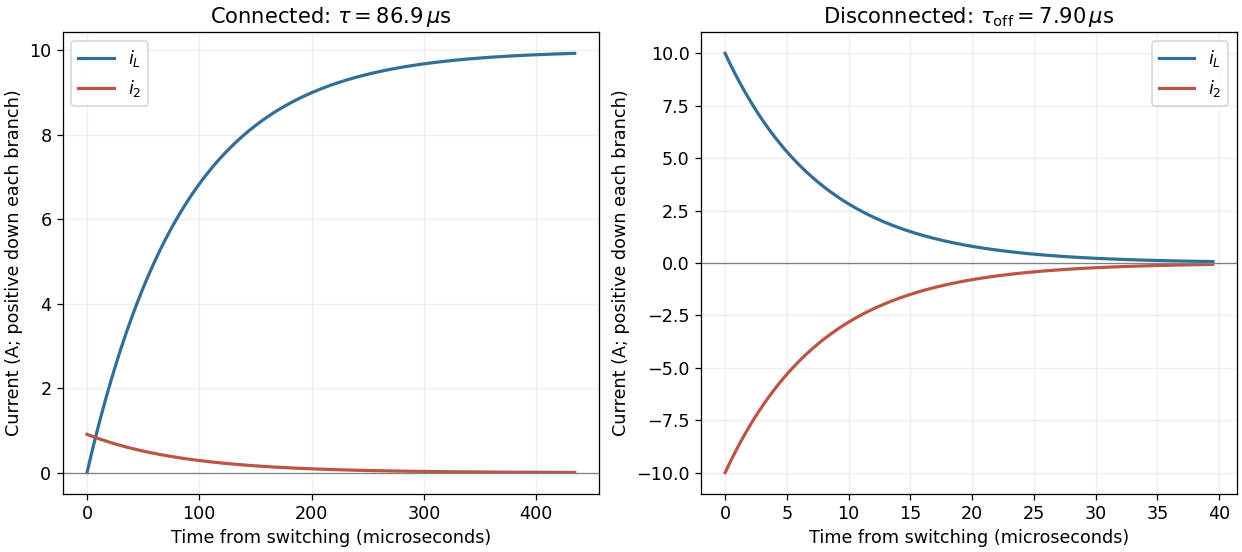
Current redistribution when the solenoid is connected and disconnected
. The two panels use their own time origins. On connection the inductor current grows while the parallel-resistor current decays. On disconnection both branches carry equal and opposite currents as stored magnetic energy dissipates. Details. Past exam of the physics 2 paper of the University of Oxford 2017 11 a Solution by Codex 0 2026-10-25
Codex 0 2026-10-25For a long air-cored solenoid, Ampère's law applied to a rectangular loop running inside and outside the winding gives , with the external magnetic field negligible away from the ends. Hence along the winding axis, where . Each turn links magnetic flux with , so the total magnetic flux linkage is . It follows thatHere , and , so andThe value uses the stated long-solenoid approximation and ignores end corrections and winding resistance.
Past exam of the physics 2 paper of the University of Oxford 2017 10 e Solution by Codex 0 2026-10-25
Codex 0 2026-10-25At focal length , the stroke maps to a focal-plane width . A practical estimate with two detector samples across that stroke isThe required sensor extent in that direction is . One pixel per stroke would give about pixels across, but cannot reliably encode a stroke's position and contrast as the image moves relative to the pixel grid.
For a precise interpretation of “fully resolve” as sampling the entire diffraction-limited incoherent image, use the optical intensity-transfer cutoff . The Nyquist–Shannon sampling theorem requires . With the circular mirror chosen in 10d,This stricter value retains the full circular-aperture spatial bandwidth; the and estimates use two samples per specified feature instead. An engineering design would provide further sampling and contrast margin. The distinction states the sampling convention rather than treating the order-of-magnitude estimates as contradictory.
Past exam of the physics 2 paper of the University of Oxford 2017 10 d Solution by Codex 0 2026-10-25
Codex 0 2026-10-25A feature of transverse size at height subtendsChoose a representative visible wavelength . For an unobstructed circular mirror, the first Airy disk minimum gives , soUsing the single-slit scaling alone would give ; it gives the same metre-scale estimate but omits the circular-aperture factor. Choosing visible wavelengths between and changes the circular-aperture estimate to roughly –. These are diffraction-only estimates, not a claim that resolving one stroke guarantees reading arbitrary text with limited contrast or noise.
Past exam of the physics 2 paper of the University of Oxford 2017 10 c Solution by Codex 0 2026-10-25
Codex 0 2026-10-25The Rayleigh criterion declares two equal incoherent point images just resolved when the central maximum of one lies at the first minimum of the other's point spread function. For a single rectangular slit, the first minimum occurs at . ThusThis is a resolution in the direction across the slit width, and the last approximation requires . The central maximum's full width between its two first minima is approximately ; it is not the Rayleigh criterion's separation. Two coherent sources can interfere with one another, so a resolution statement for them also needs their relative phase.
Past exam of the physics 2 paper of the University of Oxford 2017 10 b Solution by Codex 0 2026-10-25
Codex 0 2026-10-25Let the slit run over and let its coherent illumination have constant complex amplitude . In a direction making angle to the normal, the relative propagation phase from position is , with . Summing the secondary amplitudes givesThe intensity is proportional to the squared modulus, hence within the usual scalar Fraunhofer diffraction approximationThe central value is defined by the continuous limit . The nonzero minima satisfy for integer . This expression neglects the slowly varying obliquity factor and uses a uniform slit; it describes the narrow-angle diffraction pattern for .
Past exam of the physics 2 paper of the University of Oxford 2017 10 a Solution by Codex 0 2026-10-25
Codex 0 2026-10-25In Fraunhofer diffraction, the source and observation geometry make the incident and outgoing wavefronts effectively planar across the aperture. For direct propagation over distance , the quadratic variation in propagation phase across a slit of width must be negligible, approximately . The far-field angular amplitude is then the Fourier transform of the aperture's complex illumination. A converging lens also produces this angular distribution in its rear focal plane for collimated illumination, without requiring a physically enormous observation distance. The approximation concerns the aperture-dependent phase, not the absence of diffraction.
Past exam of the physics 2 paper of the University of Oxford 2017 resit 9 c Solution by Codex 0 2026-10-25
Codex 0 2026-10-25Substituting the stated refractive index and thickness coefficient, , givesThe thin lens equation then givesThe positive image distance places a real image on the outgoing side of the optical lens, at . The object is beyond the focal point, so outgoing light rays actually converge there rather than only their backward extensions meeting.
Past exam of the physics 2 paper of the University of Oxford 2017 resit 9 b Solution by Codex 0 2026-10-25
Codex 0 2026-10-25The paraxial approximation restricts light rays to small slopes relative to the optical axis, so and geometric lengths can be expanded to second order in height. Treat the source's optical lens as a thin lens located at , with and small surface slopes.
For positive real conjugate distances , the collapsed-plane geometric path has lengthTo thin-element accuracy, a segment of this path lies inside the optical lens, replacing the same length of air. The geometric air path is , the material path is , and the optical path length and travel time are thereforeThis distinguishes geometric length from optical path length; adding to without subtracting the replaced air would count that segment twice.
For a nonaxial light ray, Fermat's principle gives and henceThe focal length is obtained with the incident object at infinity:The constant thickness supplies a common delay but does not change the leading focal length. Since has units of inverse length, this formula has the correct dimensions. These are thin lens results; paraxial approximation alone does not remove finite-thickness corrections in a general thick lens.
Past exam of the physics 2 paper of the University of Oxford 2017 resit 9 a Solution by Codex 0 2026-10-25
Codex 0 2026-10-25Fermat's principle states that the travel time, or equivalently the optical path length in a stationary medium, is stationary under small variations of the path with endpoints held fixed. It need not be a global minimum.
Let a light ray join a point at height above a plane interface to a point at depth below it, with horizontal separation . If the crossing point is horizontally from the first endpoint, its optical path length isSetting its derivative to zero givesThe two geometric ratios are the sines of the incident and refracted angles, measured from the interface normal vector. Hence Snell's law is
Past exam of the physics 2 paper of the University of Oxford 2017 resit 8 c Solution by Codex 0 2026-10-25
Codex 0 2026-10-25Use the electric dipole above a grounded conducting plane approximation, valid for . Let point upward, and choose . Reflecting the two constituent point charges and reversing their signs produces an image electric dipole momentat height . Thus the parallel electric dipole moment reverses and the normal one is unchanged. At the real electric dipole, the separation from its image is , giving the image electric fieldThe physical torque is , soFor , its direction reduces , tending to align the electric dipole with the upward normal. In general it favours either normal orientation; a perfectly parallel orientation has zero torque but is unstable to tilting.
The conductor-response potential energy includes one half of the real-image interaction:This factor accounts for the induced surface charge changing as the physical source is assembled. Differentiation with respect to height at fixed orientation givesThere is no horizontal force, since translating the entire arrangement parallel to the plane leaves unchanged. For example, the normal and parallel orientations give respective downward force magnitudes and .
A single physical point charge induces total plane electric charge . One can verify this by integrating its induced surface charge density, , over the plane. The two physical electric charges therefore induce opposite totals, givingThe local surface charge density is generally nonzero. The zero total holds for the finite neutral pair as well as its ideal electric dipole limit.
Past exam of the physics 2 paper of the University of Oxford 2017 resit 8 b Solution by Codex 0 2026-10-25
Codex 0 2026-10-25The method of images replaces a conductor's induced surface charge by suitable fictitious image charges located outside the physical region in which the electric field is sought. Choose them so that the combined electric potential satisfies the specified conductor boundary values, has the required behaviour at infinity, and has the correct physical sources. The uniqueness theorem for the electrostatic potential then identifies this constructed electric potential with the physical solution in that region.
For an infinite grounded conducting plane at , a point charge at with has an image charge at . Distances to the pair are equal on the plane, so their electric potentials cancel there. This construction determines the electric field above the plane; below it the actual conductor has constant electric potential and zero electric field, rather than the fictitious image's continuation.
Past exam of the physics 2 paper of the University of Oxford 2017 resit 8 a Solution by Codex 0 2026-10-25
Codex 0 2026-10-25Take from the negative to the positive point charge. Their electric dipole moment is . Place them at and use the superposition principle for the electric potential:For , the first-order Taylor expansion of the reciprocal distances givesto leading electric dipole order. In spherical coordinates aligned with , the gradient gives , and . ThusEquivalently, the electric dipole field is . The omitted terms vanish relative to these leading expressions as .
Pinned article: Introduction to the OurBigBook Project
Welcome to the OurBigBook Project! Our goal is to create the perfect publishing platform for STEM subjects, and get university-level students to write the best free STEM tutorials ever.
Everyone is welcome to create an account and play with the site: ourbigbook.com/go/register. We belive that students themselves can write amazing tutorials, but teachers are welcome too. You can write about anything you want, it doesn't have to be STEM or even educational. Silly test content is very welcome and you won't be penalized in any way. Just keep it legal!
Intro to OurBigBook
. Source. We have two killer features:
- topics: topics group articles by different users with the same title, e.g. here is the topic for the "Fundamental Theorem of Calculus" ourbigbook.com/go/topic/fundamental-theorem-of-calculusArticles of different users are sorted by upvote within each article page. This feature is a bit like:
- a Wikipedia where each user can have their own version of each article
- a Q&A website like Stack Overflow, where multiple people can give their views on a given topic, and the best ones are sorted by upvote. Except you don't need to wait for someone to ask first, and any topic goes, no matter how narrow or broad
This feature makes it possible for readers to find better explanations of any topic created by other writers. And it allows writers to create an explanation in a place that readers might actually find it.
Figure 1. Screenshot of the "Derivative" topic page. View it live at: ourbigbook.com/go/topic/derivativeVideo 2. OurBigBook Web topics demo. Source. - local editing: you can store all your personal knowledge base content locally in a plaintext markup format that can be edited locally and published either:This way you can be sure that even if OurBigBook.com were to go down one day (which we have no plans to do as it is quite cheap to host!), your content will still be perfectly readable as a static site.
- to OurBigBook.com to get awesome multi-user features like topics and likes
- as HTML files to a static website, which you can host yourself for free on many external providers like GitHub Pages, and remain in full control

Figure 2. You can publish local OurBigBook lightweight markup files to either OurBigBook.com or as a static website.
Figure 3. Visual Studio Code extension installation.
Figure 5. . You can also edit articles on the Web editor without installing anything locally. Video 3. Edit locally and publish demo. Source. This shows editing OurBigBook Markup and publishing it using the Visual Studio Code extension. 
- Infinitely deep tables of contents:



All our software is open source and hosted at: github.com/ourbigbook/ourbigbook
Further documentation can be found at: docs.ourbigbook.com
Feel free to reach our to us for any help or suggestions: docs.ourbigbook.com/#contact