Topics (384k) Articles (398k) Users (410) Discussions (242) Comments (383) Files (13k) New article

Philip W. Anderson showed that disorder can prevent quantum transport in a lattice. His 1958 model assigns random energies to sites connected by hopping, demonstrating regimes in which diffusion fails even though motion between neighboring sites is allowed. The phenomenon now called Anderson localization depends on coherent wave propagation through a random system. It changed how an insulating response could be understood, connecting transport with the spatial character of quantum states.[ref]
Absence of Diffusion in Certain Random Lattices by Philip Warren Anderson. Physical Review 109, 1492 (1958), random-site model and absence-of-diffusion criterion

Portrait of Philip W. Anderson
. JdH; Yale University photograph, existing Commons crop. Creative Commons Attribution-ShareAlike 3.0 Unported selected from File's multiple available licenses; alternative GFDL/older CC licenses not needed., via Wikimedia Commons. Source.Nevill Mott investigated electronic conduction in disordered solids, including glasses and amorphous semiconductors. When states are localized, a carrier can move by thermally assisted hopping rather than ordinary propagation through an extended band. The useful hopping distance balances weak overlap at long range against the availability of energetically accessible states. This connects a temperature-dependent conductivity with both the spatial localization and energy distribution of electronic states.[ref]
Electrons in Glass by Nevill Francis Mott. Nobel lecture, localized states, mobility and hopping conduction

Portrait of Nevill Mott
. GFHund / Friedrich Hund estate; existing portrait crop. Creative Commons Attribution 3.0 Unported selected from the File's alternatives; separate GFDL option not used., via Wikimedia Commons. Source.Sheldon Glashow helped organize the weak interaction and electromagnetic interaction into a common gauge structure. Its neutral-current sector makes processes possible without changing the participating particle's electric charge. His lecture also explains why unwanted strangeness-changing neutral currents posed a consistency problem and how the developing quark framework addressed it. The work connects symmetry-based model building with the presence and suppression of specific experimentally observable reactions.[ref]
Towards a Unified Theory: Threads in a Tapestry by Sheldon Lee Glashow. 1979 authored lecture, electroweak synthesis and the strangeness-changing neutral-current problem
A physicist.[ref]
https://www.amacad.org/person/sheldon-lee-glashow. Independent professional identity

Portrait of Sheldon Glashow
. AIP Emilio Segrè Visual Archives, Segrè Collection; American Institute of Physics (AIP); existing Commons crop by Artem.G. American Institute of Physics attribution-only permission, via Wikimedia Commons. Source.James Cronin coauthored the 1964 discovery of CP violation in neutral kaon decays. Magnetic analysis and spark chambers reconstructed two charged tracks from a long-lived neutral beam. The small two-pion component was incompatible with the simple CP-conserving assignment of that state. A rare decay channel thus tested a fundamental symmetry of the weak interaction.[ref]
Evidence for the 2π Decay of the K₂⁰ Meson by James H. Christenson and others. 1964, apparatus, two-pion reconstruction and CP-symmetry implication

Portrait of James Cronin
. Rungbachduong. CC BY-SA 3.0, via Wikimedia Commons. Source.Kenneth G. Wilson developed the renormalization group as a quantitative method for studying a critical phenomenon. Repeatedly changing the length scale reorganizes a model's parameters, exposing fixed points and the perturbations that grow or shrink near them. With Michael Ellis Fisher, he calculated critical exponents by expanding about four spatial dimensions. This explains why systems with different microscopic details can share critical behavior and gives controlled corrections to simple mean-field predictions.[ref]
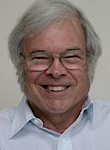
Portrait of Kenneth Geddes Wilson
. Georg Bednorz and K. Alex Müller investigated oxide compositions that displayed a striking electrical resistivity decrease on cooling. Their 1986 report described oxygen-deficient barium-lanthanum-copper compounds, with a superconducting-like onset in the 30 kelvin range. Because the samples contained several phases, a connected conducting path could dominate electrical resistance before the whole specimen behaved uniformly. The work connected materials chemistry and electrical measurements in the emergence of high-temperature superconductivity.[ref]
Possible high Tc superconductivity in the Ba-La-Cu-O system by Johannes Georg Bednorz and Karl Alexander Müller. Zeitschrift für Physik B 64, 189–193 (1986), abstract and multiphase interpretation
A solid-state physicist who researched metallic oxides at IBM's Zurich laboratory.[ref]
Professional profile of Johannes Georg Bednorz. Independent professional identity

Portrait of Georg Bednorz
. Adrian Tync. CC BY-SA 4.0, via Wikimedia Commons. Source.K. Alex Müller and Georg Bednorz found evidence for superconductivity in copper-oxide compounds at unexpectedly high temperatures. Their 1986 barium-lanthanum-copper-oxygen samples contained multiple phases and showed a large electrical resistivity drop with onset in the 30 kelvin range. The strong dependence on applied current and sample connectivity required cautious interpretation. This initial result redirected the search for high-temperature superconductors toward chemically complex oxides.[ref]
A solid-state physicist who carried out physics research at IBM.[ref]
Professional profile of Karl Alexander Müller. Independent professional identity

Portrait of K. Alex Müller
. Ibmzrl, IBM Research – Zurich; existing Commons crop by Wabbuh. CC BY 3.0, via Wikimedia Commons. Source.Leon M. Lederman coauthored the experiment showing that neutrinos associated with muons behave differently from those associated with electrons. The detector compared long charged tracks with electron-like showers after a shielded accelerator beam crossed it. The result established a second neutrino flavor through the identity of the produced lepton.[ref]
Observation of High-Energy Neutrino Reactions and the Existence of Two Kinds of Neutrinos by G. Danby and others. 1962, charged-track and shower comparison and two-neutrino conclusion
An experimental physicist who directed the Nevis laboratory and led accelerator experiments.[ref]
Professional profile of Leon Max Lederman. Independent professional identity

Portrait of Leon M. Lederman
. ENERGY.GOV (US Department of Energy). Public domain (US Department of Energy employee work). Source usage terms, via Wikimedia Commons. Source.David Morris Lee coauthored experiments establishing new low-temperature phases of liquid helium-3. Changes in nuclear magnetic resonance frequency and absorption below 3 millikelvin revealed a change in the liquid's magnetic response. These measurements supplied evidence beyond an anomaly in a cooling curve and helped discriminate among possible physical interpretations. The experiments opened a setting in which pairing, magnetic response and fluid motion can be studied together.[ref]
New Magnetic Phenomena in Liquid He3 below 3 mK by Douglas Dean Osheroff and others. Physical Review Letters 29, 920 (1972), abstract and magnetic observations
A physicist whose Cornell research included helium at very low temperatures.[ref]
David Lee by Cornell University Department of Physics. Independent professional identity

Portrait of David Lee (physicist)
. Epbernard. CC BY-SA 3.0, via Wikimedia Commons. Source.Douglas Osheroff coauthored discovery experiments on the low-temperature phases of helium-3. Anomalies first seen during cooling prompted further measurements rather than immediately identifying the phase correctly. Subsequent nuclear magnetic resonance observations in a Pomeranchuk cell linked changes in the liquid's magnetic response to the new phases. Combining thermodynamic behavior with a separate magnetic probe helped establish that the surprising signal belonged to a new quantum state of the liquid.[ref]
Superfluidity in 3He: Discovery and Understanding by Douglas Dean Osheroff. Nobel lecture, initial pressure anomaly and subsequent magnetic experiments
A physicist who conducted low-temperature research at Bell Laboratories and Stanford.[ref]
Middle-of-night call signals new Nobel by David Salisbury. Independent professional identity

Portrait of Douglas Osheroff
. Silin2005; May 2005. Public domain: released worldwide by the copyright holder (PD-self). Source usage terms, via Wikimedia Commons. Source.Robert B. Laughlin proposed correlated many-electron wave functions explaining important states of the fractional quantum Hall effect. The variational construction strongly suppresses configurations in which electrons approach one another while keeping them within the lowest Landau level. Its excited states behave as localized disturbances carrying a fraction of the electron electric charge. The theory connects a microscopic correlated state with an incompressible quantum fluid, rather than interpreting the fractional plateau as an ordinary filled electron band.[ref]
Anomalous Quantum Hall Effect: An Incompressible Quantum Fluid with Fractionally Charged Excitations by Robert Laughlin. Physical Review Letters 50, 1395 (1983), ground-state and excited-state variational construction

Portrait of Robert B. Laughlin
. Markus Pössel, own photograph at the 62nd Lindau Nobel Laureate Meeting, 6 July 2012. Creative Commons Attribution-Share Alike 3.0 Unported., via Wikimedia Commons. Source.Horst Ludwig Störmer coauthored measurements of a new quantum Hall effect plateau at one-third filling of the lowest Landau level. The high-mobility two-dimensional electron sample showed Hall electrical resistance together with reduced longitudinal electrical resistance. The 1982 report tentatively discussed crystalline electronic explanations; the observation itself was the decisive experimental result. It motivated theories in which interactions organize electrons into a correlated quantum fluid.[ref]
Two-Dimensional Magnetotransport in the Extreme Quantum Limit by Daniel Chee Tsui and others. Physical Review Letters 48, 1559 (1982), abstract and proposed interpretation

Portrait of Horst Ludwig Störmer
. Mark Pellegrini. CC BY-SA 3.0, via Wikimedia Commons. Source.Daniel C. Tsui coauthored the 1982 observation of a fractional quantum Hall effect. High-mobility electrons confined to two dimensions exhibited a Hall plateau with electrical resistance when the lowest spin-polarized Landau level was one-third filled. A simultaneous minimum in longitudinal electrical resistance distinguished a collective electronic state from an ordinary smooth change in transport. The result created a problem beyond the noninteracting integer Hall picture.[ref]
Two-Dimensional Magnetotransport in the Extreme Quantum Limit by Daniel Chee Tsui and others. Physical Review Letters 48, 1559 (1982), observed one-third-filling plateau
A physicist who studied condensed matter at Princeton.[ref]
Professional profile of Daniel Chee Tsui. Independent professional identity

Portrait of Daniel C. Tsui
. Istvan Hargittai, photograph of Daniel C. Tsui at Princeton in 1999; existing Commons crop from the three-person figure reproduced in Paradigms and paradoxes: fractional electron charge (2022). Creative Commons Attribution 4.0 International., via Wikimedia Commons. Source.Gerard 't Hooft showed how theories with massive gauge fields described by Yang-Mills theory generated through spontaneous symmetry breaking could support consistent renormalization. His 1971 paper constructs models, derives Feynman rules and checks the associated Ward identities. Controlling these identities while removing divergent intermediate expressions is what permits finite higher-order predictions without losing the theory's gauge consistency. The work made spontaneously broken gauge theories usable for precision particle calculations.[ref]
Renormalizable Lagrangians for massive Yang-Mills fields by Gerardus 't Hooft. 1971 abstract: renormalizable models, path-integral rules, Ward identities and unitary spectrum
A physicist working on theoretical physics at Utrecht.[ref]
Gerard 't Hooft homepage by Gerardus 't Hooft. Independent professional identity

Portrait of Gerard 't Hooft
. Wammes Waggel, own photograph. Creative Commons Attribution-ShareAlike 3.0 Unported chosen from dual CC/GFDL licenses., via Wikimedia Commons. Source.Zhores Alferov developed double heterostructure semiconductor devices that confine carriers in a narrow active region. Different band gaps inhibit carrier escape, while refractive-index contrast can guide the optical field through the same region. Bringing carriers and light together increases useful gain and reduces the current needed for laser operation. His account connects the heterostructure concept with practical semiconductor lasers and other electronic and optoelectronic devices.[ref]
Nobel Lecture: The double heterostructure concept and its applications in physics, electronics, and technology by Zhores Ivanovich Alferov. Reviews of Modern Physics 73, 767 (2001), carrier/optical confinement and device applications
A physicist who studied semiconductor heterostructures at the Ioffe institute.[ref]
Professional profile of Zhores Ivanovich Alferov. Independent professional identity

Portrait of Zhores Alferov
. Russian Presidential Press and Information Office (www.kremlin.ru); crop by user:Pruneau. CC BY 4.0, via Wikimedia Commons. Source.Alexei Abrikosov showed how a type-II superconductor can admit magnetic flux while remaining superconducting over most of its volume. In the mixed state, circulating supercurrents surround vortex cores where the superconducting order parameter is suppressed. An array of these vortices can minimize the free energy between the lower and upper critical magnetic fields. The resulting vortex lattice explains a regime that lies between complete magnetic-field expulsion and destruction of superconductivity.[ref]
Nobel Lecture: Type-II superconductors and the vortex lattice by Alexei Alexeyevich Abrikosov. mixed-state solution, vortex currents and critical fields
A physicist who studied superconductivity at Argonne.[ref]
Alexei Alexeyevich Abrikosov by Michael R. Norman and Andrey A. Varlamov. Independent professional identity

Portrait of Alexei Abrikosov (physicist)
. ANL; 10 December 2003. Public domain in the United States: U.S. Department of Energy employee work. Source usage terms, via Wikimedia Commons. Source.Vitaly Ginzburg and Lev Landau described superconductivity through a spatially varying complex order parameter coupled to an electromagnetic vector potential. Their Ginzburg-Landau theory balances the cost of changing the order parameter with magnetic-field energy and the tendency to form a superconducting state. It predicts characteristic coherence and penetration lengths and supports analysis of surfaces, currents and nonuniform states. The theory is phenomenological: it can organize measurable behavior near a transition without first deriving the microscopic pairing interaction.[ref]
A physicist who headed the Lebedev institute’s theoretical physics department from 1971 to 1988.[ref]
Vitaly Lazarevich Ginzburg by Lev P. Pitaevskii. Independent professional identity

Portrait of Vitaly Ginzburg
. Woodruff T. Sullivan III; NRAO/AUI Archives, Sullivan Collection; rights NRAO/AUI/NSF. CC BY 4.0, via Wikimedia Commons. Source.Anthony Leggett developed a theoretical account of the newly discovered superfluid phases of helium-3. Unlike helium-4 atoms, helium-3 atoms are fermions, so their superfluid state involves correlated pairing. The internal spin and orbital structure of the pairs allows several distinct ordered phases. His account connected this structure with unusual nuclear magnetic resonance observations, using magnetic response to distinguish possible forms of the condensate. The work illustrates how a small interaction can make the internal symmetry of a quantum fluid experimentally visible.[ref]
Nobel Lecture: Superfluid 3He: the early days as seen by a theorist by Anthony James Leggett. Nobel lecture, theoretical interpretation of pairing and NMR observations in 1972–1973
A physicist who studied superfluidity and macroscopic quantum mechanics at Illinois.[ref]
Tony Leggett, Nobel laureate and theoretical physicist, dies by Lois Yoksoulian. Independent professional identity

Portrait of Anthony Leggett
. Kenneth C. Zirkel; existing Commons crop by Wabbuh. Creative Commons Attribution-ShareAlike 3.0 Unported., via Wikimedia Commons. Source.Eric Allin Cornell and Carl Wieman developed the trapped-gas experiment that produced a dilute rubidium Bose-Einstein condensate in 1995. After optical preparation, evaporation reduced the sample's temperature enough for a macroscopically populated low-energy component to appear.
Measuring the distribution after release revealed a sharply concentrated component together with a broader thermal cloud. Its emergence across the transition supplied an observational test of quantum degeneracy rather than merely a claim that the gas had become very cold.[ref]
Observation of Bose-Einstein Condensation in a Dilute Atomic Vapor by M. H. Anderson and others. Abstract and density-distribution measurements near the condensation threshold

Portrait of Eric Allin Cornell
. Betsythedevine; 2 June 2015; existing Commons crop by Wabbuh. CC BY-SA 4.0, via Wikimedia Commons. Source.David Gross co-discovered asymptotic freedom with Frank Wilczek. Their calculation showed that a broad class of Non-Abelian gauge theories approaches free-field behavior at very short distances, with calculable logarithmic deviations. This gave a theoretical route from quantum chromodynamics to quantitative high-energy predictions and helped explain why deep inelastic scattering could reveal nearly free pointlike constituents inside strongly bound hadrons.[ref]
A physicist working on quantum chromodynamics.[ref]
Professional profile of David J. Gross. Independent professional identity

Portrait of David Gross
. NextEinstein; existing crop by Finemann. Creative Commons Attribution 2.0 Generic., via Wikimedia Commons. Source. Pinned article: Introduction to the OurBigBook Project
Welcome to the OurBigBook Project! Our goal is to create the perfect publishing platform for STEM subjects, and get university-level students to write the best free STEM tutorials ever.
Everyone is welcome to create an account and play with the site: ourbigbook.com/go/register. We belive that students themselves can write amazing tutorials, but teachers are welcome too. You can write about anything you want, it doesn't have to be STEM or even educational. Silly test content is very welcome and you won't be penalized in any way. Just keep it legal!
Intro to OurBigBook
. Source. We have two killer features:
- topics: topics group articles by different users with the same title, e.g. here is the topic for the "Fundamental Theorem of Calculus" ourbigbook.com/go/topic/fundamental-theorem-of-calculusArticles of different users are sorted by upvote within each article page. This feature is a bit like:
- a Wikipedia where each user can have their own version of each article
- a Q&A website like Stack Overflow, where multiple people can give their views on a given topic, and the best ones are sorted by upvote. Except you don't need to wait for someone to ask first, and any topic goes, no matter how narrow or broad
This feature makes it possible for readers to find better explanations of any topic created by other writers. And it allows writers to create an explanation in a place that readers might actually find it.
Figure 1. Screenshot of the "Derivative" topic page. View it live at: ourbigbook.com/go/topic/derivativeVideo 2. OurBigBook Web topics demo. Source. - local editing: you can store all your personal knowledge base content locally in a plaintext markup format that can be edited locally and published either:This way you can be sure that even if OurBigBook.com were to go down one day (which we have no plans to do as it is quite cheap to host!), your content will still be perfectly readable as a static site.
- to OurBigBook.com to get awesome multi-user features like topics and likes
- as HTML files to a static website, which you can host yourself for free on many external providers like GitHub Pages, and remain in full control

Figure 2. You can publish local OurBigBook lightweight markup files to either OurBigBook.com or as a static website.
Figure 3. Visual Studio Code extension installation.
Figure 5. . You can also edit articles on the Web editor without installing anything locally. Video 3. Edit locally and publish demo. Source. This shows editing OurBigBook Markup and publishing it using the Visual Studio Code extension. 
- Infinitely deep tables of contents:




All our software is open source and hosted at: github.com/ourbigbook/ourbigbook
Further documentation can be found at: docs.ourbigbook.com
Feel free to reach our to us for any help or suggestions: docs.ourbigbook.com/#contact