Topics (384k) Articles (398k) Users (410) Discussions (242) Comments (383) Files (13k) New article

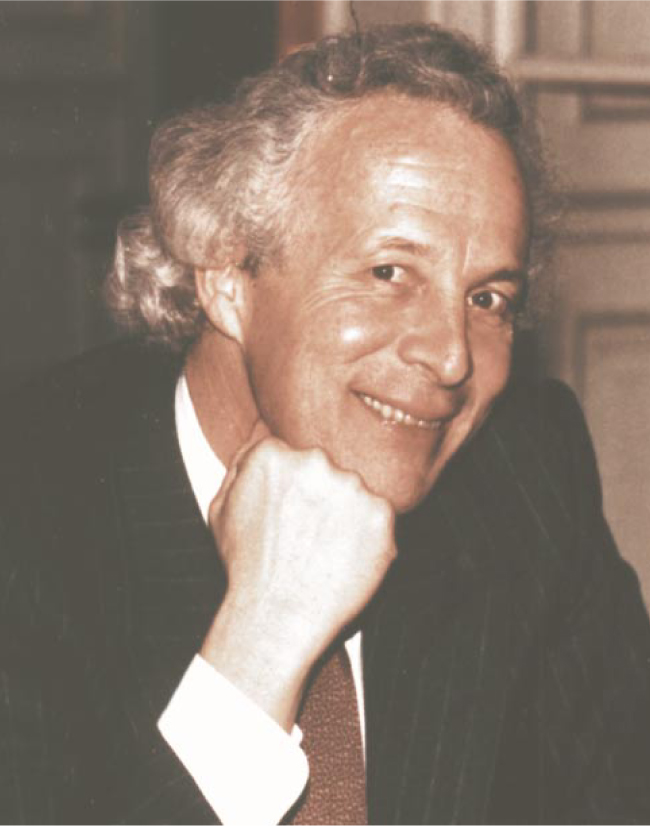
Ilya Frank worked on the experiments and theoretical interpretation of Cherenkov radiation. With Igor Tamm, he explained in 1937 why radiation from a sufficiently fast charged particle adds coherently in a medium. The emission direction is linked to the particle's speed and the refractive index, so an observed optical pattern can carry particle-identification information. His later work also established a substantial programme in neutron physics.[ref]
Ilya Mikhailovich Frank: first FLNP JINR director, laureate of Nobel Prize by Joint Institute for Nuclear Research. Participation in the liquid-irradiation work, 1937 theory and later neutron-physics programme
A physicist.[ref]
https://www.nobelprize.org/prizes/physics/1958/frank/biographical/. Independent professional profile

Portrait of Ilya Frank
. Nobel Foundation. Public domain in Sweden per Commons PD-Sweden photo tag; separate U.S. status tag not present on inspected File. Source usage terms, via Wikimedia Commons. Source.Igor Tamm and Ilya Frank explained the coherent radiation emitted when a charged particle outruns the phase velocity of light in a material. The Cherenkov radiation condition is for refractive index , without requiring a particle to exceed the vacuum speed of light. Their theory connected the observed optical emission with a definite speed threshold, making it useful for identifying fast particles.[ref]
Ilya Mikhailovich Frank: first FLNP JINR director, laureate of Nobel Prize by Joint Institute for Nuclear Research. 1937 joint theoretical explanation of the observed Vavilov–Cherenkov effect; modern threshold notation
A physicist.[ref]
https://www.nobelprize.org/prizes/physics/1958/tamm/biographical/. Independent professional profile

Portrait of Igor Tamm
. CBS press photograph, identifier ner18397; individual photographer unidentified; existing Commons crop. Commons PD-US-no-notice claim: US publication during 1931–1977 without notice. Other jurisdictions may retain protection., via Wikimedia Commons. Source.Thomas Ypsilantis coauthored the 1955 identification of the antiproton. Selecting a negative particle's momentum was insufficient because lighter negative particles were much more abundant. Measuring its speed as well supplied a mass test. The experiment combined magnetic selection, timed scintillation signals and velocity-sensitive Cherenkov detectors, connecting complementary measurements to a particle identity rather than relying on negative electric charge alone.[ref]
The early antiproton work by Owen Chamberlain. 1959 authored account, 1955 coauthor list and momentum/velocity discrimination
A physicist.[ref]
https://physicstoday.aip.org/obituaries/thomas-john-ypsilantis. Independent professional profile
Portrait of Thomas John Ypsilantis
. Donald Glaser invented the bubble chamber to record charged-particle trajectories in a dense medium. A pressure change brings a liquid into a superheated state; deposited energy along an ionizing track allows bubbles to form. Photographing those bubbles turns a brief microscopic passage into geometry that can be measured repeatedly. His own biographical account explains the search for a detector that combined the advantages of a dense target with visible particle tracks.[ref]
A physicist.[ref]
Donald Glaser: Biography Submitted by Dr. Glaser to the Nobel Committee by Donald Arthur Glaser. Independent professional profile

Portrait of Donald Glaser
. Lawrence Berkeley Laboratory image library, image 96703552 / XBD 9607-03552.TIF; individual photographer not identified. Commons PD-USGov claim under 17 USC 105 for federal official-duty work; not a declaration about all national-laboratory photographs., via Wikimedia Commons. Source.Rudolf Mössbauer discovered that some gamma ray emission and absorption events in a solid occur without changing the crystal's phonon state. The momentum can then be transferred to the whole lattice, with an effective recoil energy far smaller than for a free nucleus. This permits extremely narrow nuclear emission and absorption lines to overlap, producing the Mössbauer effect. The narrow resonance makes very small energy shifts observable, including shifts due to the local electronic and magnetic environment of a nucleus.[ref]
A physicist.[ref]
https://www.nobelprize.org/laureate/76. Independent professional profile
[ref]https://www.e15.ph.tum.de/staff/professors/prof_moessbauer/index.html. Independent professional profile

Portrait of Rudolf Mössbauer
. Unknown photographer; The Big T 1962, California Institute of Technology yearbook; existing Commons extract. Commons PD-US-no-notice claim: US publication during 1931–1977 without notice. Other jurisdictions may retain protection., via Wikimedia Commons. Source.J. Hans D. Jensen developed a nuclear shell model in which strong spin-orbit coupling reorganizes the levels available to protons and neutrons. The mechanism connects the observed nuclear magic numbers with gaps in a one-particle spectrum: filling a level with total angular momentum accommodates magnetic substates. His historical lecture describes how measured nuclear spins, binding patterns and other spectroscopic evidence constrained the model, rather than treating the choice of level ordering as purely mathematical.[ref]
A physicist.[ref]
https://www.physik.uni-heidelberg.de/historisches?lang=de. Independent professional profile

Portrait of J. Hans D. Jensen
. Nobel Foundation. Public domain in Sweden per Commons PD-Sweden photo tag; separate U.S. status tag not present on inspected File. Source usage terms, via Wikimedia Commons. Source.Eugene Wigner and Gregory Breit connected the capture of slow neutrons with resonant excited states of a target atomic nucleus. A capture probability can change rapidly when the projectile energy crosses one of these states. Their treatment relates the peak to the coupling into the intermediate state and its possible decay channels. It therefore explains why a small interval of incident energies can contain pronounced structure, rather than a smooth response determined by the target's size alone.[ref]
Capture of Slow Neutrons by Gregory Breit and Eugene Wigner. 1936 abstract and resonance treatment of slow-neutron absorption
A physicist.[ref]
https://phy.princeton.edu/about/history/faculty-history/princeton-physics-nobel-laureates. Independent professional profile

Portrait of Eugene Wigner
. Nobel Foundation. Public domain in Sweden per Commons PD-Sweden photo tag; separate U.S. status tag not present on inspected File. Source usage terms, via Wikimedia Commons. Source.Charles H. Townes, James Power Gordon and Herbert Jack Zeiger developed the molecular maser, using stimulated emission to amplify or generate coherent microwaves. Their report treats the same device as an amplifier, oscillator and spectrometer. Preparing the molecular excitation and providing resonant feedback turns microscopic transitions between energy levels into a macroscopic signal. The measured frequency stability and narrow spectroscopic resolution showed why the maser could serve as both an instrument for studying molecules and a frequency reference.[ref]
The Maser—New Type of Microwave Amplifier, Frequency Standard, and Spectrometer by James Power Gordon and others. 1955 abstract and molecular-generator mechanism: oscillator stability, spectroscopy and amplification
A physicist.[ref]
https://www.nobelprize.org/prizes/physics/1964/townes/biographical/. Independent professional profile

Portrait of Charles H. Townes
. Woodruff T. Sullivan III; NRAO/AUI Archives, Sullivan Collection; rights NRAO/AUI/NSF. Creative Commons Attribution 4.0 International, with NRAO's displayed source-credit/non-endorsement and third-party-rights qualifications., via Wikimedia Commons. Source.Nikolay Basov analyzed coherent molecular amplification with Alexander Prokhorov. Their 1956 maser theory relates the generated frequency to both the molecular transition and the cavity response, showing why a molecular oscillator can serve as a precise frequency reference. Below the condition for self-sustained oscillation, the same system can amplify an external microwave input. Distinguishing an amplifier from an oscillator therefore depends on feedback and loss as well as molecular excitation.[ref]
Theory of the Molecular Generator and Molecular Power Amplifier by Nicolay Gennadiyevich Basov and Aleksandr Mikhailovich Prokhorov. 1956, sections 2–3: frequency, self-excitation and molecular microwave amplification

Portrait of Nikolay Basov
. Nobel foundation, 1964. Public domain in Sweden (PD-Sweden photograph). Source usage terms, via Wikimedia Commons. Source.Alexander Prokhorov and Nikolay Basov developed a theory of the molecular maser. Their analysis combines a prepared molecular beam, stimulated emission and feedback from a resonant cavity. Oscillation begins only when the molecular radiation supplies more power than the cavity and load lose. Including saturation determines a finite steady amplitude. The calculation connects molecular energy levels with practical requirements for a stable microwave oscillator.[ref]
Theory of the Molecular Generator and Molecular Power Amplifier by Nicolay Gennadiyevich Basov and Aleksandr Mikhailovich Prokhorov. 1956, introduction and generator theory: self-excitation threshold and saturation
A physicist.[ref]
https://quantum-electronics.ru/wp-content/uploads/2016/en/16172.pdf. Independent professional profile

Portrait of Alexander Prokhorov
. Nobel foundation. Public domain in Sweden (PD-Sweden, as stated on Commons). Source usage terms, via Wikimedia Commons. Source.Julian Schwinger calculated the leading radiative correction to the electron's magnetic moment in quantum electrodynamics. In modern notation, its anomalous part is , where is the fine-structure constant. The small correction could be compared with magnetic and spectroscopic measurements. His 1948 paper therefore turned the interaction of the electron with the quantized field into a precise, finite prediction beyond the simplest magnetic-moment value.[ref]
On Quantum-Electrodynamics and the Magnetic Moment of the Electron by Julian Seymour Schwinger. 1948, additional spin magnetic moment, comparison with hyperfine and magnetic measurements
A physicist.[ref]
https://community.harvard.edu/event/memories-julian-celebration-centennial-birth-julian-schwinger. Independent professional profile

Portrait of Julian Schwinger
. AIP Emilio Segrè Visual Archives, Segrè Collection; American Institute of Physics (AIP). American Institute of Physics attribution-only permission, via Wikimedia Commons. Source.Shin'ichirō Tomonaga developed a relativistically consistent formulation of quantum electrodynamics and a method of renormalization. The physical problem was that naive corrections to an electron's interaction with the electromagnetic field produced divergent intermediate expressions. Relating the theory's parameters to measured mass and electric charge allowed finite predictions to be extracted. His own recollections explain how the relativistic formulation and the treatment of those divergences developed into a calculable quantum theory.[ref]
Development of Quantum Electrodynamics: Personal recollections by Sin-Itiro Tomonaga. 1966 authored lecture, relativistic formulation, electron self-energy and renormalization

Portrait of Shin'ichirō Tomonaga
. Nobel foundation. Public domain in Sweden (PD-Sweden, as stated on Commons). Source usage terms, via Wikimedia Commons. Source.Theodore Maiman demonstrated stimulated optical emission from ruby in 1960. Optical pumping transferred energy into the chromium ions in the crystal, producing the conditions for stimulated emission near 694 nm. This showed that a fluorescent solid could act as an optical amplifier and oscillator, carrying the principle of the maser into the visible spectrum. The result tied the material's energy levels to a practical laser source.[ref]
Stimulated Optical Radiation in Ruby by Theodore Harold Maiman. 1960 letter, optical pumping of chromium in corundum and emission at 6943 angstroms

Portrait of Theodore Maiman
. Unknown (Associated Press). Public domain in the United States (publication without copyright notice, as stated on Commons). Source usage terms, via Wikimedia Commons. Source.Lev Landau developed descriptions of interacting quantum fluids through their elementary excitations. In the Landau critical velocity argument, creating an excitation of energy in flowing superfluid changes the relevant energy by . Requiring this to remain positive yields the ideal bound ; additional processes can limit actual flow at lower speeds.[ref]
The Theory of Superfluidity of Helium II by Lev Davidovich Landau. 1941 excitation-spectrum treatment; ideal flow criterion in modern notation
His Fermi liquid theory explains how strongly interacting fermions can retain long-lived low-energy quasiparticles, with interactions modifying their effective mass and collective response.[ref]The Theory of a Fermi Liquid by Lev Davidovich Landau. 1956 paper, introduction and energy as a functional of the distribution
A physicist.[ref]
https://kapitza.ras.ru/history/LDLandau/main.html. Independent professional profile

Portrait of Lev Landau
. Nobel Foundation; individual photographer unidentified. Commons PD-Sweden photograph designation; File requests a separate US public-domain tag. Not a worldwide clearance., via Wikimedia Commons. Source.Pyotr Kapitsa measured extraordinarily small flow resistance in liquid helium below its lambda transition. Confining the flow to narrow passages made the failure of ordinary viscous-flow expectations experimentally striking. The observation helped establish superfluidity as a distinct quantum-fluid phenomenon. In a modern two-component interpretation, the low-resistance response does not mean that every component of the liquid has lost all viscous behavior; it motivates separating normal and superfluid contributions.[ref]
Viscosity of Liquid Helium below the λ-Point by Pyotr Leonidovich Kapitza. 1938 report, narrow-passage liquid-helium flow

Portrait of Pyotr Kapitsa
. Unknown photographer (Mondadori Publishers / Archivio Mondadori); 1930s; existing Commons adjustment by Materialscientist. Public domain in Italy: photograph copyright expired (PD-Italy). Source usage terms, via Wikimedia Commons. Source.Hannes Alfvén predicted a wave coupling the motion of an electrically conducting fluid to a background magnetic field. In an Alfvén wave, bent magnetic-field lines provide a restoring effect while the material's inertia resists the displacement.
Linearizing ideal magnetohydrodynamics for a transverse disturbance along a uniform field gives the propagation speed , with background field strength , vacuum permeability and mass density . A stronger field increases the restoring effect; greater material inertia slows propagation. The idea connects plasma dynamics in the laboratory with the behavior of astrophysical magnetic structures.[ref]
Existence of Electromagnetic-Hydrodynamic Waves by Hannes Olof Gösta Alfvén. 1942 paper, combined fluid–magnetic disturbance and propagation-speed relation

Portrait of Hannes Alfvén
. Unknown author. Public domain in Sweden (PD-Sweden, as stated on Commons). Source usage terms, via Wikimedia Commons. Source.Leon Cooper showed that a filled Fermi sea changes the physics of electron pairing. In the idealized problem, even a weak attractive interaction in an energy shell above the Fermi surface can produce a bound pair. The result concerns electrons in the presence of the filled sea, so it is not simply the problem of two isolated electrons in empty space. This instability supplied a key microscopic ingredient for BCS theory and the Cooper pair description of superconductivity.[ref]
Bound Electron Pairs in a Degenerate Fermi Gas by Leon Neil Cooper. Physical Review 104, 1189 (1956), bound-pair problem above a degenerate sea
A physicist.[ref]
Professional profile of Leon Neil Cooper. Independent professional profile
[ref]https://physics.brown.edu/news/2024-10-30/leon. Independent professional profile

Portrait of Leon Cooper
. Associated Press; 20 October 1972; existing Commons crop by Wabbuh. Public domain in the United States: publication without copyright notice (PD-US-no-notice). Source usage terms, via Wikimedia Commons. Source.Clifford Shull and J. Samuel Smart used neutron diffraction to detect antiferromagnetism. Oppositely oriented magnetic sublattices can have no net bulk magnetization, yet their spatial order produces a distinct scattering pattern because neutrons interact with magnetic moments. The experiment therefore probes internal magnetic arrangement, not just the total magnetic moment of a sample. It established neutron scattering as a way to reveal ordered magnetism that bulk magnetic measurements can conceal.[ref]
Detection of Antiferromagnetism by Neutron Diffraction by Clifford Glenwood Shull and J. Samuel Smart. Physical Review 76, 1256–1257 (1949), magnetic diffraction from opposing sublattices
A physicist who developed neutron scattering experiments and became a professor of physics at MIT.[ref]
Clifford Glenwood Shull 1915–2001. Independent professional research and appointment; see profile text

Portrait of Clifford Shull
. U.S. Department of Energy (ENERGY.GOV); existing crop by Wabbuh. Public domain in the United States (U.S. Department of Energy official-duty work; Commons PD-US-DOE). Source usage terms, via Wikimedia Commons. Source.Aage Bohr developed a description connecting individual nucleon motion with collective nuclear rotational bands and changes of nuclear shape. A deformed atomic nucleus has an intrinsic orientation, while its laboratory quantum states have definite total angular momentum. Quantizing the collective orientation produces sequences of excited levels, or nuclear rotational bands. Their energies and electric quadrupole transitions supply complementary tests of the connection between the intrinsic shape and the observed spectrum.[ref]
Rotational Motion in Nuclei by Aage Niels Bohr. Nobel lecture, p. 223, General Theory of Rotation; pp. 217 and 225, spectra and quadrupole-transition tests
A physicist.[ref]
https://nbarchive.ku.dk/about_us/people/in-memoriam/aage-bohr/. Independent professional identity

Portrait of Aage Bohr
. GFHund. CC BY 3.0, via Wikimedia Commons. Source.Samuel C. C. Ting coauthored the 1974 observation of the narrow particle signal called J. A precise pair spectrometer measured the invariant mass of electron-Positron pairs produced when protons struck beryllium. A sharp feature near 3.1 GeV stood above the smooth background, indicating a new state rather than an arbitrary individual collision. This illustrates how a short-lived particle can be identified through reconstructed decay products.[ref]

Portrait of Samuel C. C. Ting
. DLR German Aerospace Center. CC BY 2.0, via Wikimedia Commons. Source. Pinned article: Introduction to the OurBigBook Project
Welcome to the OurBigBook Project! Our goal is to create the perfect publishing platform for STEM subjects, and get university-level students to write the best free STEM tutorials ever.
Everyone is welcome to create an account and play with the site: ourbigbook.com/go/register. We belive that students themselves can write amazing tutorials, but teachers are welcome too. You can write about anything you want, it doesn't have to be STEM or even educational. Silly test content is very welcome and you won't be penalized in any way. Just keep it legal!
Intro to OurBigBook
. Source. We have two killer features:
- topics: topics group articles by different users with the same title, e.g. here is the topic for the "Fundamental Theorem of Calculus" ourbigbook.com/go/topic/fundamental-theorem-of-calculusArticles of different users are sorted by upvote within each article page. This feature is a bit like:
- a Wikipedia where each user can have their own version of each article
- a Q&A website like Stack Overflow, where multiple people can give their views on a given topic, and the best ones are sorted by upvote. Except you don't need to wait for someone to ask first, and any topic goes, no matter how narrow or broad
This feature makes it possible for readers to find better explanations of any topic created by other writers. And it allows writers to create an explanation in a place that readers might actually find it.
Figure 1. Screenshot of the "Derivative" topic page. View it live at: ourbigbook.com/go/topic/derivativeVideo 2. OurBigBook Web topics demo. Source. - local editing: you can store all your personal knowledge base content locally in a plaintext markup format that can be edited locally and published either:This way you can be sure that even if OurBigBook.com were to go down one day (which we have no plans to do as it is quite cheap to host!), your content will still be perfectly readable as a static site.
- to OurBigBook.com to get awesome multi-user features like topics and likes
- as HTML files to a static website, which you can host yourself for free on many external providers like GitHub Pages, and remain in full control

Figure 2. You can publish local OurBigBook lightweight markup files to either OurBigBook.com or as a static website.
Figure 3. Visual Studio Code extension installation.
Figure 5. . You can also edit articles on the Web editor without installing anything locally. Video 3. Edit locally and publish demo. Source. This shows editing OurBigBook Markup and publishing it using the Visual Studio Code extension. 
- Infinitely deep tables of contents:




All our software is open source and hosted at: github.com/ourbigbook/ourbigbook
Further documentation can be found at: docs.ourbigbook.com
Feel free to reach our to us for any help or suggestions: docs.ourbigbook.com/#contact