Topics (384k) Articles (398k) Users (410) Discussions (242) Comments (383) Files (13k) New article

Roy J. Glauber developed a quantum description of photon statistics and optical coherence. His 1963 paper uses coherent states to represent quantum states of the radiation field and relate them to field-correlation measurements. The coherent states form a complete set despite being nonorthogonal. This provides a useful bridge to classical field descriptions while preserving distinctions between quantum and classical photon statistics, rather than characterizing light only by its mean intensity.[ref]
Coherent and Incoherent States of the Radiation Field by Roy Jay Glauber. Abstract: photon statistics, coherent-state completeness and radiation-field density-operator representations
A physicist working on the quantum theory of optical coherence.[ref]
Professional profile of Roy Jay Glauber. Independent professional identity

Portrait of Roy J. Glauber
. Markus Pössel (User name: Mapos); Lindau Nobel Laureate Meeting, 4 July 2012. CC BY-SA 3.0, via Wikimedia Commons. Source.George Smoot led the COBE differential-radiometer analysis that detected angular variations in the cosmic microwave background. The measurement compared different sky directions to separate a nearly uniform background from much smaller temperature fluctuations.
The team had to account for observer motion, Galactic emission and instrumental effects before interpreting the remaining angular structure. These anisotropies supplied evidence about early cosmic inhomogeneity, complementing the distinct measurement of the background's nearly blackbody spectrum.[ref]
Structure in the COBE Differential Microwave Radiometer First-Year Maps by George F. Smoot and others. First-year maps: foreground treatment, angular correlation and detected temperature structure

Portrait of George Smoot
. SCZenz, own photograph at Lawrence Berkeley National Laboratory, 3 October 2006. Creative Commons Attribution-Share Alike 3.0 Unported, selected from the File’s alternative licenses., via Wikimedia Commons. Source.Willard Boyle and George E. Smith devised the charge-coupled device around controlled storage and movement of electric charge. Adjacent electrodes create potential wells in a semiconductor; timed changes of their voltages move stored electric charge between the wells. The 1970 proposal treats electric charge packets as information and discusses a shift register as well as an imaging device. This links electrostatic control of a surface to the transport and detection of an optical signal.[ref]
Charge Coupled Semiconductor Devices by Willard Sterling Boyle and George Elwood Smith. Bell System Technical Journal 49, 587–593 (1970), device concept and applications
A physicist researching lasers and semiconductor devices.[ref]
Professional profile of Willard Sterling Boyle. Independent professional identity

Portrait of Willard Boyle
. © Prolineserver 2010, Wikipedia/Wikimedia Commons (cc-by-sa-3.0); existing Commons adjustment by WikiPedant. CC BY-SA 3.0, via Wikimedia Commons. Source.George E. Smith and Willard Boyle introduced the charge-coupled device, which stores information as electric charge packets in movable potential wells at a semiconductor surface. Changing electrode potentials transfers a packet to a neighboring storage region. Their 1970 paper describes electric charge creation, transfer and detection, and proposes both information-processing and imaging applications. The same electrical mechanism can therefore shift a stored signal through a device or carry light-generated electric charge toward a detector.[ref]
Charge Coupled Semiconductor Devices by Willard Sterling Boyle and George Elwood Smith. Bell System Technical Journal 49, 587–593 (1970), opening description
A physicist researching semiconductor devices.[ref]
Professional profile of George Elwood Smith. Independent professional identity

Portrait of George E. Smith
. US Embassy Sweden. Creative Commons Attribution 2.0 Generic., via Wikimedia Commons. Source.Peter Grünberg coauthored experiments revealing a large dependence of electrical resistance on the relative orientation of magnetic layers. In iron-chromium-iron structures, an antiparallel arrangement of the iron-layer magnetization gave higher electrical resistance than a parallel arrangement. The effect grew in structures containing more magnetic layers and substantially exceeded ordinary anisotropic magnetoresistance. This connects magnetic configuration with electrical readout and helped establish giant magnetoresistance as a basis for magnetic sensing.[ref]

Portrait of Peter Grünberg
. Kuebi = Armin Kübelbeck, 25 February 2008. CC BY-SA 3.0, via Wikimedia Commons. Source.David Thouless coauthored a theory connecting the Hall conductivity of a two-dimensional electron gas to a topological invariant. In a uniform magnetic field and periodic potential, the Kubo formula can be written so that quantization becomes explicit when the Fermi energy lies in a gap. The integer character of the response explains why continuous changes of microscopic parameters need not continuously change the Hall plateau. A transition between distinct plateaus requires leaving the conditions that protect that quantization.[ref]
Quantized Hall Conductance in a Two-Dimensional Periodic Potential by D. J. Thouless and others. Physical Review Letters 49, 405 (1982), abstract and topological conductance expression
A physicist who researched superfluidity and superconductivity in thin systems.[ref]
David Thouless — Nobel laureate and UW professor emeritus — dies at age 84 by University of Washington. Independent professional identity

Portrait of David Thouless
. Mary Levin/University of Washington. CC BY-SA 4.0, via Wikimedia Commons. Source.Duncan Haldane constructed a two-dimensional lattice model with quantized Hall conductivity without a net applied magnetic field. The Haldane model separates the topological mechanism of the quantum Hall effect from the usual formation of Landau levels in a uniform field. Changing model parameters closes and reopens an energy gap, separating phases with different Hall responses. This provides a compact theoretical example in which the global structure of occupied electronic states determines a measurable transport coefficient.[ref]
Model for a Quantum Hall Effect without Landau Levels: Condensed-Matter Realization of the Parity Anomaly by F. Duncan M. Haldane. Physical Review Letters 61, 2015 (1988), lattice model and quantized Hall response
A physicist researching condensed matter physics.[ref]
Professional profile of F. Duncan M. Haldane (phy.princeton.edu). Independent professional identity

Portrait of Duncan Haldane
. Bengt Nyman from Vaxholm, Sweden; 7 December 2016. CC BY 2.0, via Wikimedia Commons. Source.Barry Barish helped turn LIGO from an interferometer proposal into an operating large-scale gravitational wave observatory. He directed its construction and early operation and established the broader LIGO Scientific Collaboration.[ref]
Professional profile of Barry C. Barish (labcit.ligo.caltech.edu). Professional chronology and LIGO responsibilities
The scientific architecture combines sensitive laser interferometers at widely separated sites. A candidate astronomical signal must be distinguished from local disturbances, using its relative arrival times and its consistency with the detectors' responses. This made instrumental performance, calibration and cross-site comparison inseparable from the eventual measurement.[ref]
Observation of Gravitational Waves from a Binary Black Hole Merger by B. P. Abbott and others. Detector description, signal consistency and instrumental-noise checks

Portrait of Barry Barish
. Victor R. Ruiz (rvr). Creative Commons Attribution 2.0 Generic., via Wikimedia Commons. Source.Kip Thorne is a physicist whose research connects general relativity, black holes, neutron stars and gravitational waves. His authored Nobel autobiography describes how theoretical questions about these systems helped shape LIGO and the interpretation of its signals. The collaboration required both predicted gravitational-wave behavior and sustained experimental development; a detector's observed strain becomes astrophysical information through that connection.[ref]
https://www.nobelprize.org/prizes/physics/2017/thorne/biographical/. Kip S. Thorne, authored Nobel autobiography, relativistic astrophysics and LIGO sections

Portrait of Kip Thorne
. Christopher Michel (Cmichel67). Creative Commons Attribution-ShareAlike 4.0 International., via Wikimedia Commons. Source.Jim Peebles calculated the recombination history of the early cosmic plasma. His treatment followed how electrons and protons form neutral hydrogen while the expanding background changes the conditions for atomic transitions.
An equilibrium abundance alone is insufficient when photons from atomic transitions are repeatedly reabsorbed and the expansion competes with reaction rates. Following this nonequilibrium history helps determine when the cosmic microwave background ceases to scatter efficiently. The calculation connects atomic physics to the observable last-scattering epoch.[ref]
Recombination of the Primeval Plasma by P. J. E. Peebles. Abstract and opening kinetic discussion: non-equilibrium recombination and cosmological radiation

Portrait of Jim Peebles
. Juan Diego Soler; 17 May 2010; existing Commons crop and levels adjustment by WikiPedant. CC BY 2.0, via Wikimedia Commons. Source.Anne L'Huillier develops experimental and theoretical methods based on high harmonic generation in gases. The generated extreme ultraviolet light contains many harmonics of the driving laser frequency; their relative spectral phases determine whether they combine into short optical pulses. Her research connects that generation problem with attosecond measurements of electron dynamics following photoionization. The central link is between a controlled optical waveform and the timing information carried by emitted electrons.[ref]
Anne L'Huillier - Lund University by Lund University. Research profile: high-order harmonics in gases, attosecond pulses and photoionization electron dynamics
A physicist who researches high harmonic generation and ultrafast electron dynamics.[ref]
Anne L'Huillier - Lund University by Lund University. Personal profile: Research; Atomic Physics appointment

Portrait of Anne L'Huillier
. Prolineserver, photograph; Vogler, existing portrait derivative. CC BY-SA 3.0, via Wikimedia Commons. Source.Leticia Cugliandolo studies the slow nonequilibrium dynamics of spin glass systems and other complex systems. Her theoretical treatment distinguishes equilibrium relaxation from aging in nonequilibrium systems, where a response depends on how long the system has already been evolving. Two-time correlation functions and responses can violate an equilibrium fluctuation-dissipation theorem, leading to carefully defined effective-temperature descriptions in suitable regimes. Solvable mean-field models connect this dynamics with a complicated free-energy landscape, supplying tests of which features extend beyond a particular material.[ref]
Dynamics of glassy systems by Leticia Fernanda Cugliandolo. 2002 lecture notes, introduction, aging and fluctuation-dissipation analysis
A physicist researching spin glasses and statistical physics at Sorbonne University.[ref]
Professional profile of Leticia Fernanda Cugliandolo (nasonline.org). Biosketch and Research Interests: Sorbonne physics professorship and nonequilibrium research

Portrait of Leticia Cugliandolo
. Leticiacugliandolo. CC BY-SA 4.0, via Wikimedia Commons. Source.John Hopfield showed how an interacting neural network can retrieve a stored pattern from incomplete information. His 1982 model uses asynchronous updates of simple units, with symmetric couplings allowing an energy-like function to decrease as the network evolves. Stored patterns act as attractors, so the collective dynamics can correct some corrupted input rather than requiring an exact address. The physical analogy connects stable states of an interacting system with associative computation; convergence to a stable state does not by itself guarantee retrieval of the intended pattern.[ref]
Neural networks and physical systems with emergent collective computational abilities by John Joseph Hopfield. Proceedings of the National Academy of Sciences 79, 2554–2558 (1982), associative memory and asynchronous dynamics
A physicist who studied condensed matter physics and theoretical models of neural networks.[ref]
John J. Hopfield - Curriculum vitae. Experience: research physicist and Physics professorships, 1960–1980

Portrait of John Hopfield
. Arthur Petron, own photograph at the Nobel-week press conference, Stockholm, 8 December 2024. Creative Commons Attribution-Share Alike 4.0 International., via Wikimedia Commons. Source.John Clarke coauthored experiments testing quantum mechanics through a macroscopic superconducting electrical circuit. In 1985, a current-biased Josephson junction exhibited quantized levels of its phase difference, with positions predicted from independently measured classical circuit parameters. The experiment connected precision electrical measurement with the discrete spectrum of a collective circuit coordinate.[ref]
A physicist researching superconducting quantum interference devices and quantum-limited measurements.[ref]
John Clarke | Physics by University of California, Berkeley, Department of Physics. Research Interests: superconducting quantum-interference devices and quantum-limited measurements

Portrait of John Clarke (physicist)
. UC Berkeley. CC BY 4.0, via Wikimedia Commons. Source.Stuart Freedman and John Clauser measured polarization correlations between pairs of photons emitted in a calcium atomic cascade. Comparing coincidence rates at different polarizer orientations allowed them to test a Bell inequality adapted to their apparatus; the 1972 results agreed with quantum mechanics. Their measurement made a foundational question experimentally concrete, while its interpretation retained assumptions concerning the detected sample and optical efficiencies.[ref]
A physicist who researched nuclear physics and experimentally tested Bell inequalities.[ref]
Professional profile of Stuart Jay Freedman (newscenter.lbl.gov). Opening biography; final biographical paragraphs.

Portrait of Stuart Freedman
. Lawrence Berkeley National Laboratory (Commons author field and photoarchive source). CC BY-SA 4.0, via Wikimedia Commons. Source.John Clauser and Stuart Freedman tested local hidden-variable theories with photons from a calcium atomic cascade. They measured joint detections behind differently oriented polarizers and compared a combination of those rates with a Bell inequality. The observed violation agreed with quantum mechanics, turning assumptions about distant outcomes into a quantitative laboratory test. The experiment used additional assumptions about detection and the sampled photon pairs; it did not close every later-identified experimental loophole.[ref]
Experimental Test of Local Hidden-Variable Theories by Stuart Jay Freedman and John Francis Clauser. 1972 paper, abstract, apparatus and inequality comparison
A physicist who performed experimental tests of Bell inequalities.[ref]
Professional profile of John Francis Clauser (johnclauser.com). Self-authored opening identity paragraph.

Portrait of John Clauser
. Peter Lyons, photograph; Adem, existing portrait crop. CC BY-SA 4.0, via Wikimedia Commons. Source.Jian-Wei Pan coauthored an optical demonstration of entanglement swapping. Starting with two separate entangled photon pairs, a joint Bell-state measurement on one photon from each pair conditionally prepared the remaining two photons in an entangled state, although those two photons had not interacted. The resulting correlations are conditioned on the joint measurement record, which is essential when comparing the data.[ref]
A physicist researching experimental quantum information science.[ref]
Professional profile of Jian-Wei Pan (quantum.ustc.edu.cn). Introduction; research-focus paragraph.

Portrait of Pan Jianwei
. Uuongkinghe. CC BY-SA 4.0, via Wikimedia Commons. Source.Erwin Hahn discovered spin echo signals, in which radiofrequency pulses restore an observable signal from nuclear spins that have apparently lost phase coherence. A spread of static magnetic fields makes different spins precess at different rates; suitable later pulses allow this reversible dephasing to refocus. The echo amplitude then probes relaxation and diffusion, rather than being determined solely by static field inhomogeneity. His 1950 analysis made pulsed nuclear magnetic resonance a method for distinguishing different causes of signal decay.[ref]
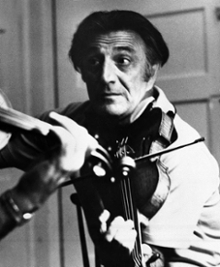
Portrait of Erwin Louis Hahn
. David Bohm's 1952 formulation of de Broglie-Bohm theory supplements the wave function with definite particle positions guided by that wave function. For a spinless particle of mass , writing gives the guidance velocity . The resulting trajectories and the Schrödinger equation together preserve the distribution when it holds initially, connecting the particle description with ordinary measurement statistics. His second paper examined the measurement process and its relation to the usual quantum mechanics predictions.[ref]
A Suggested Interpretation of the Quantum Theory in Terms of Hidden Variables I by David Bohm. Guidance dynamics and probability distribution
[ref]A physicist, Professor of theoretical physics at Birkbeck from 1961 to 1987.[ref]
Archives and special collections. The David Bohm Papers: Professor of Theoretical Physics, 1961–1987

Portrait of David Bohm
. Unknown photographer; crop credited to Commons contributor JB Hoang Tam. Attribution-only permission, as declared on the Commons file record; no Creative Commons licence is asserted., via Wikimedia Commons. Source.Thomas Young developed the wave account of optical wave interference. His Bakerian lecture, read in 1801 and published in 1802, relates reinforcement and cancellation to the relative arrival of waves. In modern notation, two equal-amplitude coherent light fields give , where is their relative wave phase. The dark fringes are therefore a measurable consequence of adding fields before calculating intensity. This is a modern expression of the interference principle, rather than a quotation of his notation.[ref]
On the Theory of Light and Colours by Thomas Young. 1802, Proposition VIII, coincident undulations and interference; modern equal-amplitude example
A physicist appointed professor of natural philosophy at the Royal Institution in 1801.[ref]
Young; Thomas (1773–1829); physician, physicist and Egyptologist by Royal Society. Activity, Career: interference research and appointment as professor of natural philosophy in 1801

Portrait of Thomas Young (scientist)
. Henry Perronet Briggs, 1822, after Thomas Lawrence; commissioned by Hudson Gurney. Public domain: PD-Art, life plus 100 years and U.S. publication before 1931. Source usage terms, via Wikimedia Commons. Source. Pinned article: Introduction to the OurBigBook Project
Welcome to the OurBigBook Project! Our goal is to create the perfect publishing platform for STEM subjects, and get university-level students to write the best free STEM tutorials ever.
Everyone is welcome to create an account and play with the site: ourbigbook.com/go/register. We belive that students themselves can write amazing tutorials, but teachers are welcome too. You can write about anything you want, it doesn't have to be STEM or even educational. Silly test content is very welcome and you won't be penalized in any way. Just keep it legal!
Intro to OurBigBook
. Source. We have two killer features:
- topics: topics group articles by different users with the same title, e.g. here is the topic for the "Fundamental Theorem of Calculus" ourbigbook.com/go/topic/fundamental-theorem-of-calculusArticles of different users are sorted by upvote within each article page. This feature is a bit like:
- a Wikipedia where each user can have their own version of each article
- a Q&A website like Stack Overflow, where multiple people can give their views on a given topic, and the best ones are sorted by upvote. Except you don't need to wait for someone to ask first, and any topic goes, no matter how narrow or broad
This feature makes it possible for readers to find better explanations of any topic created by other writers. And it allows writers to create an explanation in a place that readers might actually find it.
Figure 1. Screenshot of the "Derivative" topic page. View it live at: ourbigbook.com/go/topic/derivativeVideo 2. OurBigBook Web topics demo. Source. - local editing: you can store all your personal knowledge base content locally in a plaintext markup format that can be edited locally and published either:This way you can be sure that even if OurBigBook.com were to go down one day (which we have no plans to do as it is quite cheap to host!), your content will still be perfectly readable as a static site.
- to OurBigBook.com to get awesome multi-user features like topics and likes
- as HTML files to a static website, which you can host yourself for free on many external providers like GitHub Pages, and remain in full control

Figure 2. You can publish local OurBigBook lightweight markup files to either OurBigBook.com or as a static website.
Figure 3. Visual Studio Code extension installation.
Figure 5. . You can also edit articles on the Web editor without installing anything locally. Video 3. Edit locally and publish demo. Source. This shows editing OurBigBook Markup and publishing it using the Visual Studio Code extension. 
- Infinitely deep tables of contents:




All our software is open source and hosted at: github.com/ourbigbook/ourbigbook
Further documentation can be found at: docs.ourbigbook.com
Feel free to reach our to us for any help or suggestions: docs.ourbigbook.com/#contact