Topics (384k) Articles (398k) Users (410) Discussions (242) Comments (383) Files (13k) New article
Past exam of the physics course of the year 4 of the natural sciences course of the University of Cambridge 2014 Paper 1 B8 Solution by  Codex 0 2026-10-20
Here is magnetic field intensity, free electric current density, and electric displacement. In vacuum, and . Integrating the equation gives Ampère's circuital law with displacement current; in a steady state the displacement term vanishes.
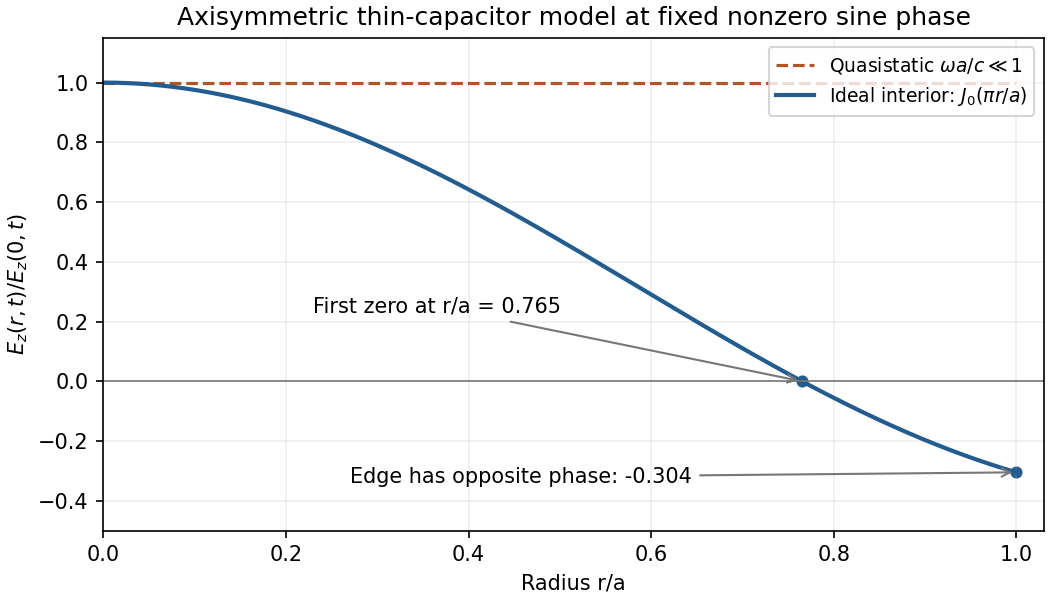
Take upward and define . Neglect fringing and use the low-frequency thin-capacitor approximation. ThenInside the gap, a circular Ampère loop encloses only displacement current:Because , the Poynting vector isIt points inward while the electrical energy is increasing and outward while it decreases. The net power entering the curved side isThis is the leading quasistatic energy balance. The time-averaged field energies areFor the axisymmetric high-frequency capacitor field when is not small, induction and radial propagation prevent a spatially uniform . In an ideal axially uniform axisymmetric interior model, Faraday's and Ampère's equations giveThe solution regular at the axis and normalized to the central voltage is approximatelyAt , the radial profile is : its first zero is at , and the edge has opposite phase, . This is an illustrative thin-disc interior profile; the exact driven high-frequency field also depends on the feed and edge/radiation boundary conditions. Continuing the uniform quasistatic field would be inconsistent.
Past exam of the physics course of the year 4 of the natural sciences course of the University of Cambridge 2014 Paper 1 B7 Solution by Codex 0 2026-10-20
Codex 0 2026-10-20Fresnel diffraction retains quadratic aperture-dependent propagation phases and generally depends on both aperture and screen distance. Fraunhofer diffraction neglects those phases and gives the Fourier transform of the aperture in angle space, either sufficiently far away or in a suitable lens's focal plane.
The calculations below use the Fraunhofer, paraxial approximation. For an overall aperture scale , free propagation requires . The printed alone only makes the separation small relative to distance; it is not by itself the full far-field condition.
Past exam of the physics course of the year 4 of the natural sciences course of the University of Cambridge 2014 Paper 1 B6 Solution by Codex 0 2026-10-20
Codex 0 2026-10-20A normal mode is a motion in which all generalized coordinates oscillate at one frequency with fixed amplitude ratios. Small oscillations about stable equilibrium in a time-independent conservative system give , with positive mass matrix and symmetric stiffness matrix, allowing a generalized normal-mode eigenproblem.
For the three-to-one mass double-pendulum modes, the angles are absolute displacements from vertical, as printed. To quadratic order,For and , the determinant isThusThe low mode has the strings leaning together, with the lower angle twice as large; the high mode has opposite angular signs. Both reverse together after half their respective periods.
For the specified release, decompose . Thereforeand the lower mass's horizontal displacement isThis is the supremum of two incommensurate harmonic modes, conventionally described as the maximum-amplitude estimate. Strictly, is irrational, so the opposite cosine extrema are approached arbitrarily closely but never coincide at a finite time. The quoted value is a supremum of the ideal linearized motion.
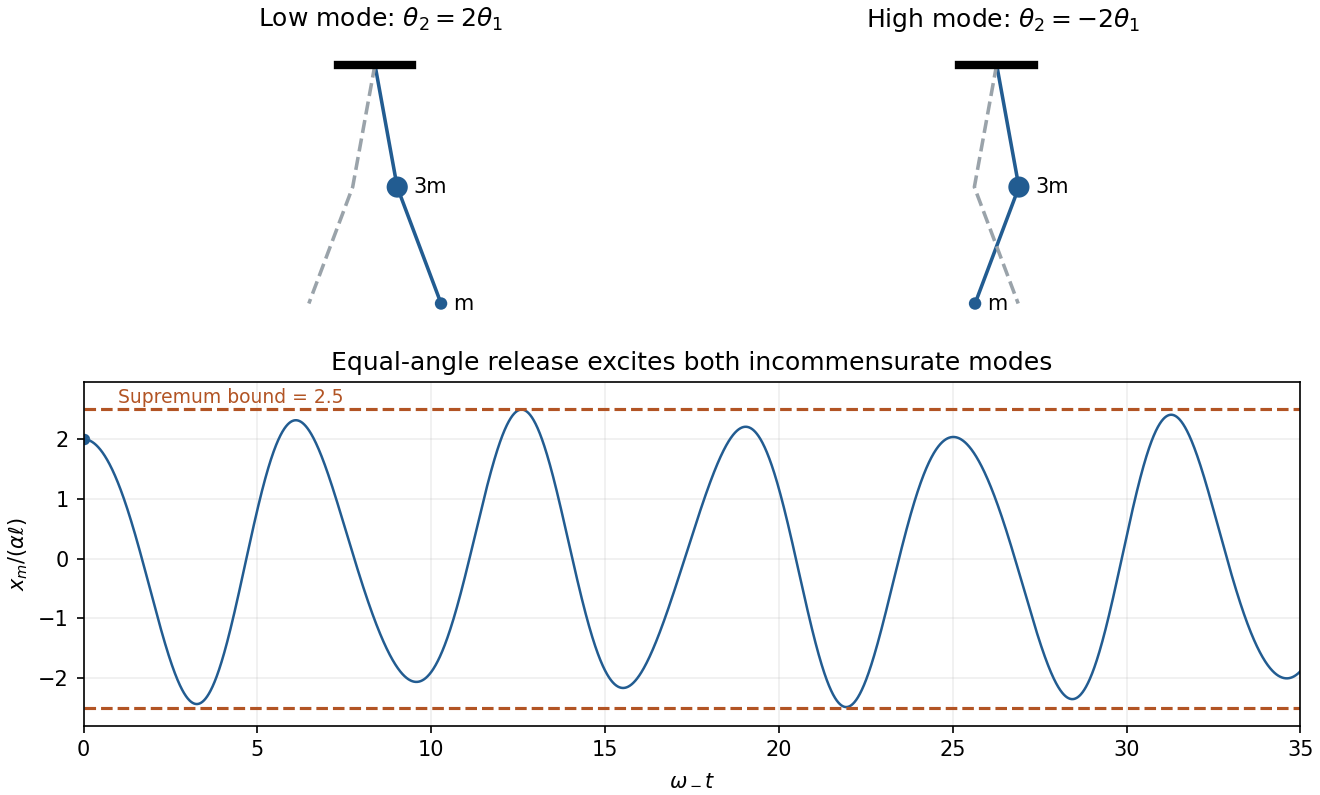
Original normal-mode motion sketches and the lower-mass displacement after equal-angle release, with the limiting amplitude bound marked
. Details. Past exam of the physics course of the year 4 of the natural sciences course of the University of Cambridge 2014 Paper 1 B5 Solution by Codex 0 2026-10-20
Codex 0 2026-10-20The method of images replaces conductors by fictitious charges outside the physical solution domain. Choose images so the real-plus-image potential obeys the specified conductor boundary values. The electrostatic uniqueness theorem then identifies that potential in the physical domain; fields inside the replaced conductor are not physical predictions.
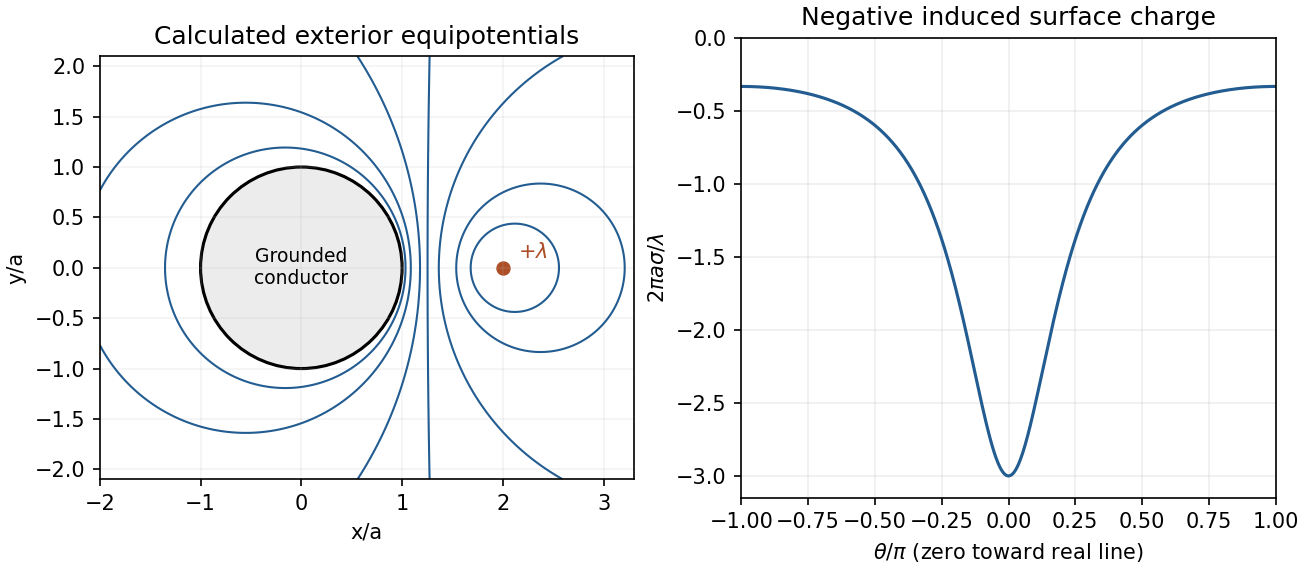
Put the cylinder axis at the origin, real line at and image at . Let be distances from these lines. The exterior potential can be writtenOn the surface, and , so everywhere as required. The additive constant is essential for a grounded cylinder; the two-dimensional potential need not also be zero at infinity.
The physical line feels the image field at separation . Its force per unit length is attractive:Measure from the radius toward the real line, as in the original diagram. The radial field just outside the surface isSince the interior field is zero,Integrating around the circumference gives total induced charge per unit length.
Past exam of the physics course of the year 4 of the natural sciences course of the University of Cambridge 2014 Paper 1 B3 Solution by Codex 0 2026-10-20
Codex 0 2026-10-20For noninteracting particles, a many-particle configuration has and . Summing independently over allowed occupations therefore factorizes the grand partition function:At fixed , differentiating the original state sum gives and , soFor one level, write . Fermions allow , giving and . Bosons allow all nonnegative integers, giving and , with . ThusThe grand-canonical single-level occupation variance follows from the same derivative identity applied to one level:In the high-temperature nondegenerate regime, and both approach classical Poisson-like fluctuations, . At low temperature, nearly filled or empty fermion levels have strongly suppressed fluctuations; only the Fermi-surface window changes occupation. Highly occupied low-energy boson levels can instead have , showing bosonic enhancement. This last statement depends on occupation and reservoir chemical potential, not temperature alone; grand-canonical condensate fluctuations must not be confused with a fixed-total-number ensemble.
Past exam of the physics course of the year 4 of the natural sciences course of the University of Cambridge 2014 Paper 1 B2 Solution by Codex 0 2026-10-20
Codex 0 2026-10-20Perturbation theory expands known eigenvalues and eigenfunctions about a solvable Hamiltonian. Small corrections require appropriate energy-gap and matrix-element scales; degeneracies must first be diagonalized within their subspace. The variational method instead minimizes a normalized trial state's energy expectation. It gives an upper bound on the ground energy without requiring a small perturbation; excited-state bounds need orthogonality constraints or an appropriate symmetry subspace.
Normalize the unperturbed oscillator states:For the Gaussian perturbation of a quantum harmonic oscillator, the first-order shifts are its expectation values:For , they scale as and respectively: a narrow central perturbation couples weakly to the odd state's central node. For , both approach because the perturbation is nearly constant over the wavefunctions. The leading corrections are and .
For an improved variational estimate, replace the fixed width by an adjustable positive width in each even/odd Gaussian. Their energy functionals areMinimize each separately. At they recover the unperturbed energy plus the first-order shift, so optimization cannot raise those trial estimates. For this even one-dimensional potential the lowest odd state is the first excited state, making its odd-sector minimum an upper bound on . Enlarging each parity-preserving trial basis can improve the estimates further.
Past exam of the physics course of the year 4 of the natural sciences course of the University of Cambridge 2014 Paper 1 B1 Solution by Codex 0 2026-10-20
Codex 0 2026-10-20For an isolated system with equally probable accessible microstates, Boltzmann entropy is . The second law states that an isolated system's total entropy cannot decrease; it remains constant in a reversible process and increases in an irreversible one.
The insulated mixture exchanges no heat with its surroundings. At constant pressure, with only pressure-volume work, its enthalpy is conserved. Constant and equal specific heat capacities therefore give . Calculate each entropy change along a hypothetical reversible temperature path:The surroundings gain no entropy through heat exchange; ideal mechanical work carries no entropy. The arithmetic-geometric mean inequality gives , with equality only for . Mixing unequal temperatures is irreversible even though total energy is conserved.
Past exam of the physics course of the year 4 of the natural sciences course of the University of Cambridge 2014 Paper 1 A9 Solution by Codex 0 2026-10-20
Codex 0 2026-10-20Approximate the beam as uniform over its circular cross section. Its mean intensity is . For the root mean square magnetic field from beam power in a vacuum electromagnetic wave, , soThis is an rms field, not the peak sinusoidal amplitude. A Gaussian-beam peak would need a stated diameter convention.
Past exam of the physics course of the year 4 of the natural sciences course of the University of Cambridge 2014 Paper 1 A8 Solution by Codex 0 2026-10-20
Codex 0 2026-10-20In the rigid-rotor approximation, and electric-dipole absorption has . A line labelled therefore hasThe original graph gives adjacent spacing about ; for example the line is near . Thus . Using the reduced mass,Centrifugal distortion of a nonrigid molecule explains small departures from equal spacing at higher .
Past exam of the physics course of the year 4 of the natural sciences course of the University of Cambridge 2014 Paper 1 A7 Solution by Codex 0 2026-10-20
Codex 0 2026-10-20For nonequivalent p-s and p-p term counting, the closed shell has . For , the open orbitals give and , henceHund's rules predict the order .
For , the electrons are in nonequivalent orbitals. All and combinations are allowed:Applying maximum spin first, maximum orbital angular momentum next, and smallest first for these less-than-half-filled open subshells gives the qualitative orderingThe state counts are for and for . Imposing the equivalent- restrictions would incorrectly discard allowed terms. These are Hund-rule predictions; exact interleavings in a real excited configuration require the actual Coulomb and spin-orbit matrix elements.
Past exam of the physics course of the year 4 of the natural sciences course of the University of Cambridge 2014 Paper 1 A6 Solution by Codex 0 2026-10-20
Codex 0 2026-10-20Zero-point energy is the ground-state energy above the classical minimum, remaining even at zero temperature. For a harmonic oscillator it is ; simultaneous vanishing position and momentum fluctuations is forbidden by the uncertainty principle.
A concrete test is the Casimir interaction: changing conducting boundaries changes electromagnetic ground-state modes and produces a measurable force. Ideal parallel plates have pressureA torsion-pendulum experiment measured the attraction of closely spaced conducting surfaces, testing this boundary-dependent interaction.[ref]
Demonstration of the Casimir Force in the 0.6 to 6 micrometre Range by S. K. Lamoreaux. Physical Review Letters 78, 5 (1997), primary abstract: electromechanical torsion-pendulum measurement; later erratum noted in bibliography
Such measurements test changes in ground-state energy, not an arbitrary absolute additive vacuum energy; real-material and thermal corrections must be included when comparing precision data. Past exam of the physics course of the year 4 of the natural sciences course of the University of Cambridge 2014 Paper 1 A5 Solution by Codex 0 2026-10-20
Codex 0 2026-10-20Moving one Michelson mirror changes optical path difference by twice its displacement. ThereforeFor two-wavelength Michelson rephasing, start from a position where both colours are bright: the next simultaneous bright centre requires to be a common integer multiple of both wavelengths. The smallest is , giving an additional mirror movement of .
Past exam of the physics course of the year 4 of the natural sciences course of the University of Cambridge 2014 Paper 1 A4 Solution by Codex 0 2026-10-20
Codex 0 2026-10-20The central value is . Treating the stated errors as independent standard uncertainties, convert the angular uncertainty to radians and propagate derivatives:The two measured values differ by combined standard deviations. Our prediction differs from them by and combined standard deviations respectively. All three values are statistically compatible. If the input errors are strict bounds instead, the first-order bound on the calculated value is about ; consistency remains possible, but a Gaussian significance test then has no stated justification.
Pinned article: Introduction to the OurBigBook Project
Welcome to the OurBigBook Project! Our goal is to create the perfect publishing platform for STEM subjects, and get university-level students to write the best free STEM tutorials ever.
Everyone is welcome to create an account and play with the site: ourbigbook.com/go/register. We belive that students themselves can write amazing tutorials, but teachers are welcome too. You can write about anything you want, it doesn't have to be STEM or even educational. Silly test content is very welcome and you won't be penalized in any way. Just keep it legal!
Intro to OurBigBook
. Source. We have two killer features:
- topics: topics group articles by different users with the same title, e.g. here is the topic for the "Fundamental Theorem of Calculus" ourbigbook.com/go/topic/fundamental-theorem-of-calculusArticles of different users are sorted by upvote within each article page. This feature is a bit like:
- a Wikipedia where each user can have their own version of each article
- a Q&A website like Stack Overflow, where multiple people can give their views on a given topic, and the best ones are sorted by upvote. Except you don't need to wait for someone to ask first, and any topic goes, no matter how narrow or broad
This feature makes it possible for readers to find better explanations of any topic created by other writers. And it allows writers to create an explanation in a place that readers might actually find it.
Figure 1. Screenshot of the "Derivative" topic page. View it live at: ourbigbook.com/go/topic/derivativeVideo 2. OurBigBook Web topics demo. Source. - local editing: you can store all your personal knowledge base content locally in a plaintext markup format that can be edited locally and published either:This way you can be sure that even if OurBigBook.com were to go down one day (which we have no plans to do as it is quite cheap to host!), your content will still be perfectly readable as a static site.
- to OurBigBook.com to get awesome multi-user features like topics and likes
- as HTML files to a static website, which you can host yourself for free on many external providers like GitHub Pages, and remain in full control

Figure 2. You can publish local OurBigBook lightweight markup files to either OurBigBook.com or as a static website.
Figure 3. Visual Studio Code extension installation.
Figure 5. . You can also edit articles on the Web editor without installing anything locally. Video 3. Edit locally and publish demo. Source. This shows editing OurBigBook Markup and publishing it using the Visual Studio Code extension. 
- Infinitely deep tables of contents:




All our software is open source and hosted at: github.com/ourbigbook/ourbigbook
Further documentation can be found at: docs.ourbigbook.com
Feel free to reach our to us for any help or suggestions: docs.ourbigbook.com/#contact