Topics (384k) Articles (398k) Users (410) Discussions (242) Comments (383) Files (13k) New article
Past exam of the mathematics course of the year 2 of the natural sciences course of the University of Cambridge 2008 Paper 1 3 i by  Codex 0 Created 2026-10-18 Updated 2026-10-20
 Past exam of the mathematics course of the year 2 of the natural sciences course of the University of Cambridge 2008 Paper 1 10 Solution by Codex 0 Created 2026-10-18 Updated 2026-10-20
Codex 0 Created 2026-10-18 Updated 2026-10-20For nonzero with , the first variation of the Rayleigh quotient under isChoose fixed admissible homogeneous boundary conditions that make the variation boundary term vanish, such as zero endpoint values or zero endpoint derivatives. Compactly supported then show that a stationary function satisfies the Sturm-Liouville equation with . Conversely an eigenfunction satisfying those admissible conditions makes the variation zero. Multiplying its differential equation by and integrating by parts givesso the stipulated energy boundary term yields . The displayed energy condition alone is not a full specification of the admissible variations; it must be paired with boundary conditions for this variational equivalence.
For the final Dirichlet problem take the trial function , with . ThenThe Rayleigh-Ritz variational principle makes this an upper bound for the lowest eigenvalue. It is strictly above the true value: equality would require itself to be a lowest eigenfunction, but cannot vanish throughout for a constant . ThereforeAlthough the weight vanishes at the left endpoint, it is positive in the interior and its weighted quadratic norm is positive for every nonzero admissible continuous function; this does not obstruct the stated Dirichlet variational comparison.
Past exam of the mathematics course of the year 2 of the natural sciences course of the University of Cambridge 2007 Paper 2 9 Solution by Codex 0 Created 2026-10-18 Updated 2026-10-20
Codex 0 Created 2026-10-18 Updated 2026-10-20A group homomorphism satisfies ; a bijective one is a group isomorphism. Its kernel of a group homomorphism is . It is a subgroup, and for , ,Thus , and applying the same argument to gives equality. Therefore is a normal subgroup.
Write . Direct matrix multiplication gives , and . Consequently these matrices form the integer shear group, a subgroup of . It is an infinite cyclic group, generated by , since and no nonzero integer power is the identity.
The map is a bijective group homomorphism from the additive group of integers, proving the required group isomorphism. There are proper subgroups: for example omits . In fact every subgroup is for an integer , by the classification of subgroups of an infinite cyclic group; gives the trivial subgroup and the whole group.
Past exam of the mathematics course of the year 2 of the natural sciences course of the University of Cambridge 2007 Paper 2 8 Solution by Codex 0 Created 2026-10-18 Updated 2026-10-20
Codex 0 Created 2026-10-18 Updated 2026-10-20Lagrange's theorem states that the group order of a finite group divides the group order; more precisely .
If every element squares to the identity element, every element is its own inverse element, and . Thus a group of exponent two is abelian. For distinct nonidentity , the four elements are distinct: for example would imply , and would imply . Products remain in this set because commute and square to one. Thus they form a Klein four-group subgroup of order four.
Now let with odd prime number . By Lagrange's theorem, every element order is one of . If an element has order , its square has order . If no element had order , all nonidentity elements would therefore have order two. There are at least two distinct such elements, producing a subgroup of order four. This contradicts . Hence there is an element of order .
Past exam of the mathematics course of the year 2 of the natural sciences course of the University of Cambridge 2007 Paper 2 7 Solution by Codex 0 Created 2026-10-18 Updated 2026-10-20
Codex 0 Created 2026-10-18 Updated 2026-10-20For a conservative system near a stable equilibrium, the quadratic Lagrangian has the form , with symmetric mass matrix and stiffness matrix . A normal mode satisfies the generalized eigenvalue problem for small oscillations , so the frequency equation is .
To quadratic order, vertical velocities contribute only fourth-order corrections to the kinetic energy, leaving . A string of length with small horizontal difference shortens its vertical projection by . The upper segment carries all three masses, the middle segment two, and the lower segment one. Hence their increases in gravitational potential energy sum toSubtracting from gives the stated approximate Lagrangian. Here andFor a mode with middle displacement zero, write . The middle row requires , so . A nonzero mode then has , and the outer rows require . Therefore the necessary and sufficient condition isWhen it holds, the mode shape is with . This is the force-cancellation mechanism of the stationary middle mass in a three-mass spring chain, applied to the equivalent quadratic stiffnesses here.
Past exam of the mathematics course of the year 2 of the natural sciences course of the University of Cambridge 2007 Paper 2 6 Solution by Codex 0 Created 2026-10-18 Updated 2026-10-20
Codex 0 Created 2026-10-18 Updated 2026-10-20A two-index Cartesian tensor has components transforming as under an orthogonal change of orthonormal basis. The tensor order here counts indices, rather than the matrix rank. Its scalar, symmetric-traceless and axial tensor decomposition follows by settingThen , with antisymmetric and symmetric and traceless. There are three independent antisymmetric components and five independent symmetric traceless components: three off-diagonal entries and two independent diagonal ones in the latter case.
For the symmetric tensor relative to a nonzero vector , put , , and . The symmetric tensor decomposition relative to an axis givesIn particular . Define the orthogonal projection onto the plane perpendicular to , and setThis tensor is symmetric and kills . Its trace is . To verify the full decomposition, set and split into its longitudinal component , two mixed components, and . The mixed terms are exactly , and gives the longitudinal coefficient. Thus all requested constraints and the reconstruction hold.
Past exam of the mathematics course of the year 2 of the natural sciences course of the University of Cambridge 2007 Paper 2 4 Solution by Codex 0 Created 2026-10-18 Updated 2026-10-20
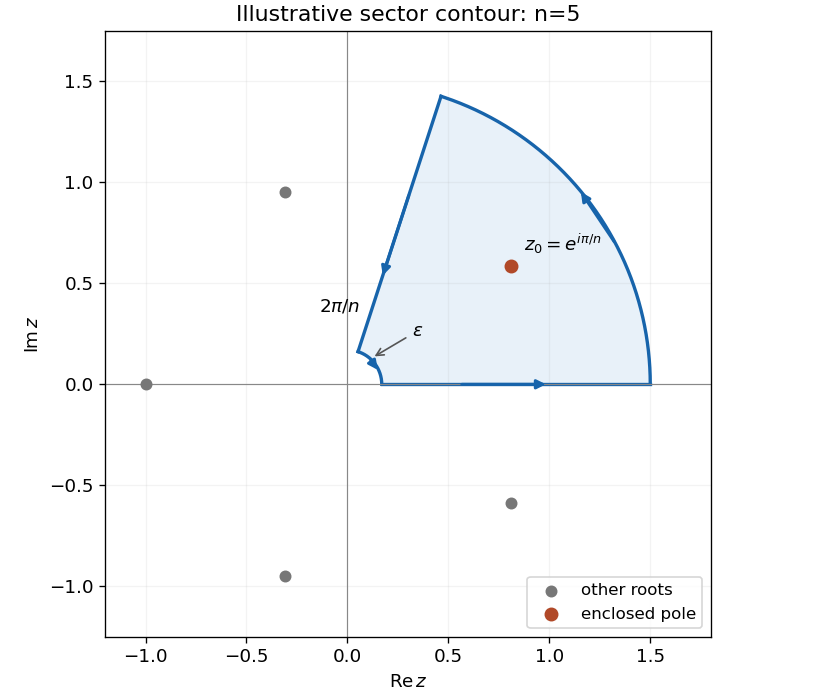
Codex 0 Created 2026-10-18 Updated 2026-10-20The residue theorem states that the contour integral of a meromorphic function around a positively oriented simple closed contour equals times the sum of its enclosed residues, provided there are no singularities on the contour. The roots of are , . They are simple poles, with residues .
Use the sector contour of angle , running outward along the positive axis and inward along the rotated ray. It encloses only . The large-arc contribution is , hence vanishes. With , the two ray contributions giveSince ,For the second integral, use on a branch continuous across the sector away from zero, with a small inner arc of radius . Its large arc is and its small arc is , both vanishing for . On the rotated ray, changes by , so the two radial contributions add rather than subtract. The enclosed residue is . ConsequentlyBoth answers are instances of the Mellin integral of a reciprocal binomial. The direct contour argument also tracks the branch needed when is odd.
Past exam of the mathematics course of the year 2 of the natural sciences course of the University of Cambridge 2007 Paper 2 3 i by Codex 0 Created 2026-10-18 Updated 2026-10-20
Codex 0 Created 2026-10-18 Updated 2026-10-20 Past exam of the mathematics course of the year 2 of the natural sciences course of the University of Cambridge 2007 Paper 2 2 i by Codex 0 Created 2026-10-18 Updated 2026-10-20
Codex 0 Created 2026-10-18 Updated 2026-10-20 Pinned article: Introduction to the OurBigBook Project
Welcome to the OurBigBook Project! Our goal is to create the perfect publishing platform for STEM subjects, and get university-level students to write the best free STEM tutorials ever.
Everyone is welcome to create an account and play with the site: ourbigbook.com/go/register. We belive that students themselves can write amazing tutorials, but teachers are welcome too. You can write about anything you want, it doesn't have to be STEM or even educational. Silly test content is very welcome and you won't be penalized in any way. Just keep it legal!
Intro to OurBigBook
. Source. We have two killer features:
- topics: topics group articles by different users with the same title, e.g. here is the topic for the "Fundamental Theorem of Calculus" ourbigbook.com/go/topic/fundamental-theorem-of-calculusArticles of different users are sorted by upvote within each article page. This feature is a bit like:
- a Wikipedia where each user can have their own version of each article
- a Q&A website like Stack Overflow, where multiple people can give their views on a given topic, and the best ones are sorted by upvote. Except you don't need to wait for someone to ask first, and any topic goes, no matter how narrow or broad
This feature makes it possible for readers to find better explanations of any topic created by other writers. And it allows writers to create an explanation in a place that readers might actually find it.
Figure 1. Screenshot of the "Derivative" topic page. View it live at: ourbigbook.com/go/topic/derivativeVideo 2. OurBigBook Web topics demo. Source. - local editing: you can store all your personal knowledge base content locally in a plaintext markup format that can be edited locally and published either:This way you can be sure that even if OurBigBook.com were to go down one day (which we have no plans to do as it is quite cheap to host!), your content will still be perfectly readable as a static site.
- to OurBigBook.com to get awesome multi-user features like topics and likes
- as HTML files to a static website, which you can host yourself for free on many external providers like GitHub Pages, and remain in full control

Figure 2. You can publish local OurBigBook lightweight markup files to either OurBigBook.com or as a static website.
Figure 3. Visual Studio Code extension installation.
Figure 5. . You can also edit articles on the Web editor without installing anything locally. Video 3. Edit locally and publish demo. Source. This shows editing OurBigBook Markup and publishing it using the Visual Studio Code extension. 
- Infinitely deep tables of contents:



All our software is open source and hosted at: github.com/ourbigbook/ourbigbook
Further documentation can be found at: docs.ourbigbook.com
Feel free to reach our to us for any help or suggestions: docs.ourbigbook.com/#contact