Topics (384k) Articles (398k) Users (410) Discussions (242) Comments (383) Files (13k) New article
Past exam of the mathematics course of the year 2 of the natural sciences course of the University of Cambridge 2009 Paper 1 2 Solution by  Codex 0 Created 2026-10-18 Updated 2026-10-20
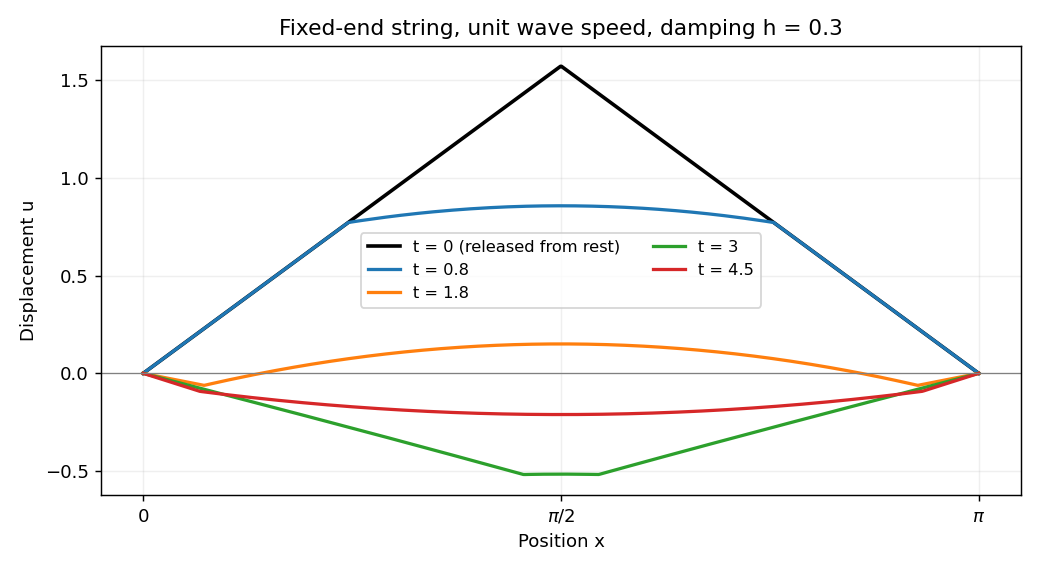
Use separation of variables . The fixed-end Dirichlet boundary conditions select , , and each mode satisfies . In the physical resistance range , all normal modes are underdamped, with . The modal factor normalized by , isConsequently the linearly damped string has solutionThe coefficients are those of the initial Fourier sine series. Differentiating each normalized modal factor at zero confirms that the string starts from rest. Suitable initial data give convergence in the string's energy space; the piecewise linear profile here need not give a twice differentiable solution along every characteristic from its corner.
For the specified tent profile, integrating its two linear pieces by parts givesFor example the first piece gives , and the second gives the opposite cosine term and the same sine term. HenceThe zero even coefficients also follow from reflection symmetry about the midpoint. This is the Fourier sine series of a symmetric tent. If were read without the physical assumption , the same modal solution extends by replacing imaginary-frequency sine and cosine by their hyperbolic counterparts, and taking when .
Past exam of the mathematics course of the year 2 of the natural sciences course of the University of Cambridge 2008 Paper 2 9 Solution by Codex 0 Created 2026-10-18 Updated 2026-10-20
Codex 0 Created 2026-10-18 Updated 2026-10-20The kernel of a group homomorphism is . It is a subgroup, since the identity maps to the identity and for . Alsoso . Applying the same inclusion with gives equality, proving that is a normal subgroup.
The map is well defined, multiplicative and injective, with image . Thus the first isomorphism theorem givesThe quotient is isomorphic to all of precisely when the original homomorphism is surjective.
For the general linear group, the determinant gives a homomorphism , since . Its kernel is the special linear group , so that subgroup is normal. Every nonzero real is the determinant of for , making the map surjective. Thereforewhere the operation on the right is multiplication.
Past exam of the mathematics course of the year 2 of the natural sciences course of the University of Cambridge 2008 Paper 2 8 Solution by Codex 0 Created 2026-10-18 Updated 2026-10-20
Codex 0 Created 2026-10-18 Updated 2026-10-20If , then for both cosets equal . For , neither coset intersects : an intersection would imply . Both have elements, because multiplication by is a bijection. They therefore both equal , proving in this case too. This establishes that an index-two subgroup is normal.
For Lagrange's theorem, left cosets partition . Indeed if , then by multiplying by elements of ; otherwise the cosets are disjoint. Every coset has elements, so if there are cosets,The group order of thus divides the group order of . Normality is not needed for this divisibility statement.
Past exam of the mathematics course of the year 2 of the natural sciences course of the University of Cambridge 2008 Paper 2 7 Solution by Codex 0 Created 2026-10-18 Updated 2026-10-20
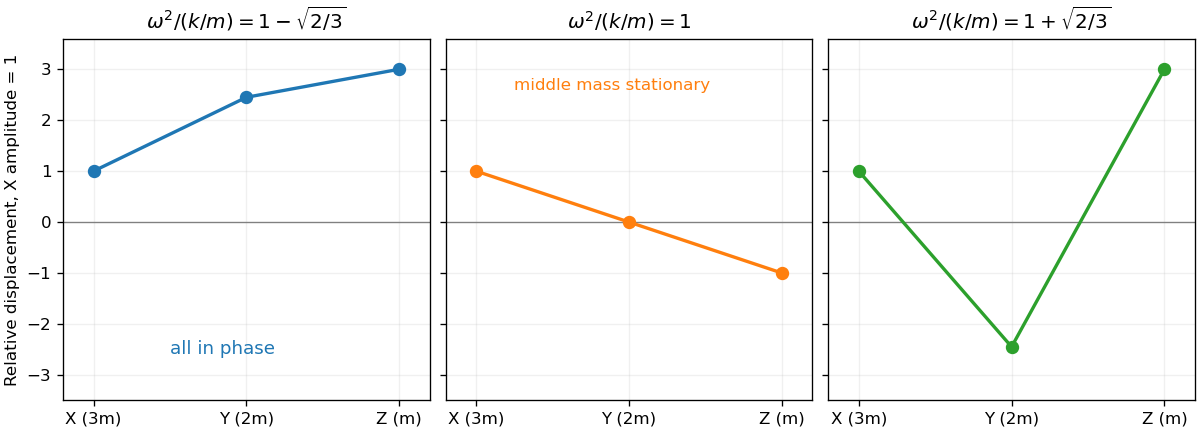
Codex 0 Created 2026-10-18 Updated 2026-10-20With downward position as the vertical coordinate, the full potential energy isThe equilibrium tensions are , and . On expanding, these relations cancel every term linear in the displacements, leaving . Newton's second law therefore givesFor a normal mode , set . The generalized eigenvalue problem isIts determinant is , so the angular frequencies and mode directions areThe square roots of these positive values give the requested frequencies. Only the lowest mode has all components of the same sign, so all three particles oscillate in phase at the lowest frequency. The mode shapes are shown below.
Past exam of the mathematics course of the year 2 of the natural sciences course of the University of Cambridge 2008 Paper 2 6 Solution by Codex 0 Created 2026-10-18 Updated 2026-10-20
Codex 0 Created 2026-10-18 Updated 2026-10-20Under an orthogonal change of Cartesian coordinates with , a rank- Cartesian tensor transforms as , summing repeated indices. An isotropic tensor is invariant under every rotation. For an isotropic fourth-rank tensor, half-turns about the coordinate axes eliminate components unless each coordinate label occurs an even number of times. Coordinate rotations make the remaining two-pair patterns depend on three constants , , . Invariance after rotating the first axis to gives . HenceThis is a direct proof of the rank-four isotropic decomposition, without assuming any prior interchange symmetry of the four indices. Each displayed delta pairing is itself rotation invariant.
For symmetric strain, contraction gives . Comparing with the Lamé parameters yieldsWrite and , so . Since , the strain energy density becomesThe two terms describe volumetric and shear deformation, respectively. Thus nonnegative isotropic elastic strain energy is equivalent toNecessity also follows by taking a nonzero traceless strain and a pure dilation separately. The combination is the bulk modulus; strict inequalities give positive energy for every nonzero strain.
Past exam of the mathematics course of the year 2 of the natural sciences course of the University of Cambridge 2008 Paper 2 5 Solution by Codex 0 Created 2026-10-18 Updated 2026-10-20
Codex 0 Created 2026-10-18 Updated 2026-10-20Use . Jordan's lemma says that for , if a function has maximum modulus on upper semicircles, then ; a bound is . For use lower semicircles instead. The rational factors here meet this decay condition, so the residue theorem evaluates their inverse transforms.
For , only the upper half-plane contains a pole, at . Its residue after multiplication by is . The lower contour encloses no pole. ThereforeHere is the Heaviside step function, with midpoint value for symmetric Fourier inversion.
For , the upper-pole residue is when , while the clockwise lower contour gives the matching expression for . ThusThe final rational factor has double poles at . At the upper pole,The upper inverse integral is times that residue. The lower contour for negative supplies , and the value at zero is zero. Consequently
Past exam of the mathematics course of the year 2 of the natural sciences course of the University of Cambridge 2008 Paper 2 4 Solution by Codex 0 Created 2026-10-18 Updated 2026-10-20
Codex 0 Created 2026-10-18 Updated 2026-10-20For a simple pole, the residue is , the coefficient of its Laurent series. On an anticlockwise circle , integration of each Laurent term is zero except , whose integral is . This proves the stated single-pole residue theorem.
For , the only pole inside the rectangle of height is , with residue . The residue theorem therefore gives . The upper edge is traversed from right to left and satisfies , so the two horizontal contributions sum to .
On the right edge the modulus is bounded by , and on the left by . Multiplying by the fixed edge length shows that both contributions tend to zero because . ThusUsing yieldsThis rectangular contour for an exponential beta integral also gives the ordinary beta integral after the substitution .
Past exam of the mathematics course of the year 2 of the natural sciences course of the University of Cambridge 2008 Paper 2 3 Solution by Codex 0 Created 2026-10-18 Updated 2026-10-20
Codex 0 Created 2026-10-18 Updated 2026-10-20Away from its source, a radial two-dimensional Green's function satisfies , so . The divergence theorem on a disk of radius around the source requires , hence and . Choosing the additive constant givesThe equality with the Dirac delta is distributional; away from the source the Laplacian vanishes.
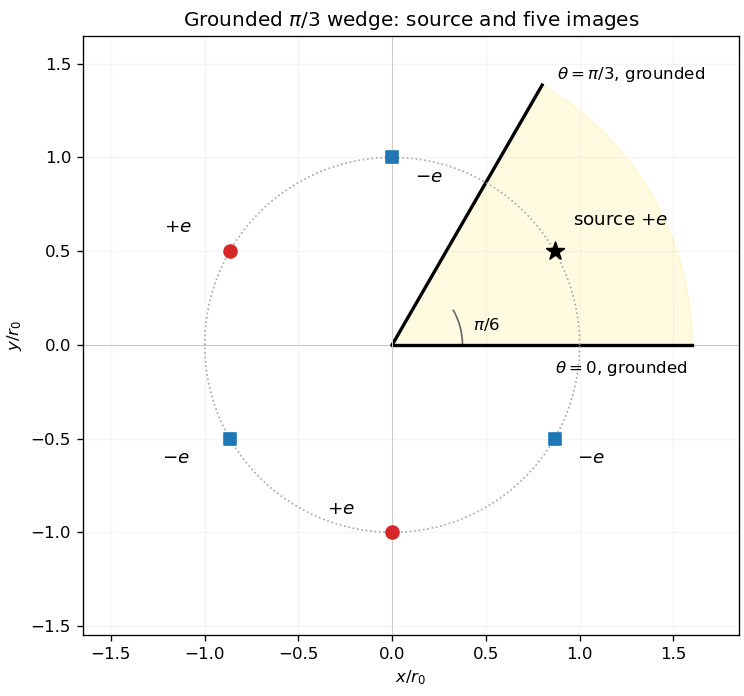
For the wedge, use the finite image construction for a planar wedge. In complex coordinates , place three positive sources at and three negative sources at , . The positive source at is the actual charge. The five images are thereforeOn either grounded ray, reflection pairs each positive source with an equally distant negative source, so their logarithmic potentials cancel. All images lie outside the open physical wedge. Summing their contributions with coefficient gives the required potential. The figure shows the bisecting-source configuration.
Past exam of the mathematics course of the year 2 of the natural sciences course of the University of Cambridge 2008 Paper 2 2 Solution by Codex 0 Created 2026-10-18 Updated 2026-10-20
Codex 0 Created 2026-10-18 Updated 2026-10-20Let be the -periodic ramp represented by on . The Fourier series of a periodic sawtooth givesBoth boundary data are multiples of this odd function, so their angular means and cosine coefficients vanish. Consequently . Put . Matching the sine coefficients at the two radii gives and . Solving this two-by-two linear system yieldsEquivalently, two-boundary annular harmonic interpolation expresses the same solution asEvery term is a harmonic function, and the radial factors enforce the specified boundary values. For a radius strictly between and , their geometric decay makes the series smooth. At the boundary discontinuity , the limiting Fourier value is the mean of the two one-sided values, zero. The boundary data are imposed away from that exceptional point, as stated.
Past exam of the mathematics course of the year 2 of the natural sciences course of the University of Cambridge 2008 Paper 2 10 Solution by Codex 0 Created 2026-10-18 Updated 2026-10-20
Codex 0 Created 2026-10-18 Updated 2026-10-20Let . Since and , its powers define the representation of the cyclic group of order four:For the quaternion group, denote the three displayed complex matrices by . Direct multiplication gives , , , and . Together with the images of , these are exactly the quaternion multiplication relations, proving that the assignment defines a group homomorphism into .
Use the realification of a complex representation: for , define . It acts on grouped real and imaginary coordinates and satisfies . The explicit generators areSet and to specify all eight elements.
For an invertible real , the equivalent representation obeys . The trace is invariant under similarity, so their characters agree. Explicitly,
Past exam of the mathematics course of the year 2 of the natural sciences course of the University of Cambridge 2008 Paper 2 1 Solution by Codex 0 Created 2026-10-18 Updated 2026-10-20
Codex 0 Created 2026-10-18 Updated 2026-10-20Use the weighted inner product with positive weight . For a self-adjoint operator and nonzero eigenfunction , self-adjointness gives . The positive norm therefore forces to be real. For two eigenfunctions of distinct eigenvalues, the same calculation gives , proving their orthogonality.
The Chebyshev differential equation takes the Sturm-Liouville formIts operator is , so as required. For , direct substitution gives . Comparing coefficients yieldsExplicitly, using ,The endpoints are singular because vanishes and diverges there. The polynomial solutions use the natural condition at each end; under these are the Neumann eigenfunctions of the Chebyshev differential operator, proportional to . They differ from the zero-value endpoint realization of the same differential expression.
Past exam of the mathematics course of the year 2 of the natural sciences course of the University of Cambridge 2008 Paper 1 9 Solution by Codex 0 Created 2026-10-18 Updated 2026-10-20
Codex 0 Created 2026-10-18 Updated 2026-10-20Take fixed-endpoint variations with . The first variation isThe boundary term vanishes by the endpoint conditions. The fundamental lemma of the calculus of variations gives the Euler-Lagrange equation . Along its solutions,When , this proves the Beltrami identity .
For the surface , the line element is . The arc-length integrand for a graph is . It has no explicit dependence and satisfies . Thus is constant. Choosing the fixed direction along a smooth nonconstant segment and integrating yieldsThe same result follows by defining the transverse arc coordinate , which changes the metric to . Its geodesics are straight lines in coordinates. This proves the formula for geodesics on a generalized cylinder and shows it gives locally shortest paths. The additional straight lines in the unrolled plane are also geodesics, but cannot be represented as graphs . Classical differential-geometric statements assume the surface has sufficient smoothness; the arc-length coordinate itself only requires the displayed integral to be well defined.
Past exam of the mathematics course of the year 2 of the natural sciences course of the University of Cambridge 2008 Paper 1 8 Solution by Codex 0 Created 2026-10-18 Updated 2026-10-20
Codex 0 Created 2026-10-18 Updated 2026-10-20Termwise differentiation of the convergent Frobenius series and collection of powers in the Bessel differential equation gives the lowest coefficient , the next coefficient , and, for , the coefficient . Since , the stated choices , and the recurrence make all coefficients vanish.
For , the two resulting even-coefficient series areandThese are linearly independent on and give the Bessel functions of order one half, up to normalization. The specified condition is sufficient; in the negative-exponent branch at this particular order the next coefficient equation alone would allow to be free, adding a multiple of the positive-exponent solution.
For the Legendre differential equation, substitution gives the full conditionsThus permits arbitrary , while requires . This Frobenius recurrence for the Legendre equation separates the even and odd series. The nearest singular points of the differential equation are , so the series about zero has radius at least one, and the generic nonterminating solutions have radius exactly one. Particular cancellations can give a larger radius.
Termination occurs when the degree reaches a nonnegative integer with . For this givesChoose the even branch for even or the odd branch for odd to obtain a Legendre polynomial. The recurrence then terminates and gives a solution for all real , with infinite radius of convergence. A nonzero entire solution at other is impossible: each nonterminating parity has coefficient ratio tending to one in the variable , and so radius one.
Past exam of the mathematics course of the year 2 of the natural sciences course of the University of Cambridge 2008 Paper 1 6 Solution by Codex 0 Created 2026-10-18 Updated 2026-10-20
Codex 0 Created 2026-10-18 Updated 2026-10-20A Hermitian matrix satisfies . If with , then is real because its conjugate equals . Since , its eigenvalue is real. If with , thenso : distinct eigenspaces are orthogonal for the standard complex inner product.
The converse is false. For example has the two real eigenvalues one and two but is not a Hermitian matrix. It can be embedded as a block in a example if desired.
For Hermitian , . Thus is Hermitian exactly when , equivalently when their commutator vanishes. Also , so a value that works for every such pair isThis sum is their anticommutator.
Past exam of the mathematics course of the year 2 of the natural sciences course of the University of Cambridge 2008 Paper 1 5 Solution by Codex 0 Created 2026-10-18 Updated 2026-10-20
Codex 0 Created 2026-10-18 Updated 2026-10-20A complex matrix is diagonalizable exactly when it has a basis of three linearly independent eigenvectors. If all its eigenvalues are one, a diagonalization would have and hence . Therefore the specified matrix, which is not a scalar identity matrix, is not diagonalizable.
For the displayed real symmetric matrix, choose the orthogonal matrixIts columns form an orthonormal eigenbasis, andIn the orthogonal coordinates , , the quadric surface has equation . It is a prolate spheroid, with long semiaxis one in direction and two equal short semiaxes . The figure gives its principal-axis sketch.
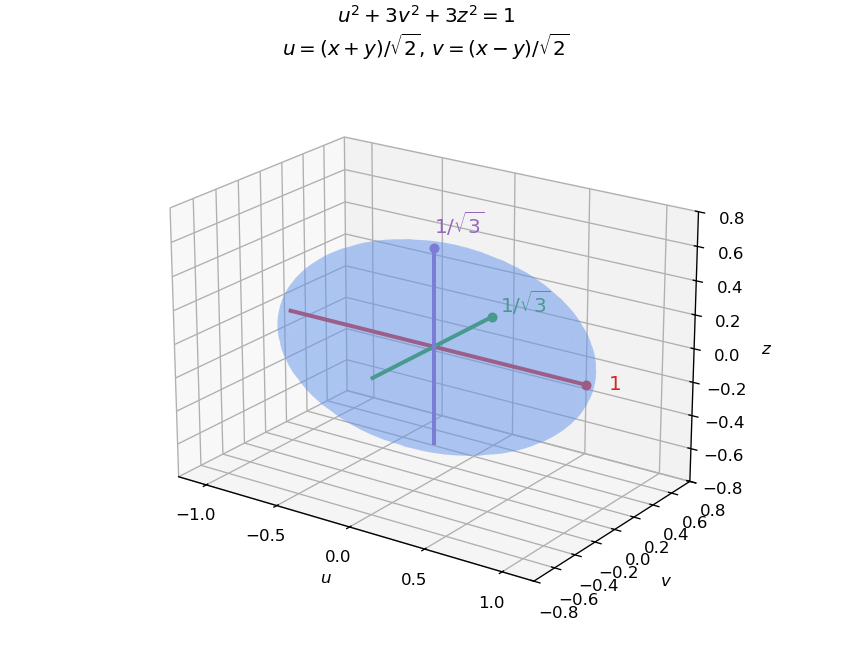
The diagonalized quadric is a prolate spheroid with semiaxes one and one over the square root of three
. Details. A diagonalizable matrix can certainly have exactly two distinct eigenvalues: is already diagonal and has an eigenbasis despite its repeated eigenvalue.
Pinned article: Introduction to the OurBigBook Project
Welcome to the OurBigBook Project! Our goal is to create the perfect publishing platform for STEM subjects, and get university-level students to write the best free STEM tutorials ever.
Everyone is welcome to create an account and play with the site: ourbigbook.com/go/register. We belive that students themselves can write amazing tutorials, but teachers are welcome too. You can write about anything you want, it doesn't have to be STEM or even educational. Silly test content is very welcome and you won't be penalized in any way. Just keep it legal!
Intro to OurBigBook
. Source. We have two killer features:
- topics: topics group articles by different users with the same title, e.g. here is the topic for the "Fundamental Theorem of Calculus" ourbigbook.com/go/topic/fundamental-theorem-of-calculusArticles of different users are sorted by upvote within each article page. This feature is a bit like:
- a Wikipedia where each user can have their own version of each article
- a Q&A website like Stack Overflow, where multiple people can give their views on a given topic, and the best ones are sorted by upvote. Except you don't need to wait for someone to ask first, and any topic goes, no matter how narrow or broad
This feature makes it possible for readers to find better explanations of any topic created by other writers. And it allows writers to create an explanation in a place that readers might actually find it.
Figure 1. Screenshot of the "Derivative" topic page. View it live at: ourbigbook.com/go/topic/derivativeVideo 2. OurBigBook Web topics demo. Source. - local editing: you can store all your personal knowledge base content locally in a plaintext markup format that can be edited locally and published either:This way you can be sure that even if OurBigBook.com were to go down one day (which we have no plans to do as it is quite cheap to host!), your content will still be perfectly readable as a static site.
- to OurBigBook.com to get awesome multi-user features like topics and likes
- as HTML files to a static website, which you can host yourself for free on many external providers like GitHub Pages, and remain in full control

Figure 2. You can publish local OurBigBook lightweight markup files to either OurBigBook.com or as a static website.
Figure 3. Visual Studio Code extension installation.
Figure 5. . You can also edit articles on the Web editor without installing anything locally. Video 3. Edit locally and publish demo. Source. This shows editing OurBigBook Markup and publishing it using the Visual Studio Code extension. 
- Infinitely deep tables of contents:




All our software is open source and hosted at: github.com/ourbigbook/ourbigbook
Further documentation can be found at: docs.ourbigbook.com
Feel free to reach our to us for any help or suggestions: docs.ourbigbook.com/#contact